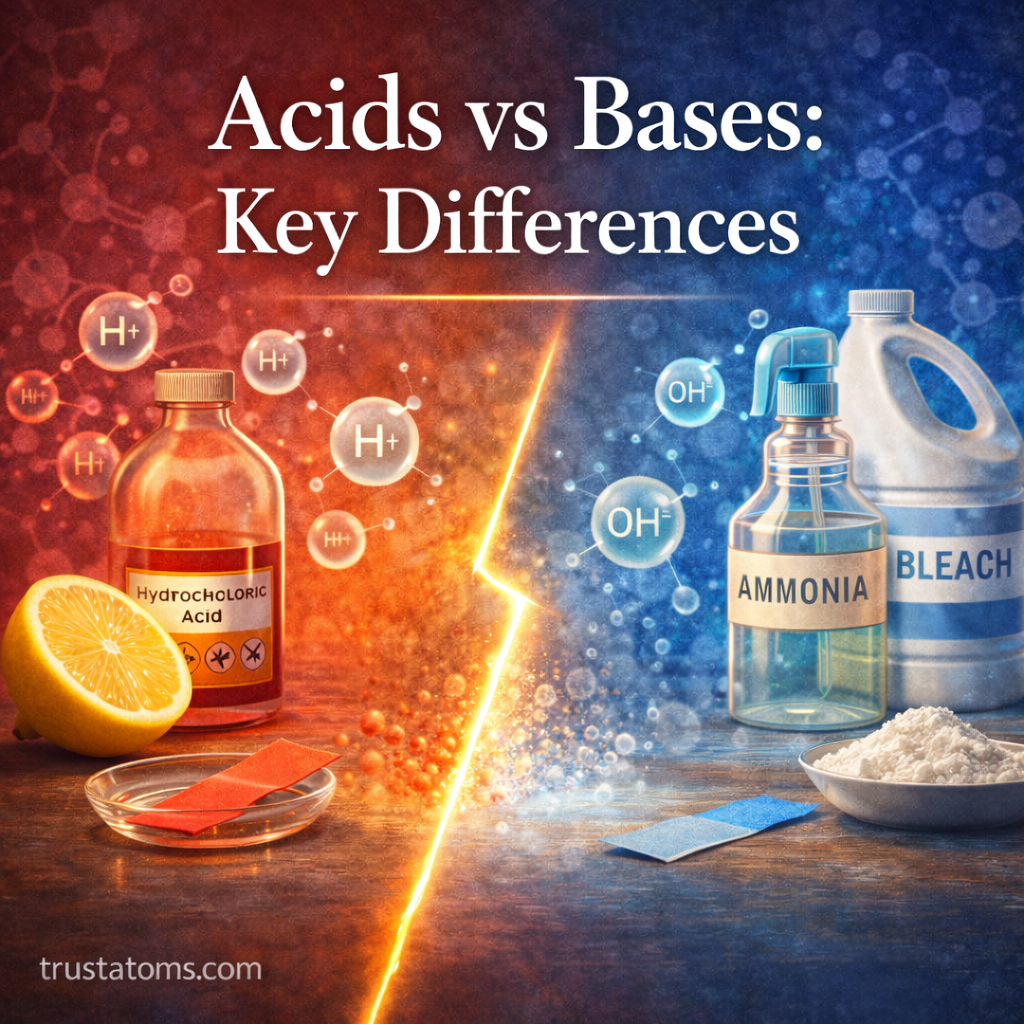
Acids and bases are two of the most fundamental categories in chemistry. They appear in everything from food and cleaning products to industrial manufacturing and human biology.
But what exactly makes an acid different from a base?
In this guide, you’ll learn the key differences between acids and bases, how they behave, how they are measured, and why understanding them is essential in chemistry.
What Is an Acid?
An acid is a substance that releases hydrogen ions (H⁺) in water.
When dissolved, acids increase the concentration of hydrogen ions in a solution. This gives them their characteristic chemical behavior.
Common examples of acids include:
- Citric acid (in lemons)
- Acetic acid (in vinegar)
- Hydrochloric acid (in stomach acid)
- Sulfuric acid (in car batteries)
Acids typically have a pH below 7.
What Is a Base?
A base is a substance that either:
- Releases hydroxide ions (OH⁻) in water, or
- Accepts hydrogen ions (H⁺) in a reaction
Bases reduce the concentration of hydrogen ions in a solution.
Common examples of bases include:
- Baking soda
- Ammonia
- Soap
- Sodium hydroxide
Bases typically have a pH above 7.
The pH Scale: Where Acids and Bases Fit
The pH scale measures how acidic or basic a solution is.
- pH 7 = Neutral (pure water)
- pH below 7 = Acidic
- pH above 7 = Basic (alkaline)
The scale ranges from 0 to 14 and is logarithmic. Each whole number change represents a tenfold difference in acidity or basicity.
For example:
- Lemon juice: around pH 2
- Water: pH 7
- Bleach: around pH 12–13
Key Differences Between Acids and Bases
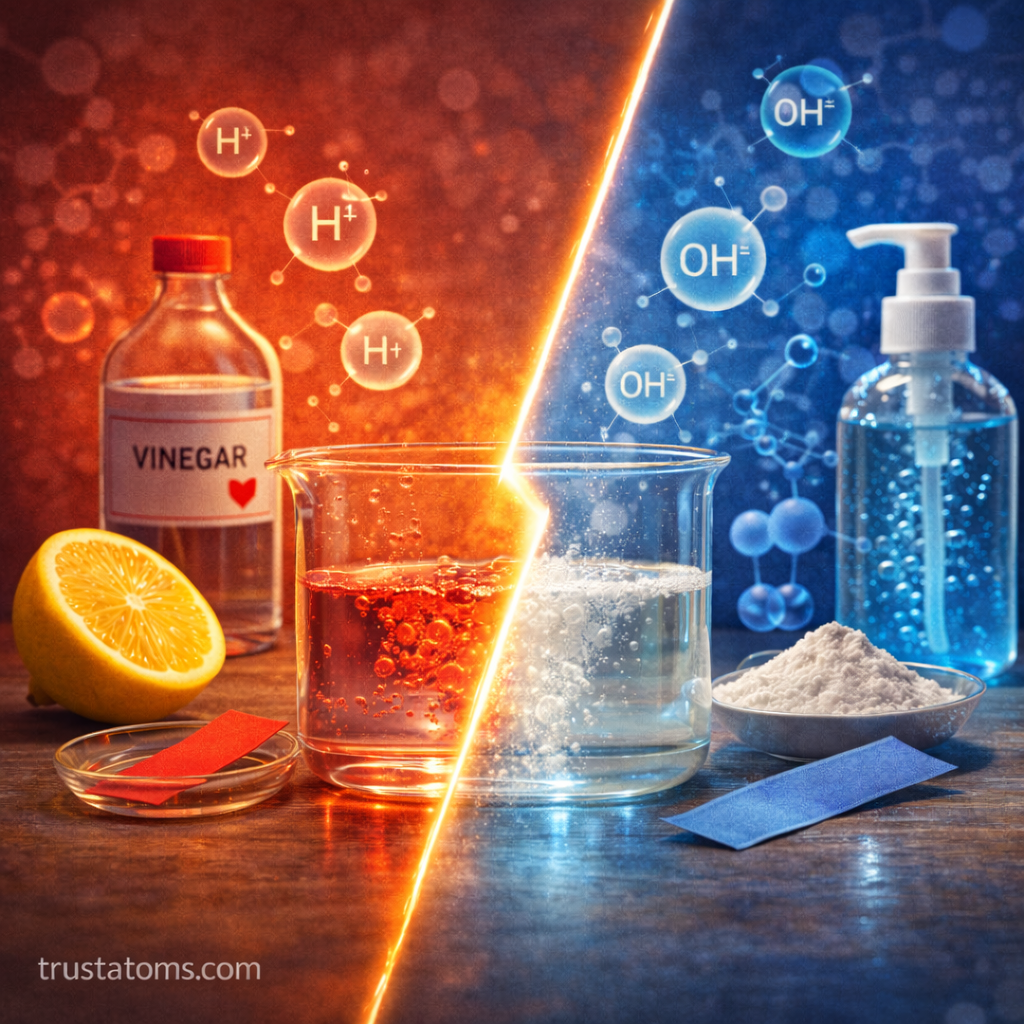
Here’s a side-by-side comparison of their major differences.
1. Ions Produced in Water
Acids:
- Release hydrogen ions (H⁺)
Bases:
- Release hydroxide ions (OH⁻) or accept hydrogen ions
2. pH Range
Acids:
- pH less than 7
Bases:
- pH greater than 7
3. Taste and Texture (Conceptual Properties)
Acids:
- Sour taste (like citrus)
Bases:
- Bitter taste
- Slippery or soapy feel
(Note: Tasting chemicals in a lab is never safe and should not be done.)
4. Reaction with Litmus Paper
Acids:
- Turn blue litmus paper red
Bases:
- Turn red litmus paper blue
5. Reaction with Each Other
When an acid reacts with a base, a neutralization reaction occurs.
The result:
- Water is formed
- A salt is produced
- The pH moves toward neutral
This reaction is one of the most important concepts in chemistry.
Strong vs Weak: Another Layer of Difference
Both acids and bases can be strong or weak.
Strong acids and bases:
- Fully ionize in water
- Produce high concentrations of ions
Weak acids and bases:
- Partially ionize
- Produce lower concentrations of ions
Strength refers to how completely a substance ionizes — not how concentrated it is.
Why Acids and Bases Matter
Understanding acids and bases is essential because they are involved in:
- Digestion in the human body
- Industrial chemical production
- Agriculture and soil treatment
- Cleaning and sanitation
- Water purification
- Energy production
The balance between acids and bases is also critical in biological systems. Even small pH changes can affect chemical reactions inside cells.
Quick Comparison Summary
Here’s a simplified overview:
Acids:
- Release hydrogen ions
- pH below 7
- Sour
- Turn blue litmus red
Bases:
- Release hydroxide ions or accept hydrogen ions
- pH above 7
- Bitter and slippery
- Turn red litmus blue
Together, acids and bases form a complementary pair in chemistry.
Final Thoughts
Acids and bases may seem like opposites — and in many ways they are. Acids increase hydrogen ion concentration, while bases decrease it. They occupy opposite ends of the pH scale and react with each other in predictable ways.
Understanding their key differences helps explain:
- Why foods taste the way they do
- How cleaning products work
- How digestion functions
- How chemical reactions are controlled
Acids and bases are foundational to chemistry — and once you understand their differences, many other chemical concepts become easier to grasp.