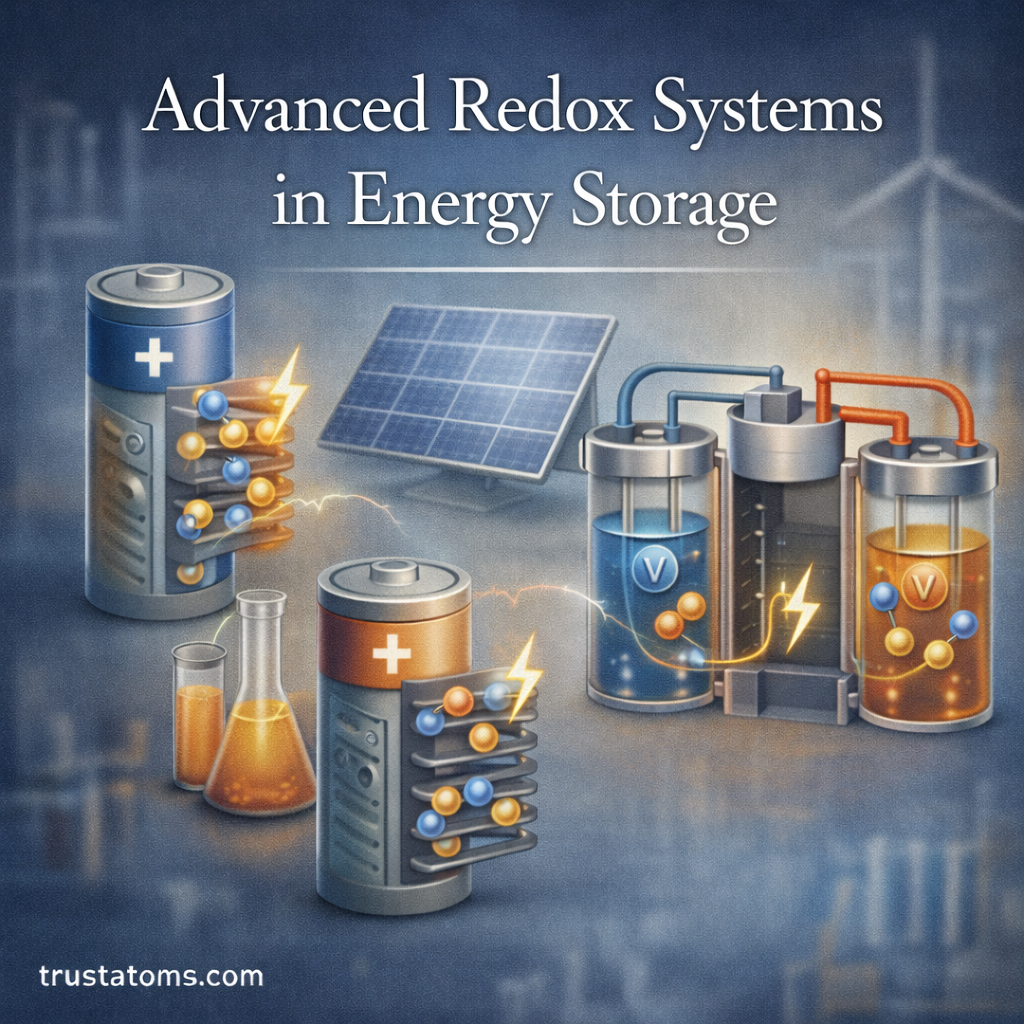
Modern energy systems increasingly depend on efficient ways to store electricity. As renewable energy sources like solar and wind become more common, energy storage technologies must improve to handle fluctuating power generation. One of the most important chemical principles behind many storage technologies is redox chemistry.
Redox reactions—short for reduction and oxidation—allow energy to be stored and released through electron transfer. Advanced redox systems are now at the center of next-generation batteries, fuel cells, and grid-scale storage solutions.
This article explores how redox chemistry works in energy storage and how advanced redox systems are shaping the future of energy technology.
What Are Redox Reactions?
Redox reactions involve the transfer of electrons between chemical species.
The term combines two processes:
- Oxidation – loss of electrons
- Reduction – gain of electrons
Because electrons are transferred, redox reactions convert chemical energy into electrical energy and vice versa.
In energy storage systems, redox reactions allow electrical energy to be stored chemically and later released when needed.
Why Redox Chemistry Is Essential for Energy Storage
Energy storage technologies rely on reversible redox reactions.
When electricity flows into a device:
- One material becomes reduced
- Another becomes oxidized
When electricity is needed again, the reaction reverses and electrons flow through an external circuit.
Redox-based storage offers several advantages:
- High energy density
- Reversible energy cycles
- Efficient charge and discharge processes
- Scalability for large systems
These characteristics make redox chemistry a foundation for modern battery technologies.
Key Components of Redox Energy Storage Systems
Most redox-based storage technologies contain several common components.
Electrodes
Electrodes are the surfaces where redox reactions occur.
Two types are typically present:
- Anode – oxidation occurs
- Cathode – reduction occurs
Electrode materials determine the battery’s voltage, efficiency, and stability.
Electrolyte
The electrolyte is a medium that allows ions to move between electrodes.
Electrolytes can be:
- Liquid solutions
- Solid-state materials
- Polymer gels
Efficient ion transport is critical for maintaining balanced redox reactions.
External Circuit
Electrons travel through an external circuit during energy transfer.
This flow of electrons creates usable electrical power.
Advanced Redox Systems in Modern Batteries
Several advanced energy technologies rely on sophisticated redox systems.
These systems improve performance, lifespan, and energy capacity compared to older battery designs.
Lithium-Ion Batteries
Lithium-ion batteries dominate portable electronics and electric vehicles.
Their operation involves redox reactions between lithium-containing compounds at the electrodes.
Key advantages include:
- High energy density
- Fast charging capability
- Long cycle life
Lithium ions move through the electrolyte while electrons travel through the external circuit.
Redox Flow Batteries
Redox flow batteries store energy in liquid electrolytes contained in external tanks.
Instead of solid electrodes storing energy, dissolved redox-active molecules carry charge.
Benefits include:
- Easy scalability
- Long operational life
- Rapid recharge through electrolyte replacement
These systems are particularly useful for grid-scale energy storage.
Sodium-Ion Batteries
Sodium-ion batteries are emerging as alternatives to lithium systems.
They operate through similar redox mechanisms but use sodium ions instead.
Advantages include:
- Lower material cost
- Greater natural abundance of sodium
- Reduced supply chain concerns
Although still developing, sodium-ion systems may become important for large-scale energy storage.
Redox Couples in Energy Storage
A redox couple refers to a pair of chemical species that undergo oxidation and reduction together.
Energy storage systems depend on carefully chosen redox couples that provide stable, reversible reactions.
Common examples include:
- Vanadium redox couples in flow batteries
- Lithium metal oxide systems in lithium-ion batteries
- Organic redox molecules in experimental storage systems
The efficiency of a battery often depends on how easily these redox couples exchange electrons.
Redox Flow Batteries Explained
Redox flow batteries represent one of the most advanced redox energy systems currently under development.
Unlike conventional batteries, their energy storage capacity depends on the volume of electrolyte rather than the size of the electrodes.
How Redox Flow Batteries Work
The system includes:
- Two tanks containing liquid electrolytes
- Pumps that circulate the liquids
- A reaction chamber with electrodes
- A membrane separating the solutions
During operation:
- Electrolytes flow through the cell
- Redox reactions occur at the electrodes
- Energy is stored or released depending on the direction of electron flow
This design allows independent control of power output and storage capacity.
Organic Redox Systems
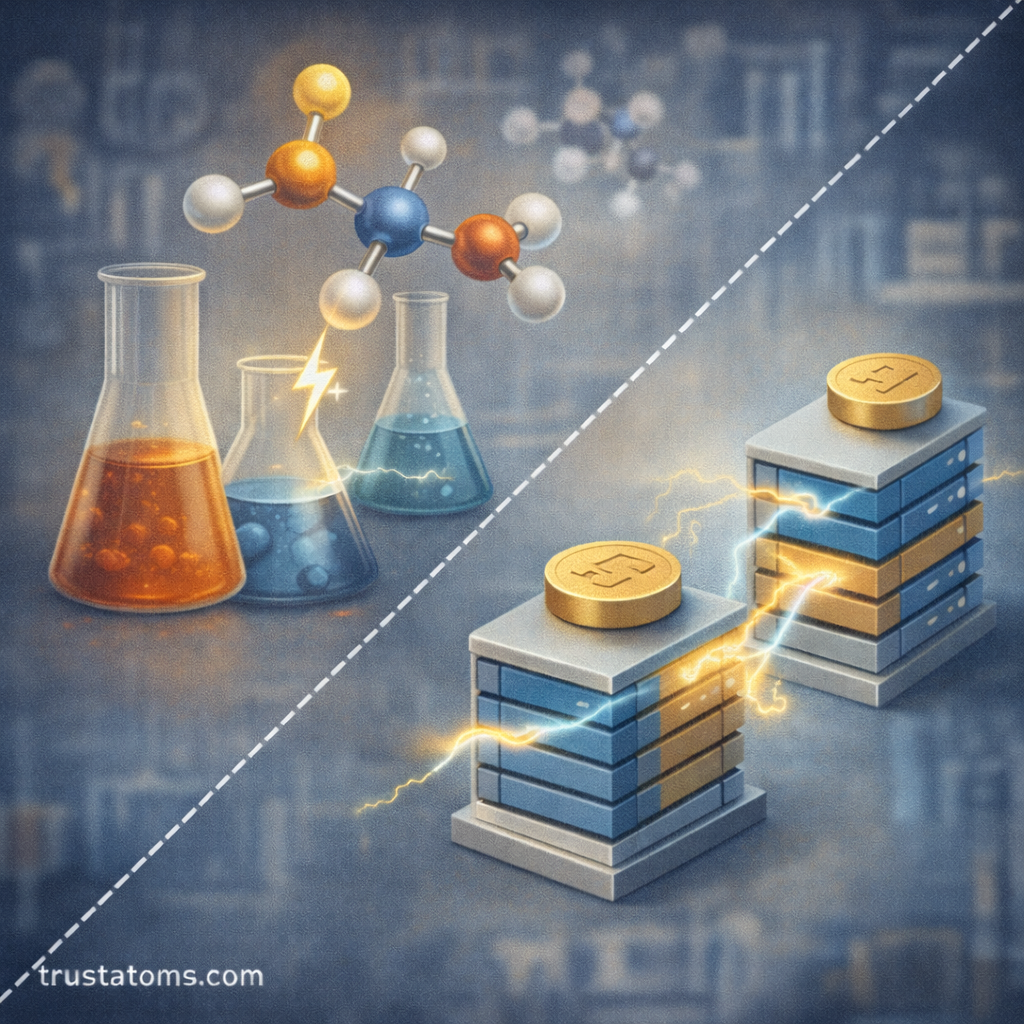
Scientists are exploring organic molecules as redox-active materials.
Organic redox systems offer several potential advantages:
- Lower material cost
- Sustainable chemical sources
- Tunable molecular structures
- Reduced reliance on rare metals
Researchers can design molecules that undergo reversible electron transfer while remaining chemically stable.
These systems are still under development but show promise for large-scale storage technologies.
Challenges in Advanced Redox Energy Systems
Despite their benefits, redox energy systems face several technical challenges.
Stability of Redox Materials
Repeated charge cycles can degrade redox-active materials.
Chemical instability can reduce battery lifespan.
Energy Density Limits
Some redox systems store less energy per unit volume than conventional batteries.
Improving energy density remains a major research focus.
Cost of Materials
Certain battery chemistries rely on rare or expensive materials.
Researchers are working to develop lower-cost alternatives.
Efficiency Losses
Energy losses can occur due to:
- Internal resistance
- Side reactions
- Heat generation
Minimizing these losses improves overall system efficiency.
Emerging Innovations in Redox Energy Storage
Ongoing research is pushing the boundaries of redox-based energy systems.
Key innovations include:
- High-voltage organic redox molecules
- Solid-state redox batteries
- Multivalent ion systems (magnesium, aluminum)
- Hybrid battery–supercapacitor designs
Scientists are also applying computational chemistry and machine learning to discover new redox materials.
These tools help identify molecules capable of efficient and stable electron transfer.
Role of Redox Systems in Renewable Energy
Renewable energy sources such as solar and wind generate electricity intermittently.
Advanced redox systems help stabilize power grids by storing excess energy and releasing it when demand increases.
Applications include:
- Grid-scale storage facilities
- Backup power systems
- Renewable energy integration
- Microgrid stabilization
As global energy demand grows, redox-based storage technologies will become increasingly important.
Final Thoughts
Advanced redox systems form the chemical backbone of modern energy storage technologies. Through controlled electron transfer reactions, these systems allow electrical energy to be stored efficiently and released when needed.
From lithium-ion batteries to redox flow systems and emerging organic redox technologies, advances in redox chemistry are enabling safer, more efficient, and more scalable energy storage solutions. As research continues, improved redox materials and battery architectures will play a crucial role in supporting renewable energy and building a more sustainable energy future.