Electricity is the backbone of modern civilization. From lighting homes to running factories and powering digital devices, electrical systems keep society functioning. One of the most important concepts behind this infrastructure is alternating current (AC).
In this guide, we’ll break down what alternating current is, how it works, why it’s used in power grids, and how it compares to direct current (DC). Whether you’re a student, an electronics enthusiast, or simply curious, this physics-based explanation will make AC easy to understand.
What Is Alternating Current?
Alternating current (AC) is a type of electrical current in which the flow of electric charge periodically reverses direction.
Unlike direct current (DC), which flows steadily in one direction, AC changes direction many times per second. In most countries:
- 60 Hz (cycles per second) is standard in the United States.
- 50 Hz is standard in much of Europe and other regions.
One complete forward-and-back movement of the current is called a cycle.
How Alternating Current Works
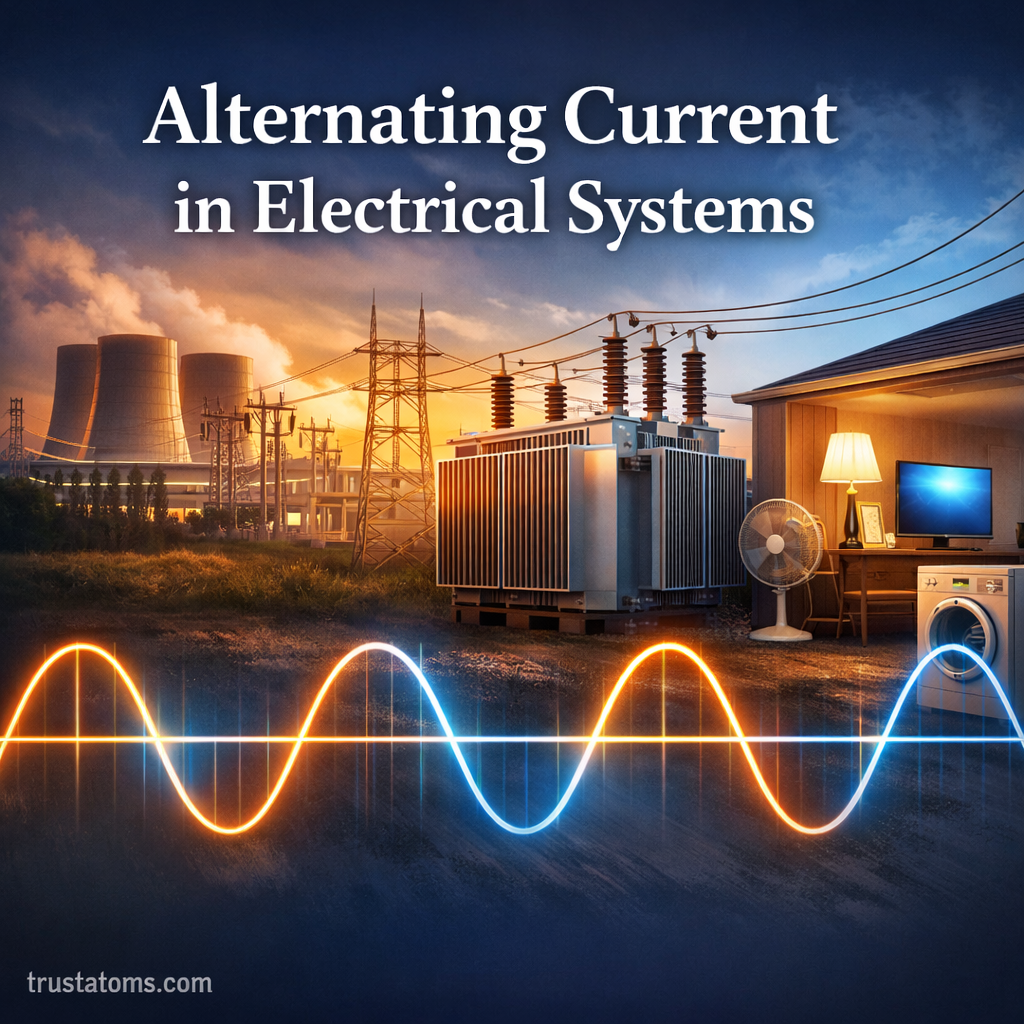
In physics terms, AC is typically represented as a sine wave when graphed over time.
The Sine Wave Pattern
If you plotted AC voltage against time, you would see:
- A rise from zero to a positive maximum
- A drop back to zero
- A fall to a negative maximum
- A return to zero
This repeating pattern forms a smooth wave.
Key Terms in AC Systems
Understanding AC requires knowing a few important physics concepts:
1. Frequency (Hz)
The number of cycles per second.
- Measured in hertz (Hz)
- Determines how often the current changes direction
2. Voltage (V)
The electrical potential difference that drives current.
3. Peak Voltage
The maximum value reached in either direction.
4. RMS Voltage (Root Mean Square)
The effective voltage of AC that produces the same heating effect as DC.
For example, standard U.S. household voltage is 120V RMS, even though the peak voltage is higher.
How AC Is Generated
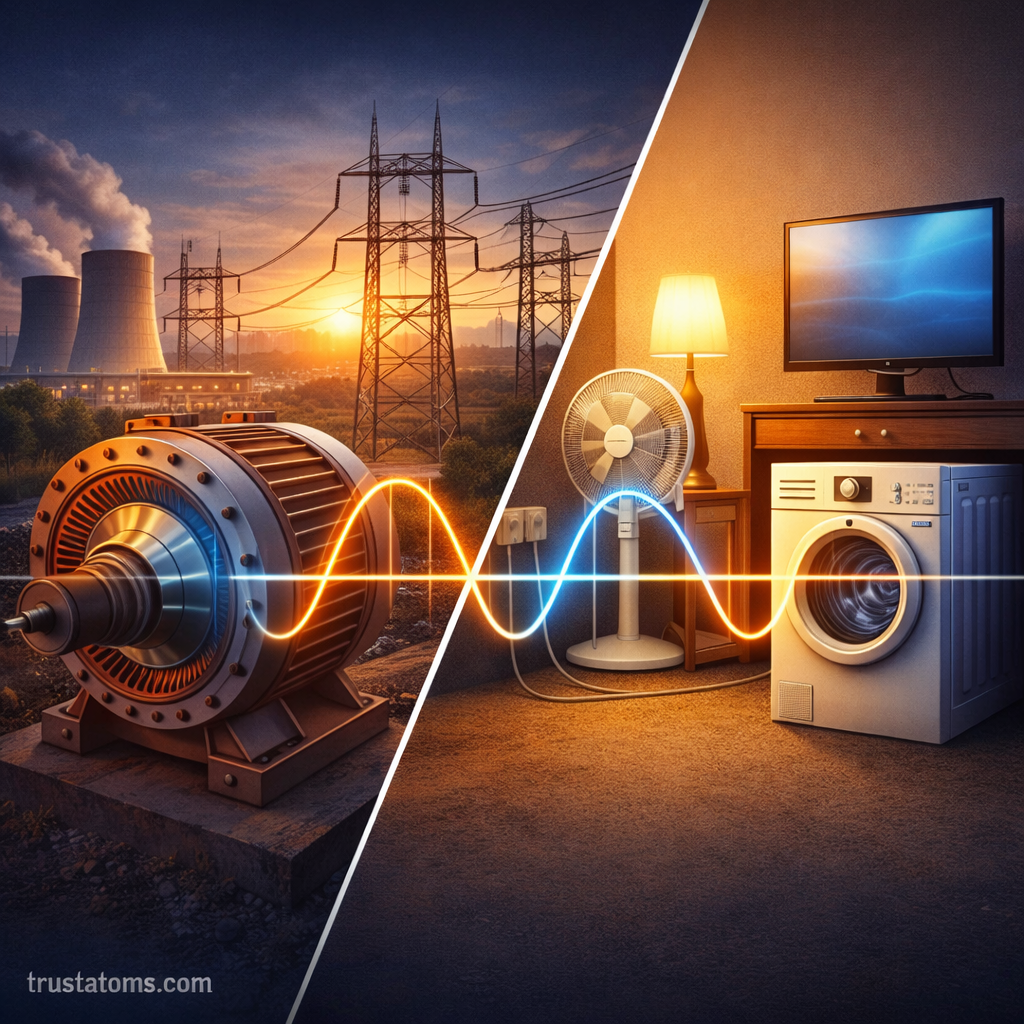
Alternating current is produced using a device called an alternator.
The Physics Behind Generation
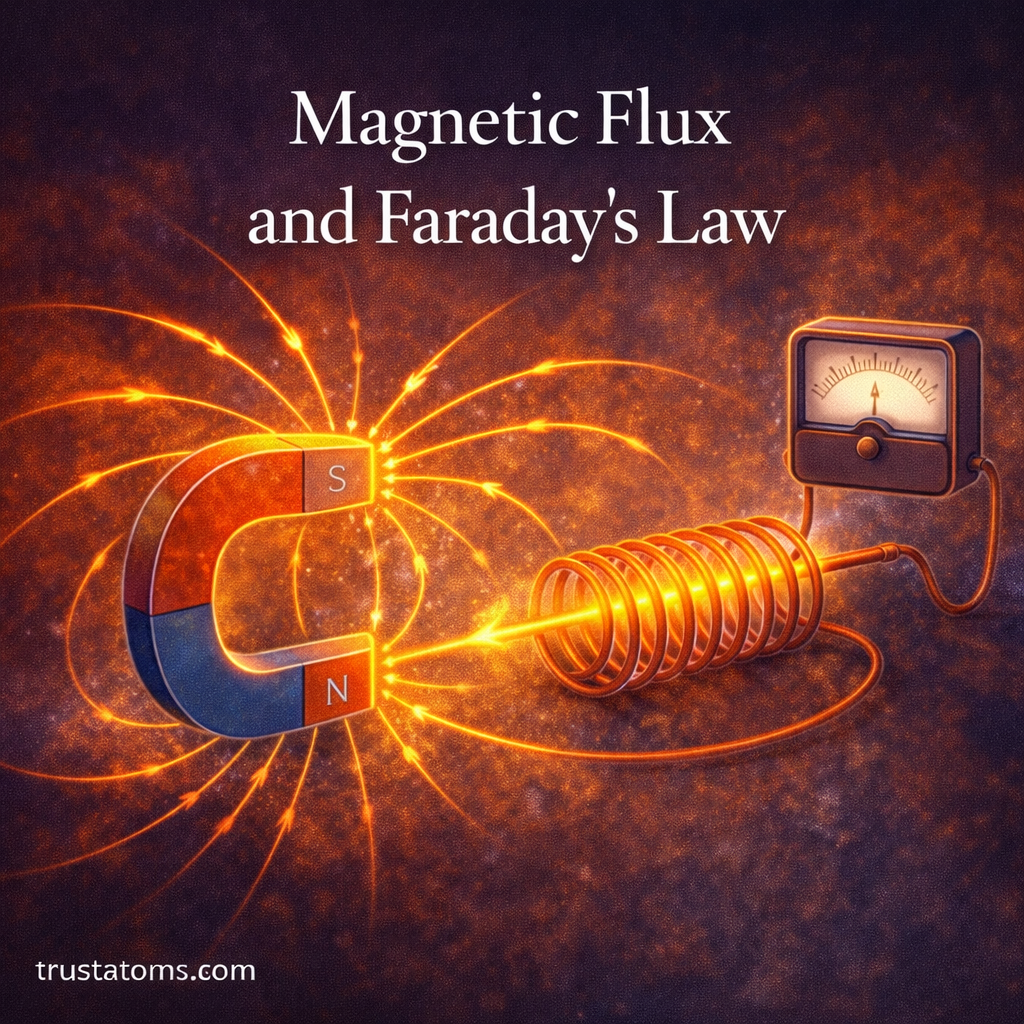
AC is generated through electromagnetic induction, a principle discovered by Michael Faraday.
The process works like this:
- A coil of wire rotates inside a magnetic field.
- The magnetic field causes electrons to move.
- As the coil rotates, the direction of electron flow reverses.
- This creates alternating current.
The continuous rotation results in a repeating sine wave pattern.
Why AC Is Used in Power Grids
You might wonder: why do power systems use AC instead of DC?
The answer lies in efficiency and transmission.
1. Easy Voltage Transformation
AC voltage can be increased or decreased using transformers.
- High voltage → lower current → reduced energy loss over long distances
- Lower voltage → safer delivery into homes
This ability to step voltage up or down efficiently is one of AC’s biggest advantages.
2. Efficient Long-Distance Transmission
Power loss in wires depends on current. By transmitting electricity at very high voltages and low current, AC systems reduce energy waste.
3. Historical Standardization
During the late 19th century, AC won the “War of Currents” because it proved more practical for widespread electrical distribution.
AC vs DC: What’s the Difference?
Here’s a simplified comparison:
Alternating Current (AC)
- Changes direction periodically
- Used in power grids and homes
- Can be easily transformed in voltage
- Typically follows a sine wave pattern
Direct Current (DC)
- Flows in one direction only
- Used in batteries, solar panels, and electronics
- Difficult to transform voltage without complex circuitry
- Steady, constant flow
Today, both systems are important. AC dominates large-scale power transmission, while DC is essential in portable electronics and renewable energy systems.
Applications of Alternating Current
AC is used almost everywhere in modern infrastructure.
Residential Use
- Lighting systems
- Air conditioning units
- Refrigerators
- Washing machines
- Outlets powering devices
Industrial Applications
- Electric motors
- Heavy machinery
- Manufacturing equipment
- Large HVAC systems
Commercial and Infrastructure
- Office buildings
- Hospitals
- Transportation systems
- Data centers
Most large electric motors operate on AC because of their efficiency and durability.
The Role of Transformers in AC Systems
Transformers only work with alternating current.
They operate based on electromagnetic induction and allow:
- Voltage to be stepped up for transmission
- Voltage to be stepped down for safe consumer use
Without AC, efficient national power grids would be far more difficult to build.
Power, Phase, and AC Systems
In large electrical systems, AC can be single-phase or three-phase.
Single-Phase Power
- Used in homes
- Simpler and cheaper
- Suitable for lower power needs
Three-Phase Power
- Used in industrial settings
- Provides smoother and more constant power delivery
- More efficient for heavy loads
Three-phase systems are especially important for running large motors and equipment.
Advantages of Alternating Current
- Efficient long-distance transmission
- Easy voltage transformation
- Reliable motor operation
- Lower infrastructure cost
- Widely standardized globally
Limitations of AC
While AC is extremely useful, it has drawbacks:
- More complex waveform analysis
- Reactive power issues in large systems
- Requires rectification for electronics (conversion to DC)
Despite these limitations, AC remains the dominant method for electrical distribution worldwide.
Why Understanding AC Matters
Alternating current is foundational to physics, engineering, and modern infrastructure.
Understanding AC helps you:
- Grasp how power grids operate
- Understand transformer systems
- Learn motor physics
- Prepare for engineering or physics studies
- Make sense of energy transmission efficiency
It’s one of the most practical physics concepts you’ll ever study because it affects daily life directly.
Final Thoughts
Alternating current isn’t just a physics concept — it’s the engine of the modern electrical world.
From power plants to wall outlets, AC enables efficient transmission, voltage control, and large-scale energy distribution. Its sine wave behavior, electromagnetic generation, and compatibility with transformers make it ideal for national grids.
Without alternating current, modern cities, industries, and digital life would look very different.
Understanding AC gives you insight into the invisible system powering nearly everything around you.