Laser Emission in Quantum Systems

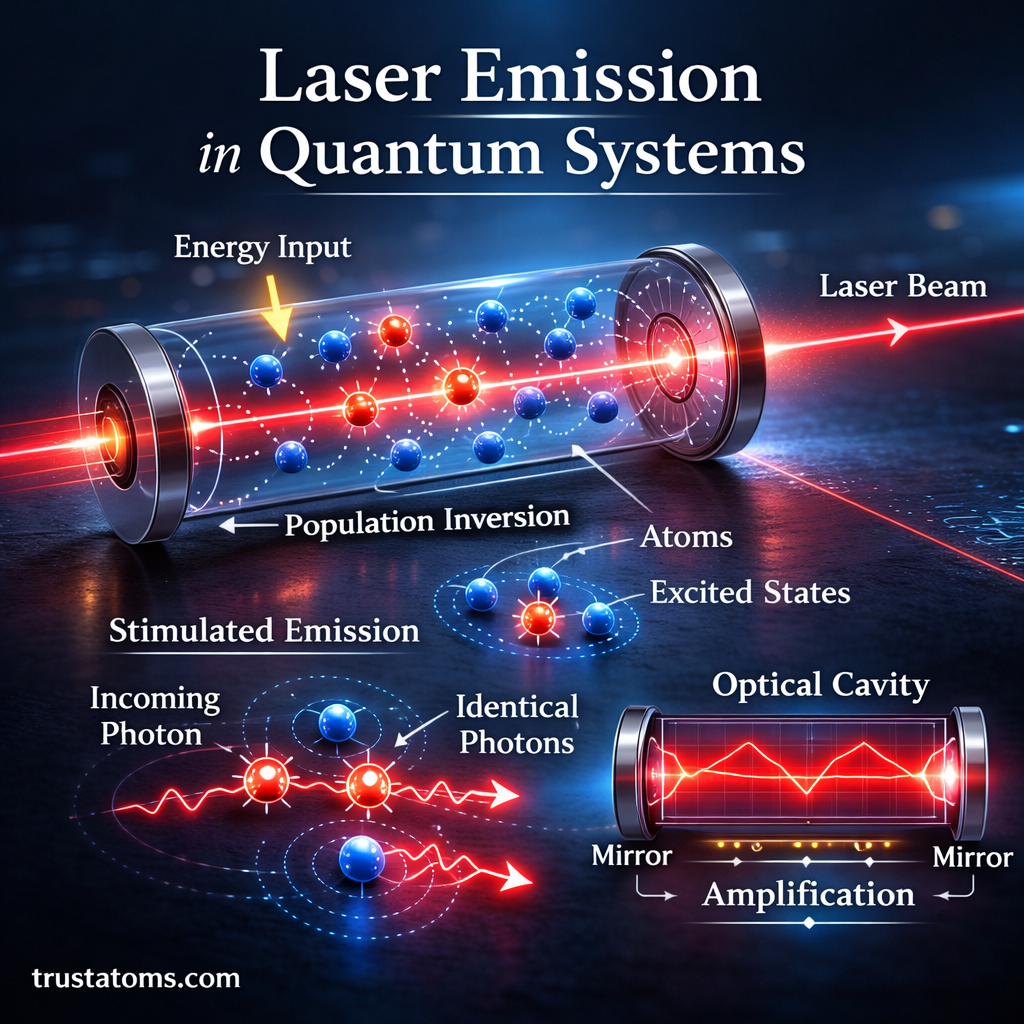
Scientific illustration of laser emission in a quantum system showing stimulated emission inside an optical cavity with a coherent laser beam.
Diagram illustrating stimulated emission, population inversion, and laser amplification inside a quantum optical cavity. trustatoms.com

Lasers are everywhere — in barcode scanners, fiber-optic communication, medical devices, manufacturing tools, and scientific research labs.

But behind every laser beam is a deeply quantum process.

Laser emission is not just bright light. It is a controlled release of energy from atoms and molecules governed by the rules of quantum mechanics. Understanding how lasers work requires exploring how electrons behave inside atoms — and how light itself can trigger more light.

In this guide, we’ll break down laser emission in quantum systems in clear, step-by-step terms.

Continue reading “Laser Emission in Quantum Systems”
Diffraction Patterns in Wave Optics

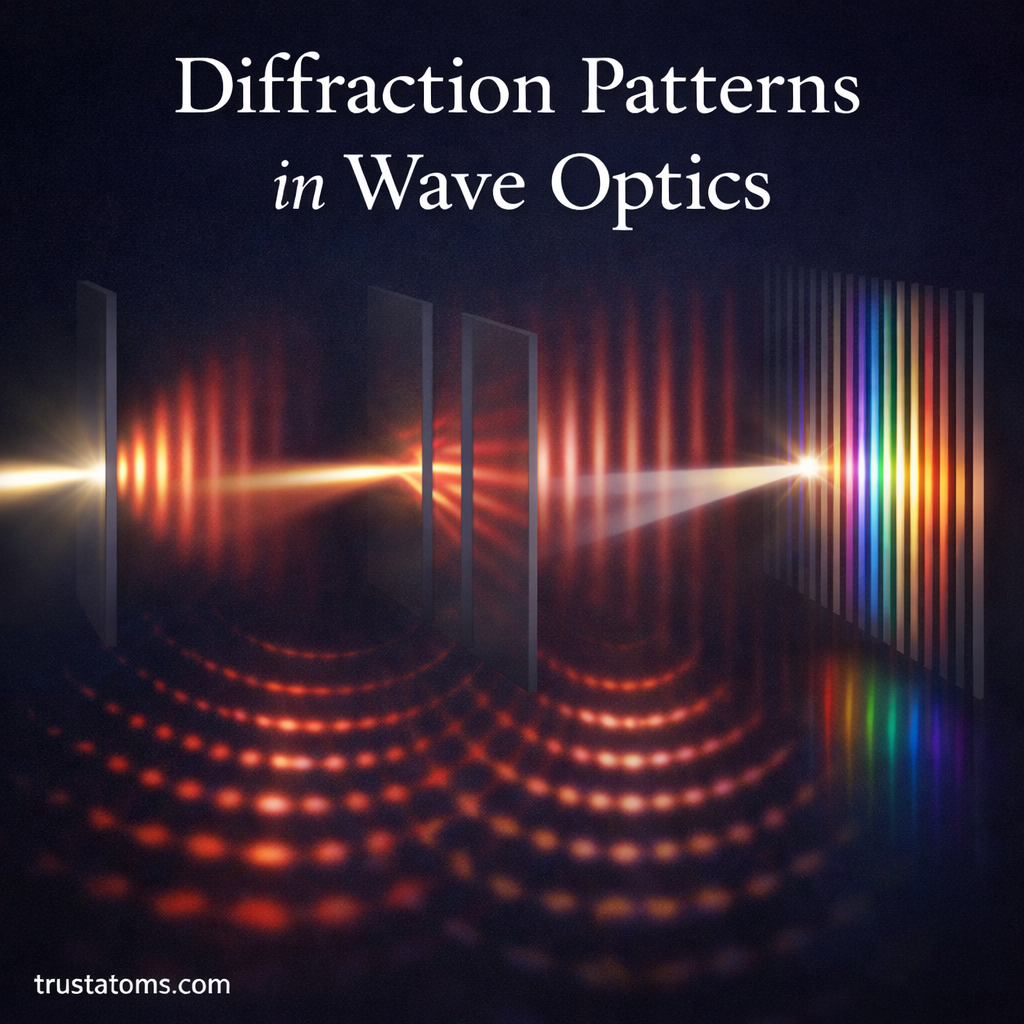
Illustration showing single-slit and double-slit diffraction patterns with light spreading and forming bright and dark fringes in wave optics.
Visualization of diffraction patterns formed when light passes through narrow slits and gratings. trustatoms.com

Light doesn’t always travel in perfectly straight lines.

When it encounters a narrow opening or passes by an edge, it spreads out. This spreading behavior is called diffraction, and the patterns it creates are known as diffraction patterns.

Diffraction is one of the clearest demonstrations that light behaves as a wave. It plays a central role in wave optics and helps explain phenomena seen in laboratories, telescopes, microscopes, and even everyday life.

In this guide, we’ll explore what diffraction patterns are, why they form, the types of diffraction, and how they’re used in science and technology.

Continue reading “Diffraction Patterns in Wave Optics”

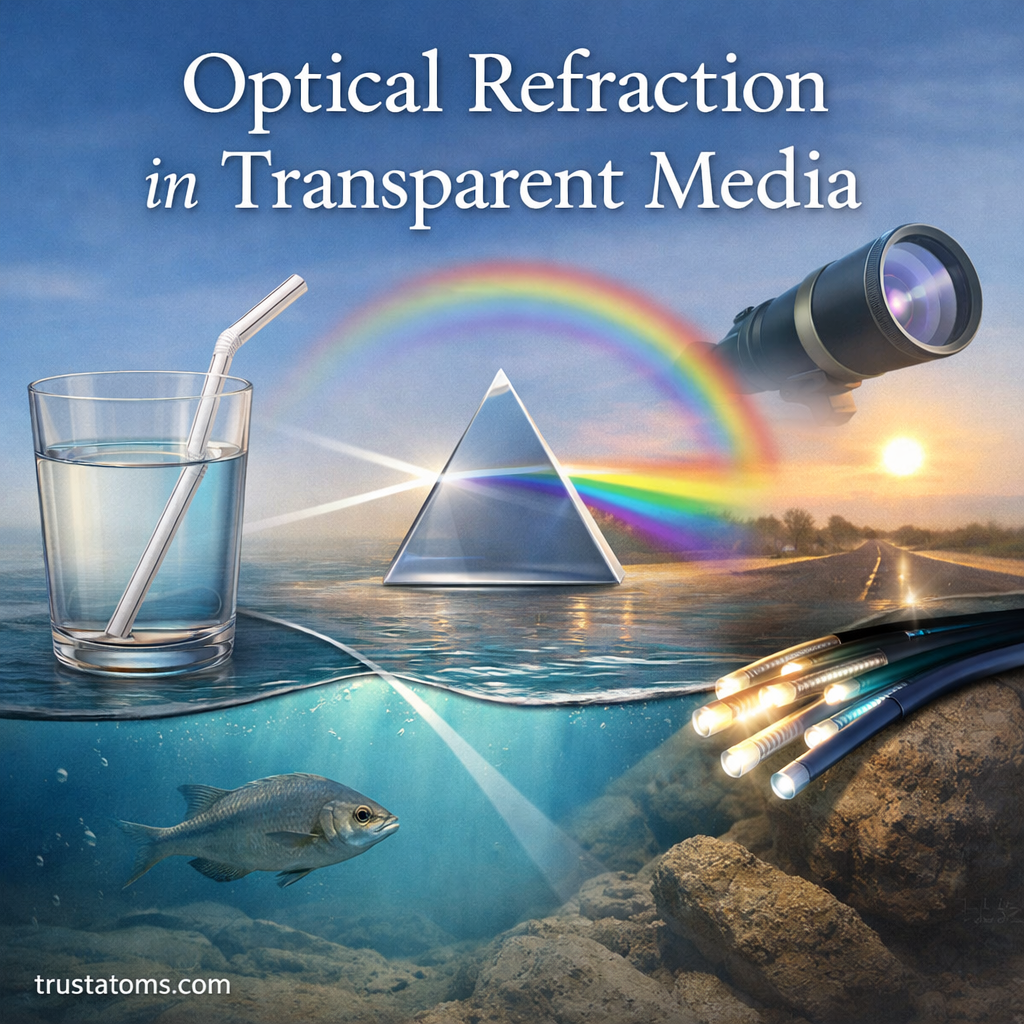
Optical Refraction in Transparent Media

Optical refraction illustration showing light bending as it passes through water and a prism in transparent media with title overlay.
Illustration demonstrating how light bends when passing through transparent materials such as water and glass. trustatoms.com

Light appears simple — it lets us see. But when light passes through water, glass, or air, it doesn’t just travel straight. It bends. This bending of light is called optical refraction, and it’s one of the most important principles in physics.

From eyeglasses and microscopes to rainbows and fiber-optic cables, refraction plays a central role in how we understand and use light.

In this guide, we’ll break down what optical refraction is, why it happens, how to calculate it, and where it shows up in everyday life.

Continue reading “Optical Refraction in Transparent Media”

Thermal Radiation and Blackbody Spectra

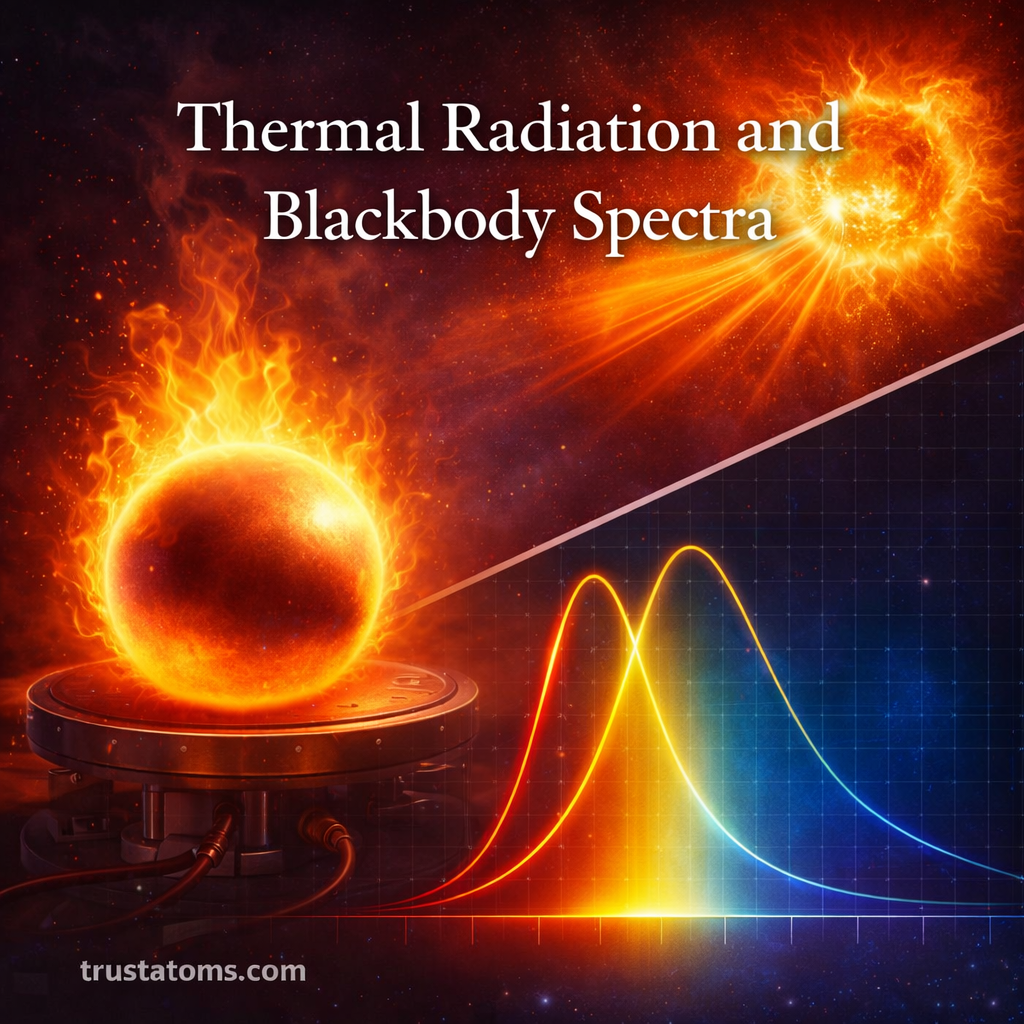
Educational illustration showing a glowing heated sphere, the Sun emitting radiation, and a colorful blackbody spectrum curve representing thermal radiation intensity at different temperatures.
Objects emit thermal radiation based on temperature, producing characteristic blackbody spectra across wavelengths. trustatoms.com.

Every object around you is emitting radiation.

From a glowing stove burner to your own body, all matter with temperature above absolute zero releases electromagnetic energy. This emission is known as thermal radiation, and its behavior is described by the concept of a blackbody spectrum.

Understanding thermal radiation and blackbody spectra is fundamental in physics, astronomy, climate science, and modern technology.

In this guide, we’ll explore what thermal radiation is, what makes a perfect blackbody, and how temperature determines the color and intensity of emitted light.

Continue reading “Thermal Radiation and Blackbody Spectra”

Plasma Dynamics in Electromagnetic Fields

Educational illustration showing plasma confined in a fusion reactor and solar plasma interacting with Earth’s magnetic field, representing plasma dynamics in electromagnetic fields.
Plasma motion is shaped by electric and magnetic fields, from fusion reactors to solar wind interacting with Earth’s magnetosphere. trustatoms.com.

Plasma is often called the fourth state of matter.

It makes up stars, solar flares, lightning, neon lights, and much of the visible universe. But unlike solids, liquids, and gases, plasma behaves very differently — especially when exposed to electric and magnetic fields.

Understanding plasma dynamics in electromagnetic fields is essential in astrophysics, fusion research, space science, and advanced engineering.

In this guide, we’ll explore how plasma forms, how it responds to electric and magnetic forces, and why its motion is so complex and powerful.

Continue reading “Plasma Dynamics in Electromagnetic Fields”

Viscosity and Shear Stress in Fluids

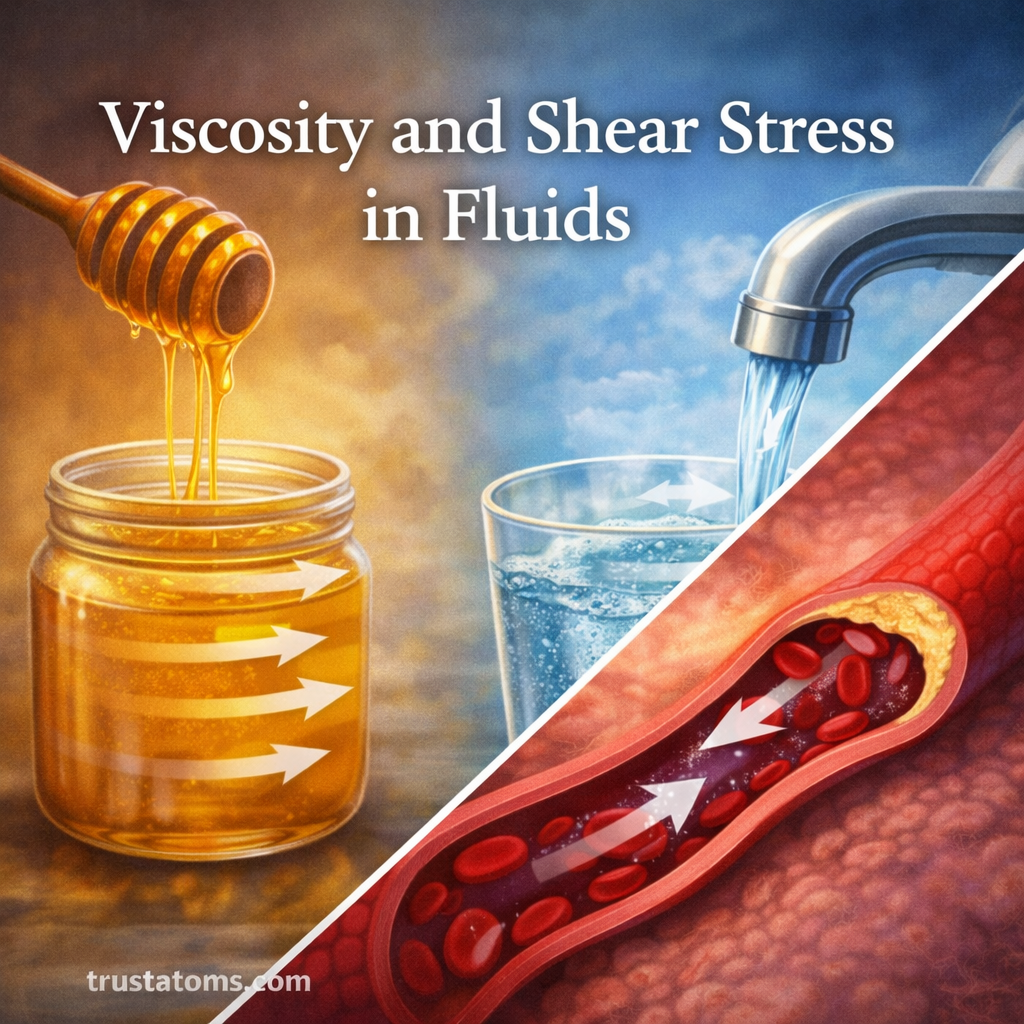
Educational split illustration showing honey flowing slowly, water pouring quickly, and blood moving through a vessel to demonstrate viscosity and shear stress in fluids.
Higher viscosity fluids resist motion more strongly, creating greater shear stress between moving layers. trustatoms.com.

Why does honey flow more slowly than water?
Why does oil behave differently at cold temperatures?
Why do some fluids resist motion while others move freely?

The answer lies in viscosity and shear stress — two core concepts in fluid mechanics that explain how fluids resist deformation and motion.

In this guide, we’ll break down what viscosity is, how shear stress works, the relationship between them, and why these ideas matter in physics, engineering, and everyday life.

Continue reading “Viscosity and Shear Stress in Fluids”

Bernoulli’s Equation in Fluid Motion

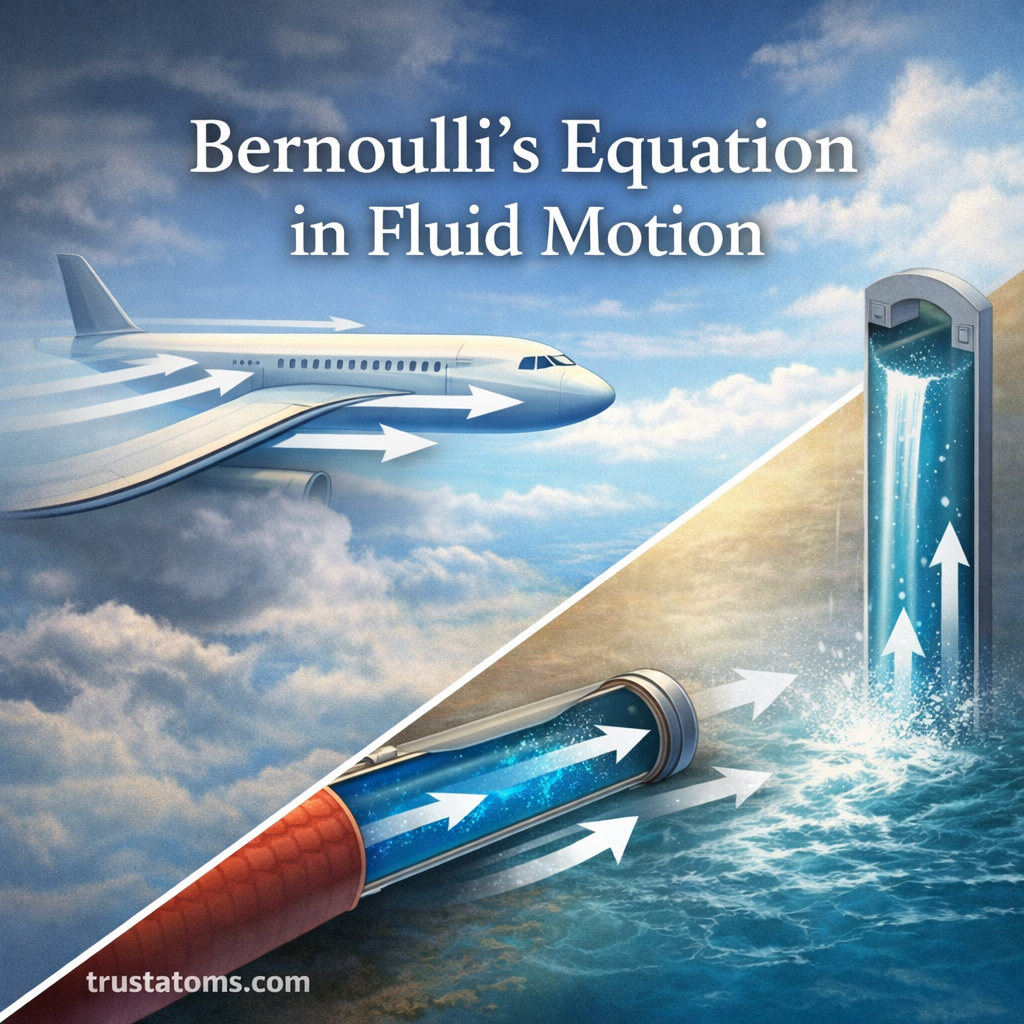
Educational illustration showing airflow over an airplane wing and water speeding through a narrowing pipe to demonstrate Bernoulli’s principle in fluid motion.
Bernoulli’s principle shows how pressure decreases as fluid speed increases in air and water systems. trustatoms.com.

Why does air move faster over an airplane wing?
Why does water speed up when a pipe narrows?
Why does pressure drop when velocity increases?

The answer lies in Bernoulli’s Equation, one of the most important principles in fluid mechanics. It explains how energy is conserved in moving fluids and how pressure, velocity, and height are connected.

In this guide, we’ll break down Bernoulli’s equation in simple terms, explore its derivation conceptually, examine real-world applications, and clarify common misconceptions.

Continue reading “Bernoulli’s Equation in Fluid Motion”

Pressure Gradients in Fluid Systems

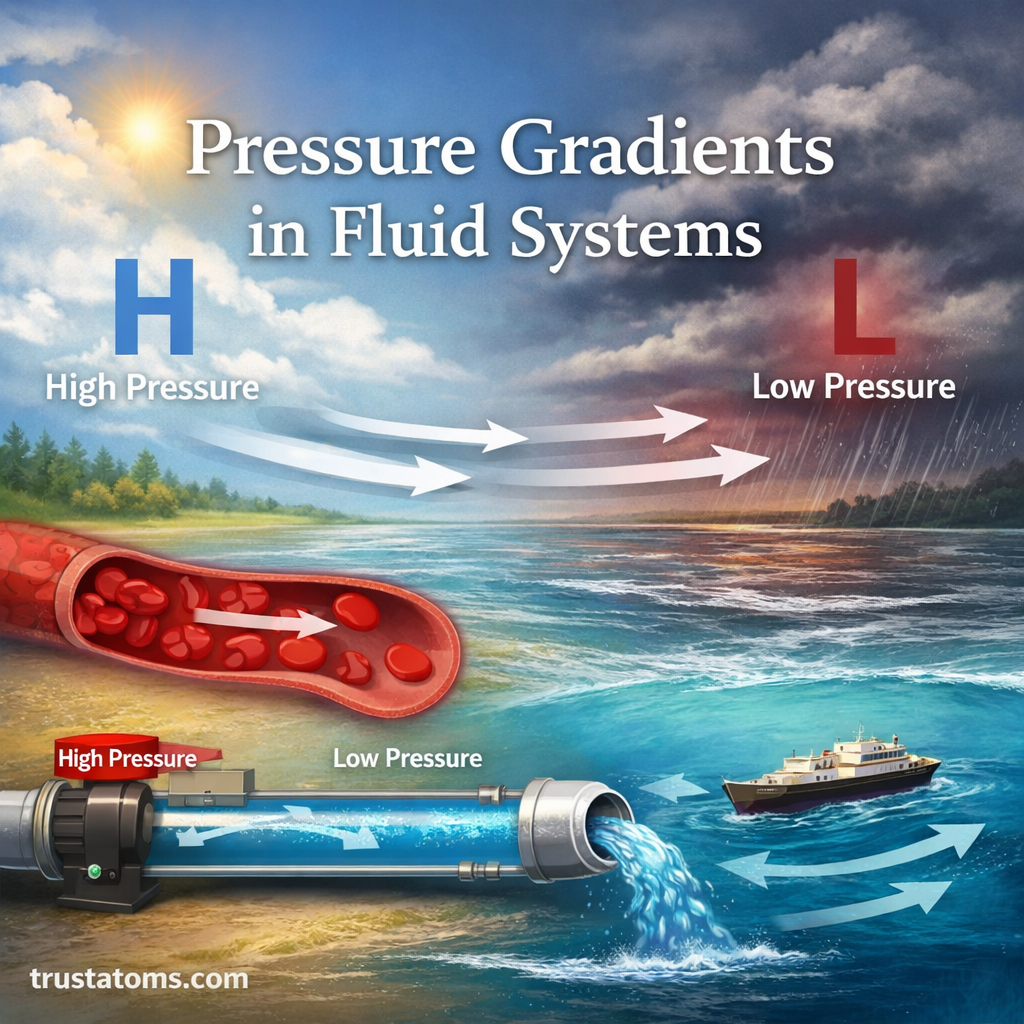
Contextual illustration showing high and low pressure regions driving fluid flow with directional arrows in a simple physics diagram.
Pressure differences drive fluid motion from high pressure to low pressure in natural and engineered systems. trustatoms.com.

Fluids move for a reason. Whether it’s blood traveling through arteries, air circulating in the atmosphere, or water flowing through a pipe, the driving force is often a pressure gradient.

Understanding pressure gradients in fluid systems is essential in physics, engineering, meteorology, biology, and countless real-world applications. In this guide, we’ll break down what pressure gradients are, how they work, the equations behind them, and why they matter.

Continue reading “Pressure Gradients in Fluid Systems”

Laminar and Turbulent Flow Regimes

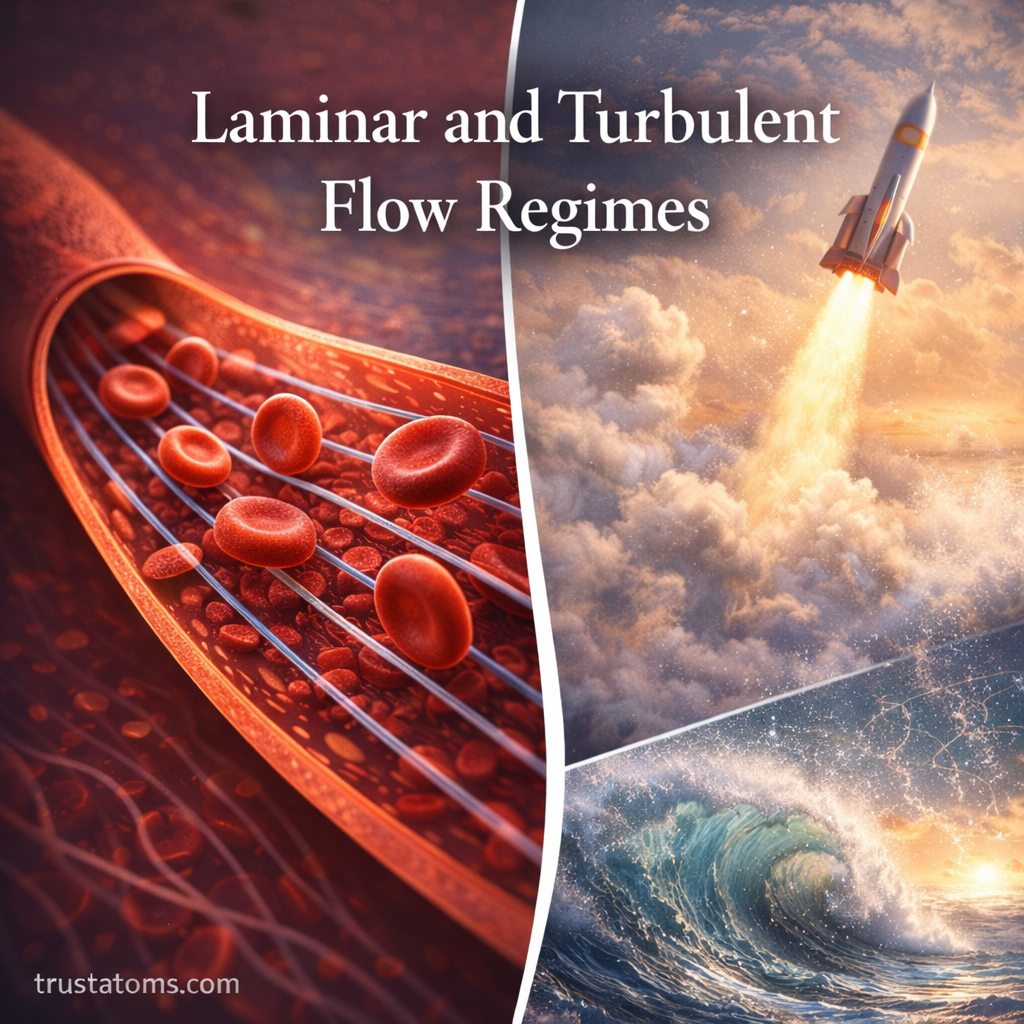
Split illustration comparing smooth laminar blood flow in an artery with turbulent rocket exhaust and ocean waves, representing different fluid flow regimes.
Visual comparison of laminar and turbulent flow regimes in physics, showing smooth layered motion versus chaotic swirling behavior. trustatoms.com

Fluid flow can look smooth and orderly — or chaotic and swirling.

These two very different behaviors are known as laminar flow and turbulent flow, and understanding the difference between them is essential in physics, engineering, biology, and environmental science.

In this article, we’ll explore what defines laminar and turbulent flow regimes, what determines the transition between them, and why this distinction matters in real-world systems.

Continue reading “Laminar and Turbulent Flow Regimes”

Fluid Flow in Continuum Mechanics

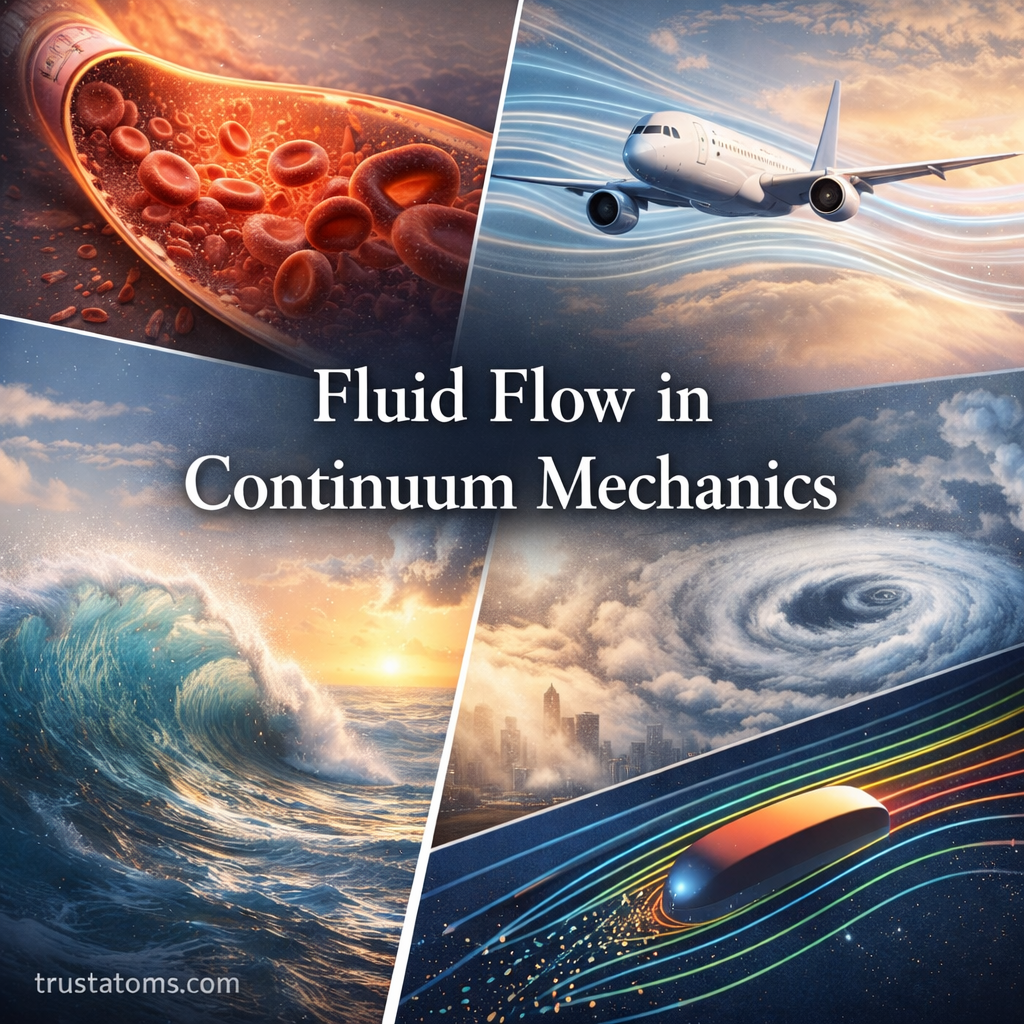
Illustration showing examples of fluid flow including blood in an artery, airflow around an airplane, ocean waves, a hurricane system, and streamlined flow around an object.
Conceptual illustration highlighting real-world examples of fluid flow in continuum mechanics across engineering, nature, and biology. trustatoms.com

Fluid flow is everywhere — from rivers and blood circulation to air moving over airplane wings.

To analyze these motions, physicists and engineers rely on continuum mechanics, a framework that treats fluids as continuous substances rather than collections of individual molecules. This approach allows us to model and predict how liquids and gases behave under different conditions.

In this article, we’ll explore what fluid flow means in continuum mechanics, the core equations that describe it, and why it matters in real-world physics and engineering.

Continue reading “Fluid Flow in Continuum Mechanics”