Center of Mass in Distributed Systems

Illustrated diagram showing center of mass in distributed systems with balanced objects and celestial bodies, educational physics concept, trustatoms.com.
Contextual illustration explaining center of mass in distributed systems. trustatoms.com

Understanding the center of mass in distributed systems is essential in physics, engineering, astronomy, and real-world problem solving. From balancing a bridge to predicting planetary motion, the concept explains how mass is effectively “averaged” across an object or system.

In this guide, we’ll break down what the center of mass is, how it works in distributed systems, how to calculate it, and why it matters in practical applications.

Continue reading “Center of Mass in Distributed Systems”

Entropy and Irreversibility in Physical Systems

Illustration showing entropy and irreversibility in physical systems with melting ice, a cracked egg, steam engine, falling dominoes, and hourglass.
Entropy and irreversibility illustrated through melting, mixing, heat flow, and the arrow of time. trustatoms.com.

Entropy is one of the most profound concepts in physics. It explains why heat flows from hot to cold, why ice melts in warm air, and why certain processes in nature can never be reversed.

At its core, entropy measures the tendency of physical systems to evolve toward disorder — or more precisely, toward the most statistically probable state.

This article explores entropy, irreversibility, and their role in physical systems, from thermodynamics to cosmology.

Continue reading “Entropy and Irreversibility in Physical Systems”

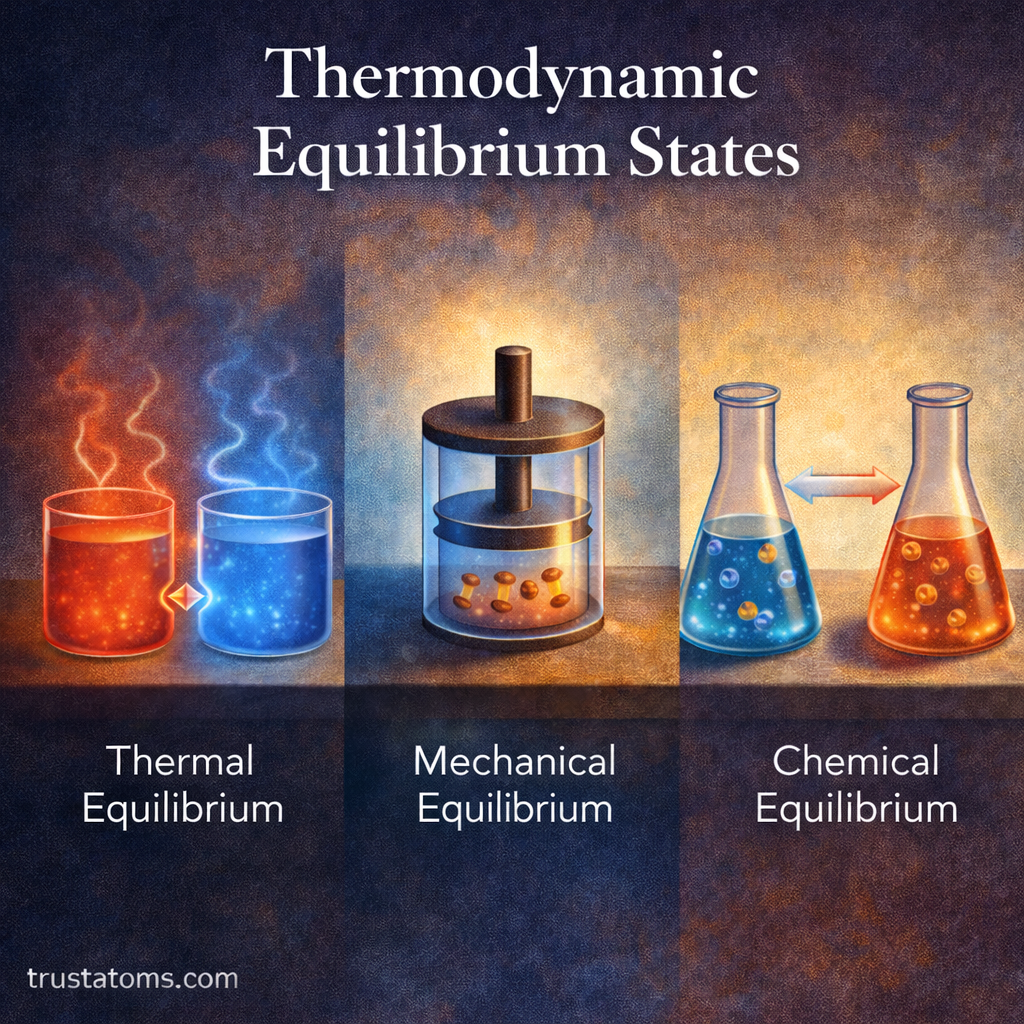
Thermodynamic Equilibrium States

Illustration of thermodynamic equilibrium states showing thermal equilibrium between two containers, mechanical equilibrium in a piston, and chemical equilibrium between reaction flasks.
Thermodynamic equilibrium states illustrated, including thermal, mechanical, and chemical equilibrium conditions. trustatoms.com.

Thermodynamic equilibrium is one of the most important concepts in physics. It describes the condition of a system when its macroscopic properties stop changing over time.

When a system reaches thermodynamic equilibrium, it becomes stable. There are no net flows of energy or matter within the system or between the system and its surroundings.

Understanding thermodynamic equilibrium states is essential in:

  • Heat transfer
  • Chemical reactions
  • Phase changes
  • Engine design
  • Atmospheric science
  • Statistical mechanics

This guide explains the concept clearly and systematically.

Continue reading “Thermodynamic Equilibrium States”

Wave Reflection and Refraction Principles

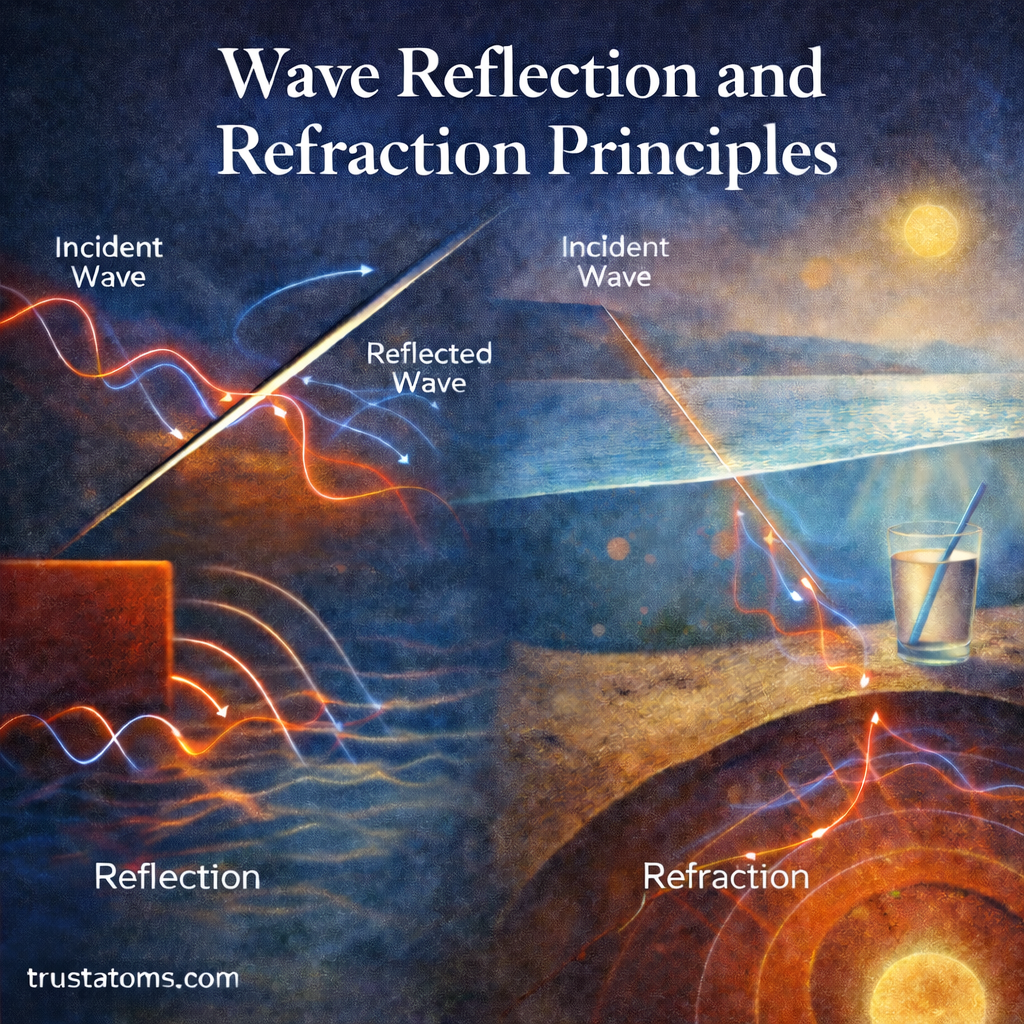
Illustration showing wave reflection and refraction principles with waves bouncing off a surface and bending as they enter water.
Wave reflection and refraction illustrated, showing waves bouncing at a boundary and bending when entering a new medium. trustatoms.com.

Waves rarely travel forever in a straight line. When they encounter boundaries or enter new materials, their behavior changes. Two of the most important wave behaviors in physics are reflection and refraction.

These principles apply to:

  • Light waves
  • Sound waves
  • Water waves
  • Seismic waves
  • Electromagnetic waves

Understanding reflection and refraction explains mirrors, lenses, echoes, rainbows, fiber optics, and even earthquake analysis.

This guide breaks the concepts down clearly and systematically.

Continue reading “Wave Reflection and Refraction Principles”

Acoustic Properties of Sound Waves

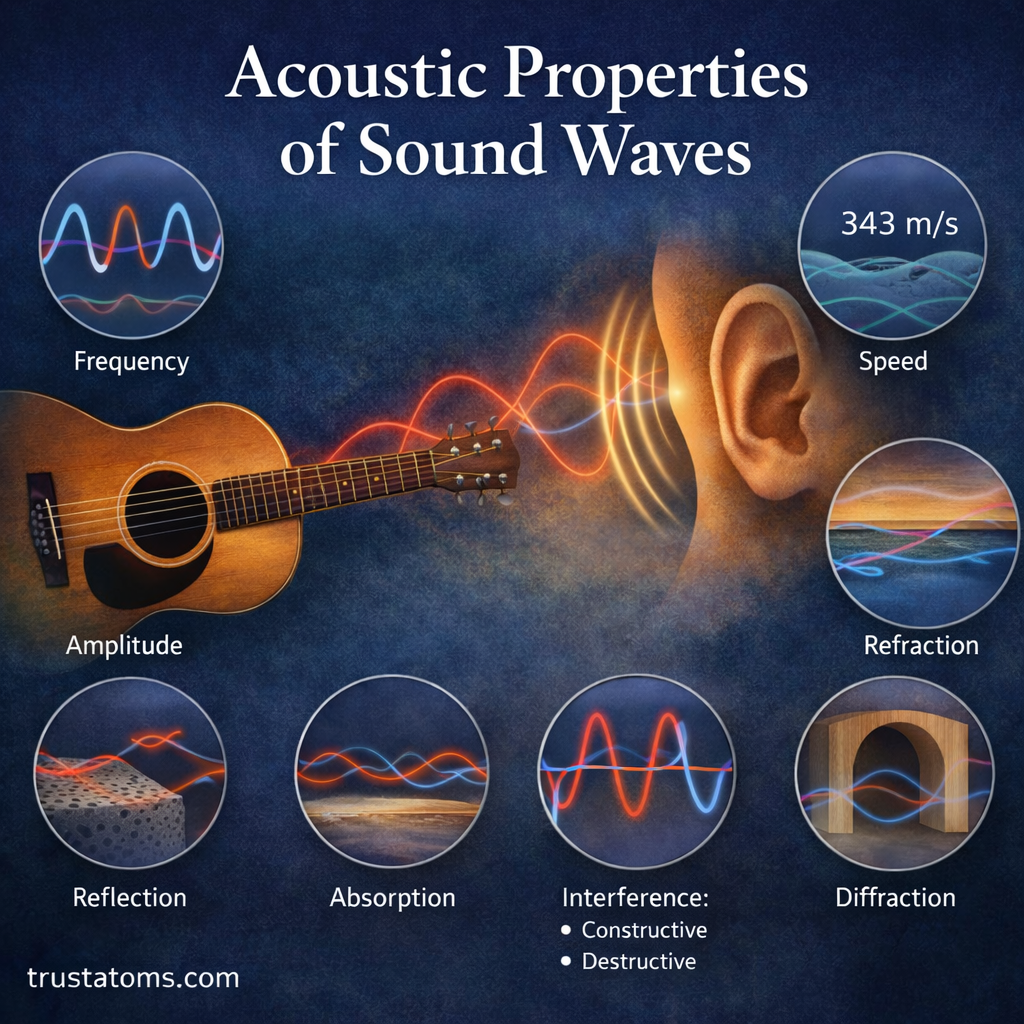
Illustration of acoustic properties of sound waves showing frequency, amplitude, speed, reflection, absorption, refraction, diffraction, and interference.
Key acoustic properties of sound waves illustrated, including frequency, amplitude, speed, reflection, absorption, refraction, diffraction, and interference. trustatoms.com.

Sound is more than just something we hear — it is a mechanical wave that travels through matter, carrying energy through vibrations. The acoustic properties of sound waves determine how sound behaves in air, water, solids, and built environments.

Understanding these properties helps explain music, speech clarity, echoes, architectural acoustics, sonar systems, and noise control.

This guide breaks down the key acoustic properties in a clear, structured way.

Continue reading “Acoustic Properties of Sound Waves”

Standing Waves in Bounded Media

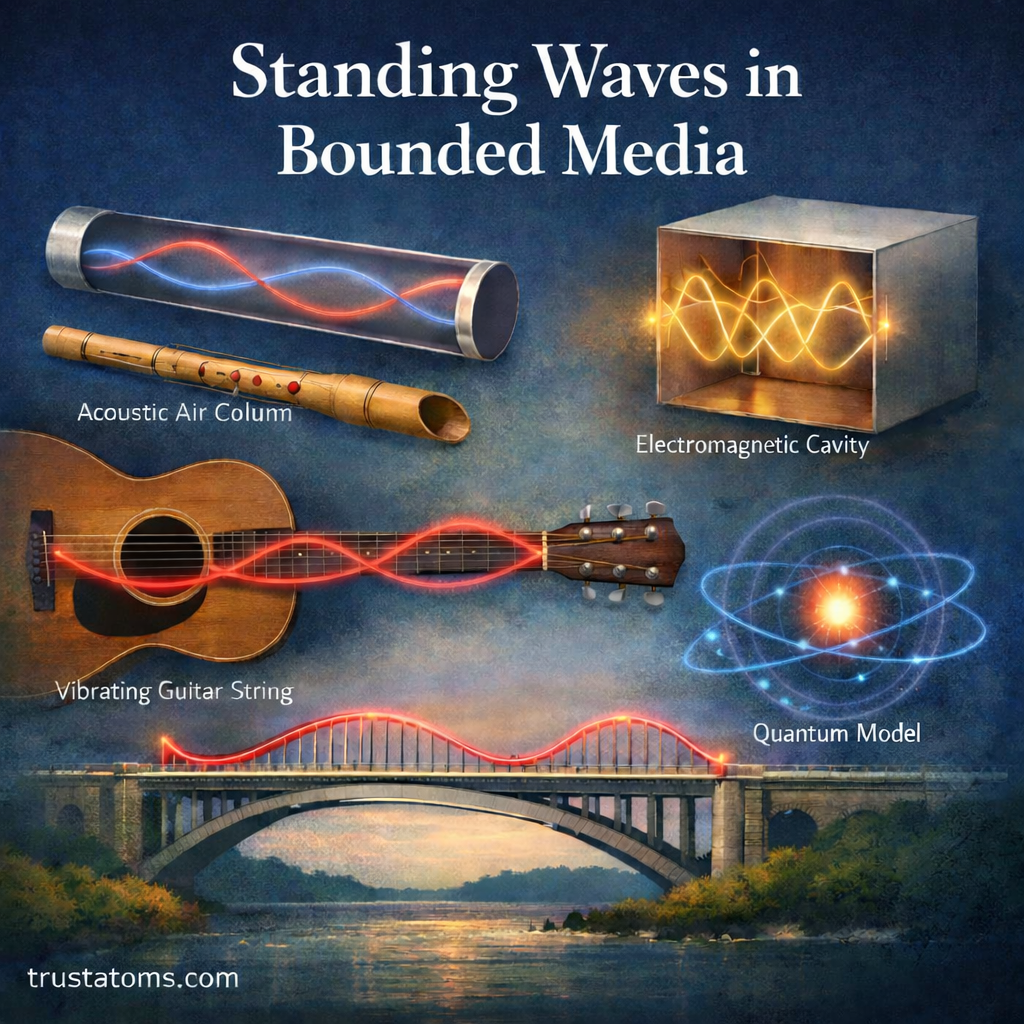
Illustration of standing waves in bounded media showing an acoustic air column, vibrating guitar string, electromagnetic cavity, and quantum model with title overlay.
Standing wave patterns illustrated in different bounded systems including air columns, strings, electromagnetic cavities, and quantum models. trustatoms.com.

Standing waves are one of the most important and visually striking phenomena in physics. They appear when waves are confined within boundaries — such as a string fixed at both ends, air trapped in a pipe, or electromagnetic fields inside a cavity.

Understanding standing waves in bounded media helps explain musical instruments, microwave ovens, laser cavities, bridge vibrations, and even quantum mechanics.

This guide breaks down the physics clearly, step by step.

Continue reading “Standing Waves in Bounded Media”

Wave Interference and Superposition

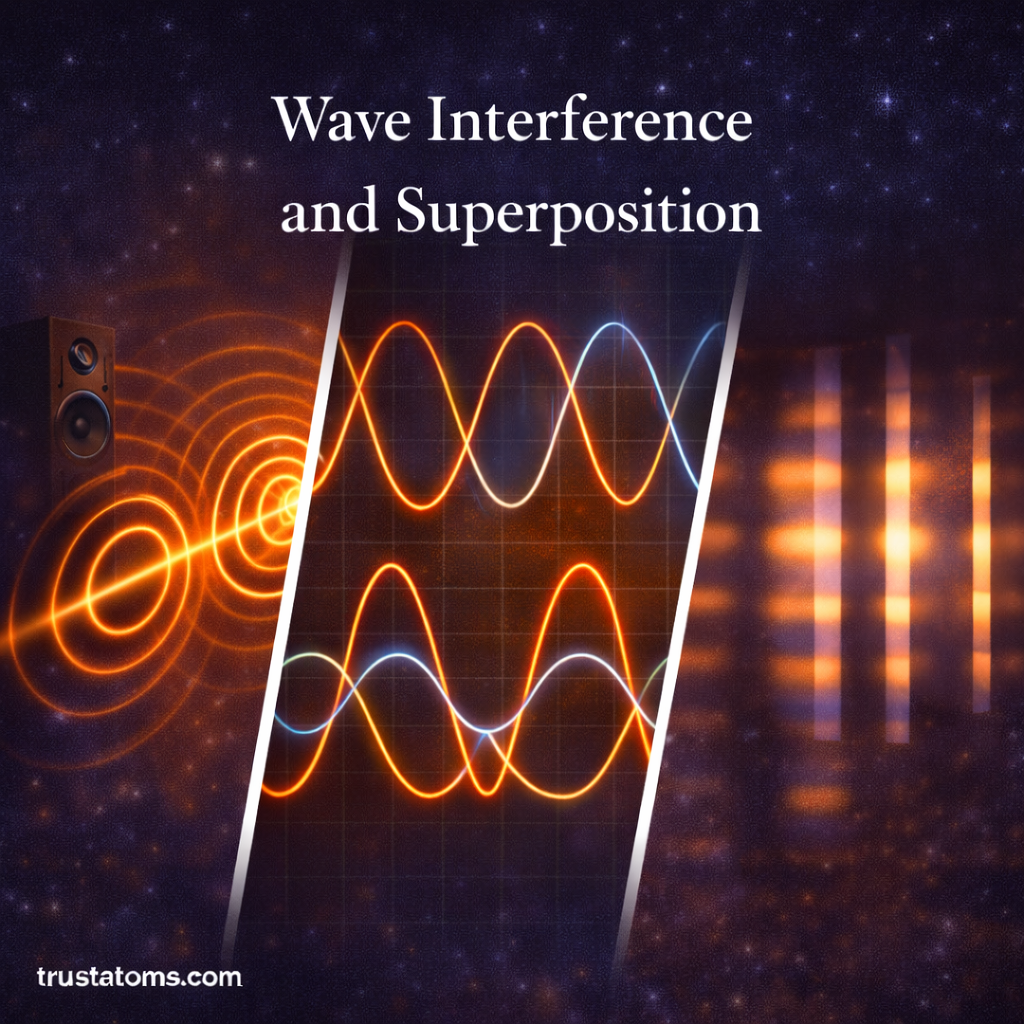
Illustration showing sound waves from speakers overlapping, sinusoidal wave patterns combining, and light interference bands demonstrating wave interference and superposition.
Visualization of wave interference and superposition in sound, mechanical waves, and light patterns. trustatoms.com

When waves meet, they don’t collide like solid objects. Instead, they pass through one another and combine. This interaction is governed by one of the most fundamental principles in physics: the principle of superposition.

Wave interference and superposition explain everything from noise-canceling headphones and musical harmonics to light patterns and quantum behavior. In this guide, we’ll break down how waves interact and why interference is so important in physics.

Continue reading “Wave Interference and Superposition”

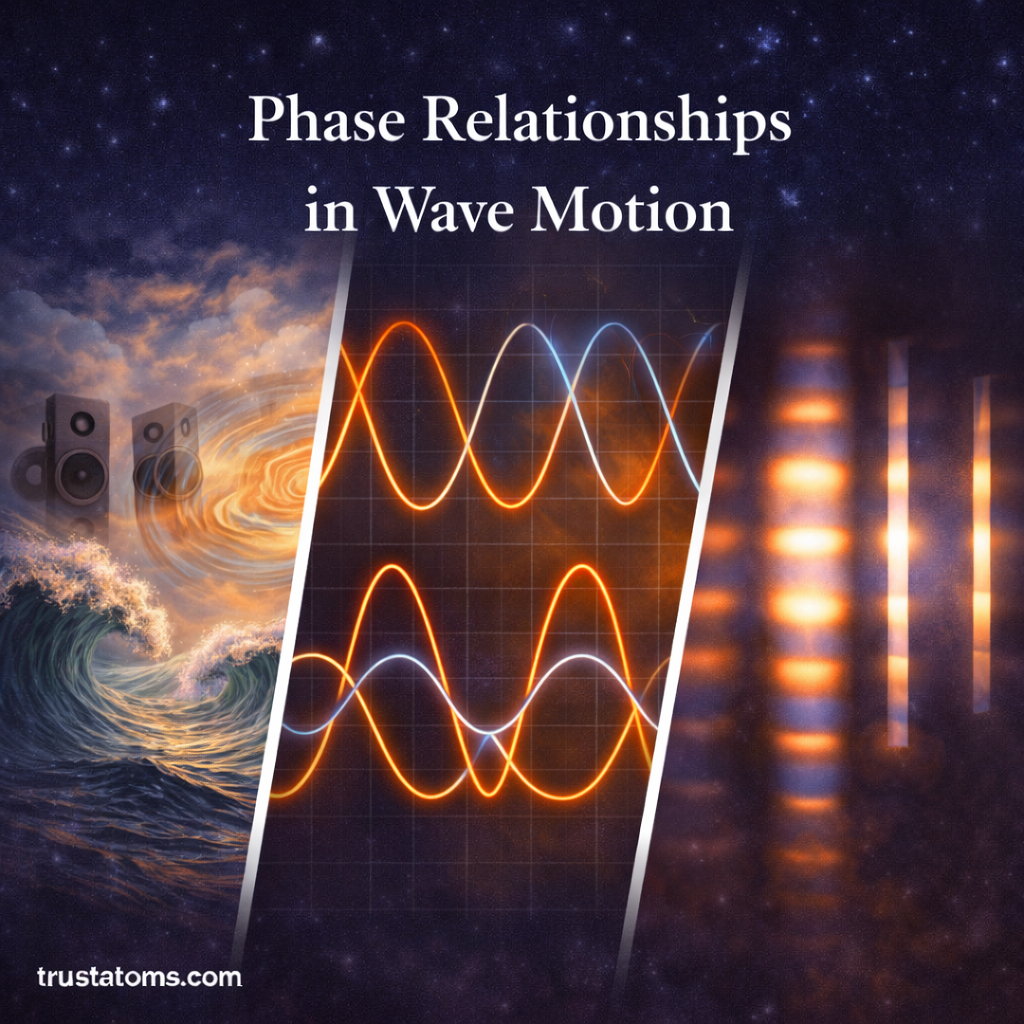
Phase Relationships in Wave Motion

Illustration showing ocean waves, sound wave interference patterns, and light interference bands to represent phase relationships in wave motion.
Examples of phase relationships in wave motion including water waves, sound interference, and light wave patterns. trustatoms.com

Waves are everywhere — in ocean tides, sound vibrations, light from the Sun, and even electrical signals. But one of the most important concepts in understanding waves is phase.

Phase relationships in wave motion determine how waves combine, interfere, amplify, or cancel each other. Whether you’re studying sound engineering, optics, or quantum physics, understanding phase is essential.

In this guide, we’ll explore what phase means, how phase differences arise, and why they matter in real-world systems.

Continue reading “Phase Relationships in Wave Motion”

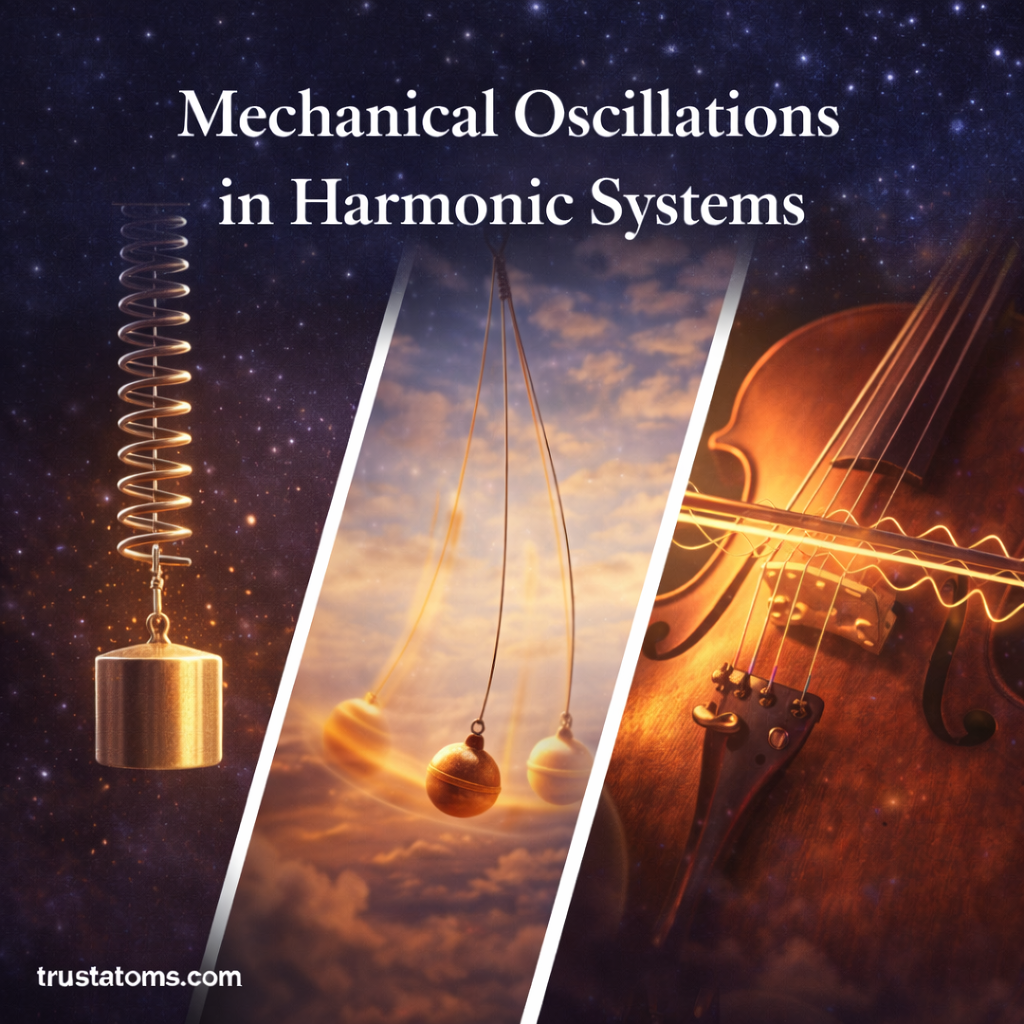
Mechanical Oscillations in Harmonic Systems

Illustration showing a mass–spring system, a swinging pendulum, and vibrating violin strings representing mechanical oscillations in harmonic systems.
Examples of harmonic motion including a spring–mass system, pendulum swing, and vibrating string. trustatoms.com

Mechanical oscillations are everywhere in physics. From a swinging pendulum to a vibrating guitar string, many systems move back and forth around an equilibrium position. When this motion follows a predictable and restoring pattern, it is called harmonic motion.

Mechanical oscillations in harmonic systems are fundamental to understanding waves, sound, energy transfer, and even atomic behavior. In this guide, we’ll break down how harmonic systems work and why they are so important in physics and engineering.

Continue reading “Mechanical Oscillations in Harmonic Systems”

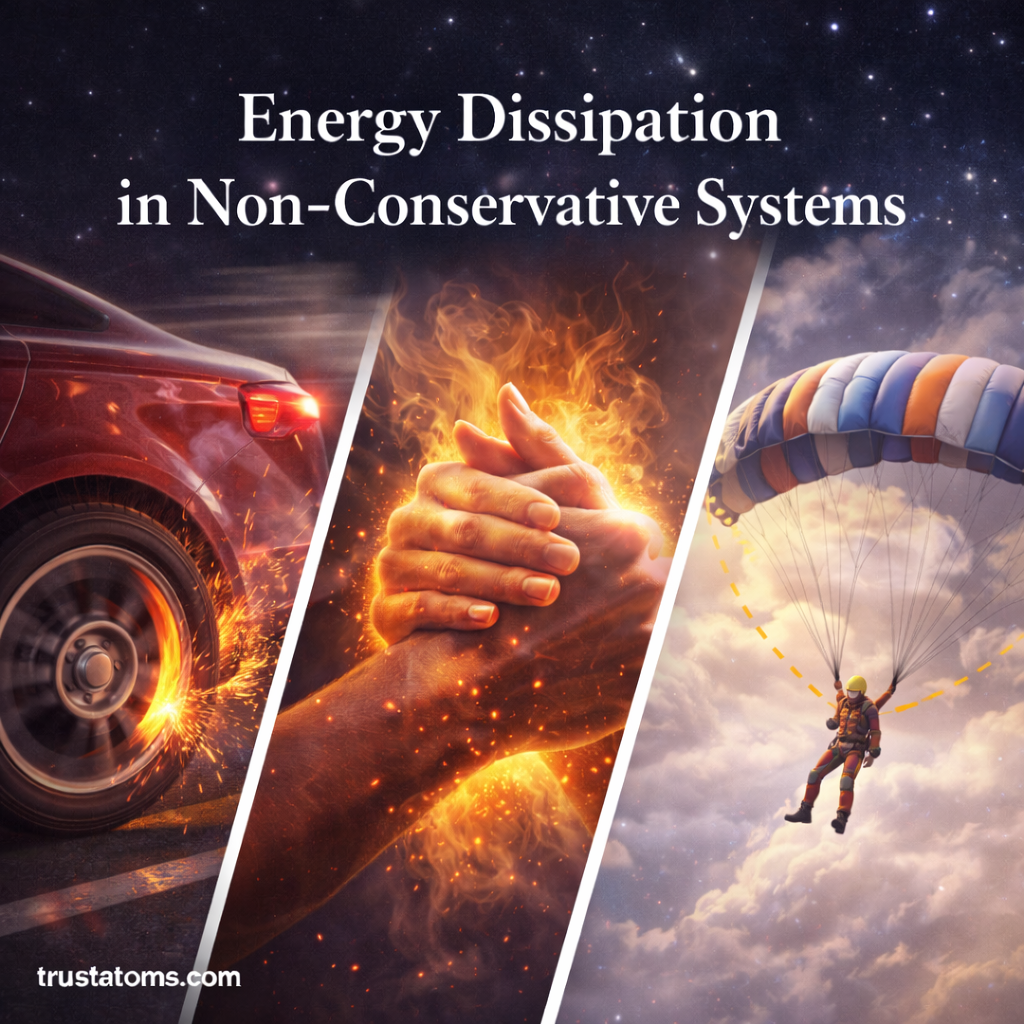
Energy Dissipation in Non-Conservative Systems

Illustration showing a car brake generating heat, hands rubbing together from friction, and a parachute slowing descent to represent energy dissipation in non-conservative systems.
Examples of energy dissipation through friction, heat, and air resistance in real-world systems. trustatoms.com

In ideal physics problems, energy is often perfectly conserved. But in the real world, energy rarely stays neatly within mechanical systems. Instead, it spreads, transforms, and dissipates.

Energy dissipation in non-conservative systems explains why machines heat up, why objects slow down due to friction, and why perpetual motion machines are impossible. Understanding this concept is essential in physics, engineering, thermodynamics, and real-world system design.

Continue reading “Energy Dissipation in Non-Conservative Systems”