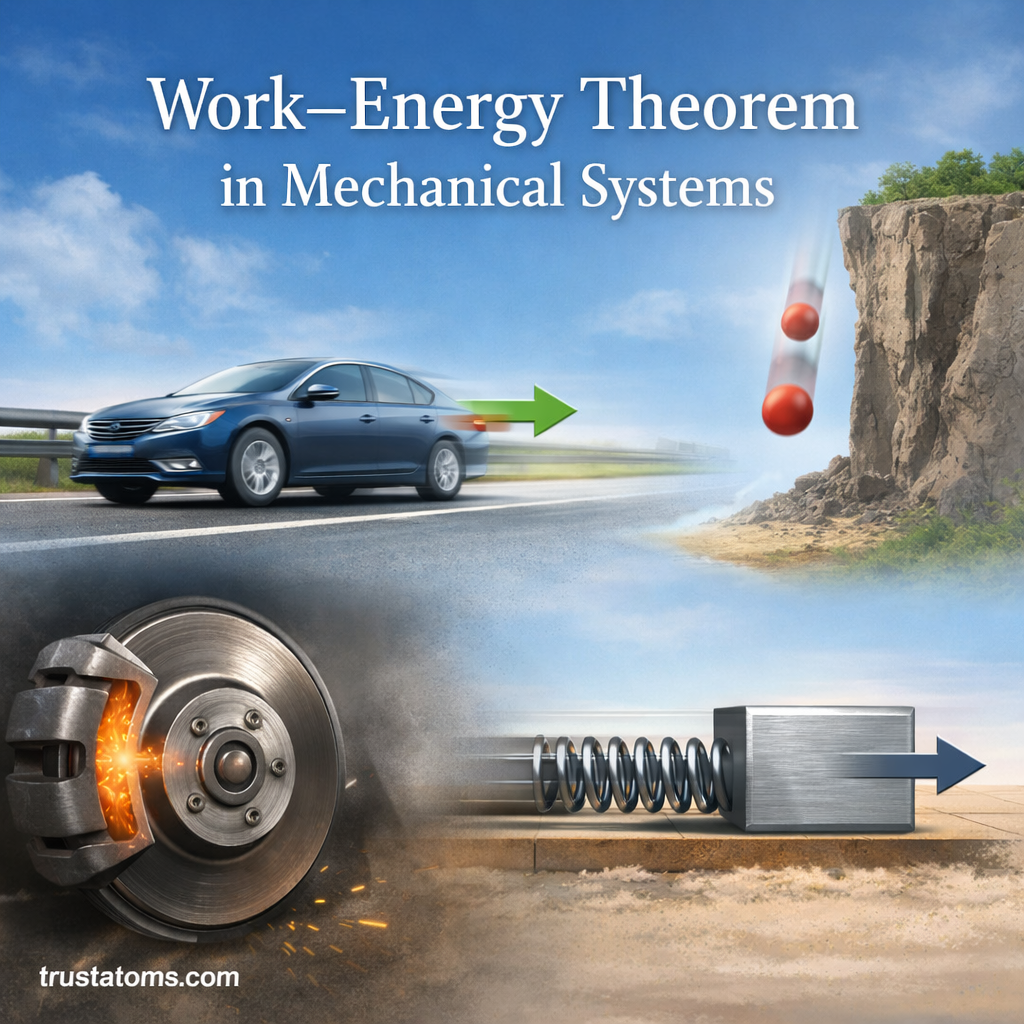
Work–Energy Theorem in Mechanical Systems

Contextual illustration showing car acceleration, braking system, falling object, and spring system representing the Work–Energy Theorem in mechanical systems.
Illustration showing real-world examples of the Work–Energy Theorem in mechanical systems. trustatoms.com

The work–energy theorem is one of the most powerful and practical ideas in classical physics. It connects two fundamental concepts—work and kinetic energy—into a single, elegant relationship that explains how forces change motion.

Whether you’re analyzing a rolling car, a falling object, or a machine in motion, the work–energy theorem provides a simpler alternative to using Newton’s laws step by step.

In this guide, we’ll break it down clearly and show how it applies to real mechanical systems.

Continue reading “Work–Energy Theorem in Mechanical Systems”


Conservation Laws in Isolated Systems

Illustration showing conservation laws in isolated systems including energy, momentum, mass, and electric charge examples, trustatoms.com.
Conservation laws in isolated systems illustrated through energy, momentum, mass, and charge examples. trustatoms.com.

Why does the total momentum of colliding billiard balls remain constant?
Why can energy change form but never simply disappear?

The answer lies in one of the most powerful ideas in physics: conservation laws.

Conservation laws explain what stays constant in nature — even when everything else seems to change. In this guide, we’ll break down what conservation laws are, what an isolated system means, and why these principles are foundational to physics.

Continue reading “Conservation Laws in Isolated Systems”

Impulse and Momentum Transfer in Collisions

Illustration showing impulse and momentum transfer in collisions with a car crash, the barrel end of a baseball bat hitting a baseball, and two spheres colliding, trustatoms.com.
Impulse and momentum transfer illustrated through real-world collision examples. trustatoms.com.

Collisions are everywhere — from a baseball hitting a bat to cars braking suddenly at a red light. Behind each impact lies a powerful physics principle: impulse and momentum transfer.

Understanding how momentum changes during a collision explains why airbags save lives, why athletes “follow through,” and why softer materials reduce injury. In this guide, we’ll break down impulse and momentum in a clear, practical way — without heavy math.

Continue reading “Impulse and Momentum Transfer in Collisions”

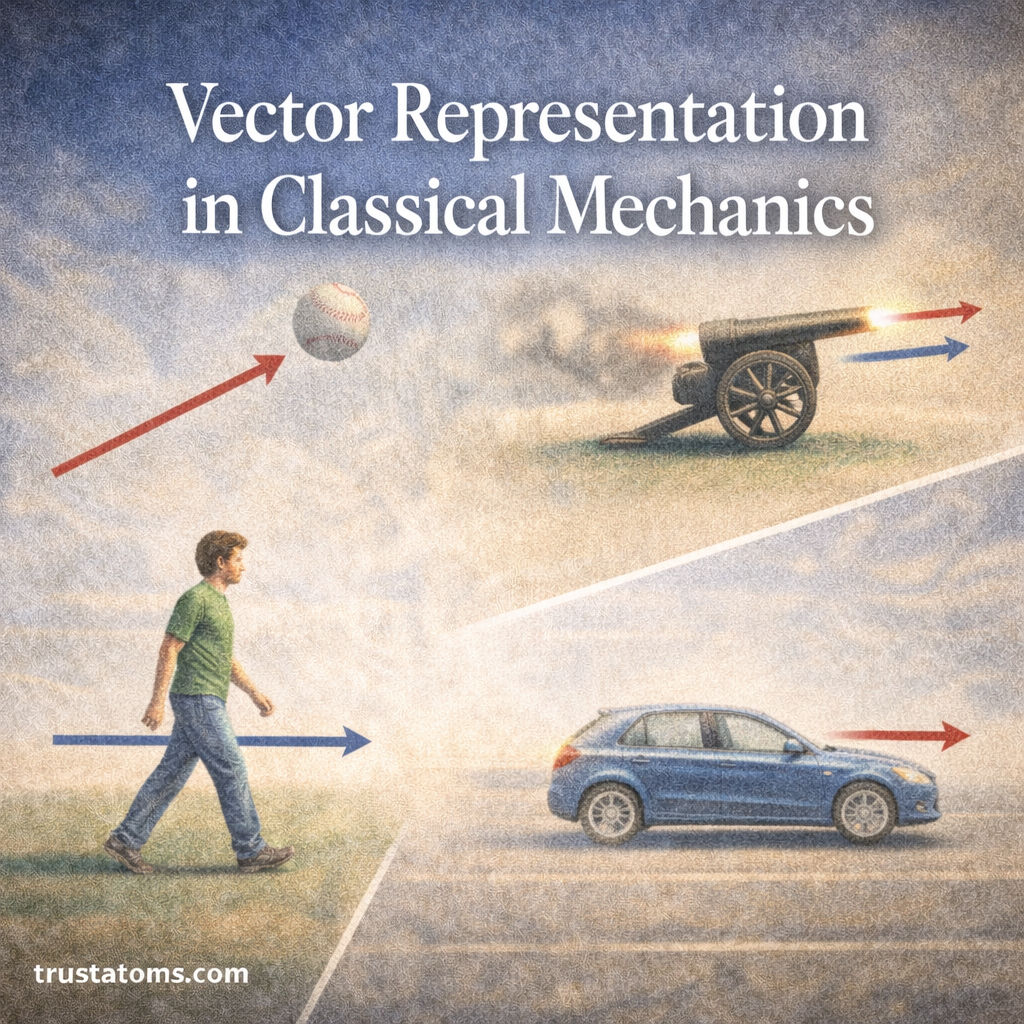
Vector Representation in Classical Mechanics

Illustration showing examples of vector representation in classical mechanics, including a moving baseball, a cannon firing, a walking person, and a car in motion with directional arrows, titled “Vector Representation in Classical Mechanics” and trustatoms.com watermark.
Examples of motion and force represented as vectors in classical mechanics. trustatoms.com

In classical mechanics, many physical quantities are not just about “how much” but also about “which direction.” That’s where vectors come in.

Vector representation allows physicists to describe motion, forces, and fields accurately by including both magnitude and direction. Without vectors, understanding real-world motion—from projectiles to planetary orbits—would be incomplete.

Let’s explore how vectors work and why they are essential in classical mechanics.

Continue reading “Vector Representation in Classical Mechanics”

Inertial and Non-Inertial Reference Frames

Split illustration showing a person observing a moving car from outside and a driver inside an accelerating car, representing inertial and non-inertial reference frames, with trustatoms.com watermark.
Visual comparison of inertial and non-inertial reference frames from an outside observer and an accelerating vehicle perspective. trustatoms.com

Understanding motion in physics requires more than just measuring speed and distance. It also depends on where you are observing from. That viewpoint is called a reference frame.

Two important types of reference frames are inertial reference frames and non-inertial reference frames. These concepts help explain why forces sometimes appear to act on objects—even when nothing seems to be pushing or pulling them.

Let’s break this down clearly and step by step.

Continue reading “Inertial and Non-Inertial Reference Frames”

What Is Mechanical Advantage?

Illustration showing examples of mechanical advantage including a pulley lifting a heavy block, a lever on a fulcrum, a car jack raising a vehicle, and a screw being driven into wood with the title “What Is Mechanical Advantage?” and trustatoms.com watermark.
Everyday examples of mechanical advantage in action, including levers, pulleys, jacks, and screws. trustatoms.com

Mechanical advantage is a key concept in physics that explains how machines make work easier.

From simple tools like levers and pulleys to complex machines like cranes and hydraulic lifts, mechanical advantage helps us lift heavier objects, move loads more efficiently, and apply force more effectively.

In simple terms, mechanical advantage describes how much a machine multiplies your input force.

Let’s break it down clearly.

Continue reading “What Is Mechanical Advantage?”

What Is Hooke’s Law?

Illustration showing a stretched spring, weighing scale, car suspension system, and mechanical watch components with the title “What Is Hooke’s Law?” and trustatoms.com watermark.
Everyday examples of Hooke’s Law in action, including springs, suspension systems, and precision mechanical devices. trustatoms.com

Hooke’s Law is one of the foundational principles in physics. It explains how springs and other elastic materials stretch or compress when a force is applied.

If you’ve ever pulled on a rubber band or compressed a spring, you’ve seen Hooke’s Law in action.

In simple terms, Hooke’s Law states that the extension of an elastic object is directly proportional to the force applied — as long as the elastic limit is not exceeded.

Let’s break that down clearly and step by step.

Continue reading “What Is Hooke’s Law?”

What Is Elasticity?

Illustration showing examples of elasticity including a stretched rubber band, bending bridge, spring, diving board, and paper clip with the title “What Is Elasticity?” and trustatoms.com watermark.
Visual examples of elasticity in physics, including stretching, bending, and returning to original shape. trustatoms.com

Elasticity is one of the most important ideas in physics. It explains why a rubber band stretches and returns to its shape, why bridges bend slightly under traffic, and how materials respond when forces act on them.

In simple terms, elasticity describes a material’s ability to return to its original shape after being stretched, compressed, or bent.

Understanding elasticity helps engineers design buildings, athletes choose equipment, and scientists predict how materials behave under stress.

Continue reading “What Is Elasticity?”

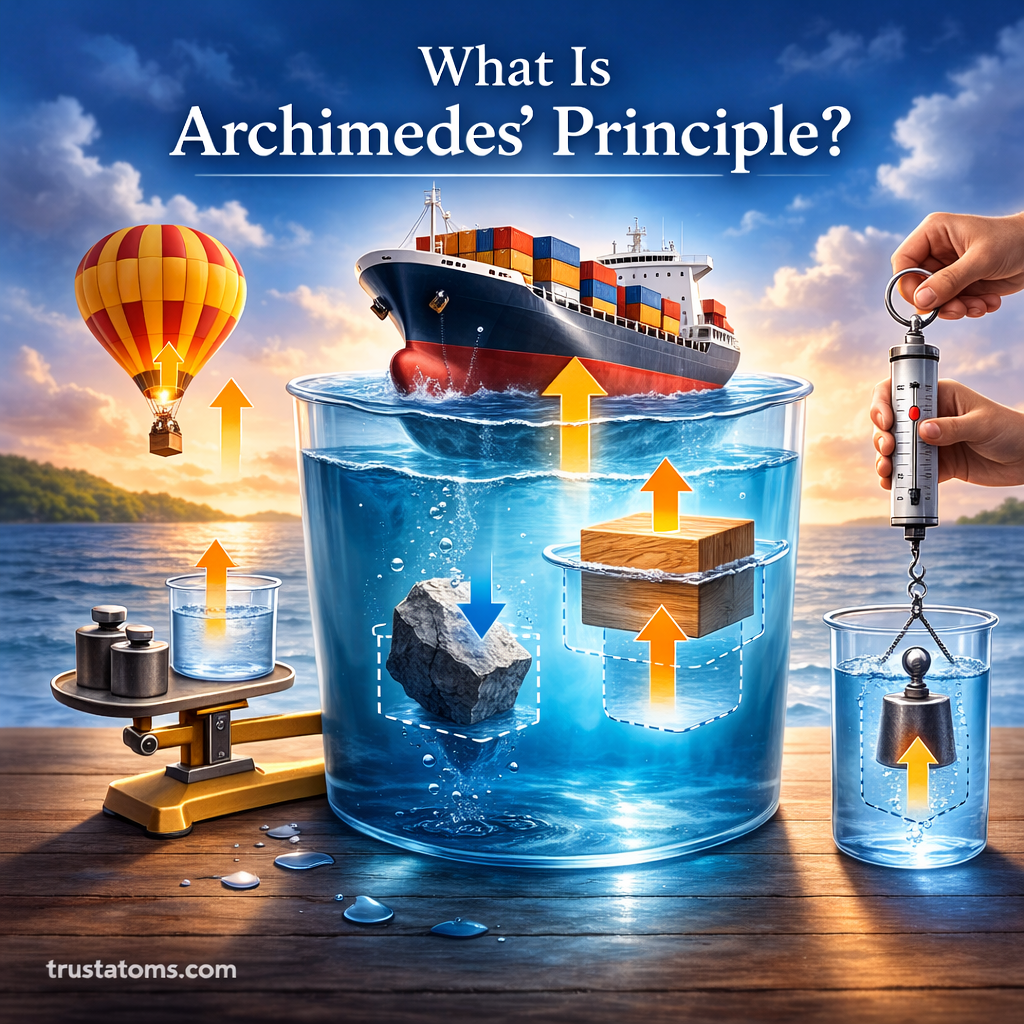
What Is Archimedes’ Principle?

Illustration showing a ship floating in water, a rock submerged, a wooden block floating, and a hot air balloon rising, titled “What Is Archimedes’ Principle?” with trustatoms.com watermark.
Conceptual illustration of Archimedes’ Principle showing displaced water, floating objects, and upward buoyant force in fluids. trustatoms.com

Archimedes’ Principle is a fundamental law of physics that explains why objects float or sink in fluids.

It states:

An object submerged in a fluid experiences an upward force equal to the weight of the fluid it displaces.

This simple idea explains everything from ships floating on water to hot air balloons rising in the sky.

Archimedes’ Principle is one of the most important concepts in fluid mechanics.

Continue reading “What Is Archimedes’ Principle?”

What Is Buoyancy?

Illustration showing a cargo ship floating, a scuba diver underwater, and a hot air balloon rising, titled “What Is Buoyancy?” with trustatoms.com watermark.
Conceptual illustration of buoyancy showing floating ships, neutral buoyancy underwater, and rising hot air balloons. trustatoms.com

Buoyancy is the upward force that a fluid exerts on an object placed in it.

This force is what allows boats to float, balloons to rise, and swimmers to stay above water.

Whenever an object is partially or completely submerged in a liquid or gas, buoyancy acts against gravity. Whether the object floats, sinks, or stays suspended depends on the balance between buoyant force and weight.

Continue reading “What Is Buoyancy?”