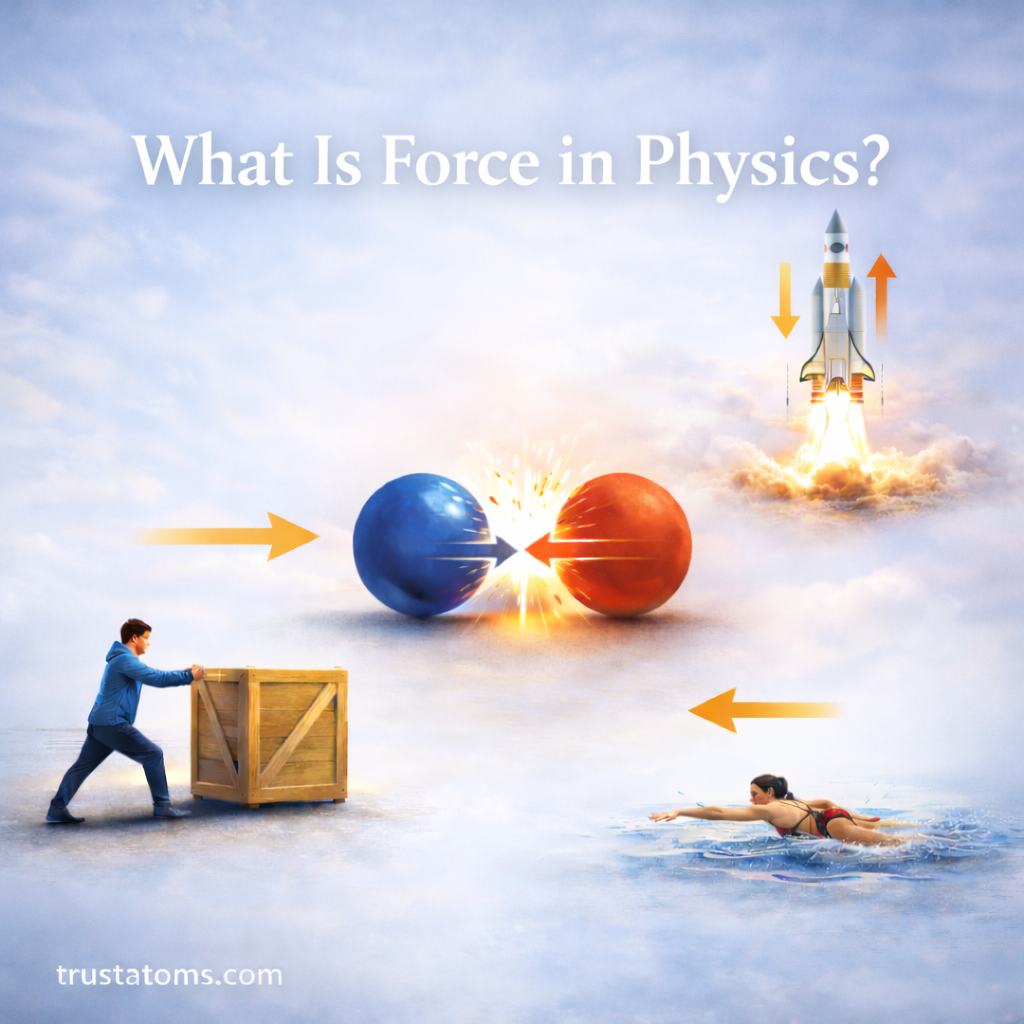
What Is Force in Physics?

White title text reading “What Is Force in Physics?” over an illustration showing colliding spheres, a rocket launch, a person pushing a crate, and a swimmer demonstrating force in motion.
“What Is Force in Physics?” illustrated through collisions, pushing, rocket propulsion, and swimming examples. trustatoms.com.

Force is one of the most fundamental concepts in physics. It explains why objects move, stop, accelerate, change direction, or even change shape.

In simple terms, a force is a push or a pull acting on an object. But in physics, force is more than just movement — it is the cause of acceleration.

In this guide, we’ll break down what force means in physics, how it’s measured, the different types of forces, and how it affects the world around us.

Continue reading “What Is Force in Physics?”
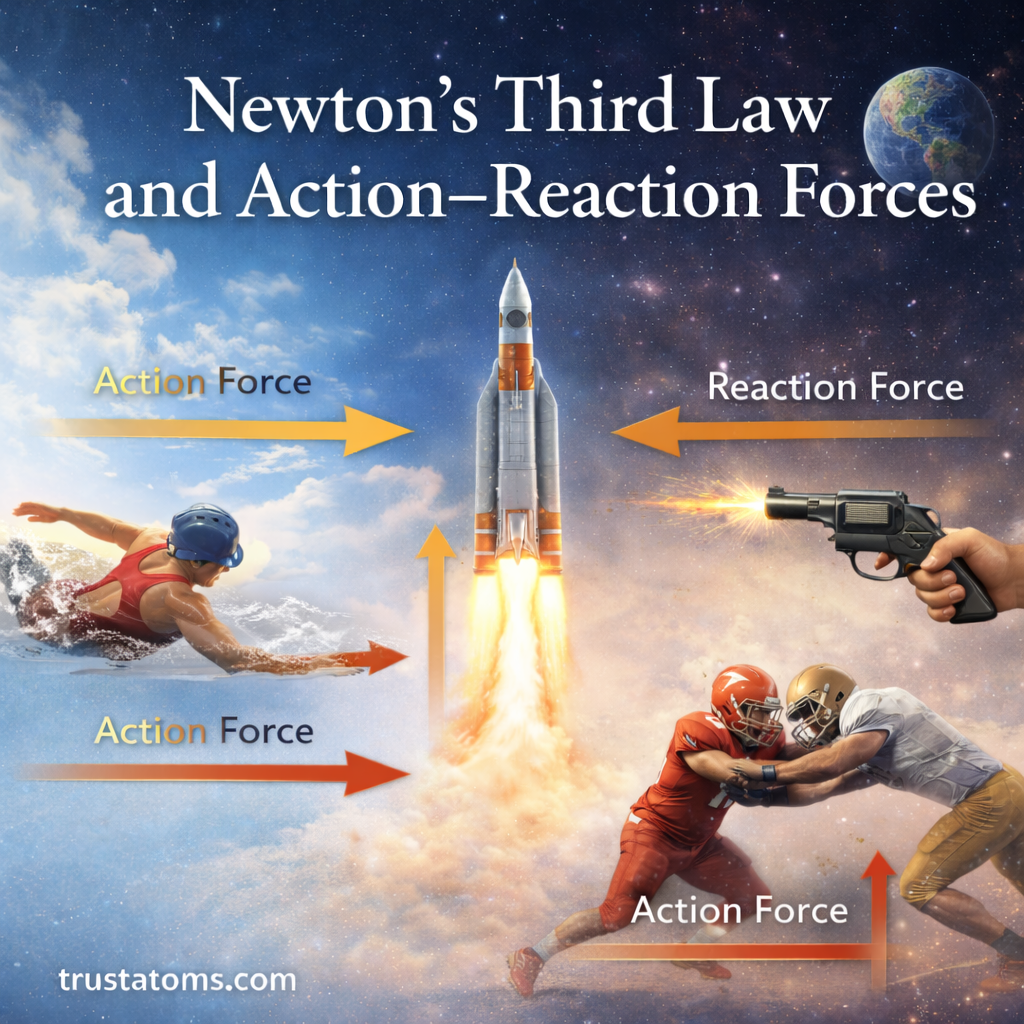
Newton’s Third Law and Action–Reaction Forces

Illustration explaining Newton’s Third Law with examples of a rocket launch, swimmer pushing water, gun recoil, and football collision demonstrating action and reaction forces.
Visual explanation of Newton’s Third Law showing equal and opposite action–reaction forces in real-world examples. trustatoms.com

Newton’s Third Law of Motion explains how forces interact between objects. It describes why rockets launch, why you move backward when you jump off a boat, and why walking is even possible.

The law introduces the concept of action–reaction forces, showing that forces always come in pairs.

In this guide, you’ll learn what Newton’s Third Law states, how action–reaction forces work, and where we see them in everyday life and advanced physics.

Continue reading “Newton’s Third Law and Action–Reaction Forces”

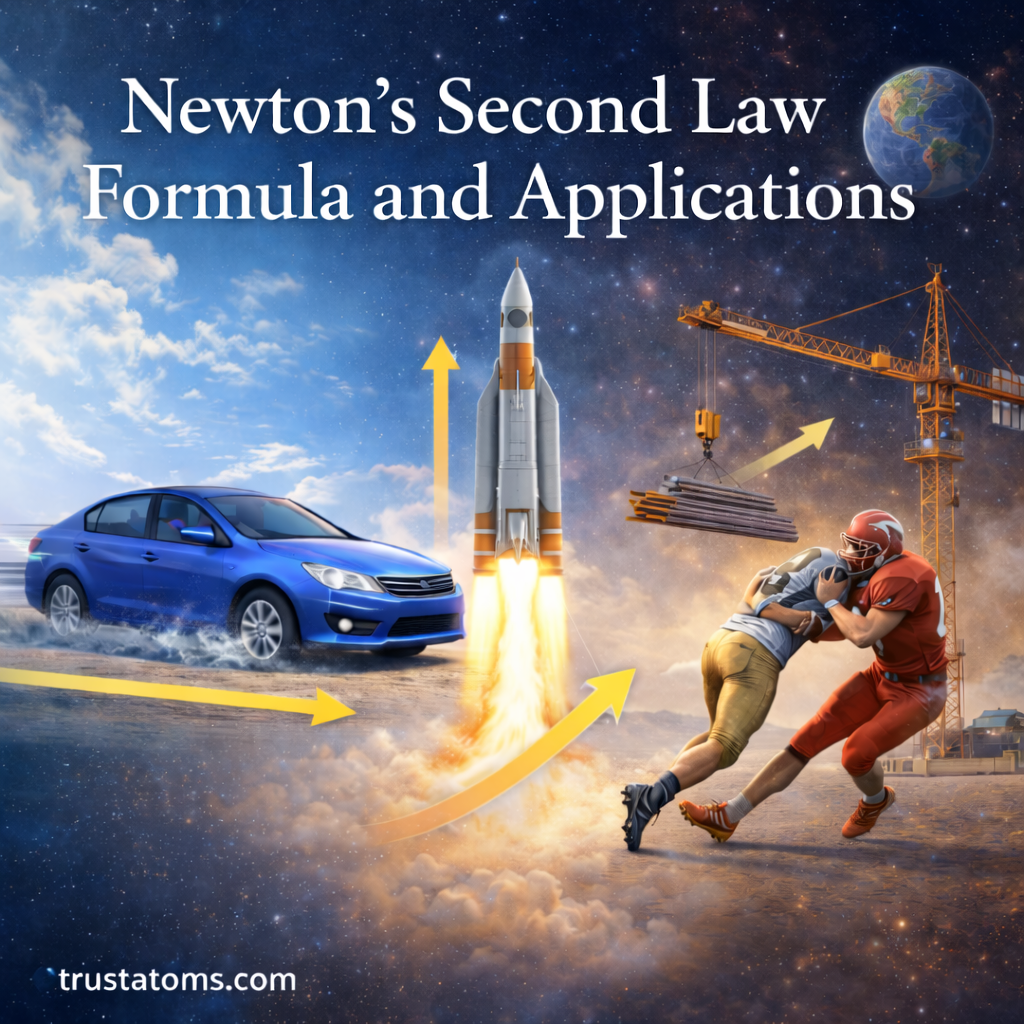
Newton’s Second Law Formula and Applications

Illustration showing Newton’s Second Law with a car accelerating, a rocket launching, construction crane lifting materials, and football players colliding to demonstrate force and motion.
Real-world examples of Newton’s Second Law showing how force affects motion in cars, rockets, construction, and sports. trustatoms.com.

Newton’s Second Law of Motion explains how force, mass, and acceleration are connected. It tells us exactly how much an object will accelerate when a certain force is applied.

This law is one of the most important formulas in physics because it allows us to calculate motion. From cars speeding up to rockets launching into space, Newton’s Second Law helps engineers and scientists predict how objects will behave.

In this guide, we’ll break down the formula, explain each variable, and explore real-world applications.

Continue reading “Newton’s Second Law Formula and Applications”

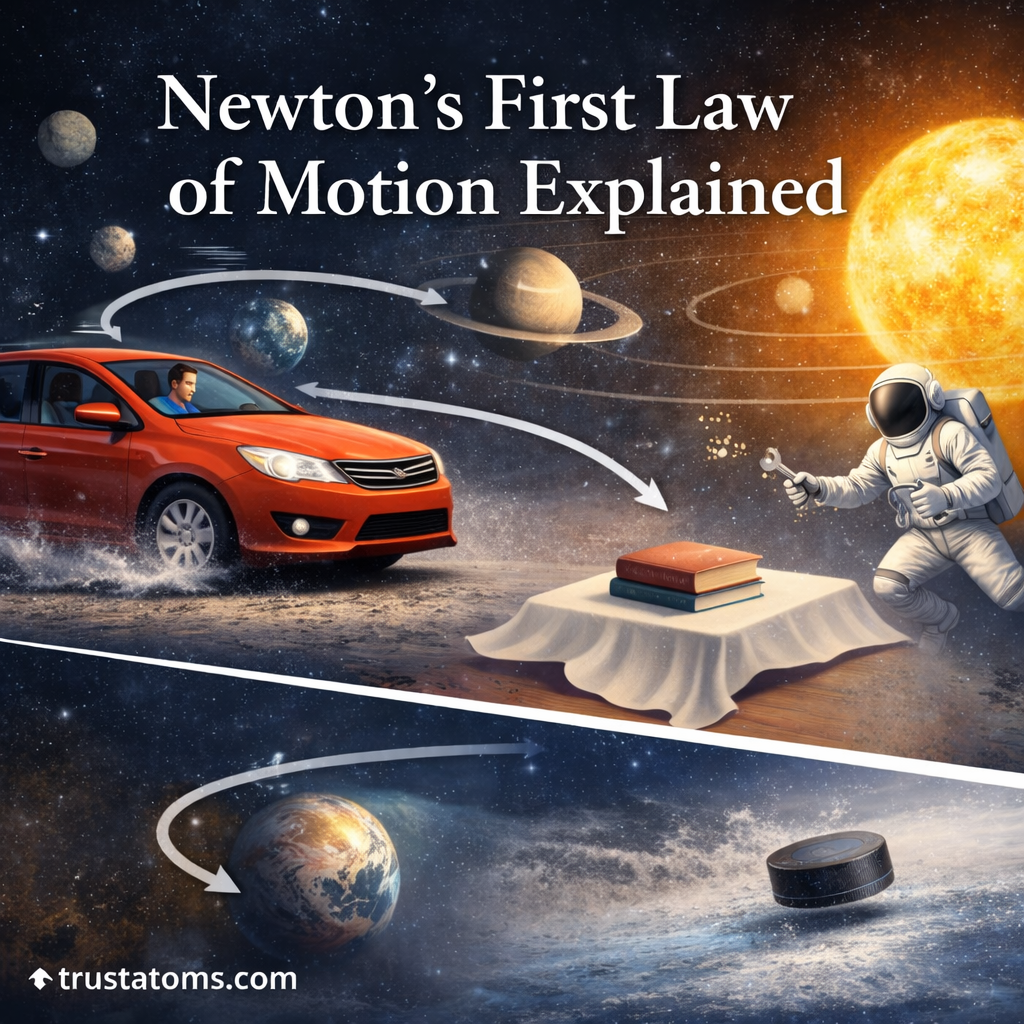
Newton’s First Law of Motion Explained

Illustration explaining Newton’s First Law of Motion with examples including a braking car, floating astronaut, book on tablecloth, hockey puck, and planetary motion.
Visual explanation of Newton’s First Law of Motion and inertia in everyday life and space. trustatoms.com

Newton’s First Law of Motion is one of the most important principles in physics. It explains why objects stay still, why moving objects keep moving, and why forces are needed to change motion.

Often called the Law of Inertia, this principle forms the foundation of classical mechanics and helps us understand everything from car safety to planetary motion.

In this guide, we’ll break down Newton’s First Law in simple terms, explore real-world examples, and explain why it matters.

Continue reading “Newton’s First Law of Motion Explained”

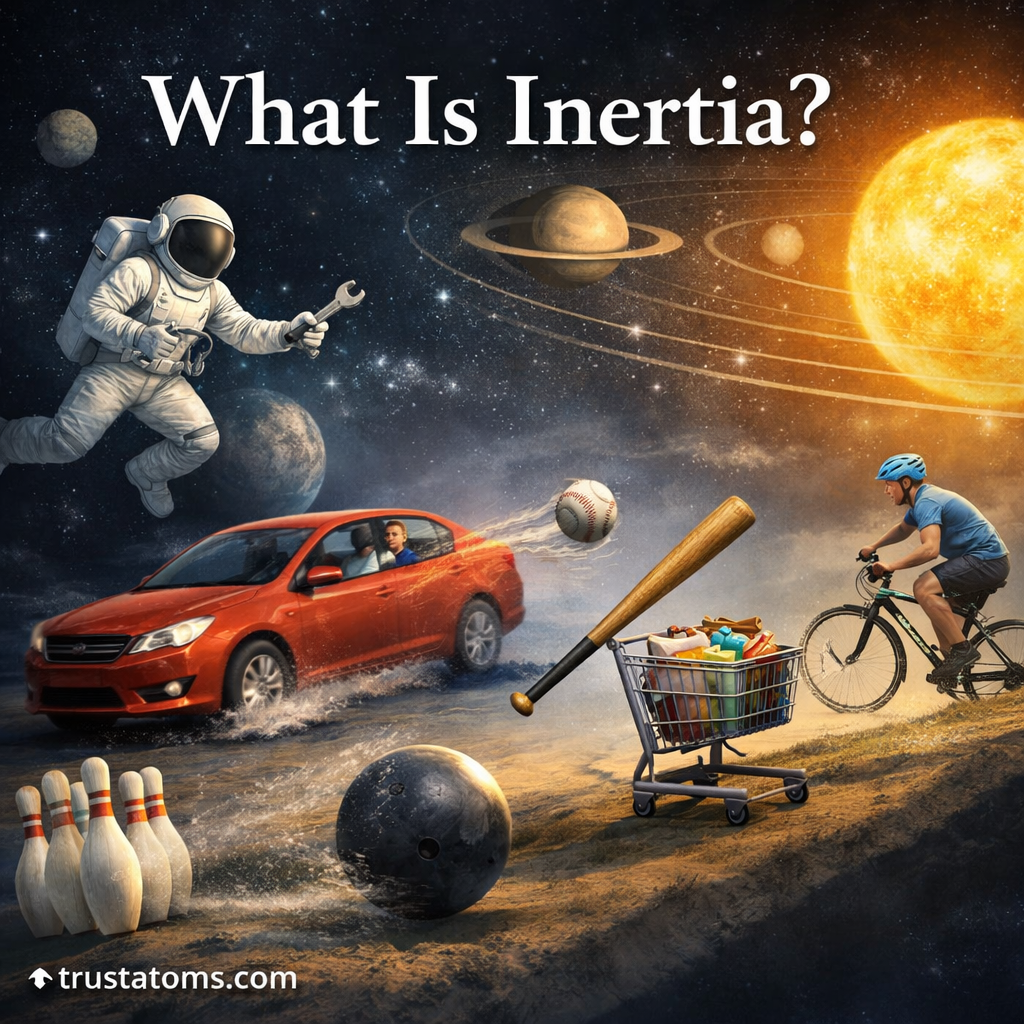
What Is Inertia?

Contextual illustration explaining inertia with examples including a car braking, astronaut in space, bowling ball, baseball, cyclist, and planetary motion.
Illustration showing real-world examples of inertia in motion and at rest. trustatoms.com

Inertia is the natural tendency of an object to resist changes in its motion. If something is at rest, it wants to stay at rest. If it’s moving, it wants to keep moving at the same speed and in the same direction—unless something forces it to change.

This simple but powerful concept explains everything from why passengers lurch forward when a car brakes to why planets stay in motion around the sun.

In this guide, you’ll learn what inertia is, why it happens, and how it shapes everyday life.

Continue reading “What Is Inertia?”