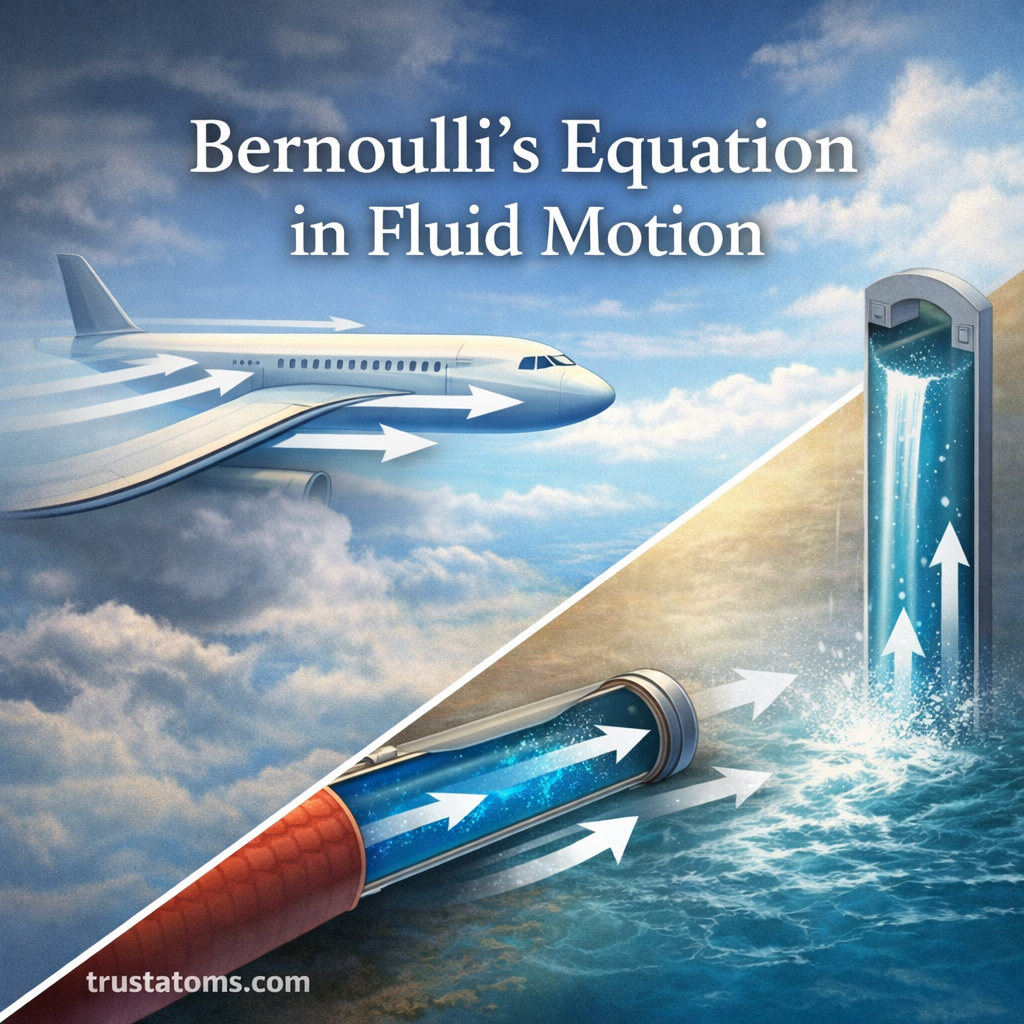
Why does air move faster over an airplane wing?
Why does water speed up when a pipe narrows?
Why does pressure drop when velocity increases?
The answer lies in Bernoulli’s Equation, one of the most important principles in fluid mechanics. It explains how energy is conserved in moving fluids and how pressure, velocity, and height are connected.
In this guide, we’ll break down Bernoulli’s equation in simple terms, explore its derivation conceptually, examine real-world applications, and clarify common misconceptions.
What Is Bernoulli’s Equation?
Bernoulli’s Equation describes the conservation of energy in a flowing fluid.
It states that in a steady, incompressible, non-viscous fluid, the total mechanical energy remains constant along a streamline.
The equation is:
P + ½ρv² + ρgh = constant
Where:
- P = pressure energy per unit volume
- ½ρv² = kinetic energy per unit volume
- ρgh = gravitational potential energy per unit volume
- ρ = fluid density
- v = velocity
- g = acceleration due to gravity
- h = height
In simpler terms:
Pressure energy + kinetic energy + potential energy = constant
If one increases, another must decrease.
The Three Energy Components Explained
To understand Bernoulli’s equation, you need to understand its three energy terms.
1. Pressure Energy
Pressure represents stored energy in a fluid.
High pressure means the fluid can exert more force on its surroundings.
If pressure decreases, that energy must go somewhere else in the system.
2. Kinetic Energy
Kinetic energy depends on fluid velocity.
When fluid speeds up:
- Velocity increases
- Kinetic energy increases
- Pressure usually decreases
This inverse relationship between velocity and pressure is one of Bernoulli’s most important insights.
3. Gravitational Potential Energy
This term depends on height.
Fluids higher above the ground have more potential energy.
If height decreases:
- Potential energy decreases
- Either velocity or pressure (or both) must increase
What Bernoulli’s Equation Really Means
Bernoulli’s equation is an energy balance.
It does not say pressure “causes” speed.
It says energy is conserved.
If fluid moves faster, that energy must come from somewhere — typically pressure or height.
Think of it as an energy exchange system:
- Narrow pipe → speed increases → pressure drops
- Fluid falls downward → height decreases → speed increases
Energy shifts forms, but total energy remains constant.
Conditions Required for Bernoulli’s Equation
Bernoulli’s equation works under specific assumptions:
- Steady flow (no time changes)
- Incompressible fluid
- Non-viscous (no friction losses)
- Flow along a streamline
In real systems, friction and turbulence reduce total mechanical energy. Engineers modify the equation to account for these losses.
Bernoulli’s Equation in Pipes
When fluid flows through a horizontal pipe:
If the pipe narrows:
- Velocity increases (continuity equation).
- Kinetic energy increases.
- Pressure decreases.
This is why:
- Shower pressure changes when another tap turns on.
- Carburetors mix air and fuel.
- Venturi meters measure flow rate.
The Venturi effect is a direct result of Bernoulli’s principle.
Bernoulli’s Equation and Airplane Lift
One of the most famous applications is airplane flight.
Airplane wings are shaped so that:
- Air moves faster over the top surface.
- Pressure decreases above the wing.
- Higher pressure below the wing pushes upward.
This pressure difference creates lift.
However, lift is not caused by Bernoulli alone — Newton’s laws also contribute. Both explanations are complementary.
Bernoulli and Atmospheric Motion
Bernoulli’s principle also helps explain:
- Wind patterns
- Storm intensification
- Pressure changes in moving air masses
Faster-moving air often corresponds to lower pressure regions.
This is why strong winds can reduce pressure locally during storms.
Bernoulli vs. the Continuity Equation
Bernoulli’s equation works together with the continuity equation.
Continuity equation:
A₁v₁ = A₂v₂
Where:
- A = cross-sectional area
- v = velocity
This equation ensures mass conservation.
If area decreases, velocity must increase.
Bernoulli then explains how pressure adjusts when velocity changes.
Together, they fully describe ideal fluid motion.
Real-World Applications
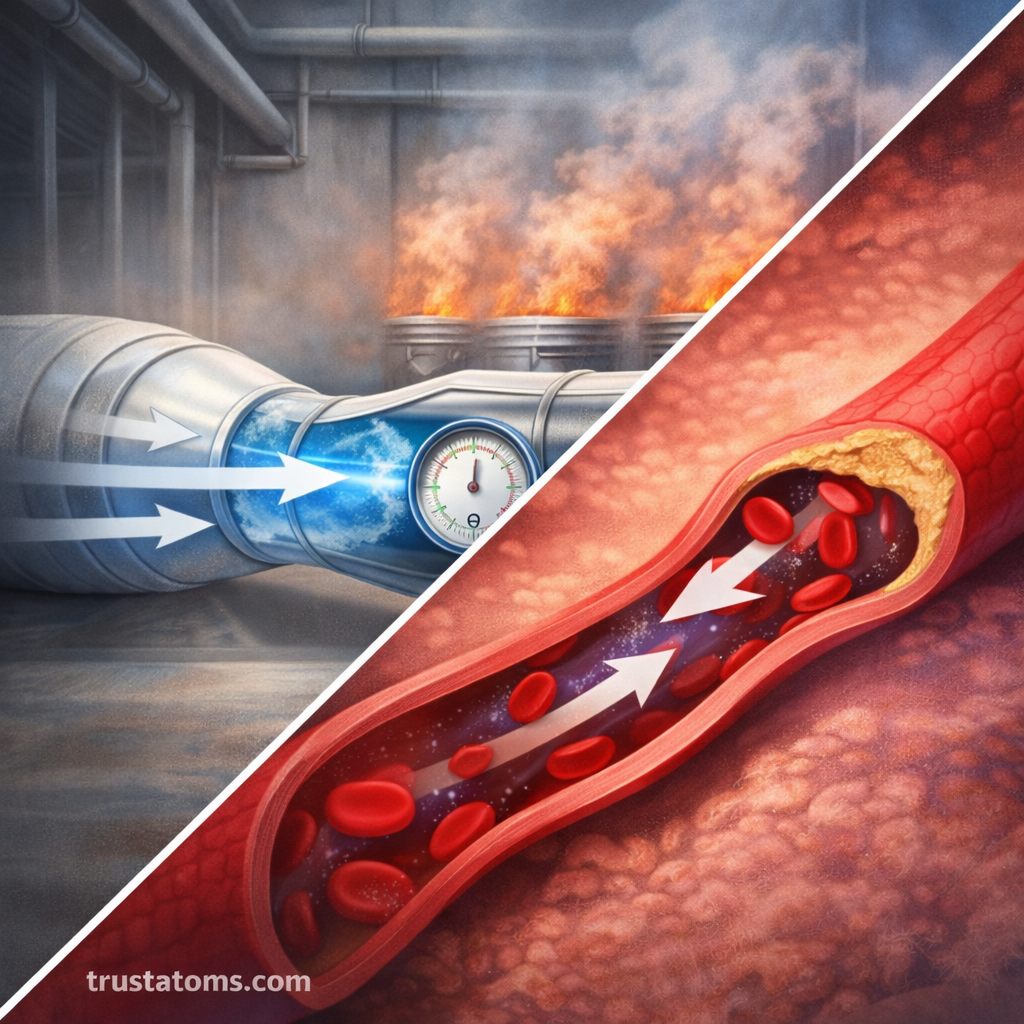
Bernoulli’s equation is used in:
- Aircraft wing design
- Wind tunnel testing
- Medical devices (blood flow analysis)
- Industrial piping systems
- Spray bottles and atomizers
- Chimneys and ventilation systems
Engineers rely on it to predict how pressure and velocity interact.
Common Misconceptions About Bernoulli’s Equation
Let’s correct a few misunderstandings.
Bernoulli does not say “faster air has lower pressure” universally.
That only applies along a streamline in ideal conditions.
It does not violate Newton’s laws.
Energy conservation and force laws work together.
It does not explain all lift on its own.
Lift involves circulation, momentum change, and pressure differences.
Limitations of Bernoulli’s Equation
Bernoulli’s equation does not account for:
- Friction
- Turbulence
- Energy loss
- Compressible flow at high speeds
- Shock waves
For high-speed aerodynamics, engineers use more advanced equations such as the Navier–Stokes equations.
Still, Bernoulli remains foundational for understanding basic fluid behavior.
Why Bernoulli’s Equation Matters in Physics
Bernoulli’s equation teaches a powerful lesson:
Energy transforms, but it is conserved.
In fluid motion:
- Pressure can become speed.
- Height can become velocity.
- Speed can become pressure.
Understanding this energy exchange is central to fluid mechanics, engineering design, meteorology, and aerospace science.
Without Bernoulli’s principle, modern aviation, ventilation systems, and fluid measurement devices would not exist in their current form.
Final Thoughts
Bernoulli’s equation is not just a formula — it’s a framework for understanding fluid energy.
Whenever you see:
- Water speeding up in a hose
- Air moving across a wing
- Fluid accelerating through a narrow channel
You are witnessing energy conservation in action.
Mastering Bernoulli’s equation means understanding how pressure, velocity, and height continuously trade energy within moving fluids.
That idea lies at the heart of fluid dynamics.