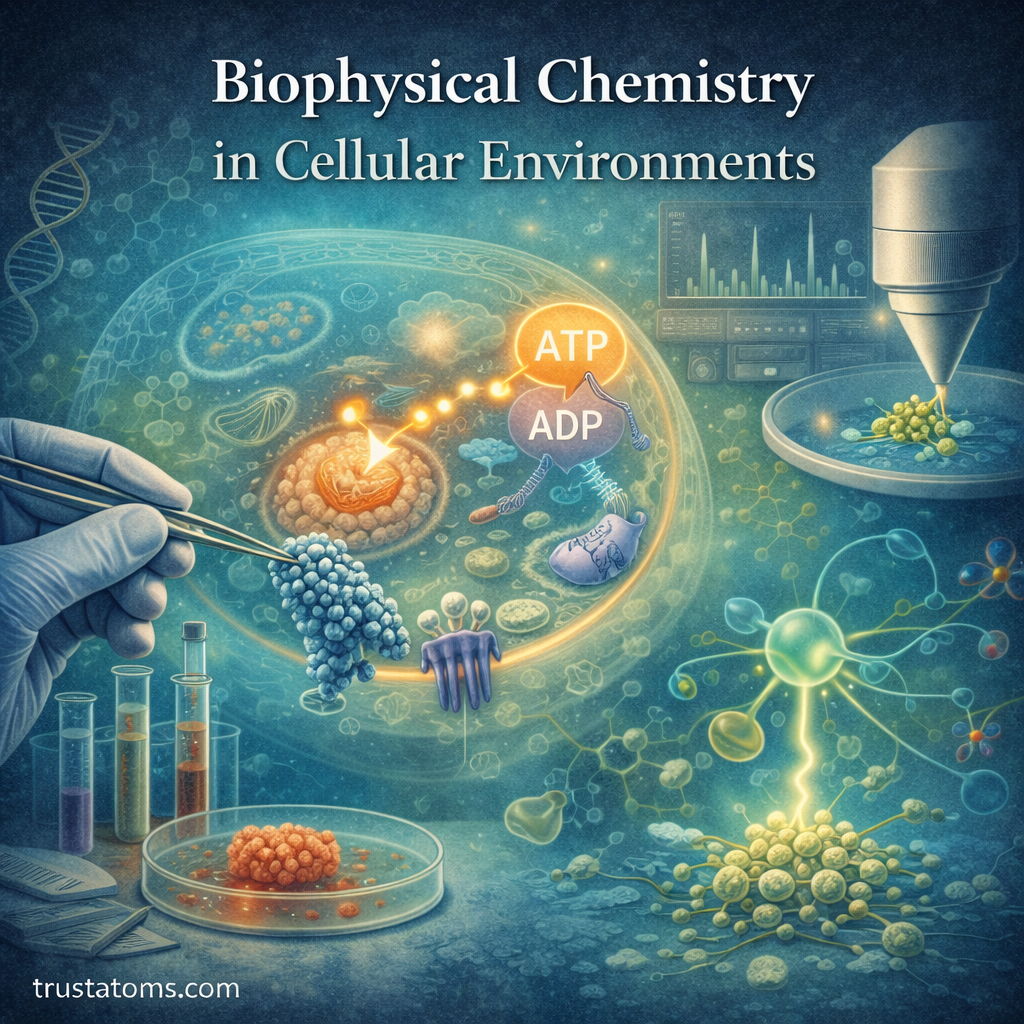
Cells are incredibly complex systems where thousands of molecules interact continuously. While biology often focuses on genes and biochemical pathways, understanding how molecules behave inside cells also requires the principles of physics and chemistry. This intersection is known as biophysical chemistry.
Biophysical chemistry studies how physical forces, molecular structures, and chemical reactions influence biological processes. By applying concepts from thermodynamics, kinetics, and molecular interactions, scientists can better understand how molecules behave in the crowded and dynamic environment of living cells.
This field plays an important role in explaining how proteins fold, how enzymes catalyze reactions, and how cellular structures maintain stability and function.
What Is Biophysical Chemistry?
Biophysical chemistry is a scientific discipline that applies physical chemistry principles to biological systems. It investigates how molecules interact, move, and transform within living organisms.
Instead of studying isolated chemical reactions, biophysical chemistry examines how biological molecules behave under real cellular conditions.
Key areas of focus include:
- Molecular structure and dynamics
- Energy transfer within cells
- Reaction rates in biological systems
- Interactions between biomolecules
- Transport of molecules across membranes
These studies help explain how chemical reactions support life at the molecular level.
The Cellular Environment: A Crowded Molecular World
Cells are far from empty spaces. They are densely packed environments filled with proteins, nucleic acids, lipids, metabolites, and ions.
In fact, up to 30–40% of the cell’s interior volume can be occupied by macromolecules.
This crowding influences how molecules behave in several ways:
- Molecules diffuse more slowly than in dilute solutions
- Reactions occur in confined spaces
- Molecular interactions become more frequent
- Structural stability can be affected
Because of this complexity, chemical reactions inside cells often behave differently than reactions studied in laboratory test tubes.
Key Principles of Biophysical Chemistry
Several fundamental physical chemistry principles help explain molecular behavior in cellular environments.
Thermodynamics in Biological Systems
Thermodynamics describes how energy flows through chemical systems.
In cells, thermodynamic principles determine whether reactions can occur spontaneously.
Important concepts include:
- Free energy changes (ΔG)
- Equilibrium conditions
- Energy coupling between reactions
For example, cells often couple energy-releasing reactions with energy-requiring processes to drive essential biological functions.
Molecular Kinetics
Kinetics studies the rate of chemical reactions.
In cellular environments, reaction rates depend on:
- Molecular concentrations
- Temperature
- Diffusion rates
- Enzyme activity
Enzymes accelerate reaction rates by lowering the activation energy required for reactions.
Molecular Interactions
Biological molecules interact through several types of forces.
Common molecular interactions include:
- Hydrogen bonding
- Electrostatic interactions
- Hydrophobic interactions
- Van der Waals forces
These forces allow proteins, nucleic acids, and other molecules to assemble into functional structures.
Protein Folding and Stability
One of the most important topics in biophysical chemistry is protein folding.
Proteins begin as linear chains of amino acids, but they must fold into specific three-dimensional structures to function properly.
Biophysical chemistry helps explain how proteins fold through:
- Hydrophobic interactions that drive folding inward
- Hydrogen bonds that stabilize secondary structures
- Electrostatic interactions that shape final conformations
Protein folding occurs rapidly and efficiently inside cells, although mistakes in folding can lead to disease.
Examples of disorders linked to protein misfolding include:
- Alzheimer’s disease
- Parkinson’s disease
- Huntington’s disease
Understanding the physical forces involved in protein folding helps researchers study these conditions.
Enzyme Catalysis in Cellular Conditions
Enzymes are biological catalysts that accelerate chemical reactions necessary for life.
Biophysical chemistry helps explain how enzymes function under cellular conditions.
Enzyme catalysis involves several steps:
- The enzyme binds to a specific substrate molecule.
- The enzyme stabilizes the transition state of the reaction.
- The reaction proceeds more quickly due to lowered activation energy.
- The product is released.
Factors that influence enzyme activity include:
- Temperature
- pH levels
- Molecular crowding
- Cofactors and regulatory molecules
Biophysical approaches allow scientists to measure reaction rates and understand how enzymes achieve such high efficiency.
Molecular Transport in Cells
Cells constantly move molecules across membranes and within the cytoplasm.
Biophysical chemistry explains these processes using principles such as diffusion and electrochemical gradients.
Diffusion
Diffusion is the movement of molecules from regions of higher concentration to lower concentration.
Inside cells, diffusion helps distribute:
- Oxygen
- Nutrients
- Metabolic products
- Signaling molecules
However, molecular crowding can slow diffusion rates inside cells.
Active Transport
Some molecules must move against concentration gradients.
Cells use energy-driven transport systems such as:
- Membrane pumps
- Transport proteins
- Ion channels
These mechanisms maintain the chemical balance necessary for cellular function.
Experimental Techniques in Biophysical Chemistry
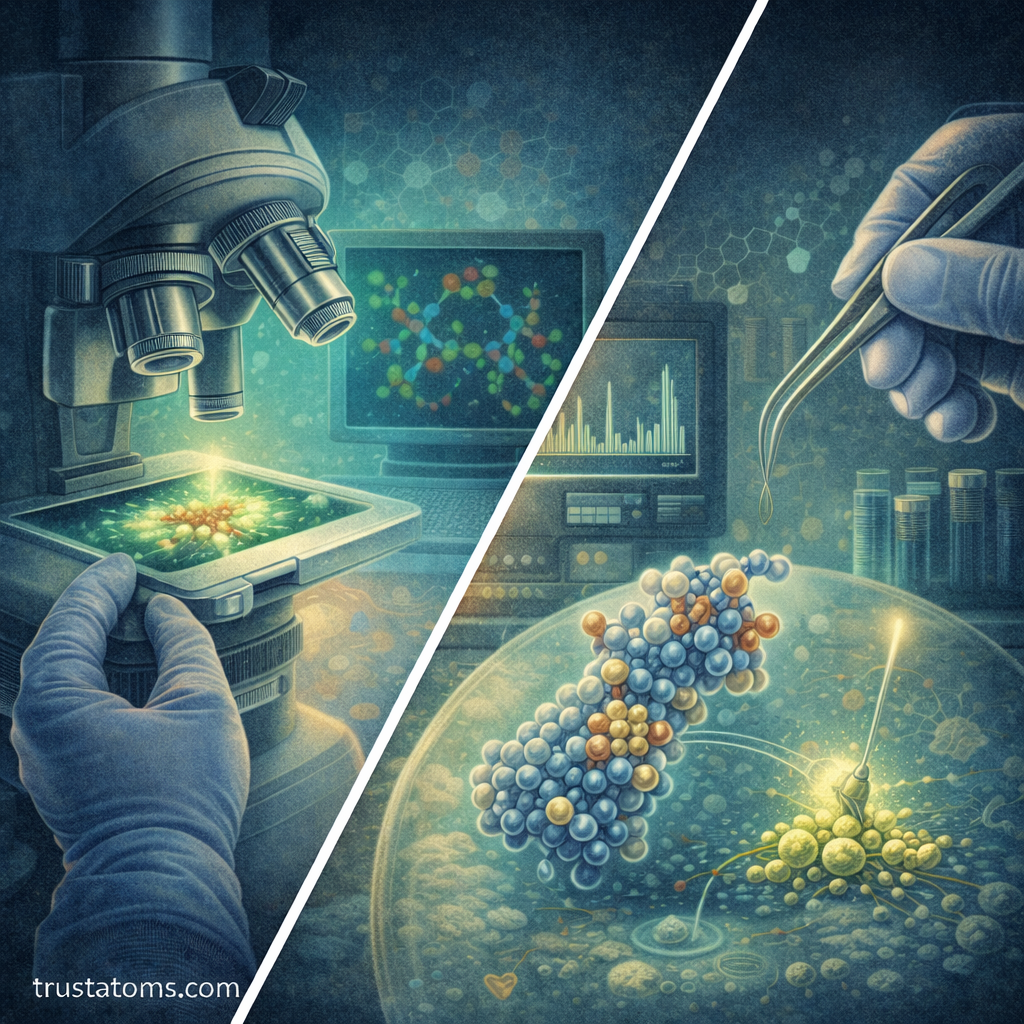
Scientists use a variety of experimental methods to study molecular behavior inside cells.
Spectroscopy
Spectroscopic techniques measure how molecules interact with light or electromagnetic radiation.
Common methods include:
- Fluorescence spectroscopy
- Infrared spectroscopy
- Nuclear magnetic resonance (NMR)
These techniques help researchers analyze molecular structure and dynamics.
Single-Molecule Imaging
Advanced imaging technologies allow scientists to observe individual molecules in real time.
This helps researchers study:
- Protein interactions
- Molecular movement inside cells
- Dynamic changes in biological structures
Atomic Force Microscopy
Atomic force microscopy (AFM) allows researchers to visualize and measure molecular structures at extremely small scales.
It can be used to:
- Measure molecular forces
- Study protein folding
- Examine cellular surfaces
Applications of Biophysical Chemistry
Biophysical chemistry contributes to many areas of modern biological research.
Drug Development
Understanding molecular interactions helps scientists design drugs that bind to specific targets.
Biophysical techniques help identify:
- Drug-binding sites on proteins
- Binding strength and stability
- Molecular mechanisms of drug action
Structural Biology
Biophysical chemistry supports structural studies of biological molecules.
These studies reveal how molecular structures influence function and interactions.
Synthetic Biology
Biophysical insights help scientists design engineered biological systems.
Applications include:
- Creating custom enzymes
- Designing metabolic pathways
- Engineering microbial systems for biotechnology
Challenges in Studying Cellular Biophysics
Despite major advances, studying molecular processes inside living cells remains challenging.
Cellular Complexity
Cells contain thousands of interacting molecules, making it difficult to isolate individual processes.
Dynamic Environments
Cellular conditions constantly change, including:
- Molecular concentrations
- Energy levels
- Environmental signals
These changes influence molecular behavior.
Measurement Limitations
Some molecular events occur at extremely small spatial and time scales, requiring highly sensitive instruments to observe.
Future Directions in Biophysical Chemistry
Biophysical chemistry continues to evolve with new technologies and computational tools.
Emerging areas of research include:
- AI-driven molecular modeling
- High-resolution live-cell imaging
- Computational simulations of cellular environments
- Integration with systems biology and molecular biology
These advances will help scientists build more detailed models of how molecular processes operate inside living cells.
Final Thoughts
Biophysical chemistry provides a powerful framework for understanding the physical and chemical principles that govern life at the molecular level. By combining physics, chemistry, and biology, researchers can explore how biomolecules behave within the crowded and dynamic environment of living cells.
From protein folding and enzyme catalysis to molecular transport and drug design, biophysical chemistry plays a critical role in explaining how cellular systems function.
As technology continues to advance, this field will remain essential for uncovering the fundamental mechanisms that drive biological processes.