Every object around you emits radiation.
A warm cup of coffee, a glowing stove coil, even your own body continuously radiate energy in the form of electromagnetic waves. This emission depends on temperature — and it follows remarkably precise physical laws.
The study of this phenomenon is called blackbody radiation, and it played a crucial role in the birth of modern physics.
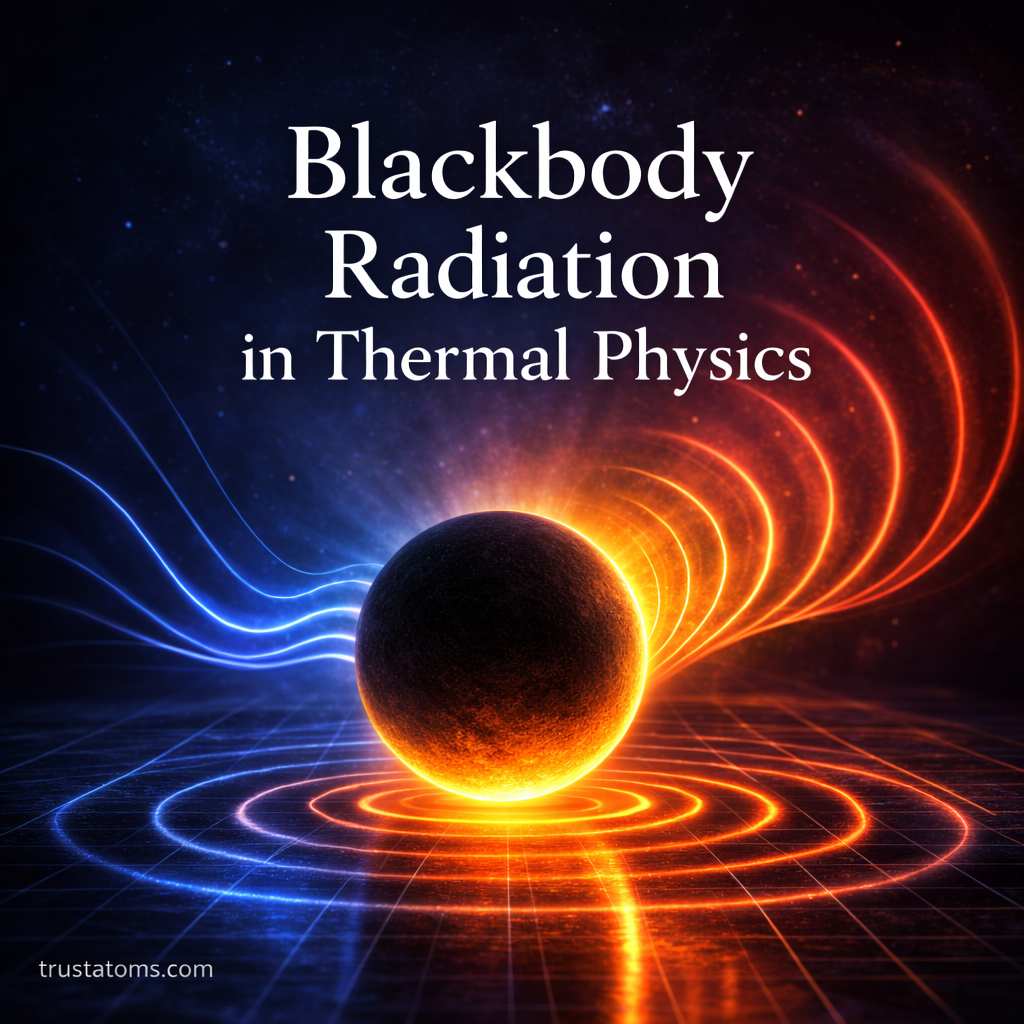
In this article, we’ll explore what blackbody radiation is, the laws that describe it, why classical physics failed to explain it, and how it led to quantum theory.
What Is a Blackbody?
A blackbody is an idealized object that:
- Absorbs all incoming radiation, regardless of wavelength
- Reflects no light
- Emits radiation purely based on its temperature
Despite the name, a blackbody does not always appear black.
If its temperature is high enough, it glows:
- Red at lower temperatures
- Yellow or white at moderate temperatures
- Blue-white at extremely high temperatures
A blackbody’s color reveals its temperature.
Why Blackbody Radiation Matters
Blackbody radiation is fundamental because it applies to:
- Stars (including the Sun)
- Heated metals
- Cosmic background radiation
- Everyday thermal objects
It allows physicists to determine temperature from emitted light alone — a technique used in astronomy, materials science, and engineering.
The Spectrum of Blackbody Radiation
A blackbody does not emit a single wavelength. Instead, it produces a continuous spectrum of radiation.
The shape of this spectrum depends entirely on temperature:
- As temperature increases, total emitted energy increases.
- The peak of the spectrum shifts to shorter wavelengths.
- Hotter objects emit more high-frequency radiation.
This behavior is predictable and governed by precise physical laws.
The Three Key Laws of Blackbody Radiation
1. Planck’s Law
Planck’s Law describes the full spectrum of radiation emitted at a given temperature.
It states that energy is emitted in discrete packets called quanta.
This law successfully explained the experimental observations that classical physics could not.
Planck’s work in 1900 marked the beginning of quantum theory.
2. Wien’s Displacement Law
Wien’s Law states:
As temperature increases, the peak wavelength decreases.
In simple terms:
- Hotter objects glow bluer.
- Cooler objects glow redder.
For example:
- A red-hot iron bar is cooler than a white-hot one.
- Blue stars are hotter than red stars.
This relationship allows astronomers to estimate a star’s surface temperature by analyzing its color.
3. Stefan–Boltzmann Law
This law states:
The total energy emitted per unit area increases rapidly with temperature.
More precisely, total emitted power is proportional to the fourth power of temperature.
This means:
- Doubling temperature increases energy output dramatically.
- Small temperature increases produce large changes in radiation.
This explains why stars, at extremely high temperatures, emit enormous amounts of energy.
The Ultraviolet Catastrophe
Before quantum theory, classical physics attempted to describe blackbody radiation using continuous energy assumptions.
The prediction was disastrous.
Classical models suggested that:
- Energy emitted at short wavelengths (ultraviolet) should be infinite.
- Hot objects should radiate unlimited high-frequency energy.
This contradiction with experimental evidence was called the ultraviolet catastrophe.
It showed that classical physics was incomplete.
The Quantum Solution
Max Planck resolved the problem by proposing a radical idea:
Energy is emitted in discrete packets (quanta), not continuously.
This quantization:
- Eliminated the ultraviolet catastrophe
- Matched experimental data perfectly
- Introduced the concept of Planck’s constant
Planck’s idea later inspired Einstein’s explanation of the photoelectric effect and helped launch quantum mechanics.
Blackbody radiation is therefore one of the foundational pillars of modern physics.
Real-World Examples of Blackbody Radiation
Blackbody radiation is not just theoretical. It appears in many real-world systems.
Stars
Stars approximate blackbodies.
Their temperature determines:
- Color
- Brightness
- Spectral distribution
Our Sun, with a surface temperature around 5,800 K, emits most strongly in visible light.
Cosmic Microwave Background (CMB)
The cosmic microwave background radiation is one of the most perfect blackbody spectra ever measured.
It represents leftover radiation from the early universe, when it was about 380,000 years old.
Its temperature today is approximately 2.7 K.
Everyday Thermal Radiation
Objects at room temperature emit infrared radiation.
Examples include:
- Human bodies
- Warm pavement
- Heated appliances
Infrared cameras detect this radiation to create thermal images.
Temperature and Color: A Simple Guide
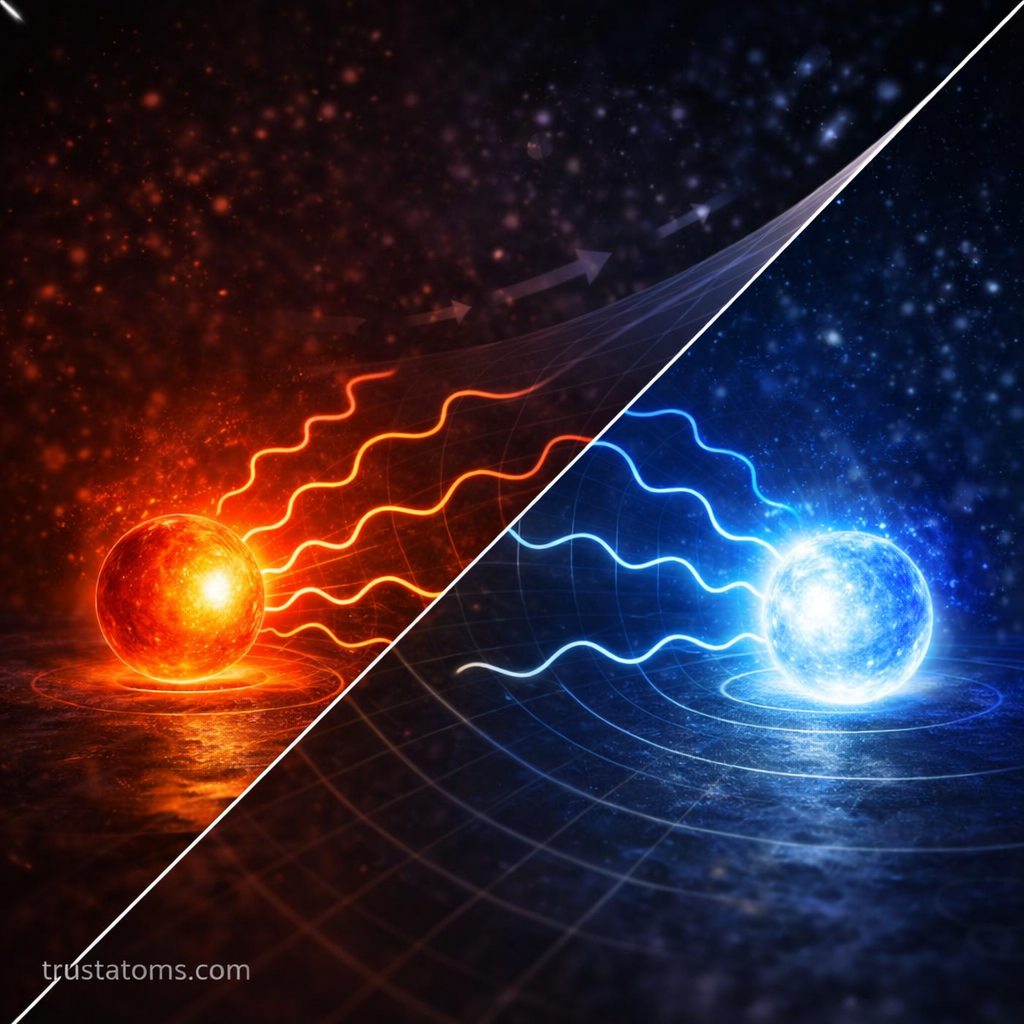
Here’s a simplified breakdown of how temperature affects emitted radiation:
- Below 800 K → Mostly infrared (invisible to human eyes)
- 800–1,500 K → Dull red glow
- 1,500–3,000 K → Orange to yellow
- 3,000–6,000 K → White
- Above 10,000 K → Blue-white
This progression explains everything from campfire embers to stellar classification.
Why Blackbody Radiation Changed Physics
Blackbody radiation forced physicists to rethink fundamental assumptions.
It revealed that:
- Energy is quantized.
- Classical wave theory was incomplete.
- Microscopic physics behaves differently than macroscopic intuition suggests.
Without blackbody radiation research, quantum mechanics might not have developed when it did.
It stands at the crossroads of thermodynamics, electromagnetism, and quantum physics.
Final Thoughts
Blackbody radiation may seem like a narrow topic in thermal physics, but it reshaped science.
It explains:
- Why stars shine the way they do
- How we measure temperature remotely
- Why quantum mechanics became necessary
At its core, blackbody radiation shows that temperature and light are deeply connected — and that even simple glowing objects can reveal profound truths about the universe.