Boltzmann statistics explains how particles distribute themselves among different energy levels in a system at thermal equilibrium. It is one of the cornerstones of statistical physics and provides the bridge between microscopic particle behavior and macroscopic thermodynamic properties.
Whether describing gas molecules, atoms in a solid, or particles in a plasma, Boltzmann statistics helps answer a fundamental question:
How likely is a particle to occupy a particular energy state?
In this guide, we’ll break down what Boltzmann statistics is, how energy distributions emerge, and why this concept is essential across physics and chemistry.
The Big Idea Behind Boltzmann Statistics
In any system at a nonzero temperature:
- Particles are constantly moving.
- They collide and exchange energy.
- They do not all have the same energy.
Instead, their energies follow a predictable probability distribution.
Boltzmann statistics applies to:
- Classical particles
- Distinguishable particles
- Systems where quantum effects are negligible
It describes the probability that a particle occupies a state with a given energy at thermal equilibrium.
Energy States and Probability
In statistical physics, particles can occupy discrete or continuous energy levels.
Boltzmann statistics states that:
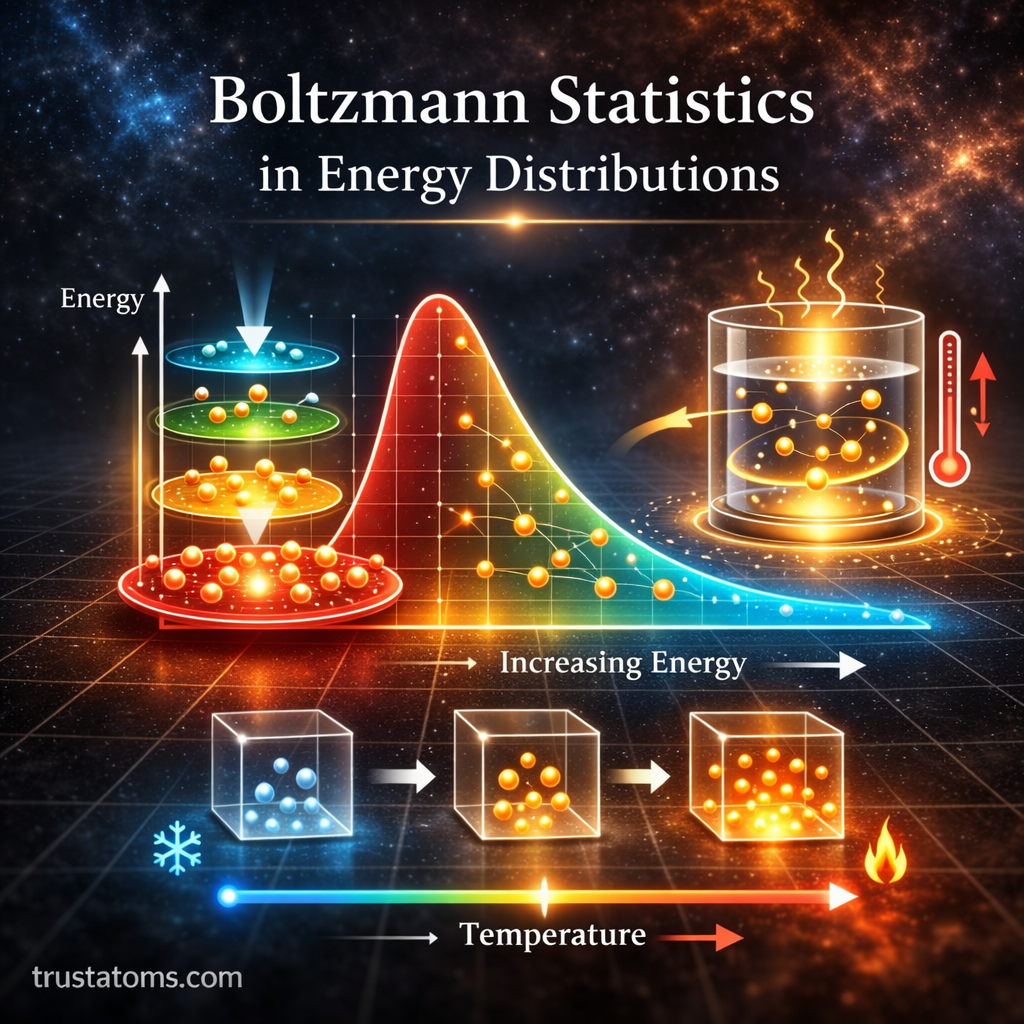
- Lower energy states are more probable.
- Higher energy states are less probable.
- The probability decreases exponentially with energy.
This exponential behavior is the defining feature of the Boltzmann distribution.
In simple terms:
As energy increases, probability drops rapidly.
This explains why most particles in a system cluster around lower energies while only a few occupy very high-energy states.
The Boltzmann Factor
At the heart of Boltzmann statistics is the Boltzmann factor.
The Boltzmann factor determines the relative probability of a state based on:
- Its energy
- The system’s temperature
It has three key implications:
- Higher energy → lower probability
- Higher temperature → higher probability of excited states
- At very low temperatures → most particles occupy the lowest energy states
Temperature plays a central role because it controls how easily particles can access higher energy levels.
Physical Meaning of Temperature
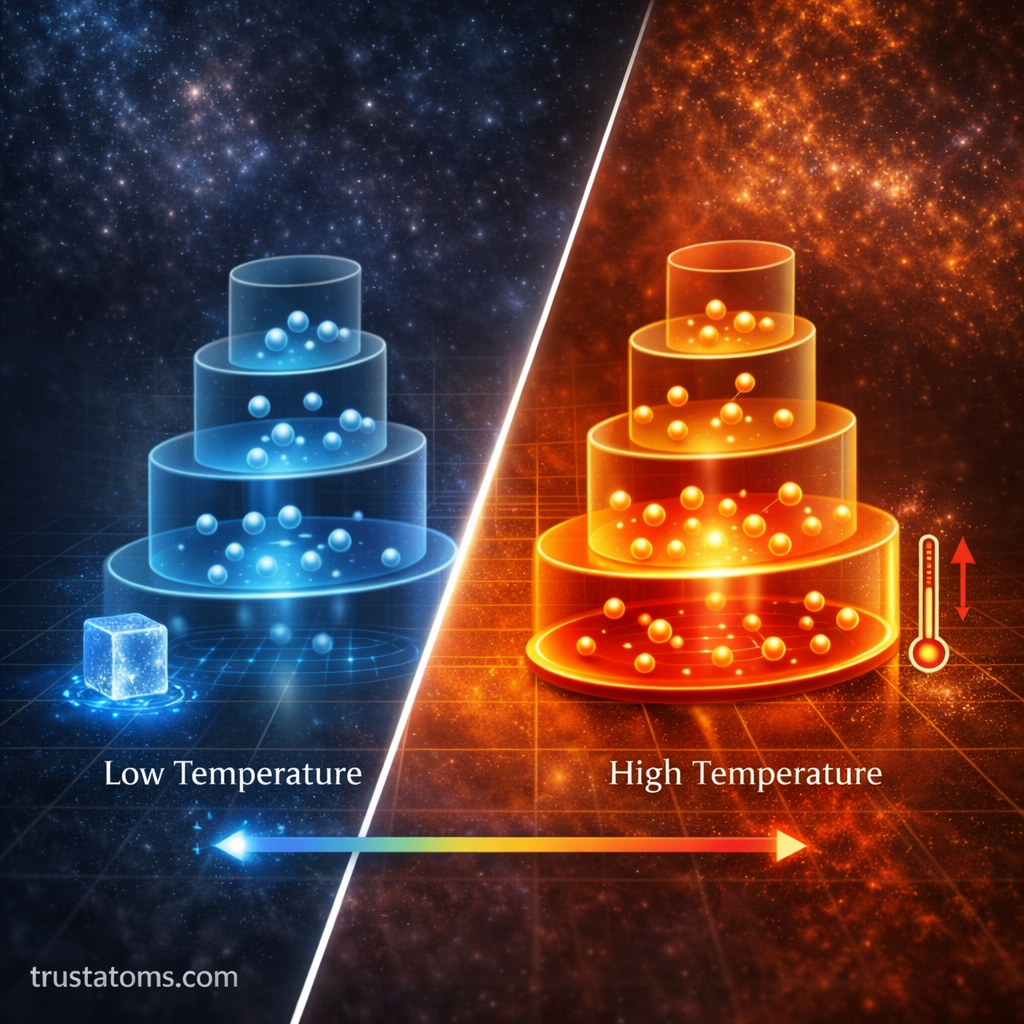
Temperature in statistical physics is not just a measure of “hotness.”
It represents:
- The average energy per particle
- The degree of energy fluctuations
- The likelihood of occupying excited states
As temperature increases:
- Energy spreads across more states
- The distribution becomes broader
- More particles occupy higher energy levels
At very high temperatures, energy states become more evenly populated.
Maxwell–Boltzmann Distribution for Gases
For ideal gases, Boltzmann statistics leads to the Maxwell–Boltzmann distribution.
This distribution describes how particle speeds are spread out in a gas at equilibrium.
Key features of the speed distribution:
- Most particles move at a moderate speed
- Fewer particles move very slowly
- Very few particles move extremely fast
The curve has a distinct peak, representing the most probable speed.
As temperature increases:
- The peak shifts to higher speeds
- The distribution spreads out
- Average kinetic energy increases
This explains why gases expand and pressure increases as temperature rises.
Applications of Boltzmann Statistics
Boltzmann statistics appears in many areas of physics.
1. Chemical Reactions
Reaction rates depend on:
- The number of molecules with enough energy to overcome an energy barrier
Only particles in the high-energy tail of the distribution can react.
This explains why reactions speed up at higher temperatures.
2. Semiconductor Physics
In semiconductors:
- Electrons occupy energy bands
- Thermal energy promotes electrons to higher energy levels
Boltzmann statistics predicts how many electrons are thermally excited.
3. Astrophysics
In stars and plasmas:
- Particle energies follow Boltzmann-like distributions
- Ionization states depend on temperature
Understanding energy distributions helps explain stellar structure and radiation.
4. Atmospheric Physics
The distribution of molecular speeds determines:
- Gas pressure
- Diffusion rates
- Escape of atmospheric particles
Boltzmann statistics explains why lighter gases escape planetary atmospheres more easily.
When Boltzmann Statistics Does Not Apply
Boltzmann statistics works well for classical systems. However, it breaks down when:
- Particles are indistinguishable
- Quantum effects dominate
- Particle densities are very high
In those cases, we use:
- Fermi–Dirac statistics (for fermions)
- Bose–Einstein statistics (for bosons)
These quantum statistics modify the energy distribution at very low temperatures or high densities.
Why the Exponential Distribution Matters
The exponential form of the Boltzmann distribution explains several fundamental principles:
- Systems naturally move toward lower energy states
- High-energy states are rare
- Thermal equilibrium is predictable
This exponential dependence is what makes statistical mechanics powerful and mathematically consistent.
It allows physicists to calculate:
- Entropy
- Free energy
- Pressure
- Heat capacity
All from probability considerations.
The Role of Entropy
Boltzmann’s famous insight connects entropy to probability.
Entropy increases when:
- More microstates are accessible
- Energy is distributed more widely
- The system becomes more disordered
Boltzmann statistics provides the microscopic foundation for the Second Law of Thermodynamics.
Systems evolve toward the most probable distribution of energy.
Key Takeaways
Boltzmann statistics describes how particles distribute themselves among energy levels at thermal equilibrium.
Its central principles:
- Probability decreases exponentially with energy
- Temperature controls how energy spreads
- Most particles occupy low-energy states
- High-energy states are rare but crucial for reactions
It explains:
- Gas behavior
- Reaction rates
- Thermal excitation
- Energy fluctuations
Without Boltzmann statistics, modern physics and chemistry would lack their microscopic foundation.
At its core, Boltzmann statistics reveals a powerful truth:
Macroscopic order emerges from probabilistic microscopic behavior.