In classical physics, particles are treated as distinguishable and independent. But at very small scales — especially at low temperatures or high densities — nature behaves differently.
Particles become indistinguishable, and quantum effects dominate.
This is where Bose–Einstein and Fermi–Dirac statistics replace classical Boltzmann statistics. These two quantum statistical frameworks explain how particles distribute themselves among energy states when quantum mechanics cannot be ignored.
Understanding these statistics is essential for modern physics, from semiconductors to neutron stars.
Why Classical Statistics Break Down
Boltzmann statistics works well when:
- Particle densities are low
- Temperatures are high
- Quantum effects are negligible
However, at very low temperatures or very high densities:
- Particles’ wavefunctions overlap
- Indistinguishability becomes important
- Quantum rules restrict how states can be occupied
Two types of particles behave in fundamentally different ways:
- Bosons
- Fermions
Their behavior is governed by two different statistical laws.
Bosons and Bose–Einstein Statistics
Bosons are particles with integer spin (0, 1, 2, …).
Examples include:
- Photons
- Gluons
- Higgs bosons
- Helium-4 atoms (as composite bosons)
Bosons obey Bose–Einstein statistics.
Key Property of Bosons
Multiple bosons can occupy the same quantum state.
There is no restriction on how many identical bosons can share a single energy level.
This leads to remarkable physical phenomena.
Bose–Einstein Distribution
In Bose–Einstein statistics:
- Low-energy states become highly populated at low temperatures
- Particles tend to “cluster” in the same state
- The probability of occupation increases as energy decreases
Unlike classical statistics, there is no exclusion principle limiting occupancy.
At extremely low temperatures, something extraordinary happens.
Bose–Einstein Condensation
When a gas of bosons is cooled close to absolute zero:
- A large fraction of particles collapses into the lowest energy state
- The particles behave as a single quantum entity
- Quantum effects become visible on a macroscopic scale
This phenomenon is called a Bose–Einstein condensate (BEC).
In a BEC:
- Matter behaves like a coherent wave
- Superfluidity can emerge
- Resistance-free flow becomes possible
Bose–Einstein condensation was experimentally observed in 1995 using ultracold atomic gases.
Fermions and Fermi–Dirac Statistics
Fermions are particles with half-integer spin (1/2, 3/2, …).
Examples include:
- Electrons
- Protons
- Neutrons
- Quarks
Fermions obey Fermi–Dirac statistics.
Key Property of Fermions
Fermions obey the Pauli exclusion principle.
No two identical fermions can occupy the same quantum state simultaneously.
This single rule changes everything.
Fermi–Dirac Distribution
In Fermi–Dirac statistics:
- Each energy state can hold at most one particle (per spin state)
- Lower energy states fill up first
- A sharp boundary forms at low temperatures
This boundary is called the Fermi energy.
At absolute zero:
- All states below the Fermi energy are filled
- All states above it are empty
As temperature increases:
- The boundary becomes slightly smeared
- Some particles gain energy above the Fermi level
But the exclusion principle always applies.
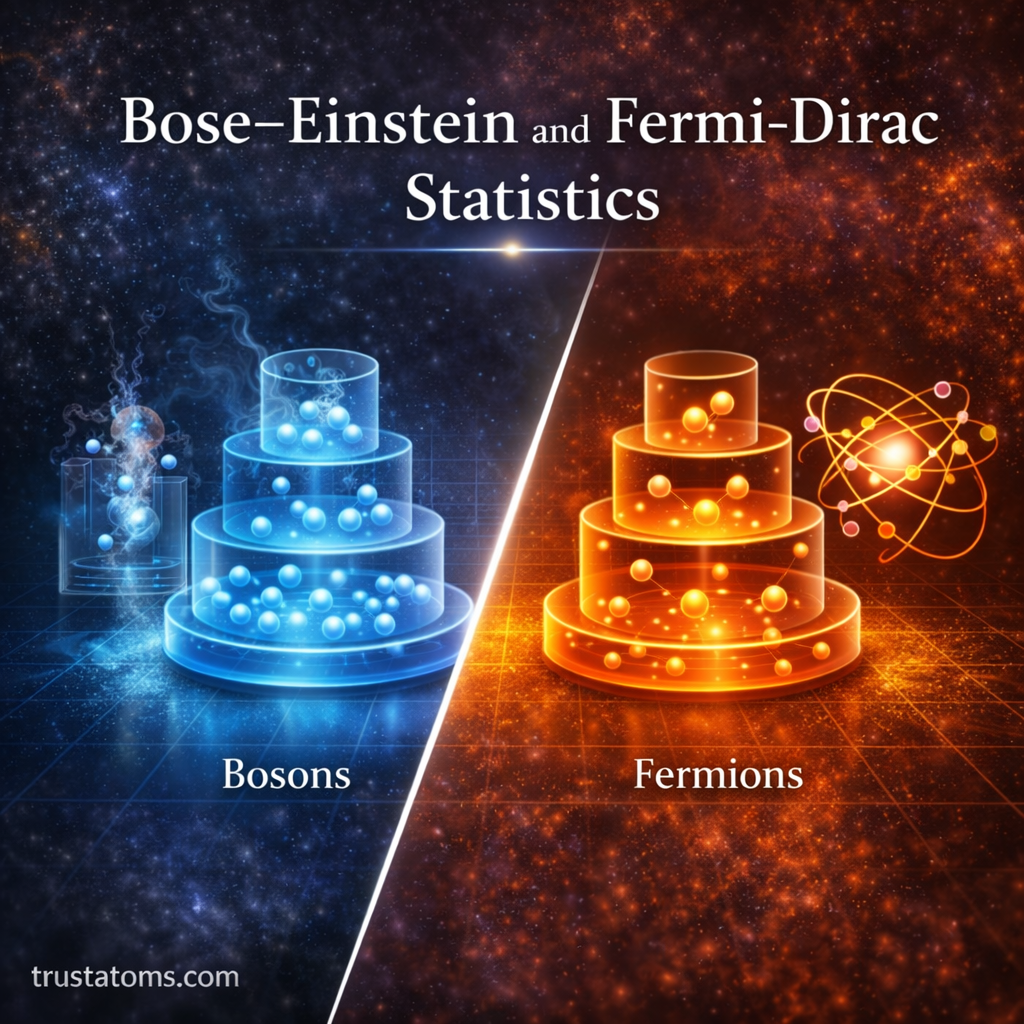
Comparing Bose–Einstein and Fermi–Dirac Statistics
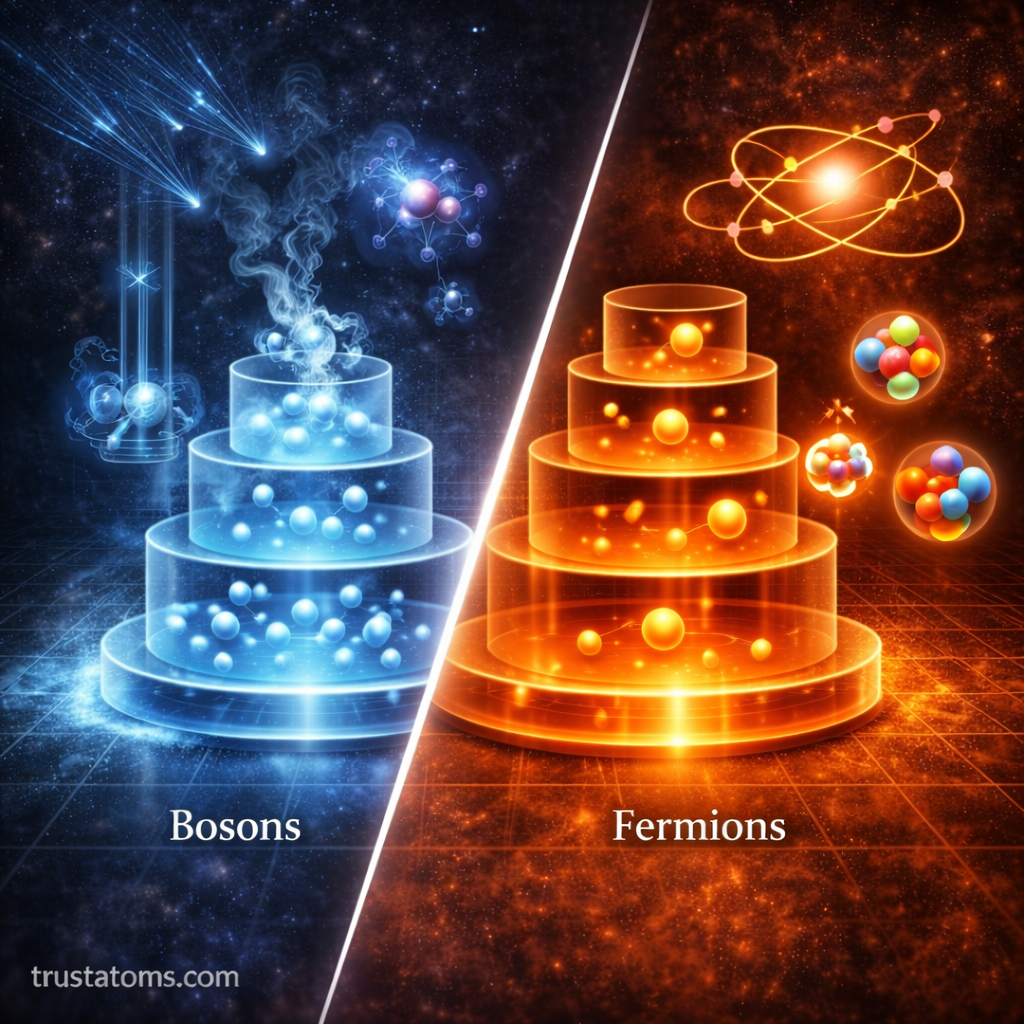
Here’s the fundamental difference:
Bosons
- Can share states
- Tend to cluster
- Enable condensation
Fermions
- Cannot share states
- Fill energy levels one by one
- Create degeneracy pressure
These differences produce dramatically different physical outcomes.
Why Quantum Statistics Matter
Quantum statistics explains phenomena that classical physics cannot.
1. Structure of Atoms
Electrons are fermions.
Because of the exclusion principle:
- Electrons occupy distinct energy levels
- Atoms have structure
- Chemistry exists
Without Fermi–Dirac statistics, matter would collapse.
2. Stability of Matter
The exclusion principle creates a type of pressure called degeneracy pressure.
This pressure:
- Prevents electrons from collapsing into the nucleus
- Supports white dwarf stars
- Supports neutron stars
Without it, stars and matter itself would behave completely differently.
3. Superfluidity and Superconductivity
Bosonic behavior allows:
- Superfluid helium
- Zero-resistance superconductors (through paired electrons acting as composite bosons)
These effects arise from Bose–Einstein-like collective behavior.
4. Blackbody Radiation
Photons are bosons.
Their distribution follows Bose–Einstein statistics.
This explains:
- The spectrum of thermal radiation
- The cosmic microwave background
- Stellar radiation curves
The Role of Temperature
Temperature determines how quantum statistics manifests.
At high temperatures:
- Both distributions approach classical Boltzmann behavior
- Differences become negligible
At low temperatures:
- Bose–Einstein condensation may occur
- Fermi degeneracy becomes dominant
Quantum effects emerge most strongly when thermal energy is small compared to particle energy spacing.
The Fermi Energy and Degeneracy
In systems of fermions:
- The Fermi energy sets the scale of particle behavior
- Even at zero temperature, fermions possess kinetic energy
- This residual energy is called zero-point energy
This explains why:
- Metals conduct electricity
- White dwarfs resist gravitational collapse
- Neutron stars are incredibly dense
The exclusion principle creates structural stability at every scale.
When Do We Use Each Statistic?
Use Bose–Einstein statistics when:
- Particles are bosons
- Quantum overlap is significant
- Temperature is low
Use Fermi–Dirac statistics when:
- Particles are fermions
- The exclusion principle applies
- Density is high or temperature is low
Use Boltzmann statistics when:
- Quantum effects are negligible
- Particles are sparse
- Temperature is relatively high
Key Takeaways
Bose–Einstein and Fermi–Dirac statistics describe how quantum particles distribute energy.
Their core difference:
- Bosons can share states
- Fermions cannot
This leads to:
- Bose–Einstein condensation
- Degeneracy pressure
- Atomic structure
- Stellar stability
Together, these two statistical laws form the foundation of quantum statistical mechanics.
They reveal a profound truth:
The rules governing microscopic identity shape the structure of the entire universe.