Plants play a critical role in Earth’s ecosystems by converting atmospheric carbon dioxide into organic molecules that support life. One of the key processes that makes this possible is carbon fixation.
Carbon fixation is the step in plant metabolism where inorganic carbon from carbon dioxide (CO₂) is incorporated into organic molecules. This process allows plants to build sugars, which provide energy for growth, reproduction, and cellular maintenance.
Carbon fixation occurs during the Calvin cycle, the second major stage of photosynthesis that follows the light reactions. Together, these processes enable plants to transform sunlight and carbon dioxide into the chemical energy that fuels nearly all life on Earth.
What Is Carbon Fixation?
Carbon fixation refers to the conversion of inorganic carbon dioxide into organic carbon compounds inside living cells.
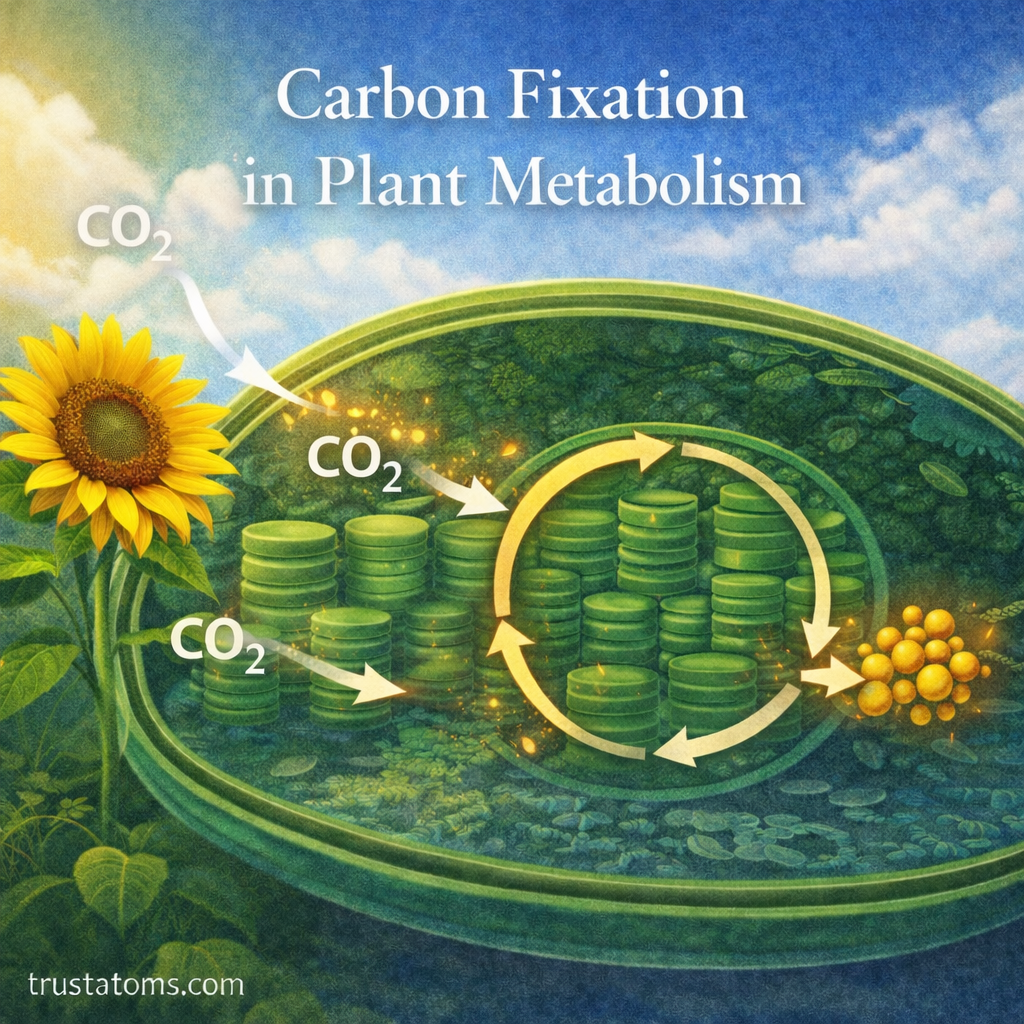
Plants take in carbon dioxide from the atmosphere through tiny openings in their leaves called stomata. Once inside the leaf, carbon dioxide enters the chloroplasts where it becomes part of a series of biochemical reactions.
The end goal of carbon fixation is to produce glucose and other carbohydrates, which plants use as both energy sources and structural building blocks.
These sugars are used to:
- Power cellular metabolism
- Build plant tissues
- Store energy
- Provide nutrients for animals and other organisms
Without carbon fixation, the carbon cycle and most food webs would collapse.
Where Carbon Fixation Occurs
Carbon fixation occurs inside chloroplasts, the same organelles where photosynthesis begins.
Within chloroplasts are two main regions:
- Thylakoid membranes – where the light reactions take place
- Stroma – the fluid-filled region where carbon fixation occurs
The Calvin cycle reactions take place in the stroma, using energy-rich molecules produced during the light reactions.
These molecules include:
- ATP, which provides energy
- NADPH, which provides high-energy electrons
Together, they drive the chemical reactions that convert carbon dioxide into organic molecules.
The Calvin Cycle: The Engine of Carbon Fixation
Carbon fixation occurs through a sequence of reactions known as the Calvin cycle.
The Calvin cycle operates continuously in the chloroplast stroma when ATP and NADPH are available.
The cycle can be divided into three main phases:
- Carbon fixation
- Reduction
- Regeneration of the starting molecule
Phase 1: Carbon Fixation
The first step involves attaching carbon dioxide to a five-carbon molecule called ribulose-1,5-bisphosphate (RuBP).
This reaction is catalyzed by the enzyme RuBisCO, one of the most abundant enzymes on Earth.
During this step:
- CO₂ combines with RuBP
- The unstable intermediate splits into two molecules of 3-phosphoglycerate (3-PGA)
This step effectively locks atmospheric carbon into organic molecules.
Phase 2: Reduction
In the second stage, ATP and NADPH produced in the light reactions provide energy and electrons.
These molecules help convert 3-PGA into glyceraldehyde-3-phosphate (G3P), a three-carbon sugar.
Some G3P molecules are used to:
- Produce glucose
- Build starch and cellulose
- Form other carbohydrates needed for plant growth
This stage is where energy from sunlight becomes stored in chemical bonds.
Phase 3: Regeneration of RuBP
To keep the cycle running, the original carbon-accepting molecule RuBP must be regenerated.
Most of the G3P produced during the cycle is used to rebuild RuBP.
ATP provides the energy required for this regeneration process.
Once RuBP is regenerated, the cycle can begin again with new carbon dioxide molecules.
Carbon Fixation and Glucose Production
Although the Calvin cycle produces G3P directly, this molecule can later be used to build glucose and other sugars.
Two G3P molecules combine to form glucose.
Plants then use glucose in several ways:
- Immediate energy through cellular respiration
- Storage as starch in roots, stems, and seeds
- Construction of cellulose for cell walls
- Production of other organic molecules
These compounds support plant metabolism and provide nutrients for organisms that consume plants.
The Importance of RuBisCO
The enzyme RuBisCO (ribulose-1,5-bisphosphate carboxylase/oxygenase) is central to carbon fixation.
RuBisCO catalyzes the first reaction in the Calvin cycle by attaching carbon dioxide to RuBP.
Although extremely abundant, RuBisCO is not a very efficient enzyme.
It sometimes reacts with oxygen instead of carbon dioxide, leading to a process known as photorespiration, which reduces photosynthetic efficiency.
Despite this limitation, RuBisCO remains essential for global carbon cycling.
Alternative Carbon Fixation Strategies
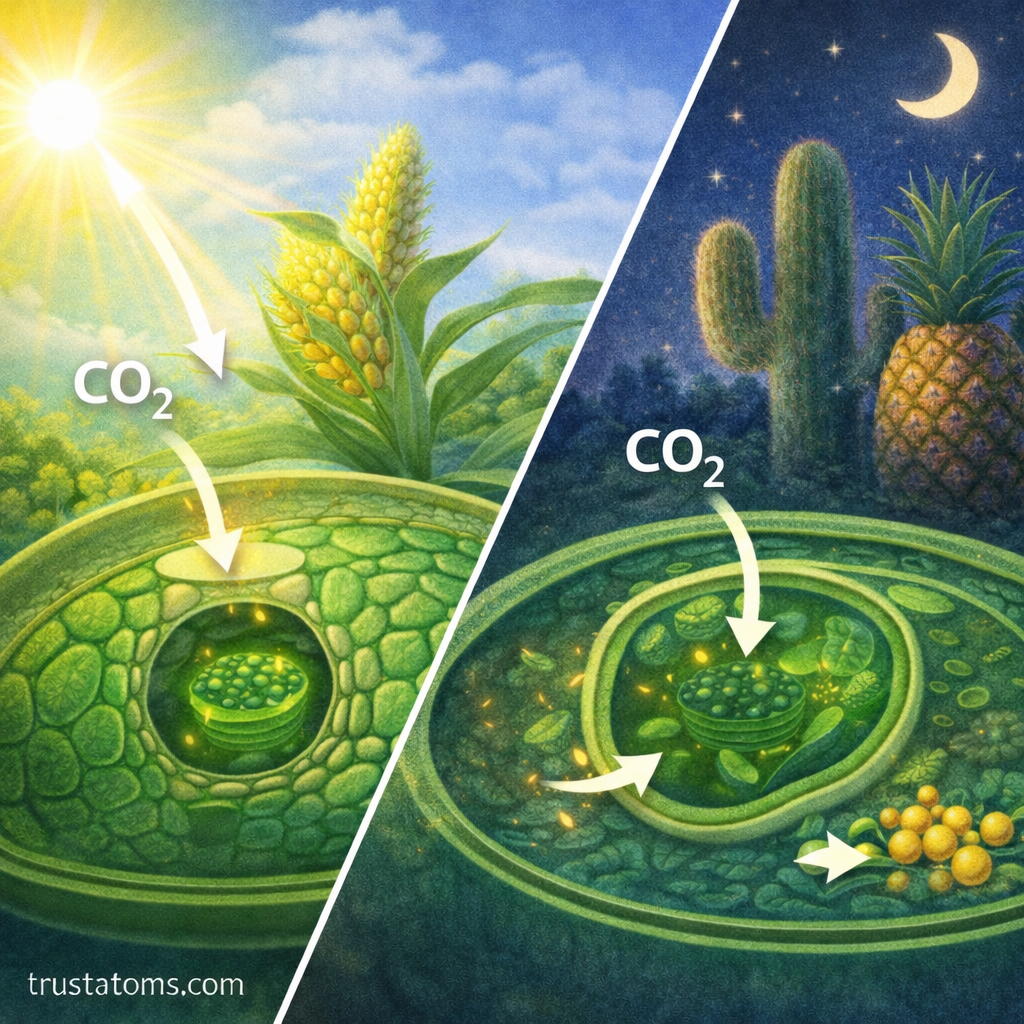
Some plants have evolved alternative pathways to improve carbon fixation efficiency, especially in hot or dry environments.
Two important adaptations are C4 photosynthesis and CAM photosynthesis.
C4 Photosynthesis
C4 plants separate carbon fixation and the Calvin cycle into different cell types.
This adaptation helps reduce photorespiration.
Examples of C4 plants include:
- Corn
- Sugarcane
- Sorghum
- Certain grasses
C4 plants are especially successful in warm climates.
CAM Photosynthesis
CAM (Crassulacean Acid Metabolism) plants fix carbon dioxide at night instead of during the day.
This adaptation reduces water loss in dry environments.
Examples include:
- Cacti
- Pineapple plants
- Many succulents
CAM plants store carbon dioxide overnight and release it for the Calvin cycle during the day.
Carbon Fixation and the Global Carbon Cycle
Carbon fixation is a major driver of the global carbon cycle.
Through photosynthesis, plants remove large amounts of carbon dioxide from the atmosphere.
This carbon becomes stored in:
- Plant biomass
- Soil organic matter
- Food chains
- Long-term carbon reservoirs
Over geological timescales, carbon fixation has helped regulate Earth’s climate by controlling atmospheric carbon dioxide levels.
Why Carbon Fixation Matters for Life on Earth
Carbon fixation is essential because it forms the foundation of the biological energy system.
This process:
- Converts atmospheric carbon into organic molecules
- Supports plant growth and ecosystem productivity
- Provides the base energy source for food chains
- Helps regulate global climate systems
Nearly all organisms depend on the sugars produced through plant carbon fixation either directly or indirectly.
Without this process, life as we know it could not exist.
Key Takeaways
- Carbon fixation converts atmospheric carbon dioxide into organic molecules.
- The process occurs during the Calvin cycle in the chloroplast stroma.
- The enzyme RuBisCO catalyzes the first step of carbon fixation.
- ATP and NADPH from the light reactions power the Calvin cycle.
- The cycle produces G3P, which can later form glucose.
- Some plants use alternative pathways like C4 and CAM photosynthesis to improve efficiency.
Carbon fixation is one of the most important biochemical processes on Earth, linking sunlight, atmospheric carbon, and the biological systems that sustain life.