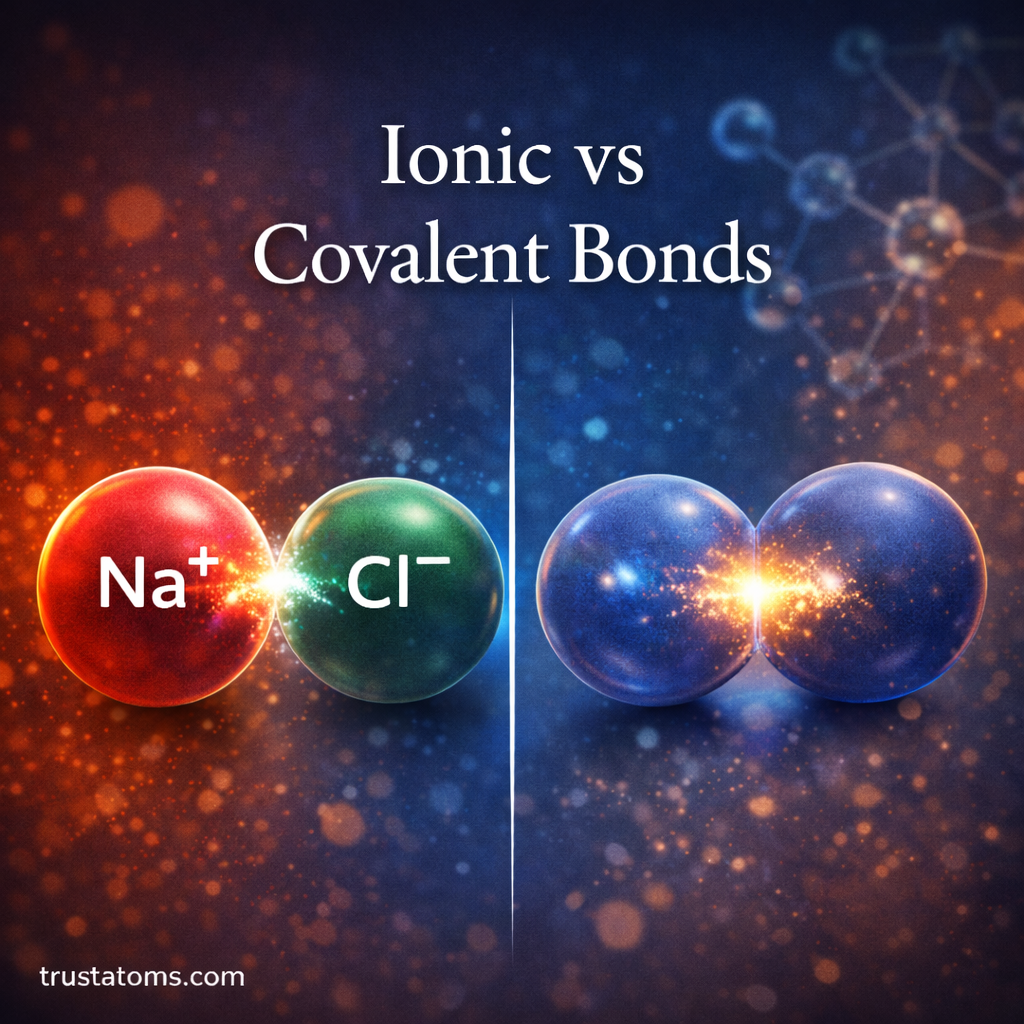
Ionic vs Covalent Bonds

Illustration comparing ionic and covalent bonds with simple atom diagrams and trustatoms.com watermark.
Visual comparison of ionic electron transfer and covalent electron sharing. trustatoms.com.

Ionic and covalent bonds are the two primary ways atoms join together to form compounds. While both involve electrons and the pursuit of stability, they differ in how those electrons behave.

Understanding ionic vs covalent bonds helps explain why salt dissolves in water, why metals conduct electricity, and why gases like oxygen exist as molecules. Let’s break down the key differences in a clear, simple way.

Continue reading “Ionic vs Covalent Bonds”
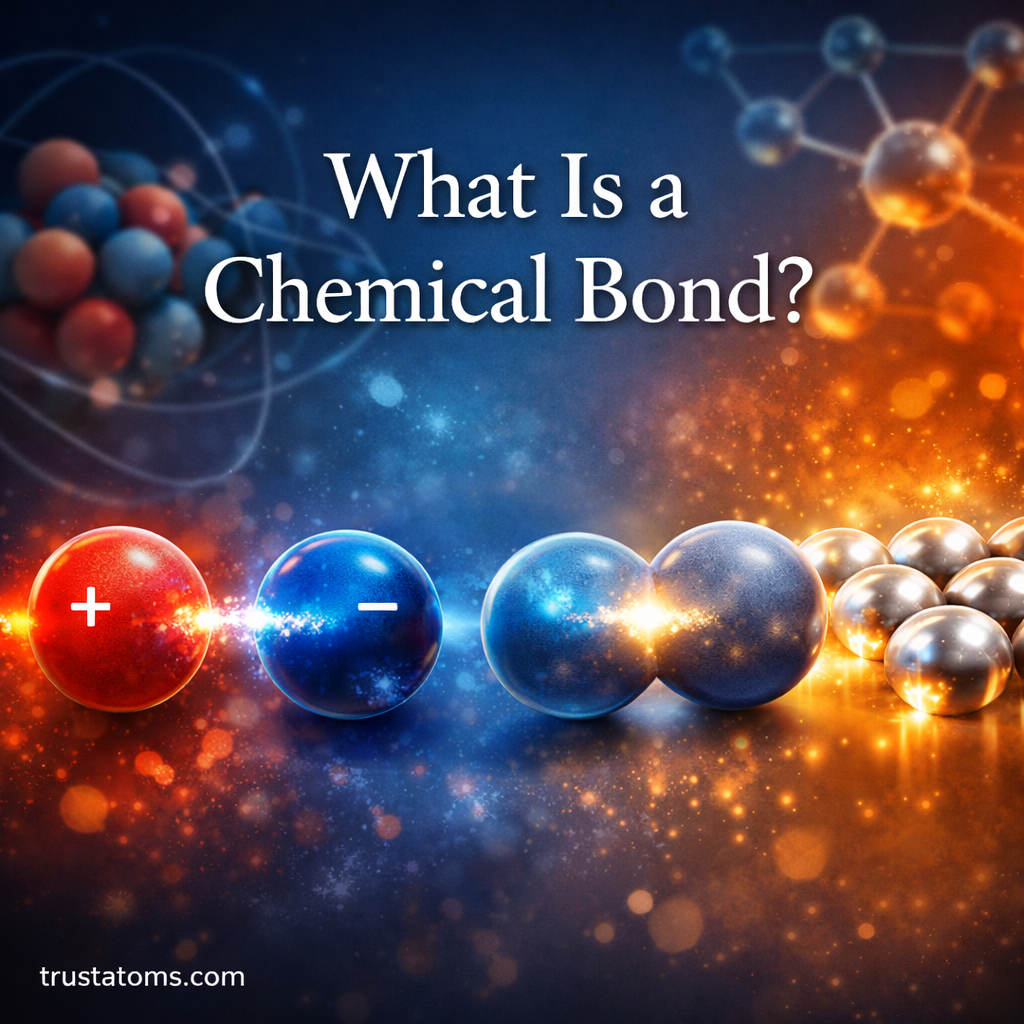
What Is a Chemical Bond?

Illustration explaining what a chemical bond is, showing simplified ionic, covalent, and metallic bonding with trustatoms.com watermark.
Simple visual overview of ionic, covalent, and metallic bonding types. trustatoms.com.

A chemical bond is the force that holds atoms together to form molecules and compounds. Without chemical bonds, matter as we know it would not exist — no water, no air, no cells, and no life.

At its core, a chemical bond forms because atoms seek a more stable, lower-energy arrangement of their electrons. By sharing, gaining, or losing electrons, atoms connect in predictable ways that create everything from simple gases to complex biological structures.

Continue reading “What Is a Chemical Bond?”

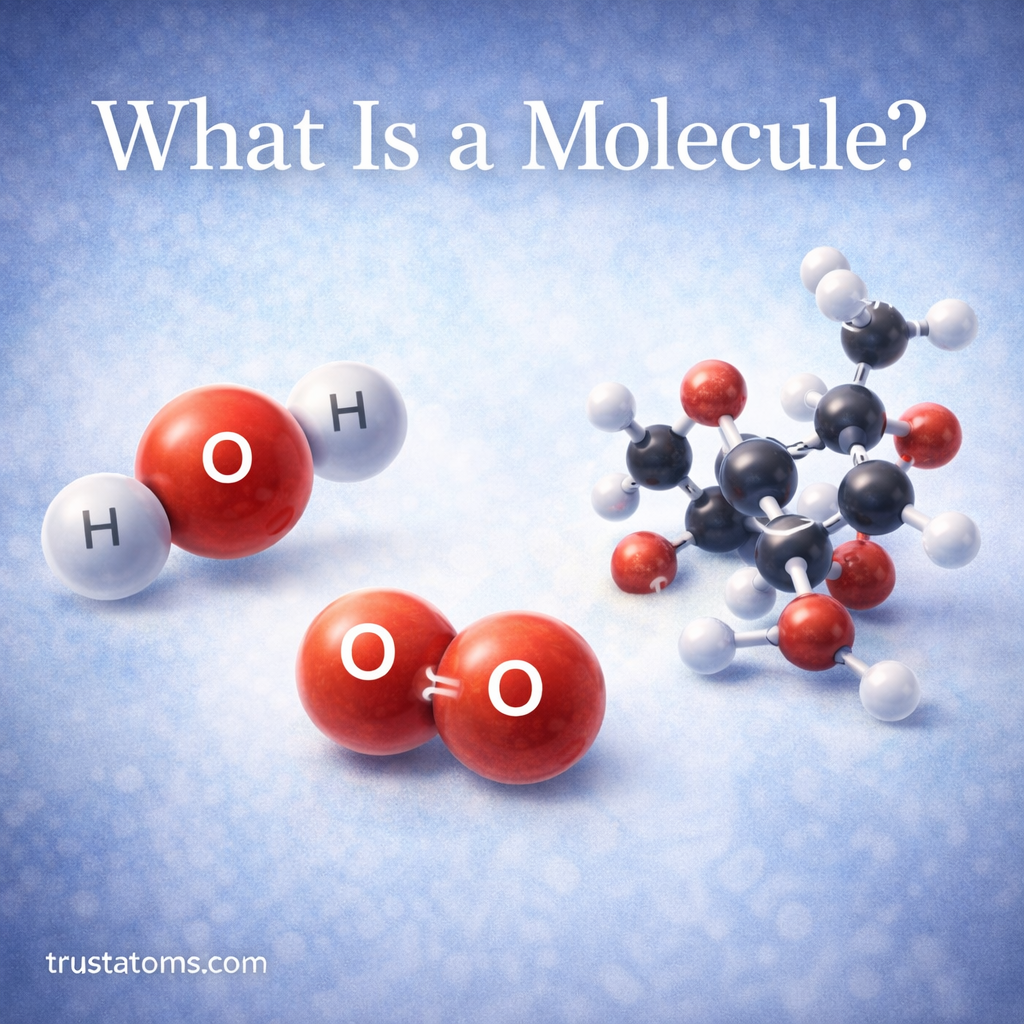
What Is a Molecule?

Educational molecule diagram showing water, oxygen, and a larger organic molecule with the title “What Is a Molecule?” and trustatoms.com watermark.
Simple molecular models showing how atoms bond together to form molecules. trustatoms.com

A molecule is formed when two or more atoms bond together. These bonded atoms act as a single unit and make up many of the substances around us — including water, oxygen, sugar, and carbon dioxide.

Understanding what a molecule is helps explain how matter is built, how chemical reactions work, and why substances have different properties.

Continue reading “What Is a Molecule?”

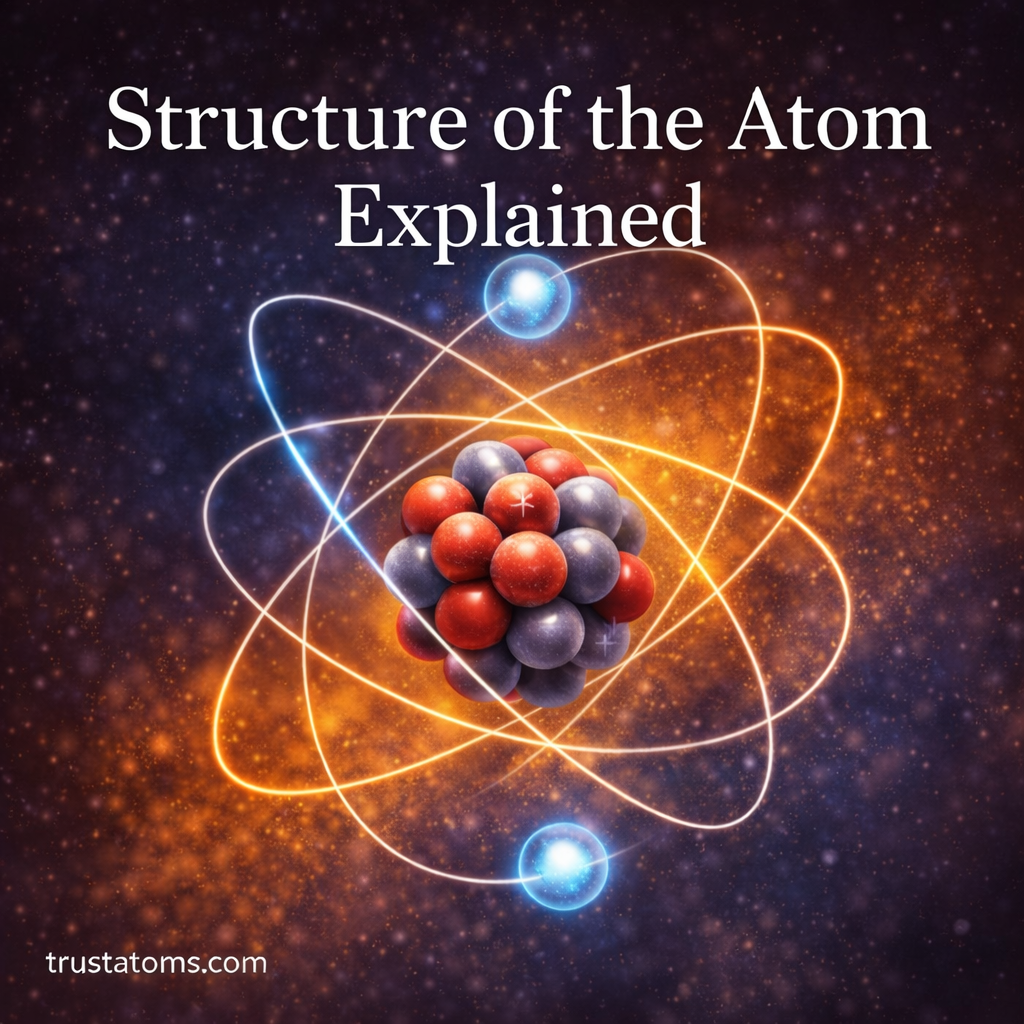
Structure of the Atom Explained

Educational atomic structure diagram showing a nucleus with protons and neutrons and electrons surrounding it, with the title “Structure of the Atom Explained” and trustatoms.com watermark.
A clear visual diagram showing the nucleus and electrons that make up the structure of an atom. trustatoms.com

Understanding the structure of the atom is one of the most important foundations in chemistry. Every substance — from water and air to metals and living cells — is made of atoms. But atoms aren’t solid, indivisible particles. They have internal structure.

In this guide, we’ll break down the structure of the atom in simple terms, explain how its parts work together, and show why atomic structure matters in chemistry.

Continue reading “Structure of the Atom Explained”

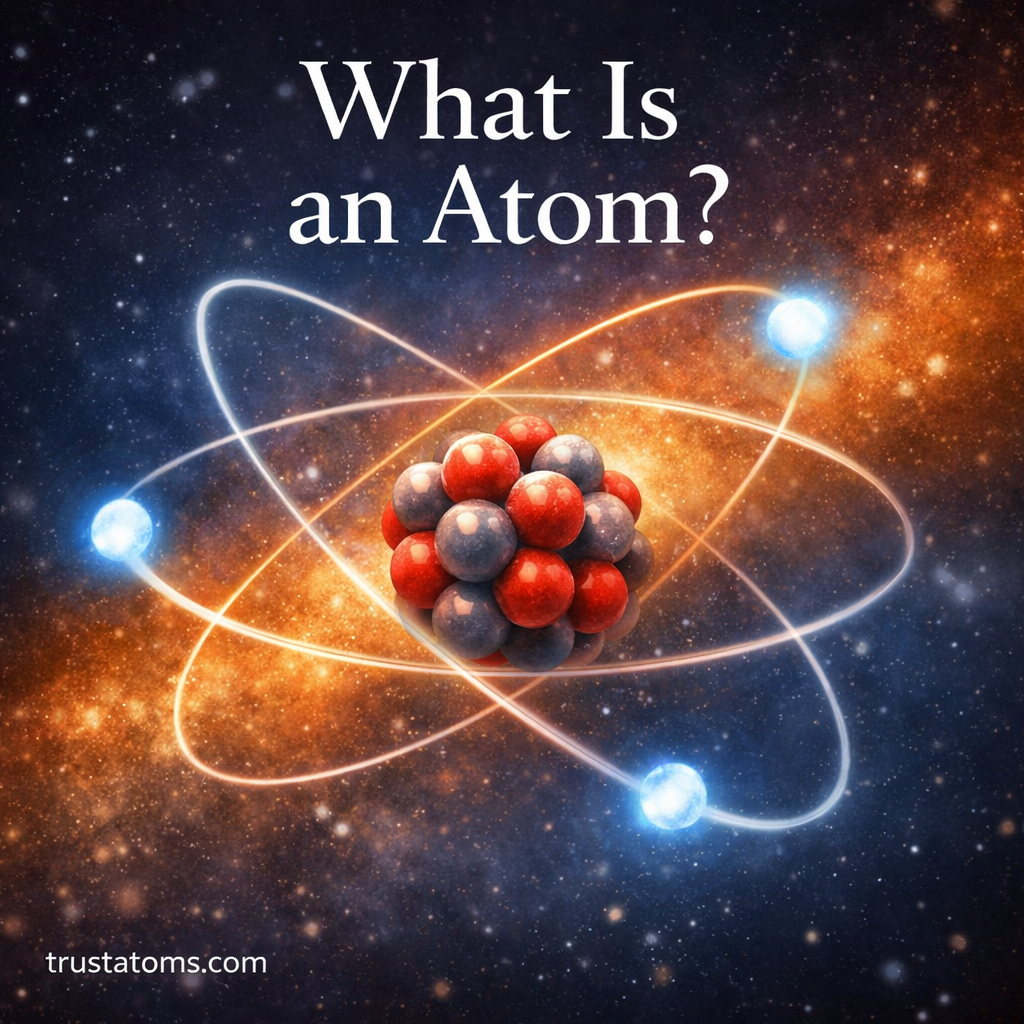
What Is an Atom?

Simple atomic structure illustration showing a nucleus with protons and neutrons and electrons orbiting, with the title “What Is an Atom?” and trustatoms.com watermark.
Simple atomic structure illustration explaining the basic components of an atom. trustatoms.com

Atoms are the fundamental building blocks of matter. Everything you can see, touch, and even breathe is made of atoms — from water and air to stars and living cells.

In chemistry, understanding what an atom is helps explain how substances form, why elements behave differently, and how chemical reactions occur. This article breaks down the concept of the atom in clear, simple terms.

Continue reading “What Is an Atom?”