Supramolecular Chemistry in Complex Systems

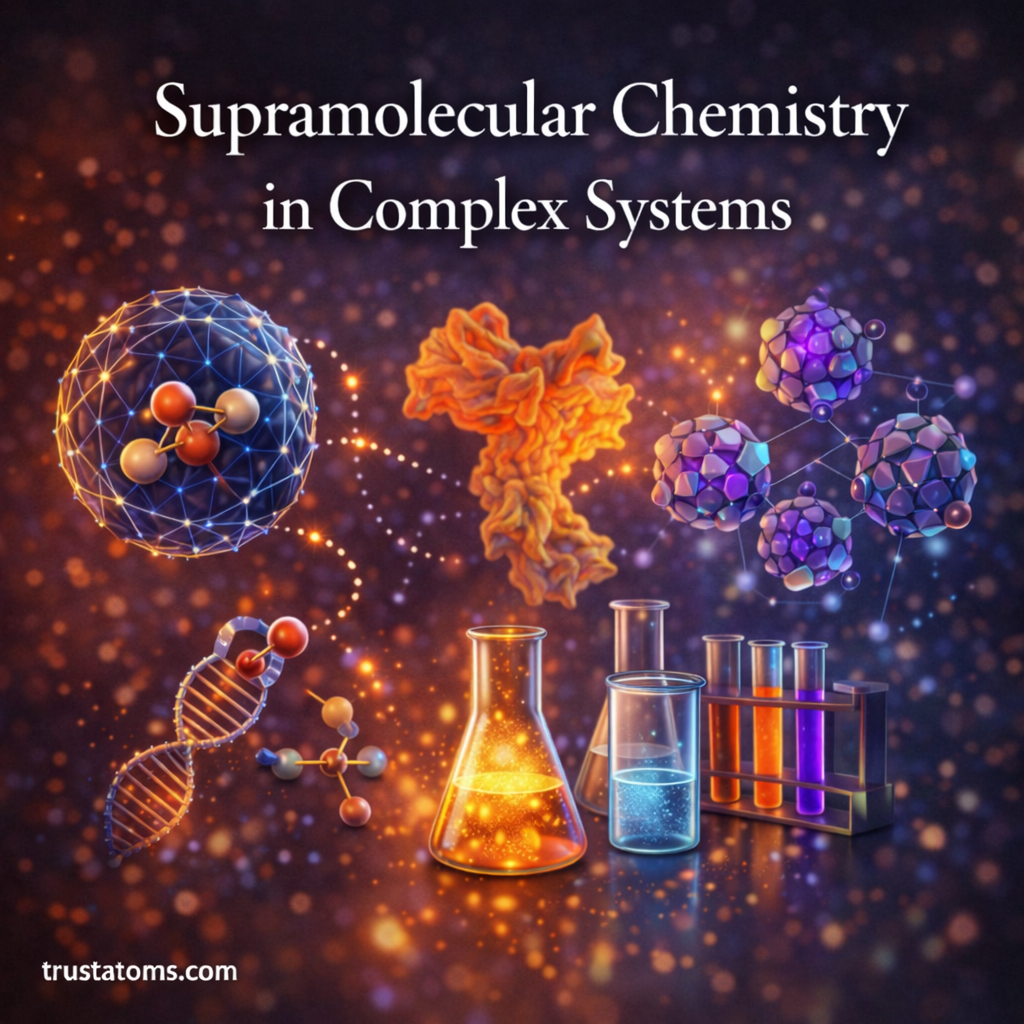
Illustration showing molecular self-assembly, host–guest complexes, and biological molecular structures representing supramolecular chemistry in complex systems. trustatoms.com.
Illustration representing molecular recognition, self-assembly, and supramolecular structures in complex chemical systems. trustatoms.com.

Supramolecular chemistry focuses on how molecules interact with one another through non-covalent forces rather than traditional chemical bonds. Instead of studying individual molecules alone, this field examines how groups of molecules assemble, organize, and function together in larger structures.

In complex systems, these molecular interactions can lead to highly organized arrangements such as molecular cages, host–guest complexes, self-assembled materials, and biological structures. Supramolecular chemistry plays an essential role in fields such as nanotechnology, drug delivery, materials science, and molecular biology.

Continue reading “Supramolecular Chemistry in Complex Systems”


Photochemistry in Molecular Excitation

Illustration showing light exciting a molecule and electron energy transitions representing photochemistry in molecular excitation. trustatoms.com.
Illustration showing light-driven molecular excitation and energy transitions in photochemistry. trustatoms.com.

Photochemistry is the study of chemical reactions and molecular changes triggered by light. When molecules absorb light energy, their electrons can become excited and move to higher energy levels. This process, known as molecular excitation, often leads to chemical reactions, energy transfer, or structural changes within the molecule.

Photochemistry plays a major role in natural processes such as photosynthesis and atmospheric chemistry, as well as modern technologies including solar cells, photodynamic therapy, and light-activated materials. Understanding how light interacts with molecules allows chemists to control and predict these reactions.

Continue reading “Photochemistry in Molecular Excitation”

Statistical Thermodynamics in Chemical Analysis

Illustration showing molecular structures, energy distribution curve, and laboratory equipment representing statistical thermodynamics in chemical analysis. trustatoms.com.
Illustration representing energy distributions and molecular behavior used in statistical thermodynamics for chemical analysis. trustatoms.com.

Statistical thermodynamics connects microscopic molecular behavior with the macroscopic properties we observe in chemical systems. While classical thermodynamics focuses on bulk measurements such as temperature, pressure, and energy, statistical thermodynamics explains these properties by analyzing the behavior of individual atoms and molecules.

In chemical analysis, this approach allows scientists to understand reaction probabilities, molecular energy distributions, and equilibrium behavior. By combining probability theory with thermodynamics, statistical thermodynamics provides powerful tools for predicting chemical processes and interpreting experimental data.

Continue reading “Statistical Thermodynamics in Chemical Analysis”

Quantum Mechanical Models in Molecular Systems

Illustration showing molecular structures and electron clouds representing quantum mechanical models in molecular systems with trustatoms.com watermark.
Illustration representing quantum mechanical models and electron behavior in molecular systems. trustatoms.com.

Quantum mechanics plays a central role in modern chemistry. While classical models can explain many everyday chemical behaviors, they fail when describing the microscopic world of atoms and molecules. Quantum mechanical models provide the framework scientists use to understand how electrons behave, how chemical bonds form, and how molecules interact.

In molecular systems, these models help explain properties such as molecular shape, reactivity, energy levels, and spectroscopy. By applying quantum principles, chemists can predict molecular behavior with remarkable accuracy.

Continue reading “Quantum Mechanical Models in Molecular Systems”

Density Functional Theory in Quantum Chemistry

Illustration showing electron density visualization and molecular modeling representing Density Functional Theory in quantum chemistry.
Illustration representing Density Functional Theory in quantum chemistry, highlighting electron density visualization and computational molecular modeling. trustatoms.com.

Understanding how electrons behave inside atoms and molecules is one of the most challenging problems in chemistry. Because electrons interact with each other and move according to the laws of quantum mechanics, accurately predicting their behavior requires advanced mathematical models.

One of the most widely used approaches for studying electronic structure is Density Functional Theory (DFT). DFT allows scientists to calculate the properties of atoms, molecules, and materials by focusing on electron density rather than tracking each electron individually.

Today, Density Functional Theory plays a central role in quantum chemistry, materials science, nanotechnology, and molecular physics. It allows researchers to investigate chemical systems with high accuracy while keeping computational costs manageable.

Continue reading “Density Functional Theory in Quantum Chemistry”

Advanced Inorganic Frameworks in Materials Science

Illustration showing structured inorganic framework materials such as lattice networks used in advanced materials science.
Illustration depicting advanced inorganic frameworks used in materials science, highlighting structured lattice networks and engineered material architectures. trustatoms.com.

Modern materials science increasingly relies on complex inorganic structures that provide unique physical, chemical, and mechanical properties. Among these structures, advanced inorganic frameworks have become essential for designing materials with precise functions at the molecular and atomic scale.

These frameworks consist of metal atoms or clusters connected through inorganic or organic linkers to form extended networks. The resulting structures can create highly ordered architectures with tunable properties.

Advanced inorganic frameworks are now widely studied in fields such as catalysis, energy storage, environmental science, and nanotechnology. Their ability to control molecular interactions and structural stability makes them a powerful tool in modern materials engineering.

Continue reading “Advanced Inorganic Frameworks in Materials Science”

Chemical Dynamics in Complex Reactions

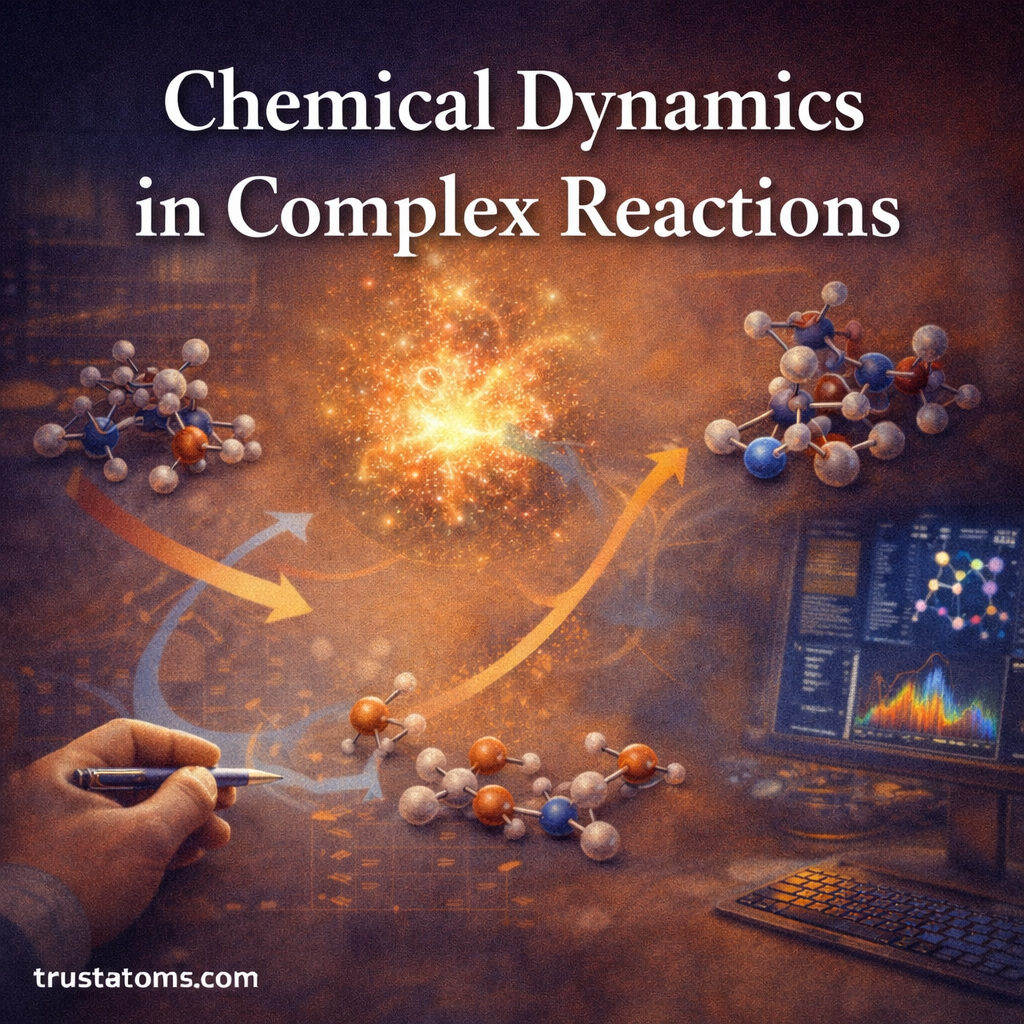
Illustration showing molecular interactions and reaction pathways representing chemical dynamics in complex chemical reactions.
Illustration depicting chemical dynamics in complex reactions, highlighting molecular motion, reaction pathways, and energy changes. trustatoms.com.

Chemical reactions are often presented in simple equations showing reactants converting into products. In reality, many reactions involve numerous intermediate steps, competing pathways, and rapidly changing molecular interactions. The study of chemical dynamics focuses on how these reactions actually unfold over time at the atomic and molecular level.

Chemical dynamics explores how molecules move, collide, transfer energy, and rearrange bonds during a reaction. Understanding these processes helps scientists predict reaction mechanisms, control chemical processes, and design more efficient industrial and biological reactions.

From atmospheric chemistry to drug development, chemical dynamics plays a central role in modern chemical research.

Continue reading “Chemical Dynamics in Complex Reactions”

Reaction Energetics in Chemical Systems

Illustration showing energy changes in chemical reactions with molecular interactions and a simplified reaction energy pathway concept.
Illustration representing reaction energetics in chemical systems, highlighting energy changes during chemical reactions. trustatoms.com.

Chemical reactions involve the transformation of substances into new products. While these transformations may appear simple on the surface, they are governed by complex energy changes at the atomic and molecular level.

The study of reaction energetics focuses on how energy is absorbed, released, and redistributed during chemical reactions. Understanding these energy changes allows chemists to predict whether reactions will occur, how fast they will proceed, and how conditions such as temperature and pressure influence them.

Reaction energetics is a central topic in chemistry because it explains everything from fuel combustion and battery operation to biological metabolism and industrial manufacturing.

Continue reading “Reaction Energetics in Chemical Systems”

Computational Chemistry in Molecular Modeling

Illustration showing a scientist using computer software to model molecular structures, representing computational chemistry and digital molecular modeling.
Illustration depicting computational chemistry used to simulate and analyze molecular structures through computer-based modeling. trustatoms.com.

Computational chemistry has transformed how scientists study molecules and chemical reactions. Instead of relying only on laboratory experiments, researchers now use powerful computer simulations to analyze molecular behavior, predict chemical properties, and design new compounds.

This field combines chemistry, physics, mathematics, and computer science to model atoms and molecules digitally. By applying quantum mechanics and molecular physics through algorithms, computational chemistry allows scientists to explore chemical systems that may be difficult or expensive to study experimentally.

Today, computational chemistry plays an important role in areas such as drug discovery, materials science, environmental chemistry, and nanotechnology.

Continue reading “Computational Chemistry in Molecular Modeling”

Chemical Bonding Models in Modern Theory

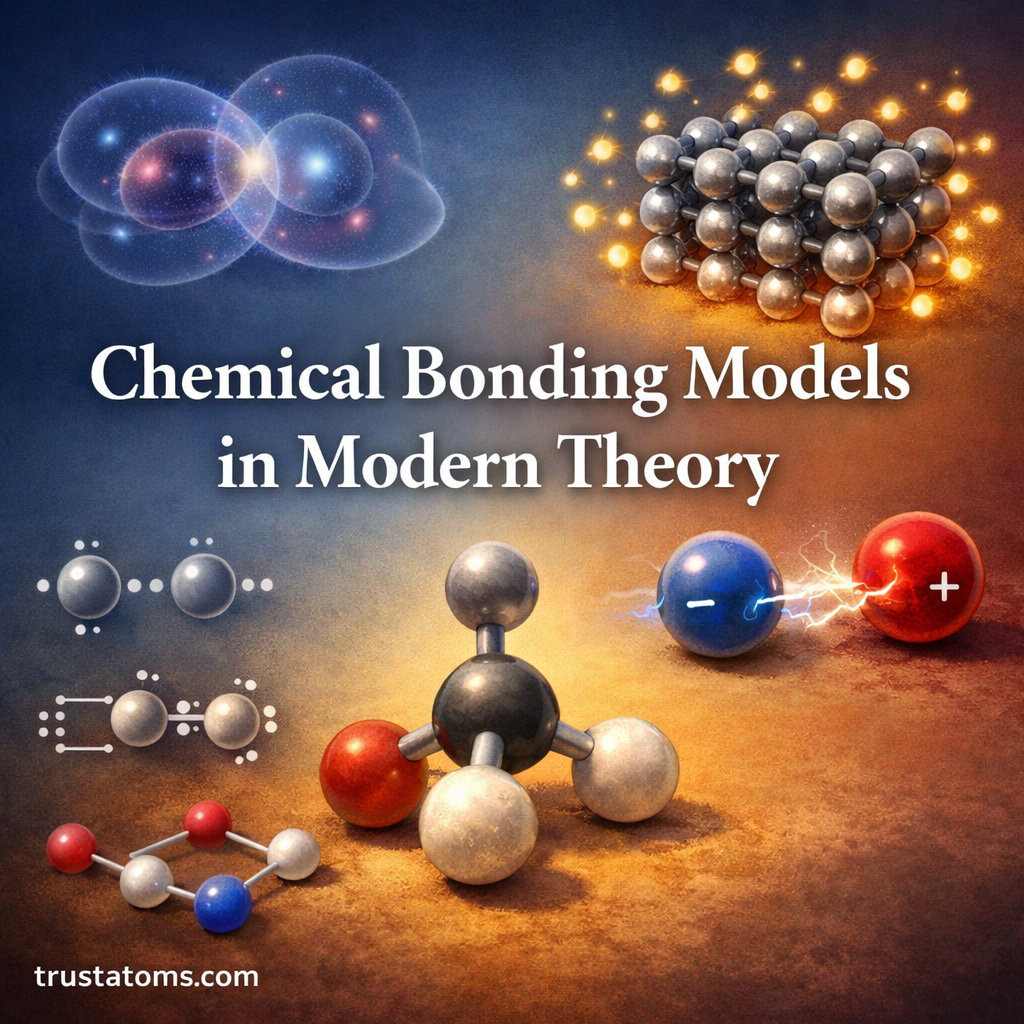
Illustration showing conceptual representations of chemical bonding models including orbital overlap, molecular structures, ionic interaction, and metallic lattice used in modern chemistry theory.
Illustration representing different chemical bonding models used in modern chemistry, including orbital overlap, molecular structures, and ionic interactions. trustatoms.com

Chemical bonding is one of the most fundamental concepts in chemistry. It explains how atoms connect to form molecules and materials, shaping everything from water and proteins to metals and semiconductors.

Early scientists understood that atoms combine in predictable ratios, but modern chemistry goes much deeper. Today, several chemical bonding models help scientists explain how and why atoms share or transfer electrons. These models provide different perspectives on the same underlying reality of atomic interactions.

Understanding these bonding models helps students and researchers interpret molecular structure, predict chemical behavior, and design new materials.

Continue reading “Chemical Bonding Models in Modern Theory”