Surface Chemistry in Catalytic Systems

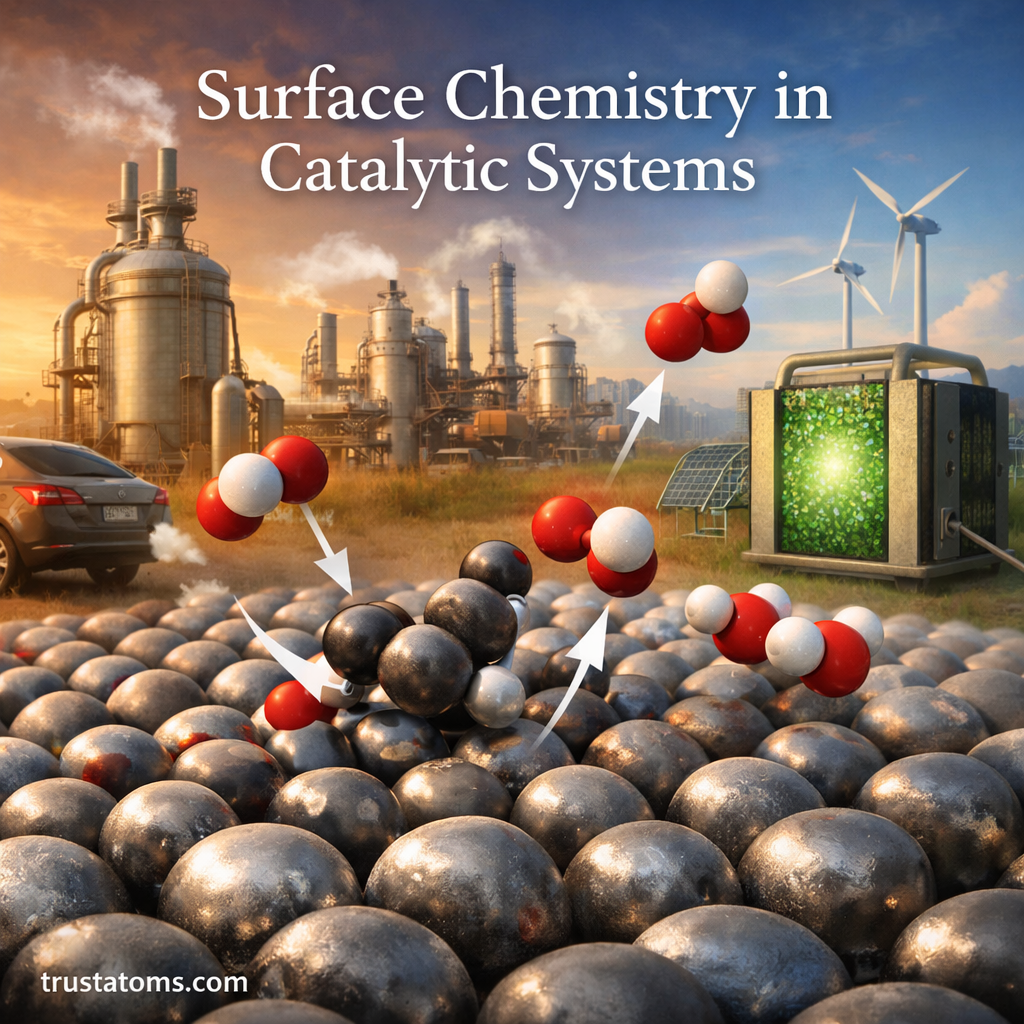
Illustration showing molecules interacting with a catalyst surface to demonstrate surface chemistry in catalytic systems.
Illustration of molecules interacting with a catalyst surface, demonstrating how surface chemistry enables catalytic reactions. trustatoms.com.

Surface chemistry plays a central role in catalytic reactions. Catalysts accelerate chemical reactions without being consumed, and most catalytic processes occur at the surface of a solid material. Understanding how molecules interact with these surfaces is essential in fields ranging from industrial manufacturing to environmental technology and energy production.

In catalytic systems, the surface of a material provides the active sites where reactant molecules attach, react, and form products. Because reactions occur at the interface between phases—typically solid catalysts and gaseous or liquid reactants—surface chemistry determines how efficient a catalyst can be.

Continue reading “Surface Chemistry in Catalytic Systems”
Solvent Effects in Chemical Reactions

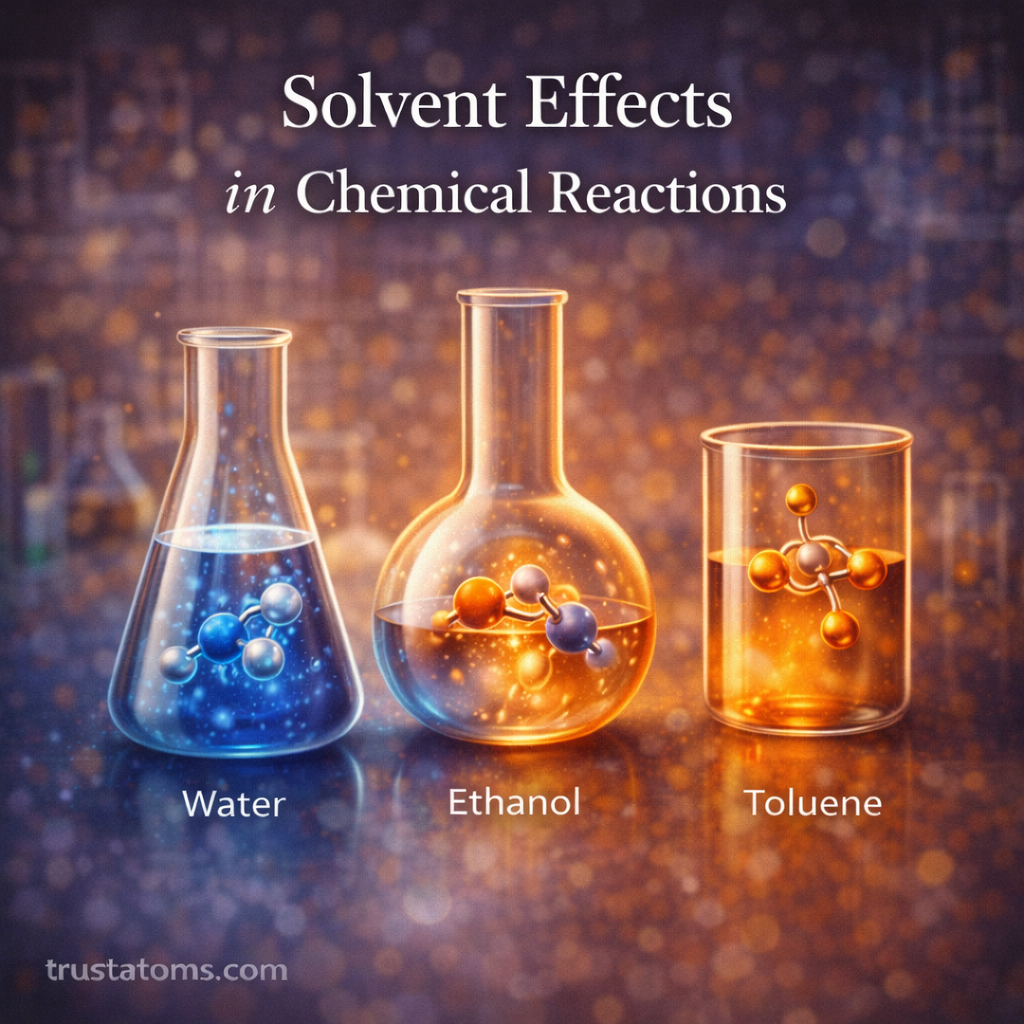
Illustration showing different solvents such as water, ethanol, and toluene influencing molecular interactions in chemical reactions.
Conceptual illustration showing how different solvents like water, ethanol, and toluene influence molecular behavior in chemical reactions. trustatoms.com.

In many chemical reactions, the substances involved are not interacting in isolation. Instead, they are surrounded by another substance known as the solvent. The solvent provides the environment in which reactants dissolve, move, and interact.

Solvents play a crucial role in determining how quickly reactions occur, what products form, and how stable certain molecules remain during a reaction. These influences are known collectively as solvent effects.

Understanding solvent effects allows chemists to control reaction outcomes, improve reaction efficiency, and design better industrial and laboratory processes.

Continue reading “Solvent Effects in Chemical Reactions”

Acid–Base Theories in Chemical Frameworks

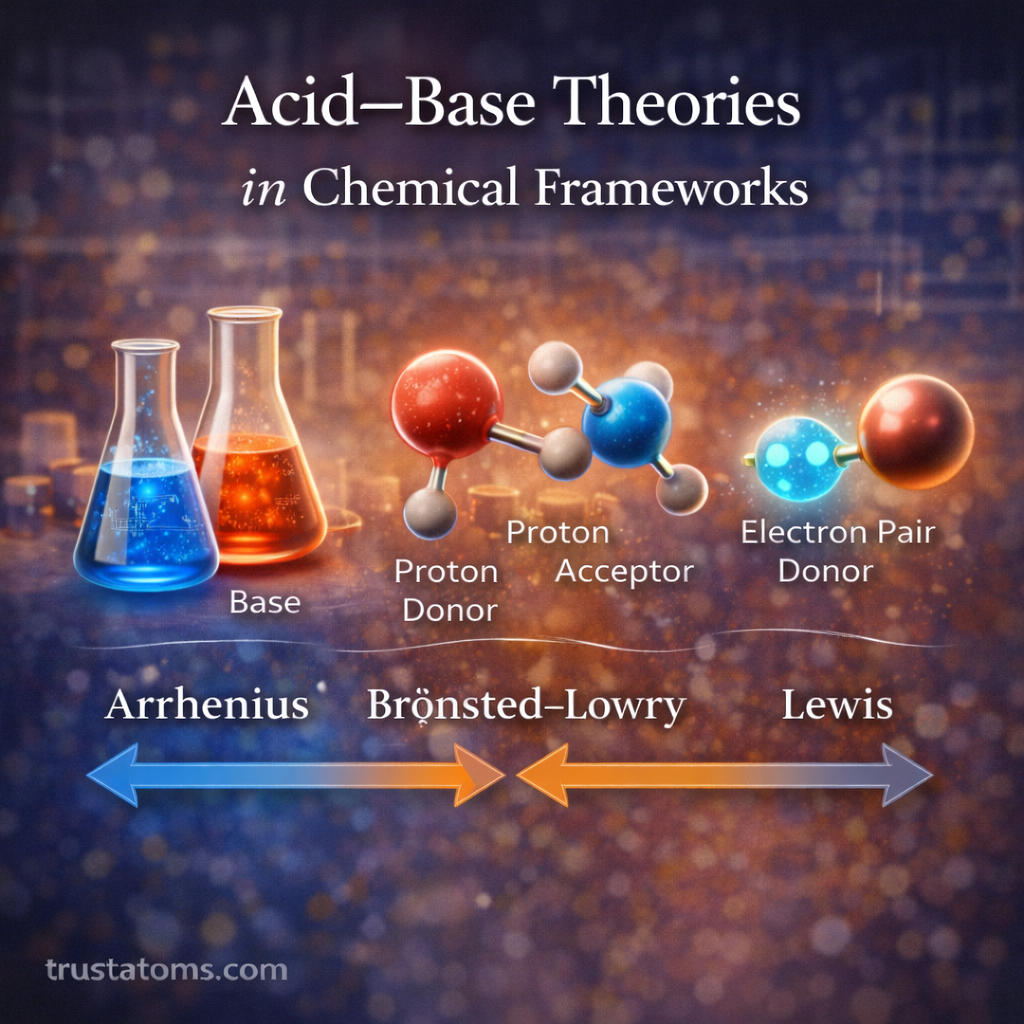
Illustration explaining Arrhenius, Brønsted–Lowry, and Lewis acid–base theories with molecular models and laboratory flasks.
Conceptual diagram illustrating the Arrhenius, Brønsted–Lowry, and Lewis acid–base theories used to explain chemical reactions. trustatoms.com.

Acids and bases are fundamental concepts in chemistry that help explain how substances interact, react, and transform in chemical systems. Over time, scientists have developed several frameworks to describe acid–base behavior more accurately across different environments and reactions.

These frameworks—known as acid–base theories—allow chemists to understand chemical reactions ranging from simple neutralization in water to complex reactions in organic chemistry and industrial processes.

Three major theories are commonly used to explain acid–base interactions:

  • Arrhenius theory
  • Brønsted–Lowry theory
  • Lewis theory

Each theory expands on the previous one, providing a broader explanation of chemical behavior.

Continue reading “Acid–Base Theories in Chemical Frameworks”

Equilibrium Shifts in Chemical Systems

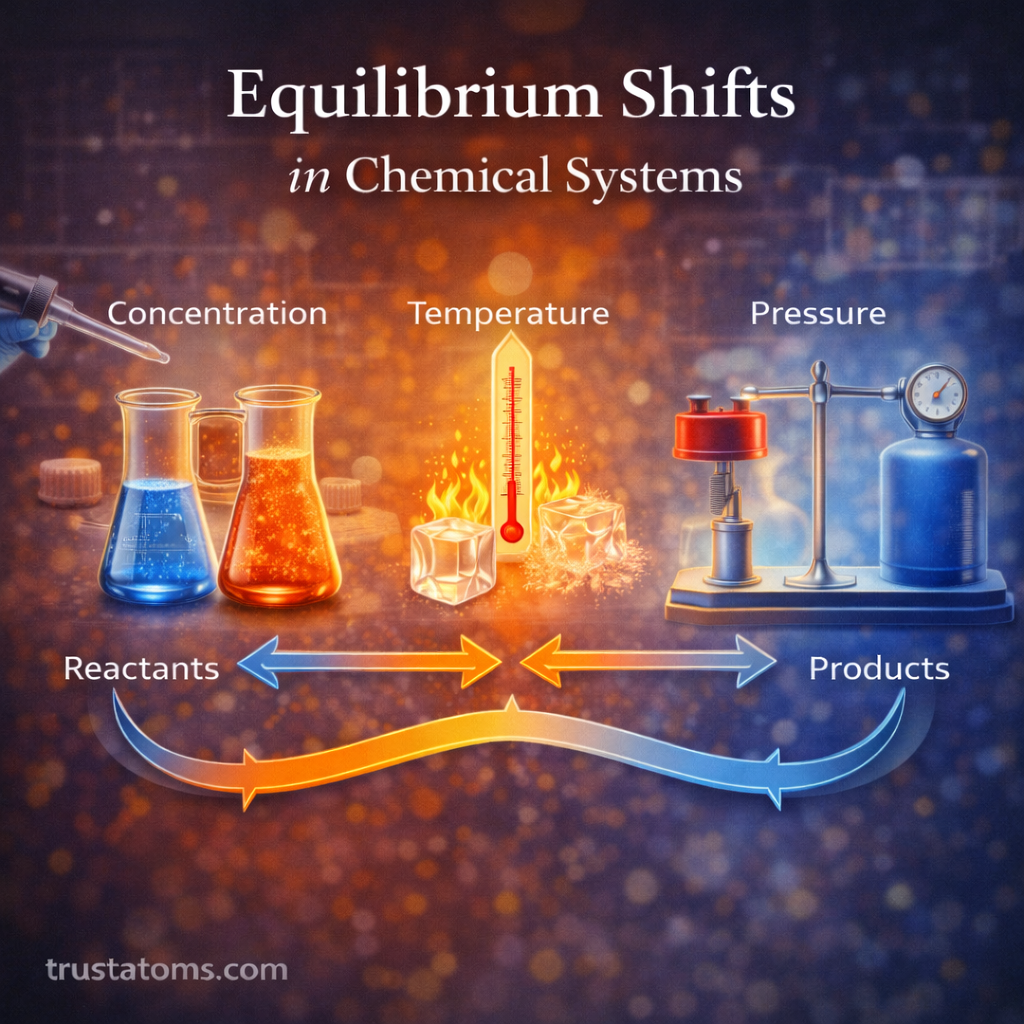
Illustration showing equilibrium shifts in chemical systems influenced by concentration, temperature, and pressure changes.
Conceptual diagram illustrating how concentration, temperature, and pressure changes can shift equilibrium in chemical systems. trustatoms.com.

Chemical reactions often move toward a state where reactants and products exist together in balanced proportions. This state is known as chemical equilibrium. At equilibrium, reactions do not stop, but the forward and reverse reactions occur at equal rates.

However, equilibrium conditions can change when external factors influence the system. When this happens, the reaction adjusts to restore balance. These adjustments are called equilibrium shifts.

Understanding equilibrium shifts is essential in chemistry because it allows scientists and engineers to predict how reactions respond to changes in temperature, pressure, and concentration. This knowledge is widely used in industrial chemistry, environmental science, and biological systems.

Continue reading “Equilibrium Shifts in Chemical Systems”

Reaction Pathways in Chemical Systems

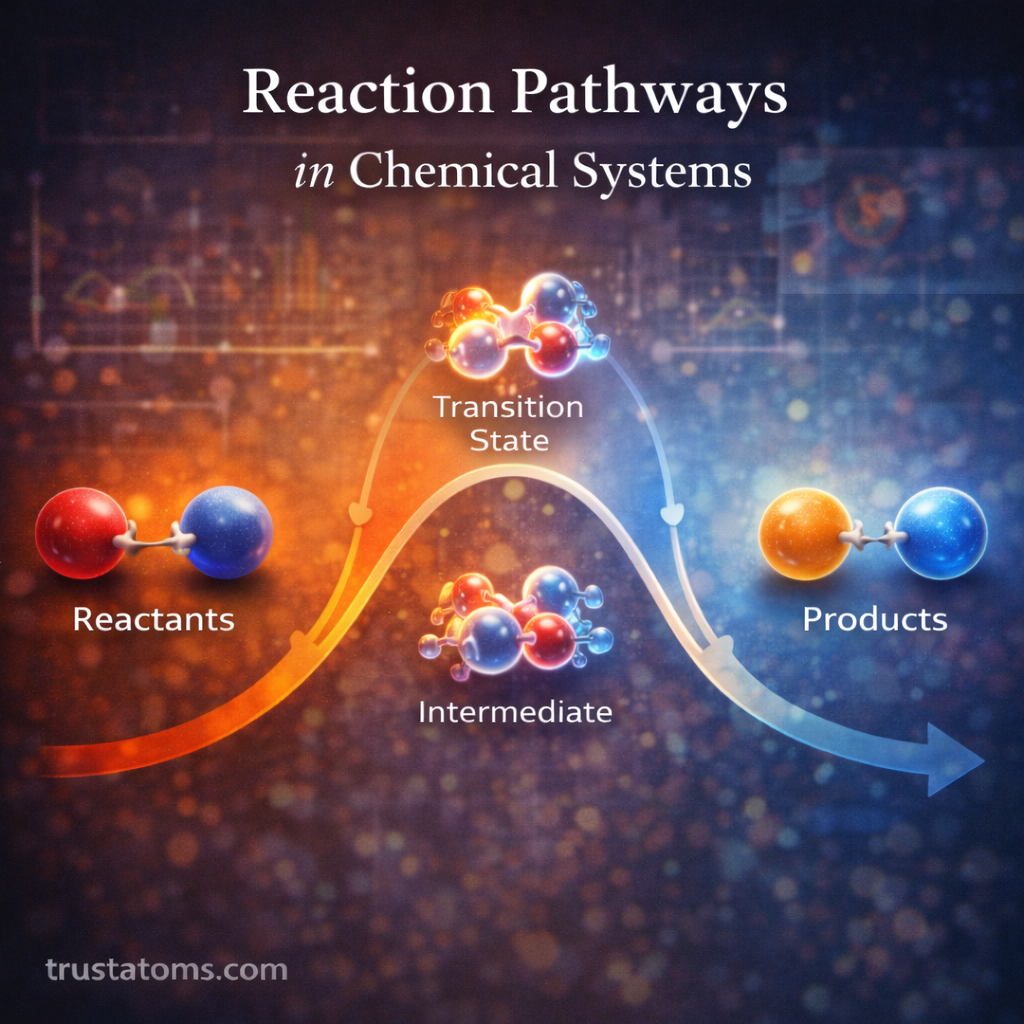
Illustration showing reaction pathways in chemical systems with reactants transforming through intermediates and a transition state into final products.
Conceptual diagram illustrating how chemical reactions move through intermediates and transition states along a reaction pathway. trustatoms.com.

Chemical reactions rarely occur in a single, simple step. Instead, most reactions proceed through a sequence of smaller transformations that gradually convert reactants into products. These sequences are known as reaction pathways.

Understanding reaction pathways helps chemists explain how reactions occur, how fast they proceed, and what intermediate structures form during the process. Reaction pathway analysis is essential in fields such as organic chemistry, biochemistry, materials science, and industrial chemical engineering.

By studying reaction pathways, scientists can predict reaction behavior, improve reaction efficiency, and design safer chemical processes.

Continue reading “Reaction Pathways in Chemical Systems”

Molecular Orbital Theory in Bonding Models

Illustration explaining molecular orbital theory showing atomic orbitals combining into bonding and antibonding molecular orbitals in a chemical bonding model.
Conceptual diagram illustrating how atomic orbitals combine to form bonding and antibonding molecular orbitals in molecular orbital theory. trustatoms.com.

Molecular Orbital (MO) Theory is one of the most powerful models used in modern chemistry to explain how atoms bond together to form molecules. Unlike earlier bonding theories that treat electrons as localized between specific atoms, molecular orbital theory describes electrons as occupying orbitals that extend across an entire molecule.

This perspective allows chemists to understand bonding, molecular stability, magnetism, and even the color of substances at a deeper level. Today, molecular orbital theory plays a central role in quantum chemistry, materials science, and spectroscopy.

Continue reading “Molecular Orbital Theory in Bonding Models”

Chemical Potential in Thermodynamic Analysis

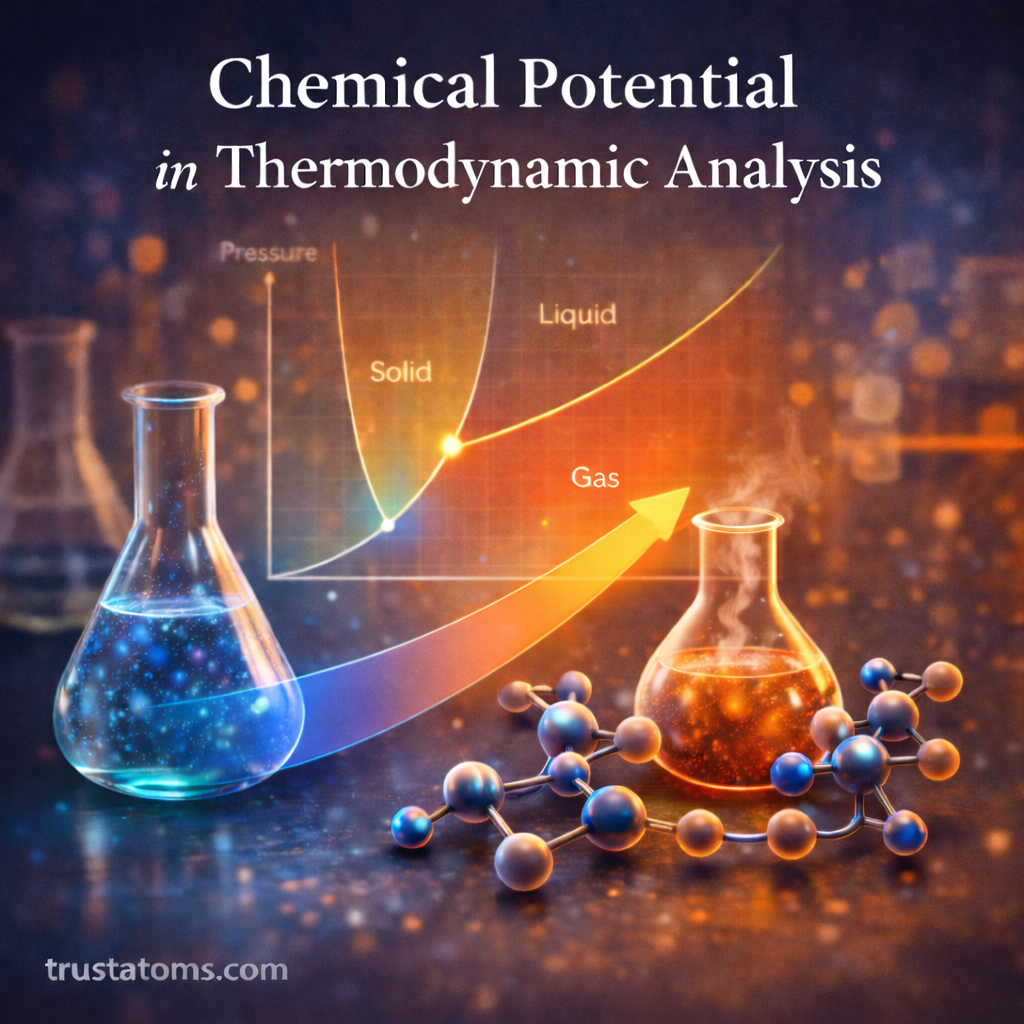
Illustration showing chemical potential in thermodynamic systems with two laboratory flasks, molecular models, and a phase diagram representing energy differences between states.
Conceptual illustration of chemical potential in thermodynamic analysis showing energy differences between molecular systems and phase behavior. trustatoms.com.

Chemical potential is one of the most important concepts in thermodynamics and physical chemistry. It helps scientists understand how substances move, react, and reach equilibrium in chemical systems.

At its core, chemical potential describes the energy change associated with adding or removing a small amount of a substance from a system. This idea plays a central role in explaining diffusion, chemical reactions, phase transitions, and equilibrium.

From biological cells to industrial chemical reactors, chemical potential helps determine how matter and energy behave in complex systems.

Continue reading “Chemical Potential in Thermodynamic Analysis”

Electron Delocalization in Molecular Systems

Illustration showing electron delocalization across a molecular system with a benzene ring and conjugated chain representing shared electrons across atoms.
Conceptual illustration representing electron delocalization across a molecular system and conjugated structures. trustatoms.com

Electron delocalization is a fundamental concept in chemistry that helps explain why some molecules are unusually stable, reactive, or capable of conducting electricity. Rather than being confined to a single bond or atom, delocalized electrons are shared across multiple atoms within a molecule.

This phenomenon appears in many important chemical systems, including aromatic rings, conjugated molecules, and biological compounds such as DNA bases and pigments. Understanding electron delocalization helps chemists predict molecular stability, chemical behavior, and physical properties like color and conductivity.

Continue reading “Electron Delocalization in Molecular Systems”

Bond Dissociation Energy in Reactions

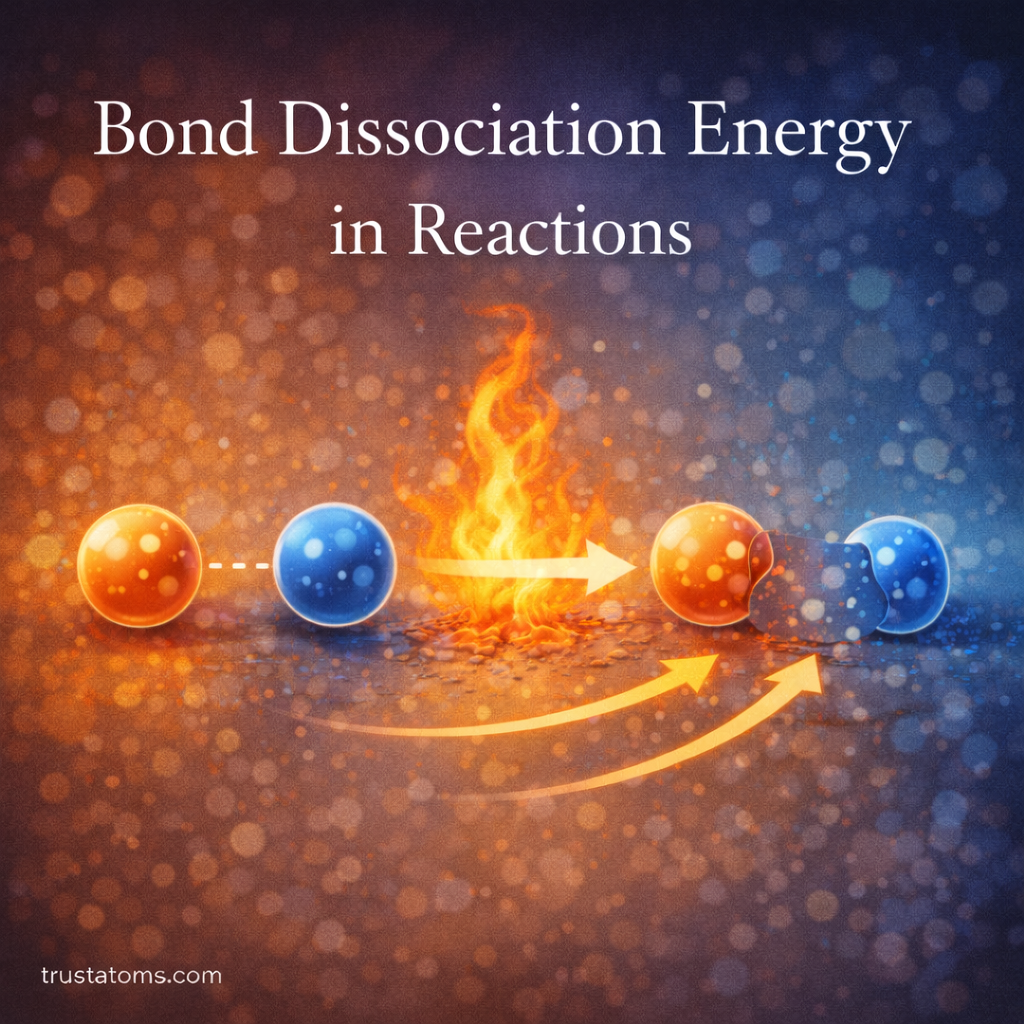
Illustration showing a chemical bond breaking between atoms with energy released during bond dissociation in a reaction.
Conceptual illustration showing energy required to break chemical bonds during reactions. trustatoms.com.

Chemical reactions occur when existing chemical bonds break and new ones form. The energy required to break these bonds plays a critical role in determining how reactions proceed. One of the most important concepts chemists use to understand this process is bond dissociation energy (BDE).

Bond dissociation energy measures the strength of a chemical bond and indicates how much energy is needed to separate two bonded atoms. This concept helps scientists predict reaction pathways, estimate reaction energies, and understand why some molecules are more stable than others.

From combustion reactions to biological metabolism, bond dissociation energy is a key factor that explains how chemical reactions occur and how much energy they release or absorb.

Continue reading “Bond Dissociation Energy in Reactions”

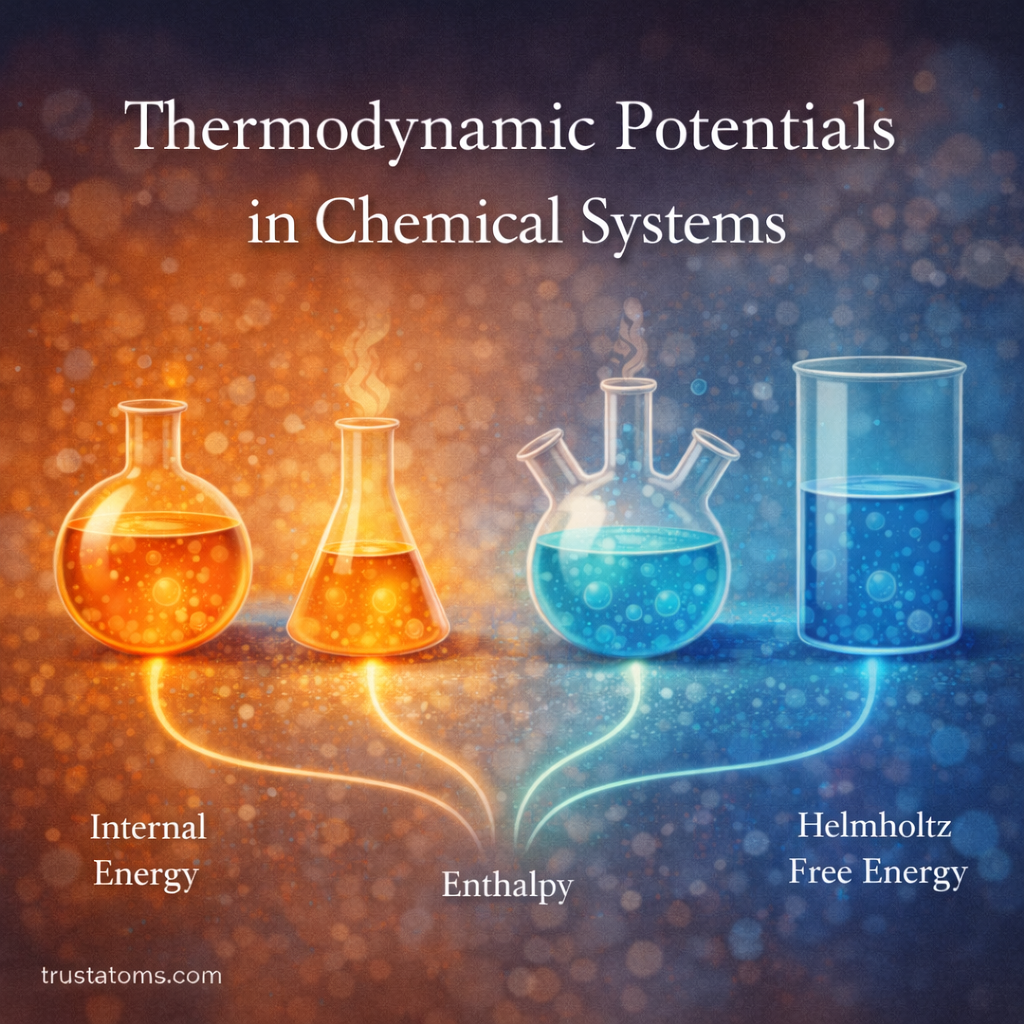
Thermodynamic Potentials in Chemical Systems

Illustration showing laboratory glassware representing energy changes and thermodynamic potentials in chemical systems.
Conceptual illustration representing how energy is stored and transformed in chemical systems through thermodynamic potentials. trustatoms.com.

Chemical systems constantly exchange energy with their surroundings. Understanding how energy moves and transforms is essential for predicting whether chemical reactions occur and how systems reach equilibrium. One of the most powerful tools chemists use for this purpose is the concept of thermodynamic potentials.

Thermodynamic potentials are energy-related quantities that describe how energy is stored, transferred, and converted within chemical systems. They help scientists determine whether processes will occur spontaneously and how systems respond to changes in temperature, pressure, or composition.

By analyzing these energy relationships, chemists can predict reaction behavior in fields ranging from industrial chemistry to biochemistry and materials science.

Continue reading “Thermodynamic Potentials in Chemical Systems”