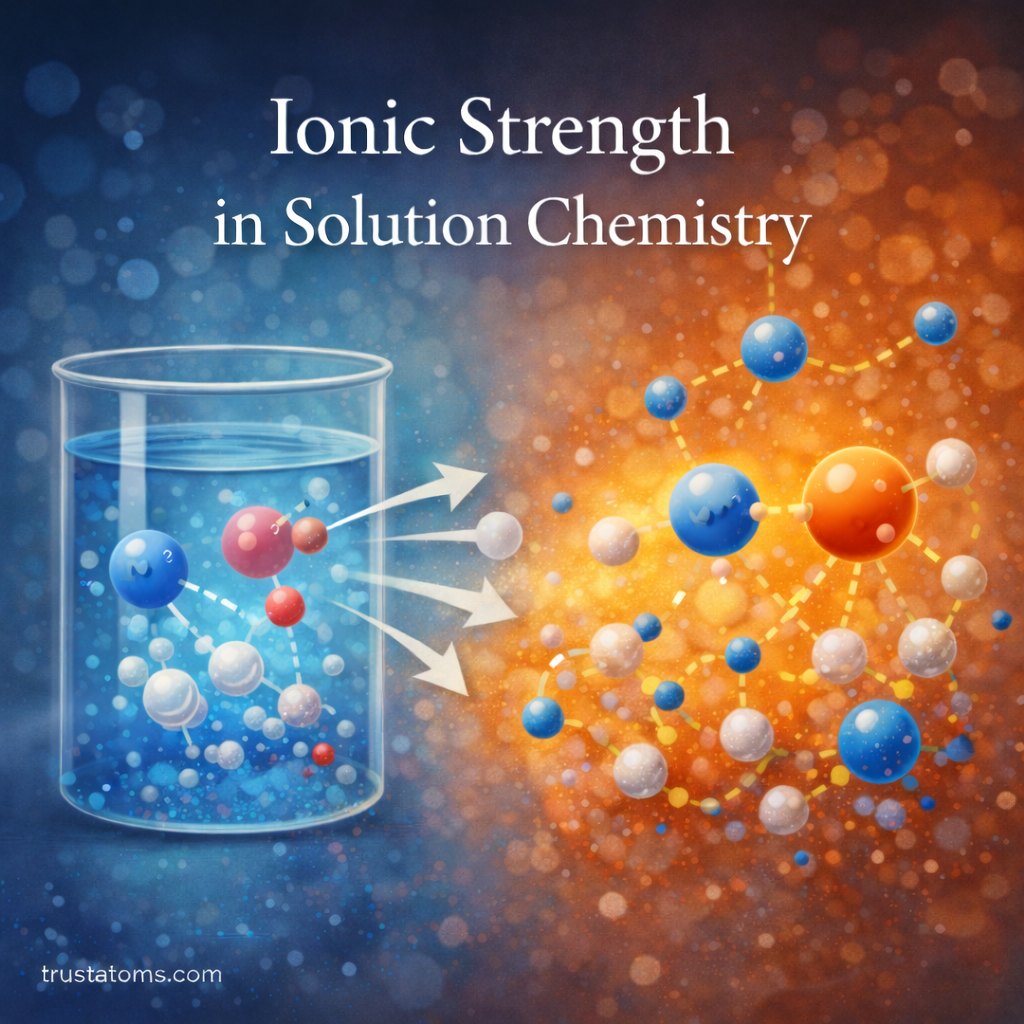
Ionic Strength in Solution Chemistry

Illustration showing ions interacting in a chemical solution to represent ionic strength in solution chemistry.
Conceptual diagram illustrating how dissolved ions influence interactions and behavior in chemical solutions. trustatoms.com.

Many chemical reactions occur in solutions that contain dissolved ions. These ions influence how molecules interact, how reactions proceed, and how stable compounds remain in solution. One key concept chemists use to understand these effects is ionic strength.

Ionic strength measures the total concentration of ions present in a solution and accounts for both the number of ions and their electrical charges. This property significantly influences reaction rates, equilibrium conditions, solubility, and the behavior of charged particles in chemical systems.

Understanding ionic strength helps scientists predict and control reactions in fields such as environmental chemistry, pharmaceuticals, biochemistry, and industrial processes.

Continue reading “Ionic Strength in Solution Chemistry”
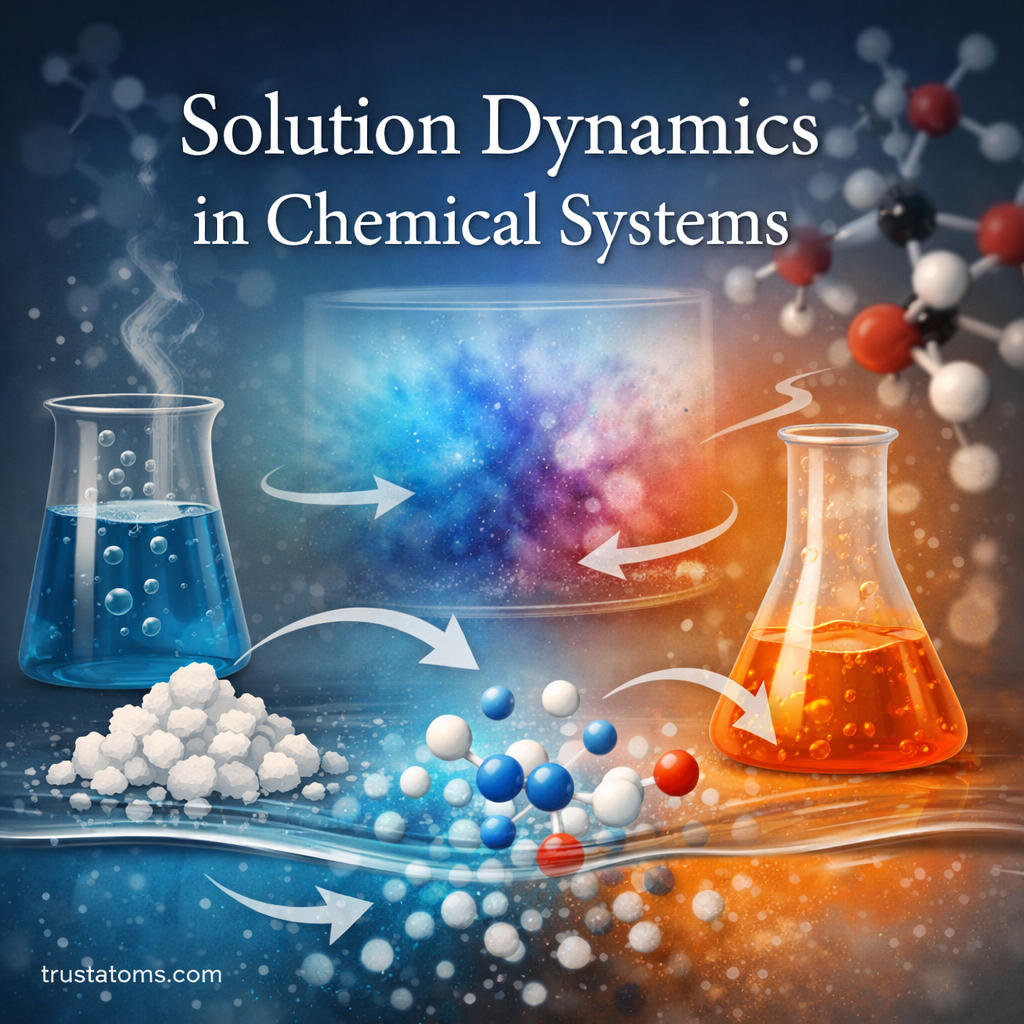
Solution Dynamics in Chemical Systems

Illustration diagram showing solution dynamics in chemical systems with molecules diffusing and interacting inside laboratory glassware.
Conceptual illustration showing how molecules move and interact in chemical solutions. trustatoms.com

Solutions are everywhere in chemistry. From salt dissolving in water to complex industrial mixtures used in manufacturing, solutions play a crucial role in how substances interact. But solutions are not static mixtures. On a molecular level, they are constantly moving, interacting, separating, and reforming.

This ongoing molecular activity is known as solution dynamics. Understanding how molecules behave inside solutions helps chemists predict reaction rates, control chemical processes, and design better materials and medicines.

In this article, we’ll explore what solution dynamics are, how molecules move in solutions, and why these processes are essential in chemistry and real-world applications.

Continue reading “Solution Dynamics in Chemical Systems”

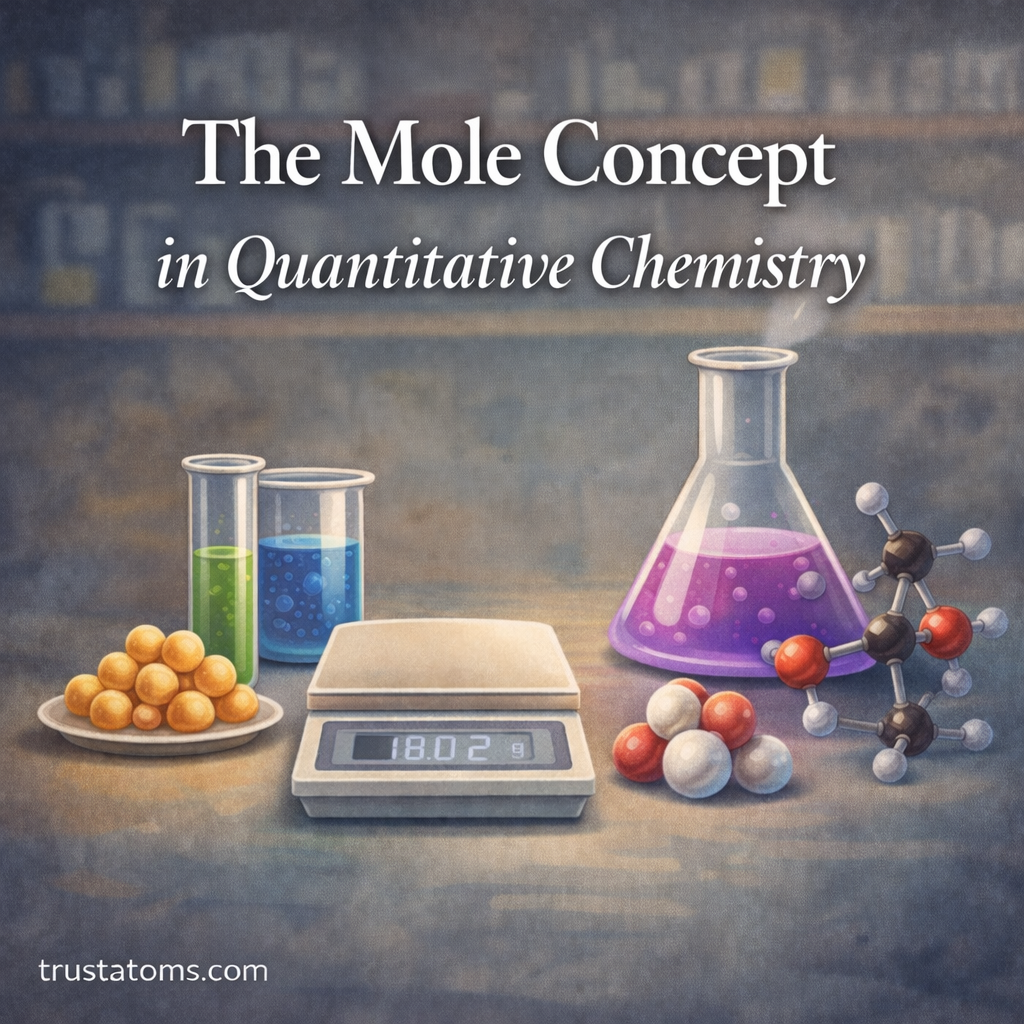
The Mole Concept in Quantitative Chemistry

Illustrated chemistry diagram showing laboratory glassware, molecular models, and a scale representing the mole concept in quantitative chemistry.
Illustration representing the mole concept used to connect particle quantities with measurable chemical mass in quantitative chemistry. trustatoms.com

The mole concept is one of the most important ideas in chemistry. It provides a bridge between the microscopic world of atoms and molecules and the measurable quantities used in laboratory experiments.

Chemists rarely count individual atoms or molecules directly. Instead, they use the mole to represent large numbers of particles in a manageable way. This concept allows scientists to calculate how substances react, determine chemical compositions, and predict the outcomes of chemical reactions.

Understanding the mole concept is essential for studying stoichiometry, chemical reactions, and quantitative analysis in chemistry.

Continue reading “The Mole Concept in Quantitative Chemistry”

Limiting Reactants in Chemical Reactions

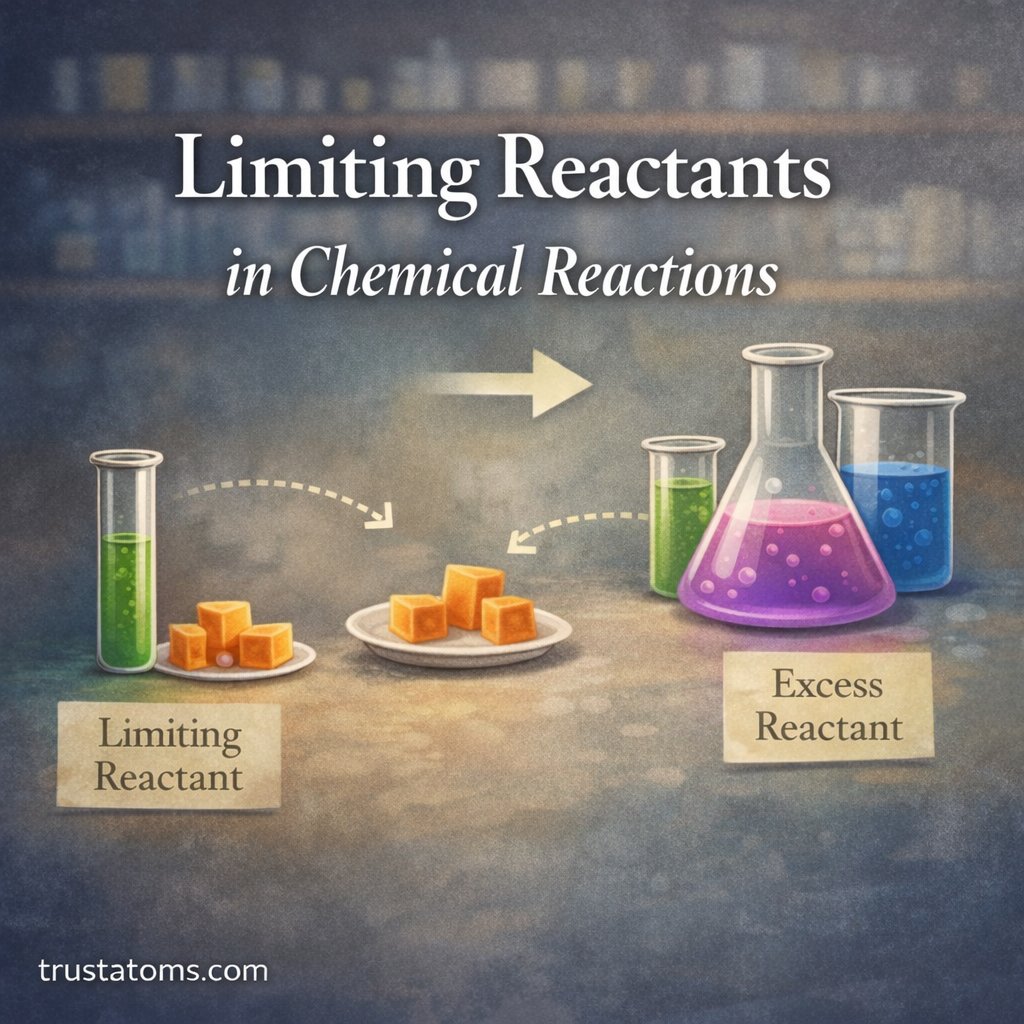
Illustrated chemistry diagram showing a limiting reactant and excess reactant in laboratory glassware to explain how limiting reactants control product formation in chemical reactions.
Illustration explaining how a limiting reactant determines how much product forms in a chemical reaction system. trustatoms.com

Chemical reactions rarely occur under perfectly balanced conditions. In most reaction systems, one substance is consumed before the others, stopping the reaction from continuing. This substance is known as the limiting reactant (also called the limiting reagent).

Understanding limiting reactants is essential in chemistry because it determines how much product can actually form in a reaction. Whether in laboratory experiments, industrial manufacturing, or environmental chemistry, identifying the limiting reactant helps scientists predict reaction outcomes and manage resources efficiently.

Continue reading “Limiting Reactants in Chemical Reactions”

Stoichiometric Calculations in Reaction Systems

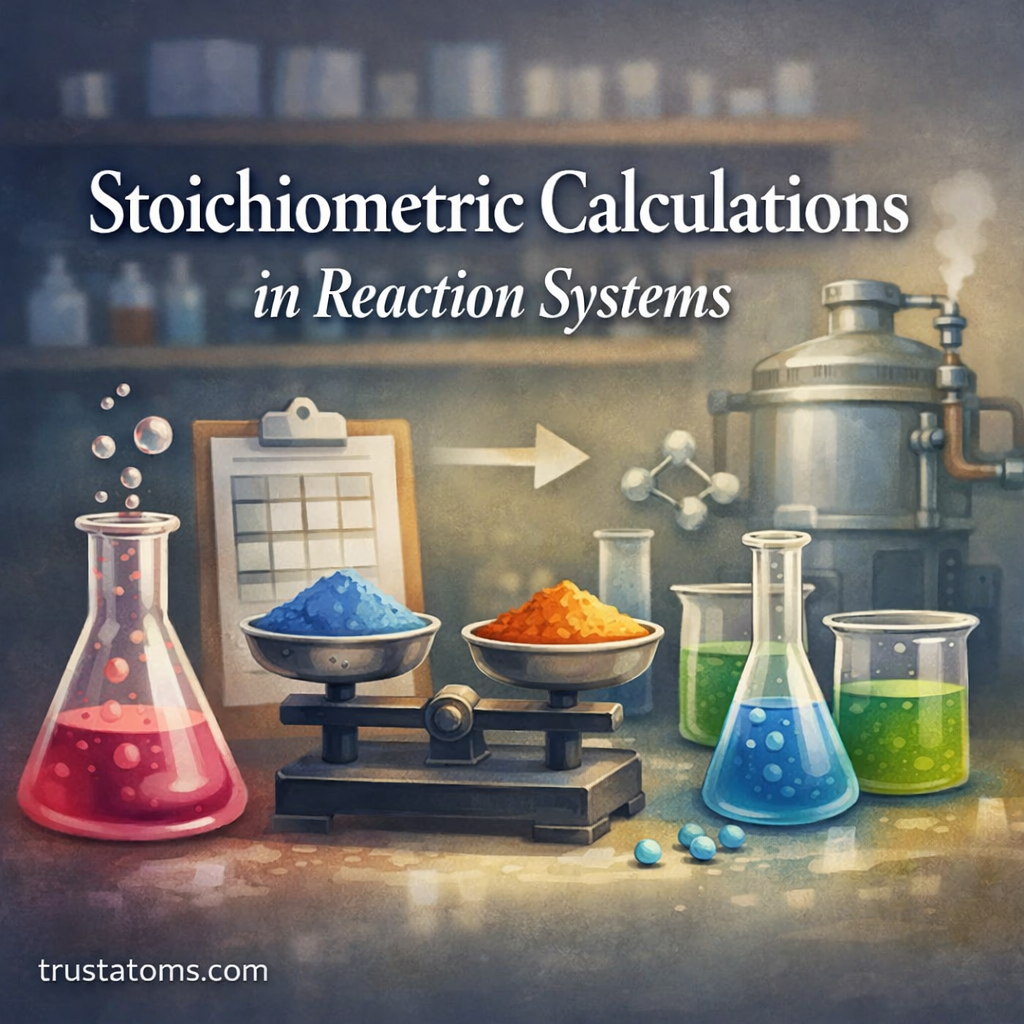
Illustrated chemistry diagram showing reactants and products on a balance scale with laboratory glassware representing stoichiometric calculations in reaction systems.
Illustrated chemistry concept showing balanced reactants and products used to explain stoichiometric calculations in reaction systems. trustatoms.com

Stoichiometry is one of the foundational tools in chemistry for understanding how substances react and how much product a reaction can produce. In any chemical reaction system—whether it occurs in a laboratory flask, an industrial reactor, or inside living organisms—stoichiometric calculations help chemists determine the exact proportions of reactants and products.

By using balanced chemical equations and simple mathematical relationships, stoichiometry allows scientists and engineers to predict quantities, optimize reactions, reduce waste, and design efficient chemical processes.

Continue reading “Stoichiometric Calculations in Reaction Systems”

Mass Spectrometry in Molecular Characterization

Illustration showing a mass spectrometer analyzing molecules and producing a mass spectrum used for molecular characterization.
Illustration demonstrating how mass spectrometry identifies and characterizes molecules by analyzing ionized particles and mass spectra. trustatoms.com

Mass spectrometry is one of the most powerful analytical techniques used in modern chemistry. It allows scientists to identify molecules, determine their mass, and analyze their structure with exceptional precision.

By measuring the mass of ionized particles, mass spectrometry helps researchers identify unknown compounds, study complex mixtures, and characterize molecular structures. This method is widely used in fields such as pharmaceutical research, environmental science, forensic chemistry, and biochemistry.

This guide explains how mass spectrometry works, how it helps characterize molecules, and why it is such a critical tool in analytical chemistry.

Continue reading “Mass Spectrometry in Molecular Characterization”

Chromatography in Analytical Chemistry

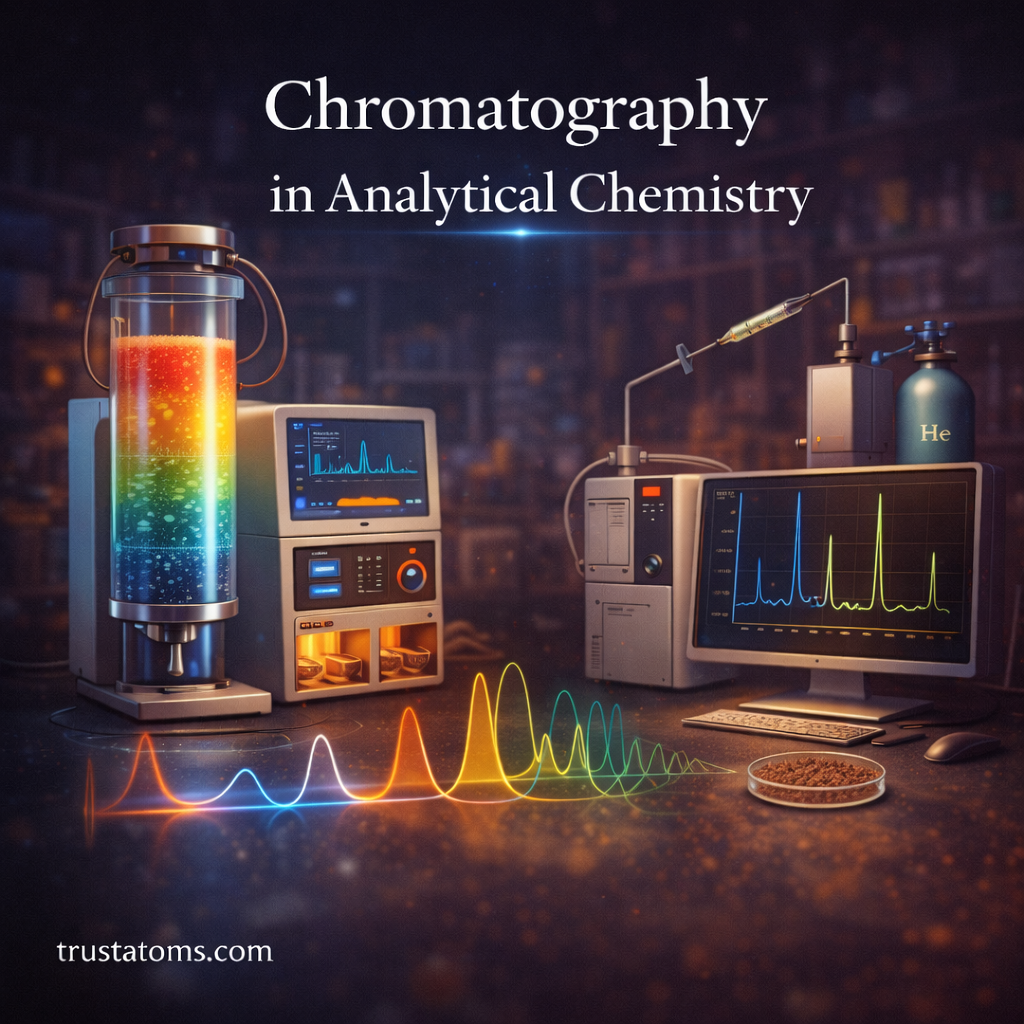
Scientific illustration showing chromatography instruments and chromatogram peaks used to separate chemical mixtures.
Illustration showing chromatography techniques used in analytical chemistry to separate and analyze chemical mixtures. trustatoms.com

Chromatography is one of the most important techniques used in analytical chemistry to separate, identify, and analyze mixtures of chemical substances. It allows scientists to isolate individual components within complex samples, making it easier to study their properties and concentrations.

From pharmaceutical testing and environmental monitoring to food safety and forensic science, chromatography plays a central role in modern laboratory analysis.

This guide explains how chromatography works, the major types used in analytical chemistry, and why it remains one of the most reliable tools for chemical analysis.

Continue reading “Chromatography in Analytical Chemistry”

NMR Spectroscopy in Structural Determination

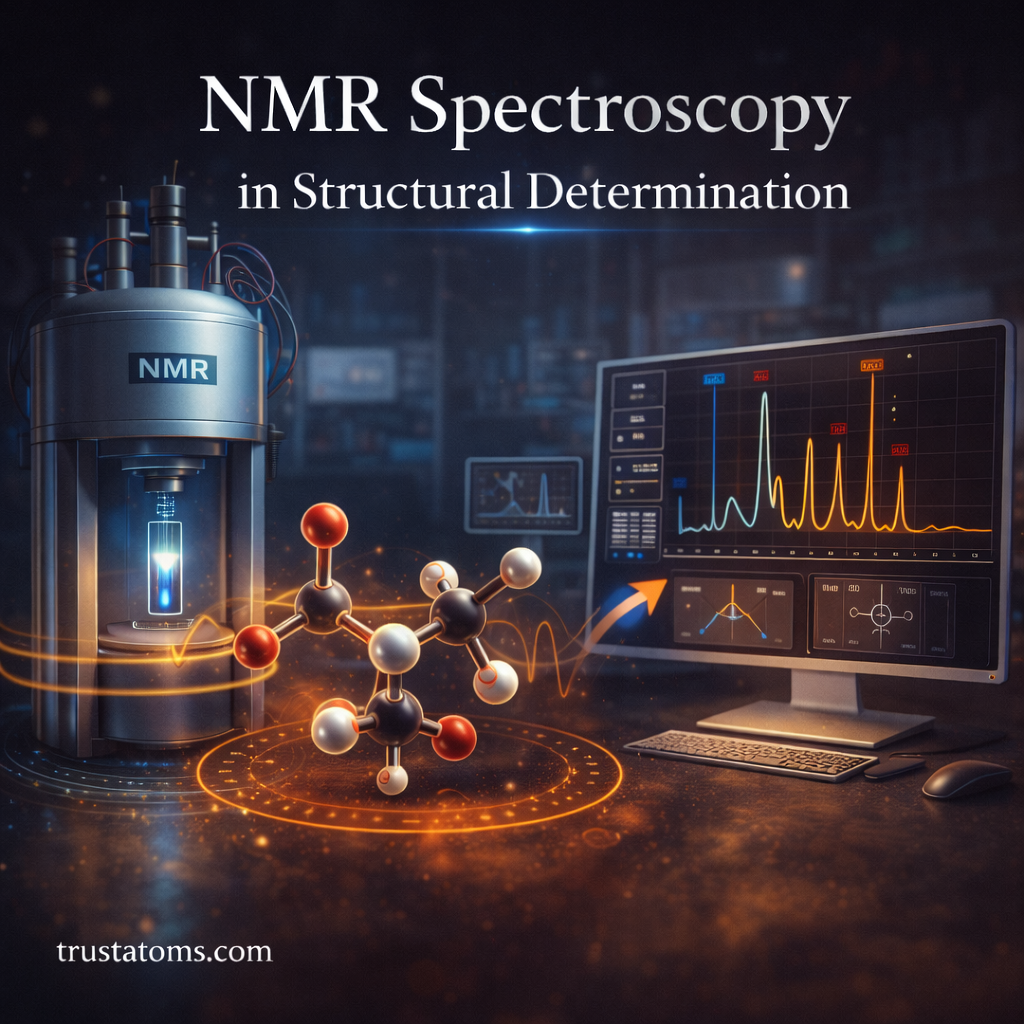
Illustration showing NMR spectroscopy analyzing molecular structure using a magnetic spectrometer and spectral data.
Illustration demonstrating how NMR spectroscopy reveals molecular structure by analyzing signals from atomic nuclei in a magnetic field. trustatoms.com

Nuclear Magnetic Resonance (NMR) spectroscopy is one of the most powerful tools chemists use to determine the structure of molecules. By analyzing how atomic nuclei behave in strong magnetic fields, scientists can uncover detailed information about how atoms are connected within a compound.

Unlike many analytical techniques that only identify elements, NMR spectroscopy reveals how atoms are arranged in a molecule. This makes it essential in organic chemistry, pharmaceutical research, and biochemical studies.

This guide explains how NMR spectroscopy works, how it helps determine molecular structures, and why it is such an important technique in modern chemical analysis.

Continue reading “NMR Spectroscopy in Structural Determination”

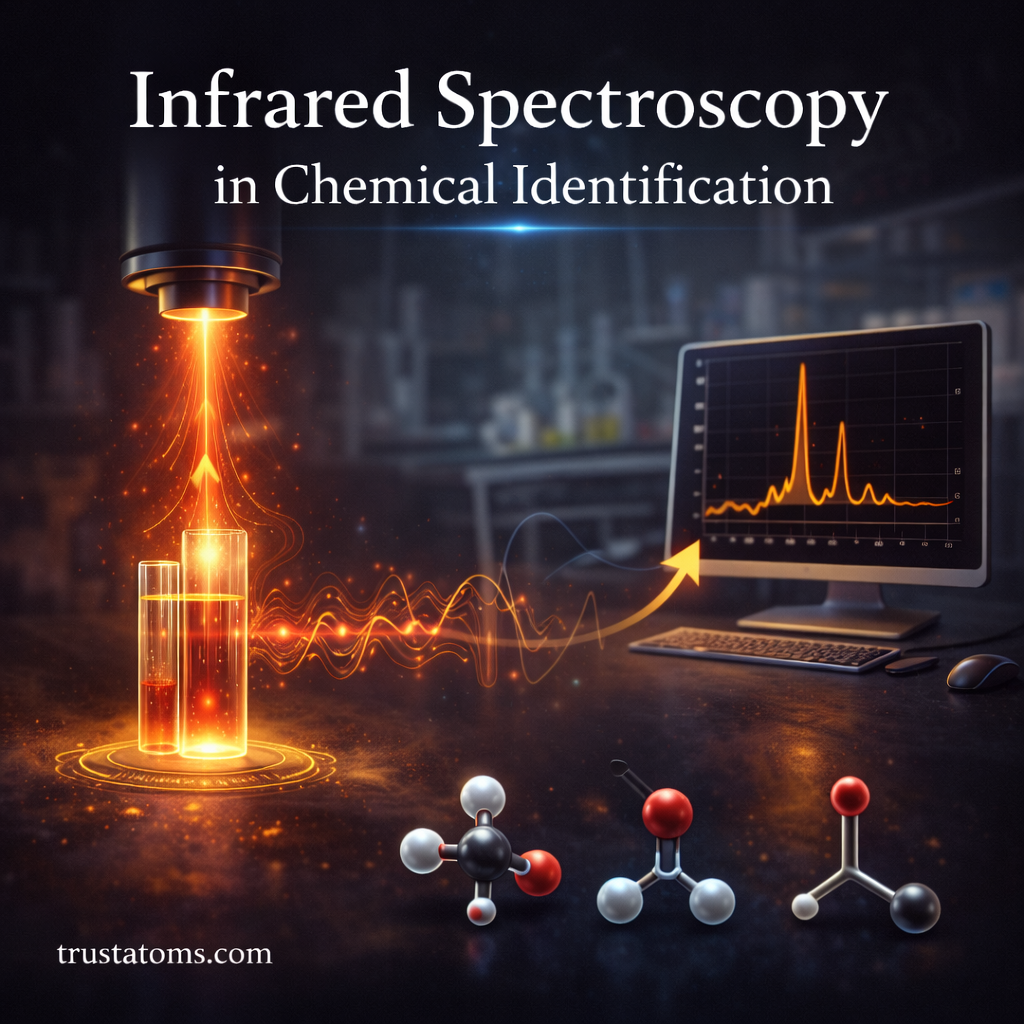
Infrared Spectroscopy in Chemical Identification

Scientific illustration showing infrared spectroscopy analyzing a chemical sample and producing an infrared absorption spectrum.
Illustration demonstrating how infrared spectroscopy identifies chemical compounds by analyzing molecular vibrations and absorption patterns. trustatoms.com

Infrared spectroscopy (IR spectroscopy) is one of the most widely used analytical techniques in chemistry for identifying chemical compounds. By examining how molecules absorb infrared light, scientists can determine the types of chemical bonds present in a substance and often identify the compound itself.

Because each molecule absorbs infrared radiation in a unique way, infrared spectroscopy provides a kind of molecular fingerprint. This makes the technique extremely valuable in research laboratories, environmental testing, pharmaceuticals, and forensic science.

This guide explains how infrared spectroscopy works, why it is useful for chemical identification, and where it is commonly applied in modern science.

Continue reading “Infrared Spectroscopy in Chemical Identification”

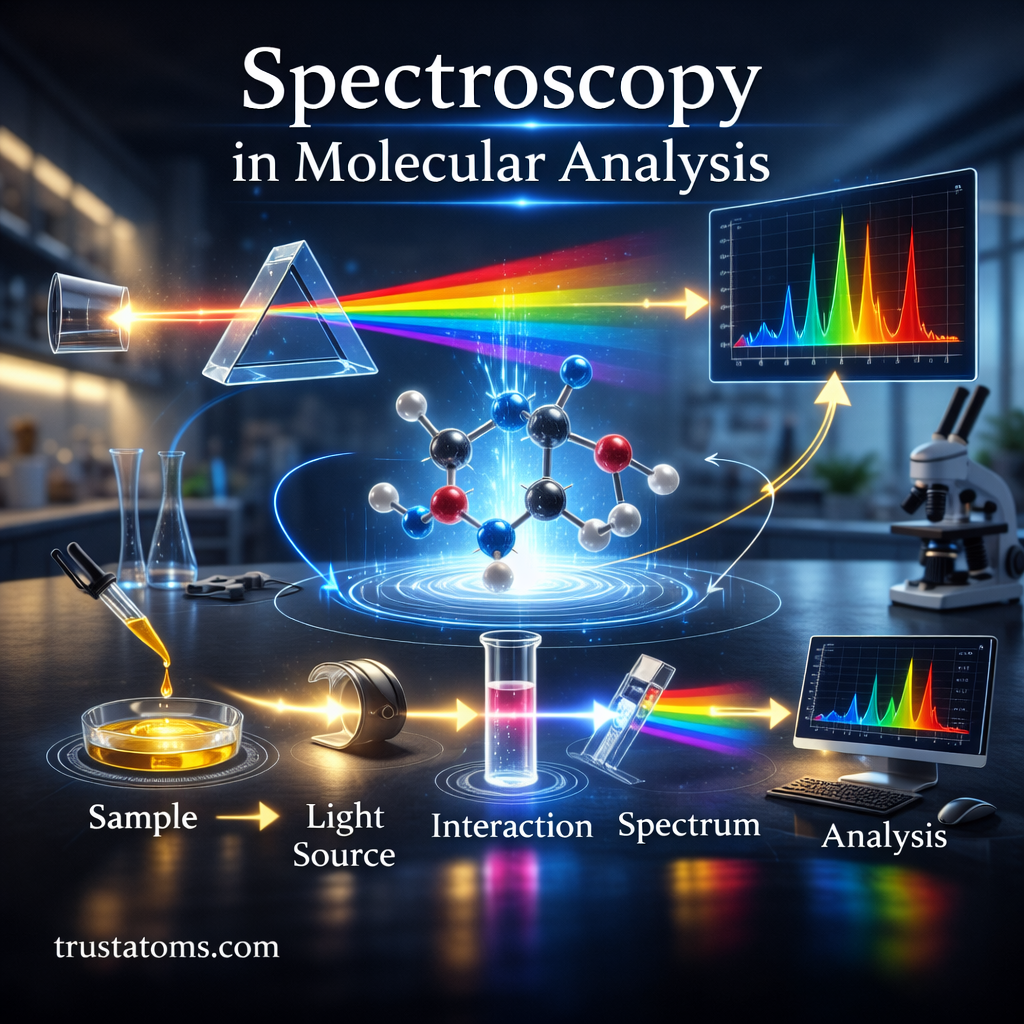
Spectroscopy in Molecular Analysis

Scientific illustration showing spectroscopy used to analyze molecules with different types of electromagnetic radiation.
Illustration showing how spectroscopy analyzes molecules using different types of electromagnetic radiation. trustatoms.com

Spectroscopy is one of the most powerful tools scientists use to understand the structure and composition of molecules. By studying how matter interacts with light and other electromagnetic radiation, researchers can identify substances, analyze chemical bonds, and determine molecular structures with remarkable precision.

From pharmaceutical research to environmental monitoring, spectroscopy plays a critical role in modern chemistry. It allows scientists to detect molecules that are invisible to the naked eye and reveal how atoms are arranged within compounds.

This guide explains how spectroscopy works, why it is important in molecular analysis, and the most common types used in chemical research.

Continue reading “Spectroscopy in Molecular Analysis”