Organometallic Compounds in Catalysis

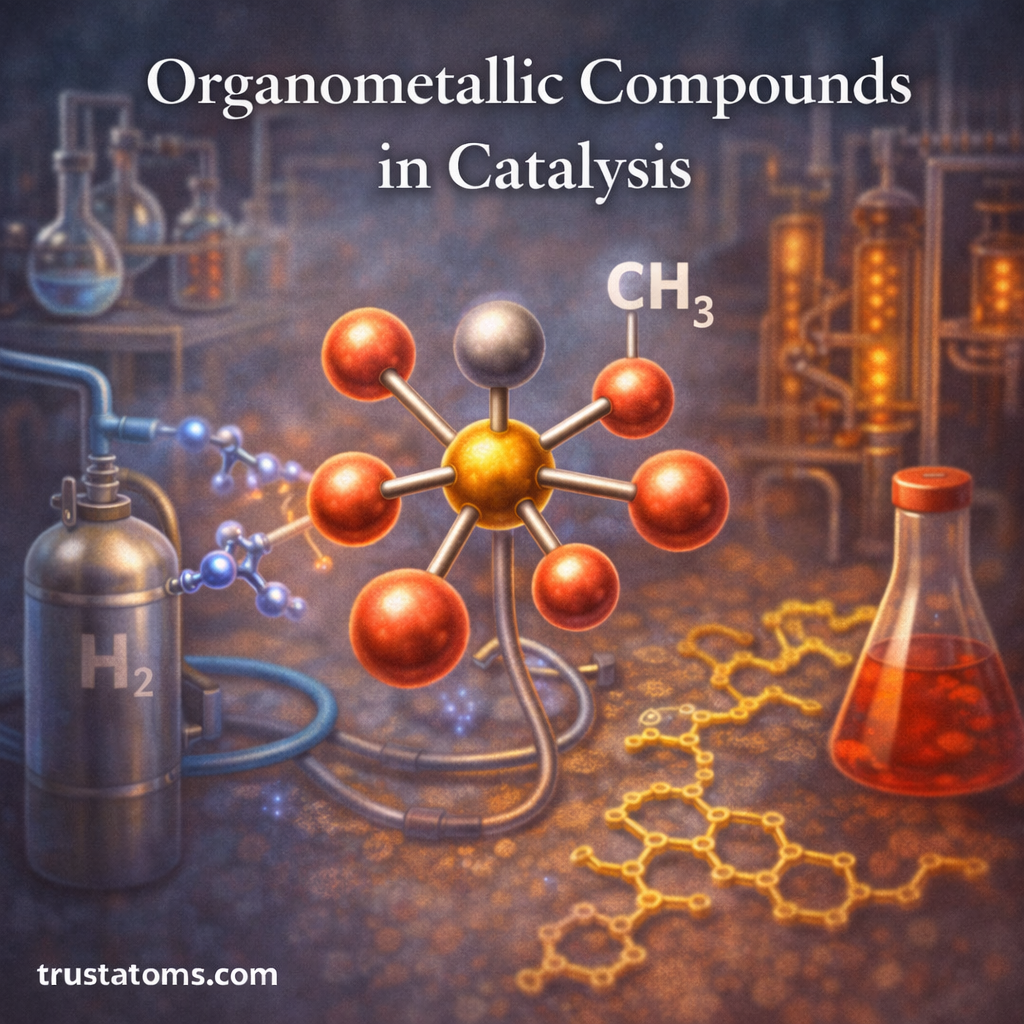
Illustration showing an organometallic catalyst with a metal center bonded to organic groups used in chemical reactions and industrial catalysis.
Illustration representing organometallic compounds used as catalysts in chemical reactions and industrial processes. trustatoms.com

Organometallic compounds are a fascinating class of substances that play a critical role in modern chemical reactions. These compounds contain metal–carbon bonds, linking a metal atom directly to an organic molecule. Because of this unique structure, organometallic compounds often serve as highly effective catalysts in chemical processes.

In catalysis, organometallic compounds help accelerate reactions, improve efficiency, and enable transformations that might otherwise be difficult or impossible. They are widely used in industries such as pharmaceuticals, plastics manufacturing, energy production, and environmental chemistry.

Understanding how organometallic compounds function in catalytic systems is an important topic in inorganic and industrial chemistry.

Continue reading “Organometallic Compounds in Catalysis”
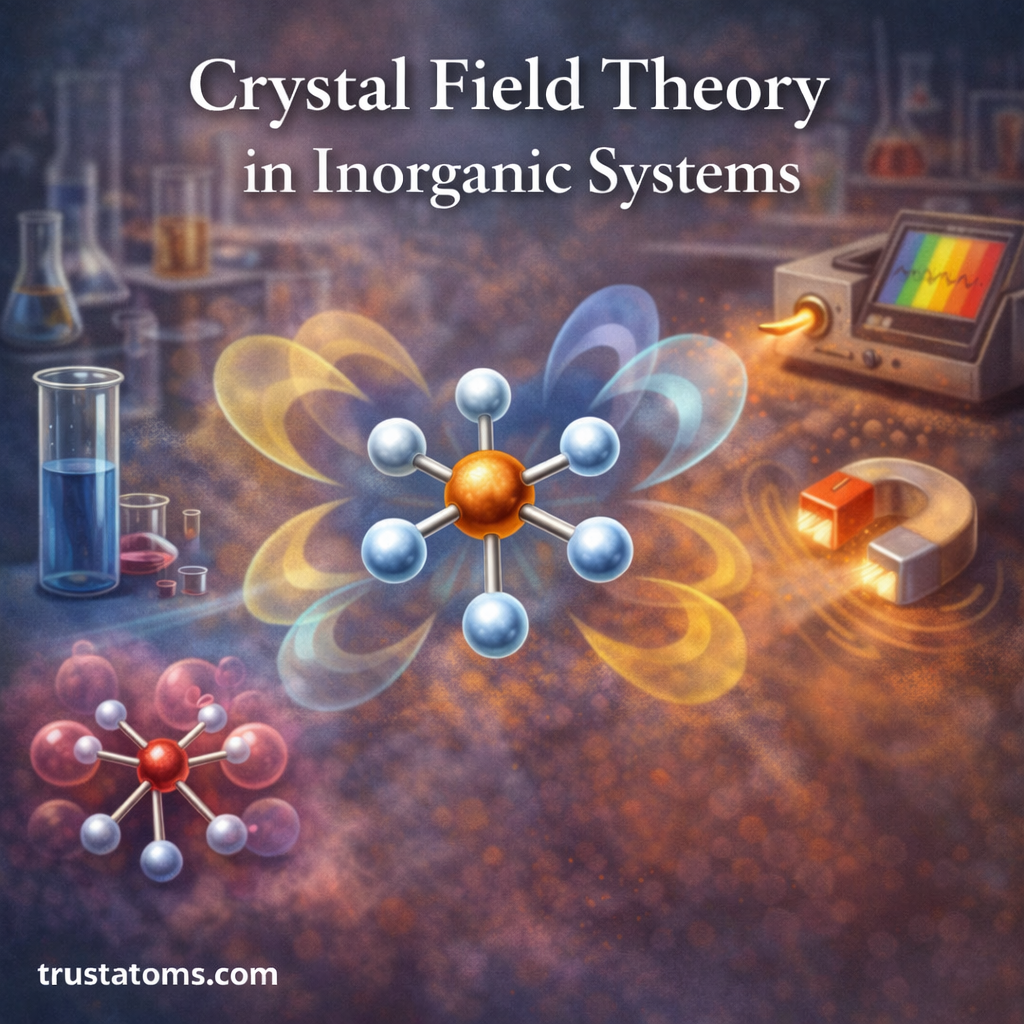
Crystal Field Theory in Inorganic Systems

Illustration explaining crystal field theory in inorganic systems with a transition metal ion surrounded by ligands showing orbital interactions.
Illustration of crystal field theory showing a transition metal ion surrounded by ligands and the resulting orbital interactions in inorganic chemistry. trustatoms.com

Crystal Field Theory (CFT) is an important concept in inorganic chemistry that explains how transition metal ions interact with surrounding molecules or ions called ligands. The theory helps chemists understand the structure, color, magnetism, and stability of coordination compounds.

By analyzing how ligands influence the energy levels of a metal ion’s d-orbitals, Crystal Field Theory provides insight into the behavior of many inorganic systems. It is widely used to explain the properties of metal complexes found in laboratory chemistry, industrial catalysis, and biological molecules.

Understanding Crystal Field Theory allows scientists to predict how metal complexes will behave in chemical reactions and materials.

Continue reading “Crystal Field Theory in Inorganic Systems”

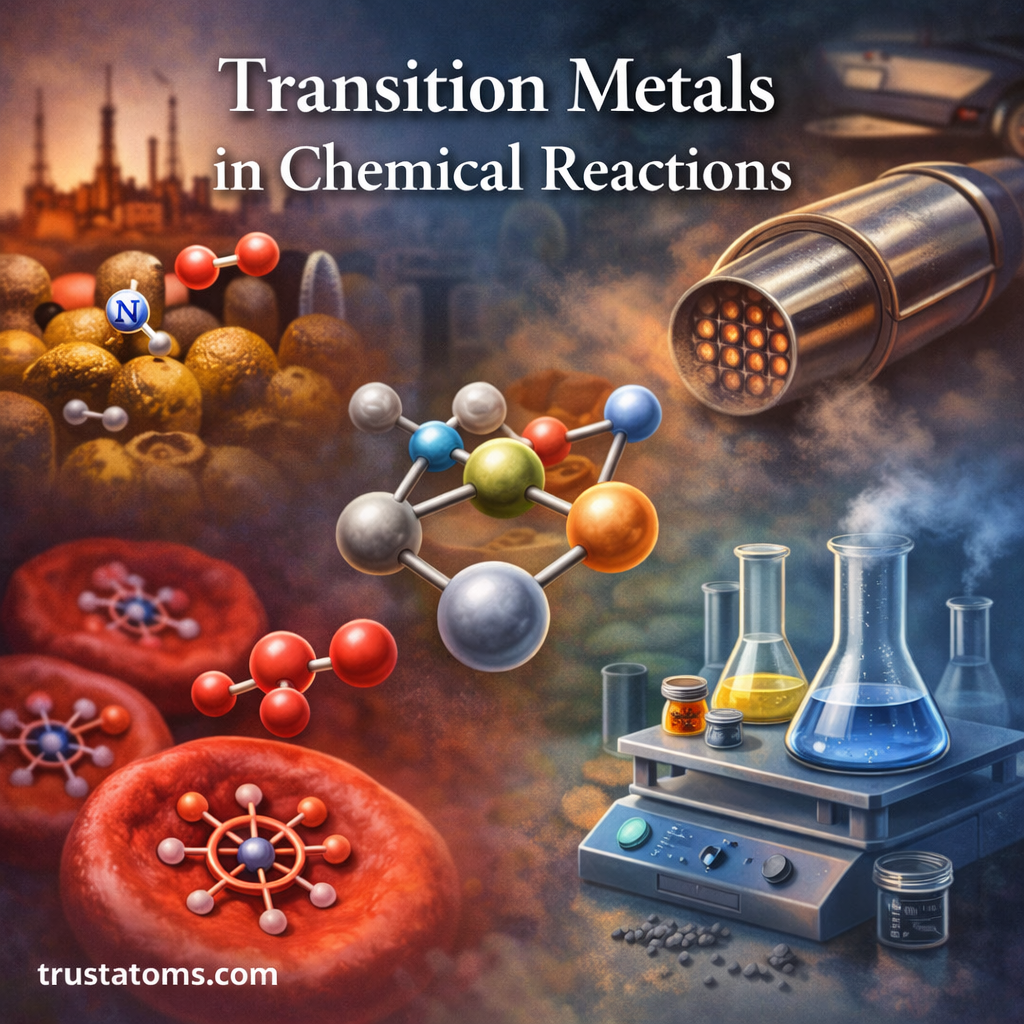
Transition Metals in Chemical Reactions

Illustration showing transition metals in chemical reactions, including catalytic processes in industry, laboratory chemistry, and biological systems.
Illustration representing transition metals driving chemical reactions in laboratories, industrial catalysis, and biological systems. trustatoms.com

Transition metals play a central role in many chemical reactions across nature, industry, and modern technology. Found in the middle of the periodic table, these metals have unique electronic structures that allow them to participate in complex chemical transformations.

Because transition metals can exist in multiple oxidation states and form strong interactions with other molecules, they are widely used as catalysts and reactive centers in chemical systems. From industrial manufacturing to biological processes, transition metals help drive reactions that would otherwise occur slowly or inefficiently.

Understanding how transition metals behave in chemical reactions is an essential part of inorganic chemistry and helps explain many real-world chemical processes.

Continue reading “Transition Metals in Chemical Reactions”

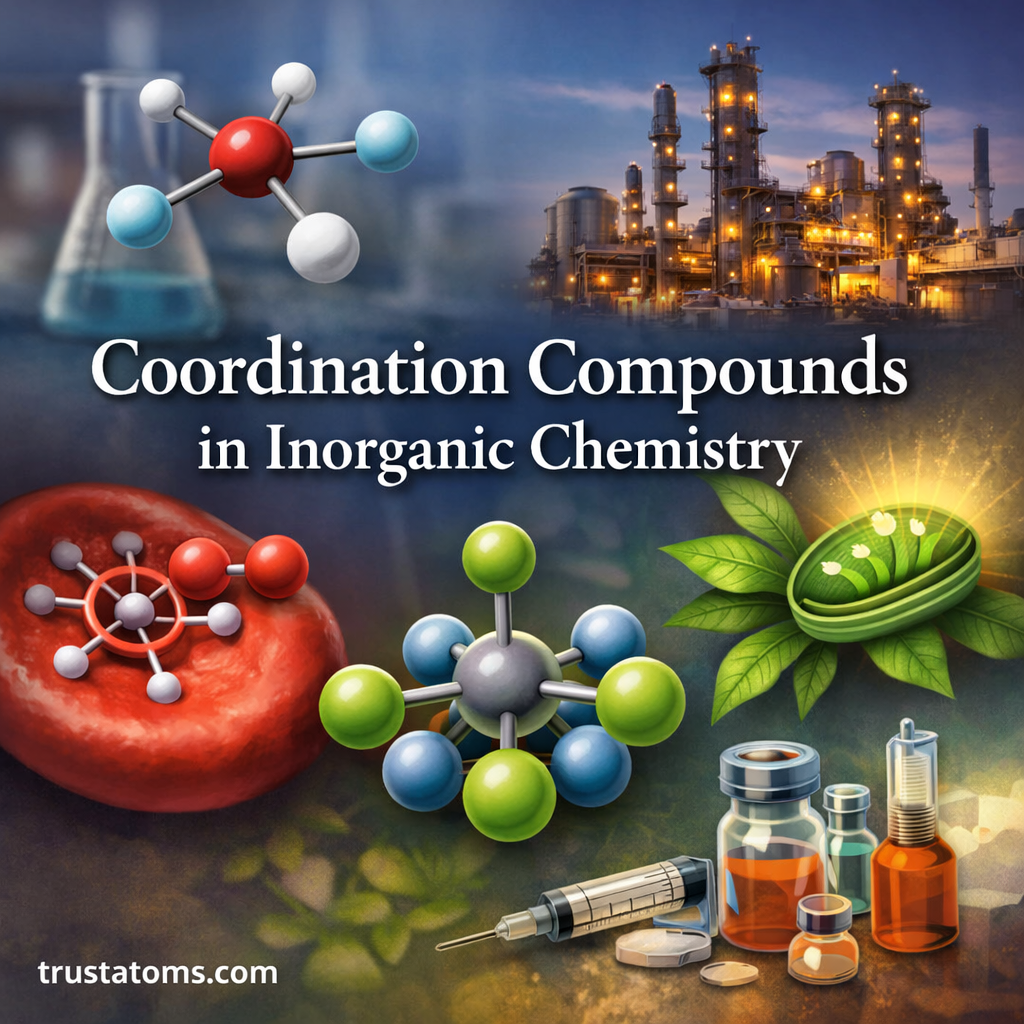
Coordination Compounds in Inorganic Chemistry

Illustration showing coordination compounds in inorganic chemistry with a central metal atom surrounded by ligands, highlighting biological and industrial applications.
Illustration representing coordination compounds with a central metal atom bonded to surrounding ligands, used in biological systems and industrial chemistry. trustatoms.com

Coordination compounds are an essential part of inorganic chemistry, playing a major role in biological systems, industrial processes, and modern materials science. These compounds consist of a central metal atom or ion bonded to surrounding molecules or ions known as ligands.

From oxygen transport in blood to catalysts used in chemical manufacturing, coordination compounds appear in many natural and technological systems. Understanding how these compounds form, behave, and interact helps chemists design new medicines, improve industrial reactions, and develop advanced materials.

Continue reading “Coordination Compounds in Inorganic Chemistry”

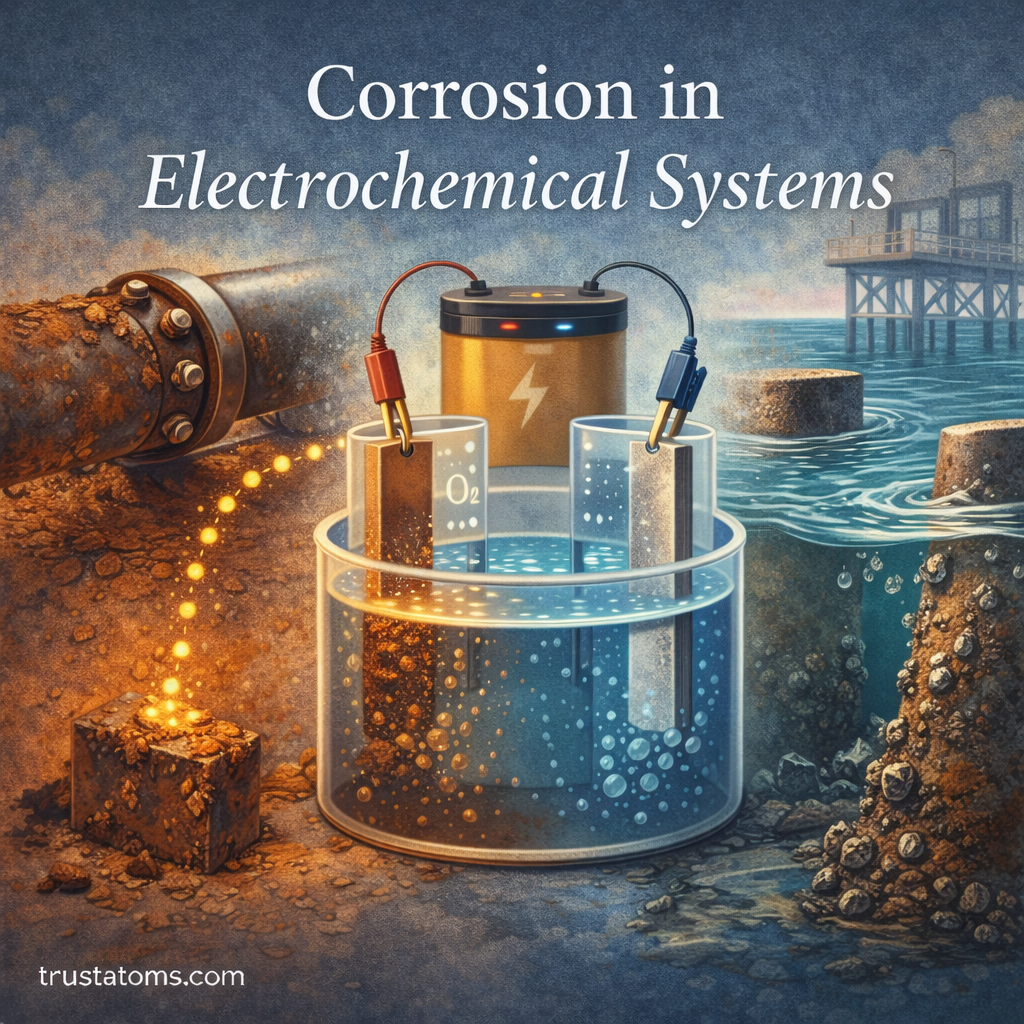
Corrosion in Electrochemical Systems

Illustration showing corrosion processes in electrochemical systems, including rusting metal, an electrochemical corrosion cell, and marine corrosion on metal structures.
Illustration explaining how corrosion occurs in electrochemical systems, including rust formation, electrode reactions, and environmental corrosion. trustatoms.com

Corrosion is a natural electrochemical process that gradually degrades metals through chemical reactions with their environment. It affects everything from bridges and pipelines to vehicles and electronic components.

In electrochemical systems, corrosion occurs when metals lose electrons and form compounds such as oxides, hydroxides, or sulfides. Understanding corrosion from an electrochemical perspective helps scientists and engineers design better materials, improve infrastructure durability, and develop strategies to prevent damage.

Because corrosion can lead to structural failure, economic loss, and safety risks, it is a major focus of research in chemistry, materials science, and engineering.

Continue reading “Corrosion in Electrochemical Systems”

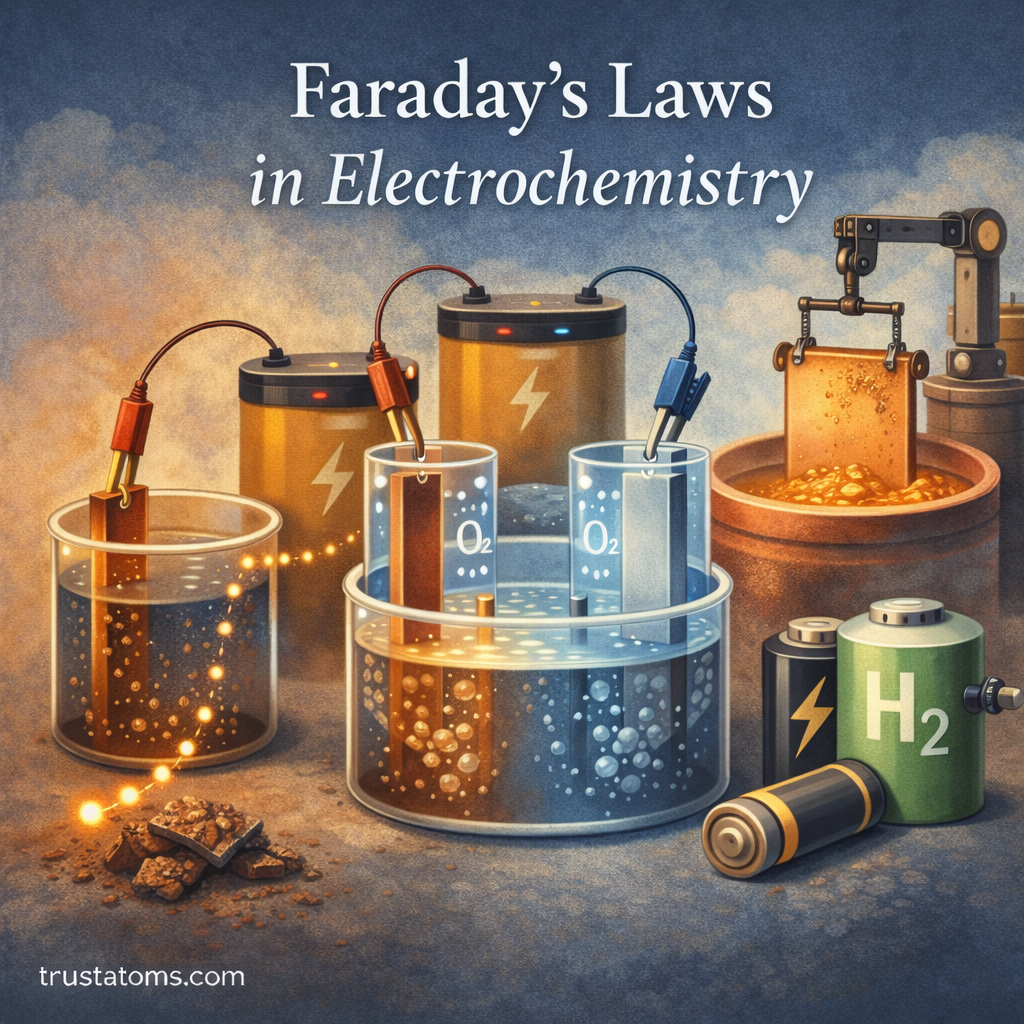
Faraday’s Laws in Electrochemistry

Illustration showing electrolysis processes used to demonstrate Faraday’s Laws in electrochemistry, including metal deposition, water electrolysis, and electron flow between electrodes.
Illustration demonstrating electrolysis processes used to explain Faraday’s Laws in electrochemistry, including metal deposition and water splitting. trustatoms.com

Faraday’s Laws of Electrolysis are foundational principles in electrochemistry that describe how electrical energy drives chemical reactions. These laws explain the relationship between the amount of electric charge passing through a substance and the amount of chemical change that occurs.

First formulated by the scientist Michael Faraday in the 19th century, these laws remain essential for understanding processes such as electroplating, metal refining, battery charging, and hydrogen production.

By linking electricity and chemical reactions quantitatively, Faraday’s work helped establish electrochemistry as a major scientific field and continues to influence modern energy technologies.

Continue reading “Faraday’s Laws in Electrochemistry”

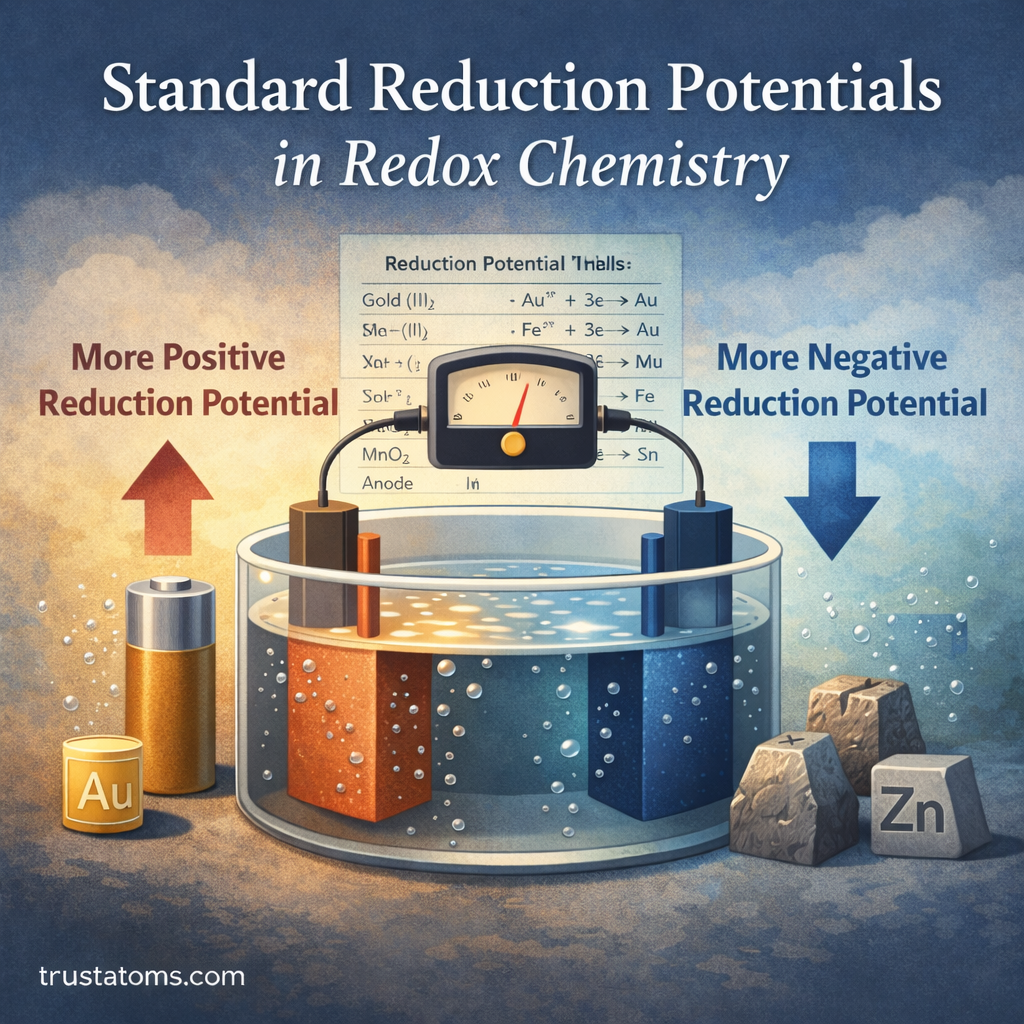
Standard Reduction Potentials in Redox Chemistry

Illustration showing an electrochemical cell and the concept of standard reduction potentials comparing metals with higher and lower tendencies to gain electrons.
Educational illustration explaining how standard reduction potentials influence electron flow and redox reactions in electrochemical cells. trustatoms.com

Standard reduction potentials are a fundamental concept in redox chemistry. They allow scientists to predict how easily a substance will gain electrons during a chemical reaction and help determine whether a redox reaction will occur spontaneously.

This concept is especially important in electrochemistry, where chemical reactions are used to generate electricity in batteries, fuel cells, and other energy systems. By comparing reduction potentials, chemists can determine the direction of electron flow and estimate the voltage produced by electrochemical cells.

Continue reading “Standard Reduction Potentials in Redox Chemistry”

Electrochemical Cells in Energy Systems

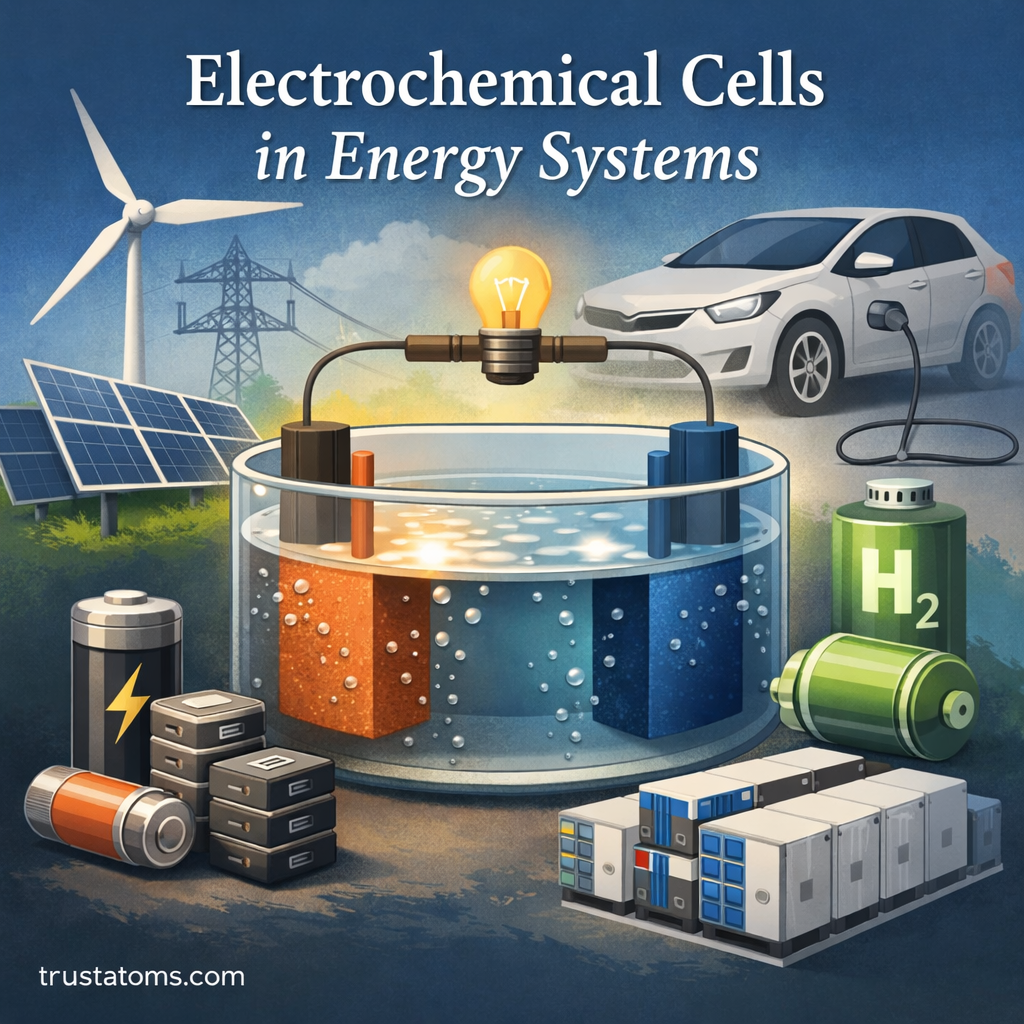
Illustration diagram showing how electrochemical cells power energy systems including renewable energy storage, batteries, and electric vehicles.
Illustration showing how electrochemical cells store and deliver energy in modern systems such as renewable grids, batteries, and electric vehicles. trustatoms.com

Electrochemical cells are a cornerstone of modern energy technology. From powering smartphones and laptops to supporting renewable energy storage and electric vehicles, these systems convert chemical energy into electrical energy through controlled chemical reactions.

As the global energy landscape shifts toward cleaner and more sustainable solutions, electrochemical cells are becoming increasingly important. Understanding how they work helps explain many of the technologies that support modern power systems, portable electronics, and large-scale energy storage.

Continue reading “Electrochemical Cells in Energy Systems”

Catalysis in Reaction Dynamics

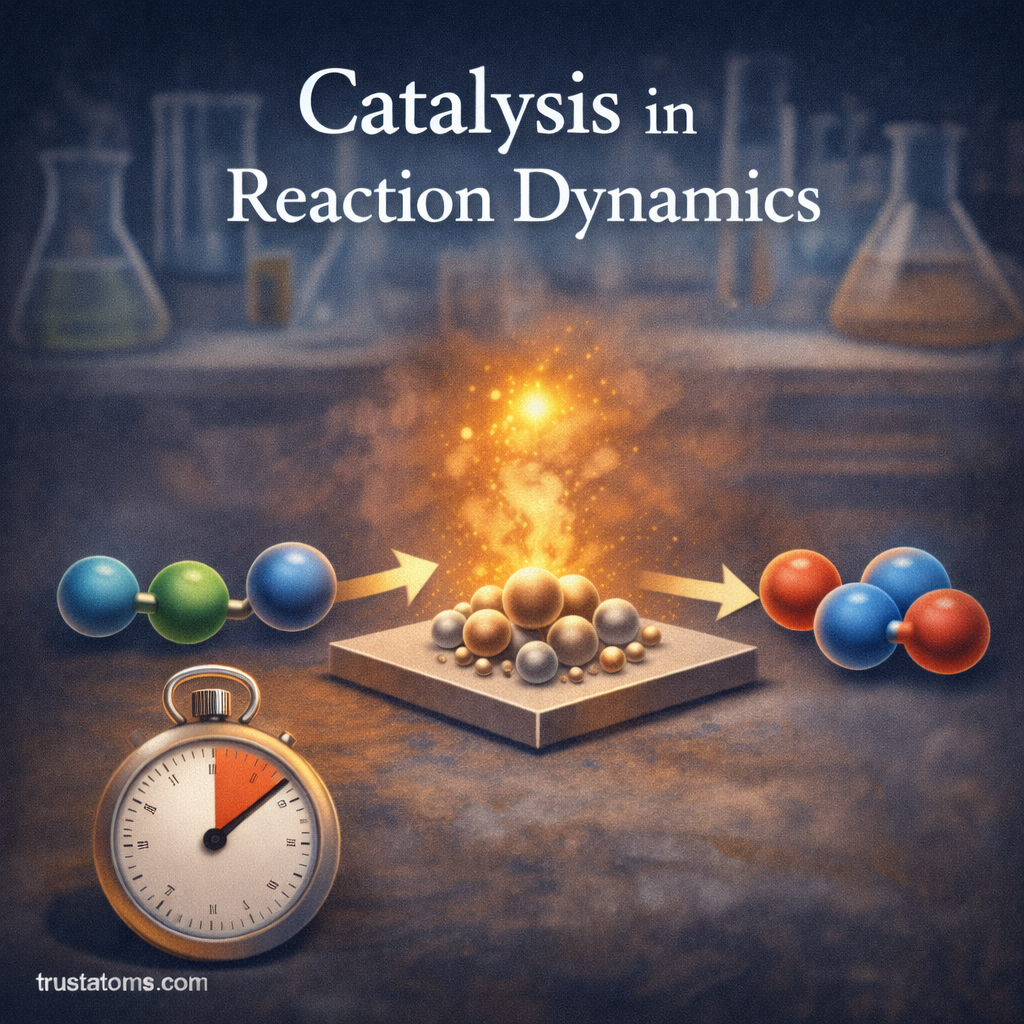
Illustration showing molecules reacting on a catalyst surface to speed up a chemical reaction in reaction dynamics.
Illustration depicting molecules interacting with a catalyst surface that accelerates a chemical reaction. trustatoms.com.

Many chemical reactions occur very slowly under normal conditions. In both natural systems and industrial processes, reactions often need to happen faster or more efficiently. This is where catalysis becomes important.

Catalysis refers to the process in which a substance called a catalyst speeds up a chemical reaction without being permanently consumed. By lowering the energy barrier of a reaction, catalysts help reactions occur more quickly and efficiently while maintaining the same overall chemical outcome.

Understanding catalysis is a key part of reaction dynamics, which studies how chemical reactions proceed and what factors influence their speed and pathways.

Continue reading “Catalysis in Reaction Dynamics”

Activation Energy in Reaction Pathways

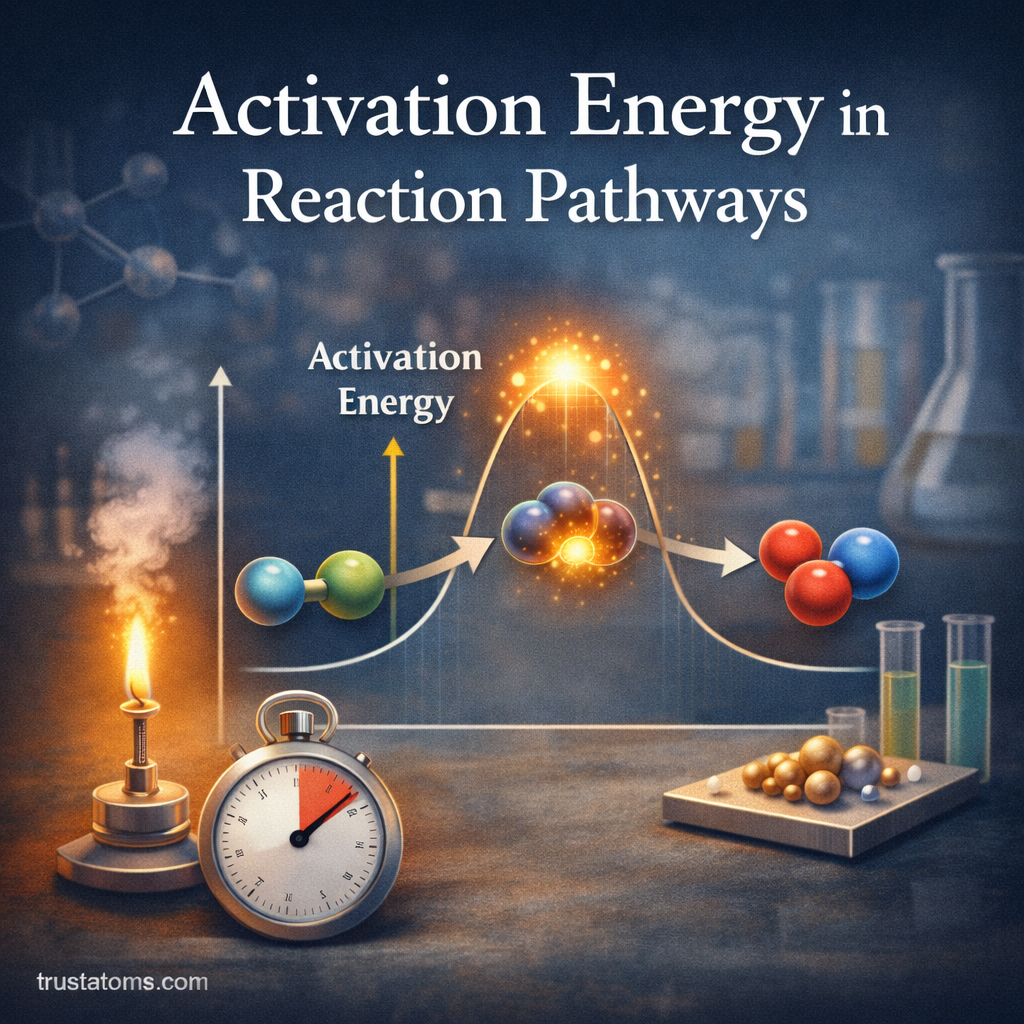
Illustration showing molecules crossing an energy barrier during a chemical reaction pathway to explain activation energy.
Illustration showing molecules overcoming an energy barrier during a reaction pathway, representing activation energy in chemistry. trustatoms.com.

Chemical reactions occur when atoms and molecules rearrange to form new substances. However, not every molecular collision results in a reaction. For a reaction to proceed, molecules must first overcome a specific energy barrier known as activation energy.

Activation energy plays a crucial role in determining how quickly a chemical reaction occurs and which pathway a reaction follows. By understanding activation energy, chemists can better predict reaction rates, control chemical processes, and design more efficient reactions.

Continue reading “Activation Energy in Reaction Pathways”