Kinetic Energy Formula and Examples

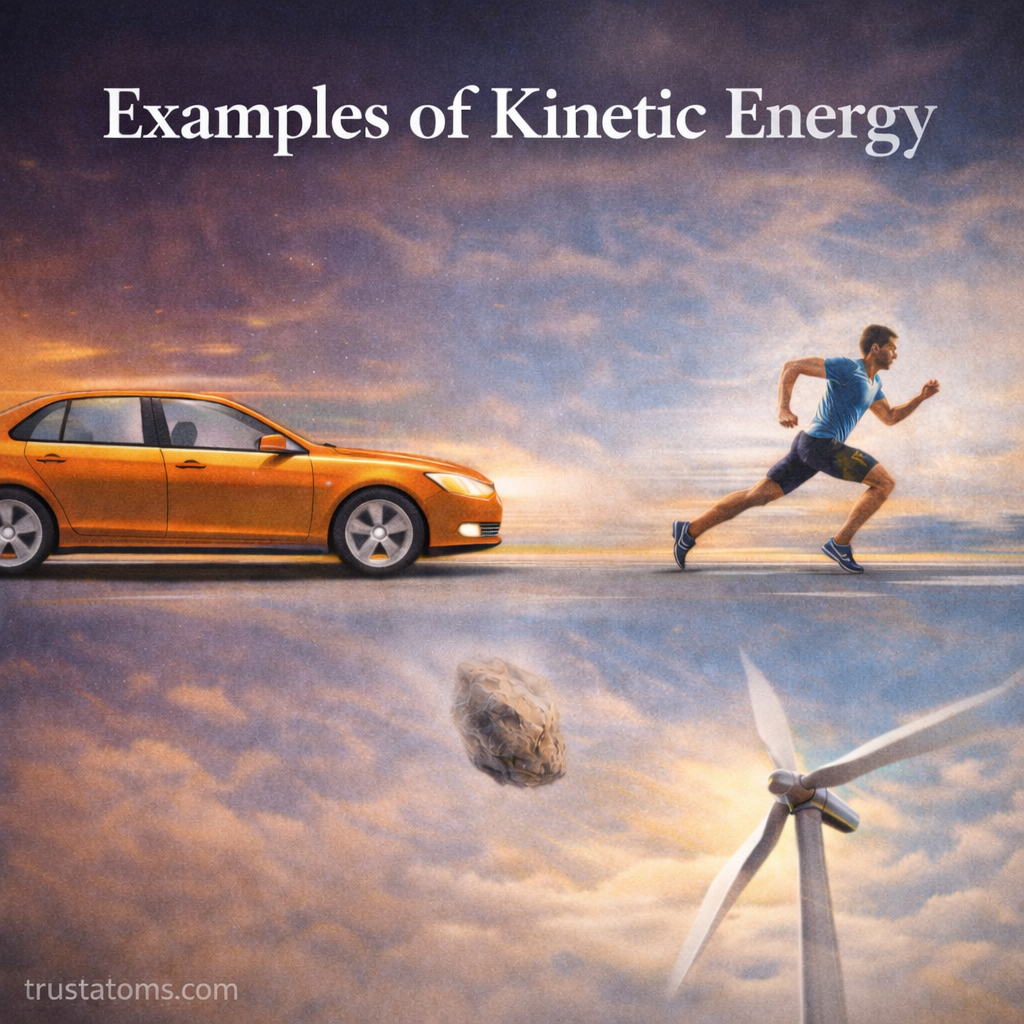
Illustration showing examples of kinetic energy including a moving car, a running athlete, a falling rock, and a spinning wind turbine.
Examples of kinetic energy shown through everyday motion including a car, runner, falling rock, and wind turbine. trustatoms.com

Kinetic energy is the energy an object has because it is moving.

From speeding cars to flowing rivers, kinetic energy explains how motion carries power. In this guide, you’ll learn the kinetic energy formula, how to use it, and see clear step-by-step examples.

Continue reading “Kinetic Energy Formula and Examples”
What Is Kinetic Energy?

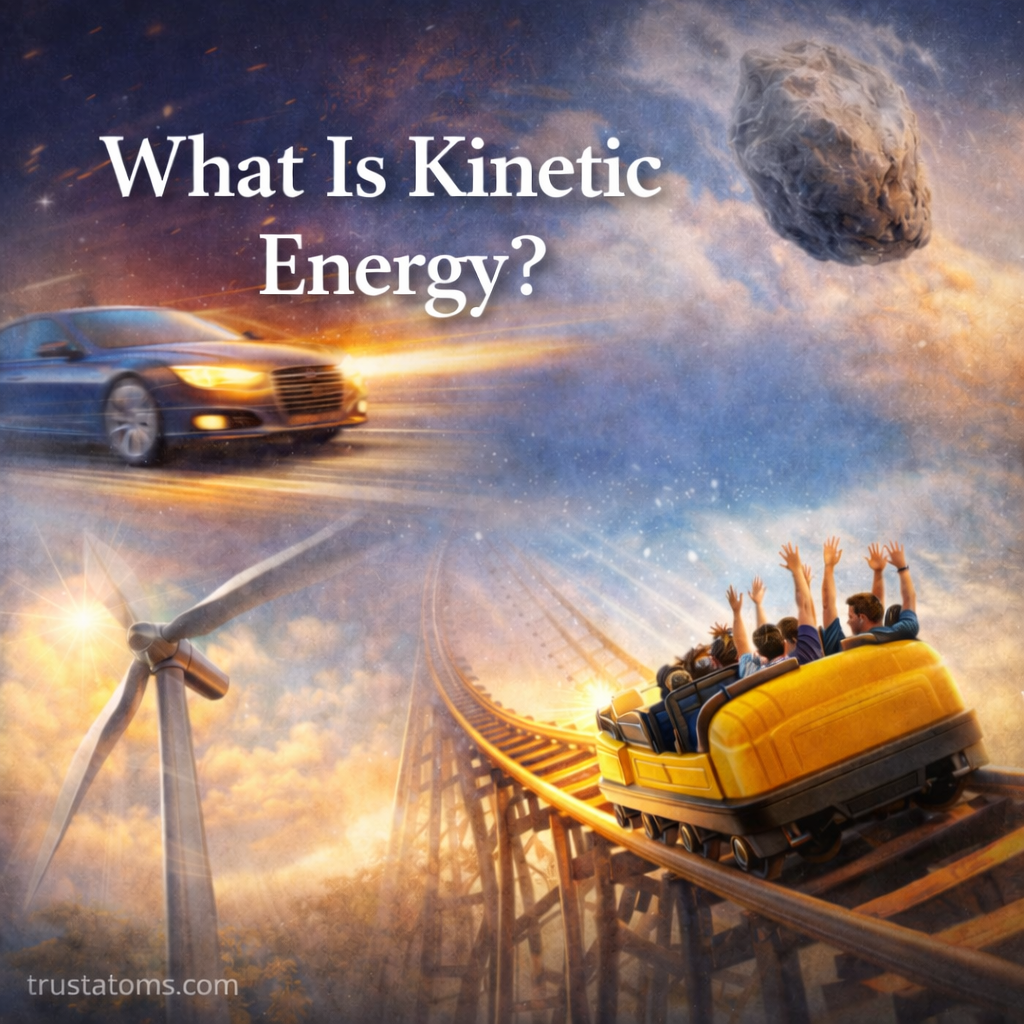
Illustration showing kinetic energy examples including a moving car, roller coaster, wind turbine, and asteroid, with trustatoms.com watermark.
Examples of kinetic energy in motion, including vehicles, rides, natural forces, and moving objects. trustatoms.com.

Kinetic energy is the energy an object has because it is moving.

Every time something moves — a car on the highway, a falling apple, or even air molecules in the wind — it has kinetic energy.

In this guide, you’ll learn:

  • What kinetic energy is
  • The kinetic energy formula
  • How mass and speed affect it
  • Real-life examples
  • How it connects to other physics concepts
Continue reading “What Is Kinetic Energy?”

Momentum Formula and the Law of Conservation of Momentum

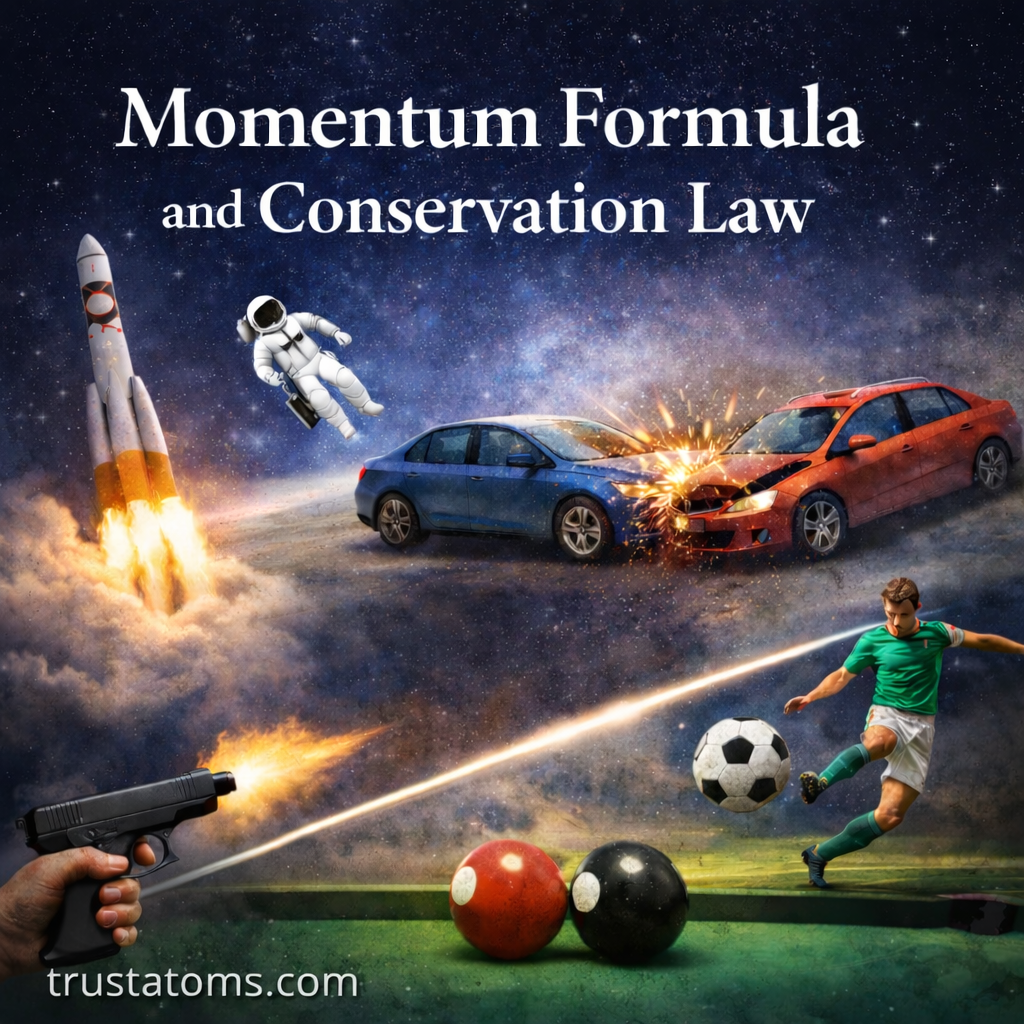
Educational image showing real-world examples of momentum including a rocket launch, astronaut in space, car collision, soccer kick, billiard balls, and a fired bullet, illustrating conservation of momentum.
Real-world demonstrations of momentum and conservation through rockets, collisions, sports, and object impacts. trustatoms.com.

Momentum is one of the most important concepts in physics. It explains why a moving truck is harder to stop than a bicycle, why airbags save lives, and how rockets launch into space.

In this guide, we’ll break down the momentum formula, what it means, and how the law of conservation of momentum works in real-world situations.

Continue reading “Momentum Formula and the Law of Conservation of Momentum”

What Is Momentum?

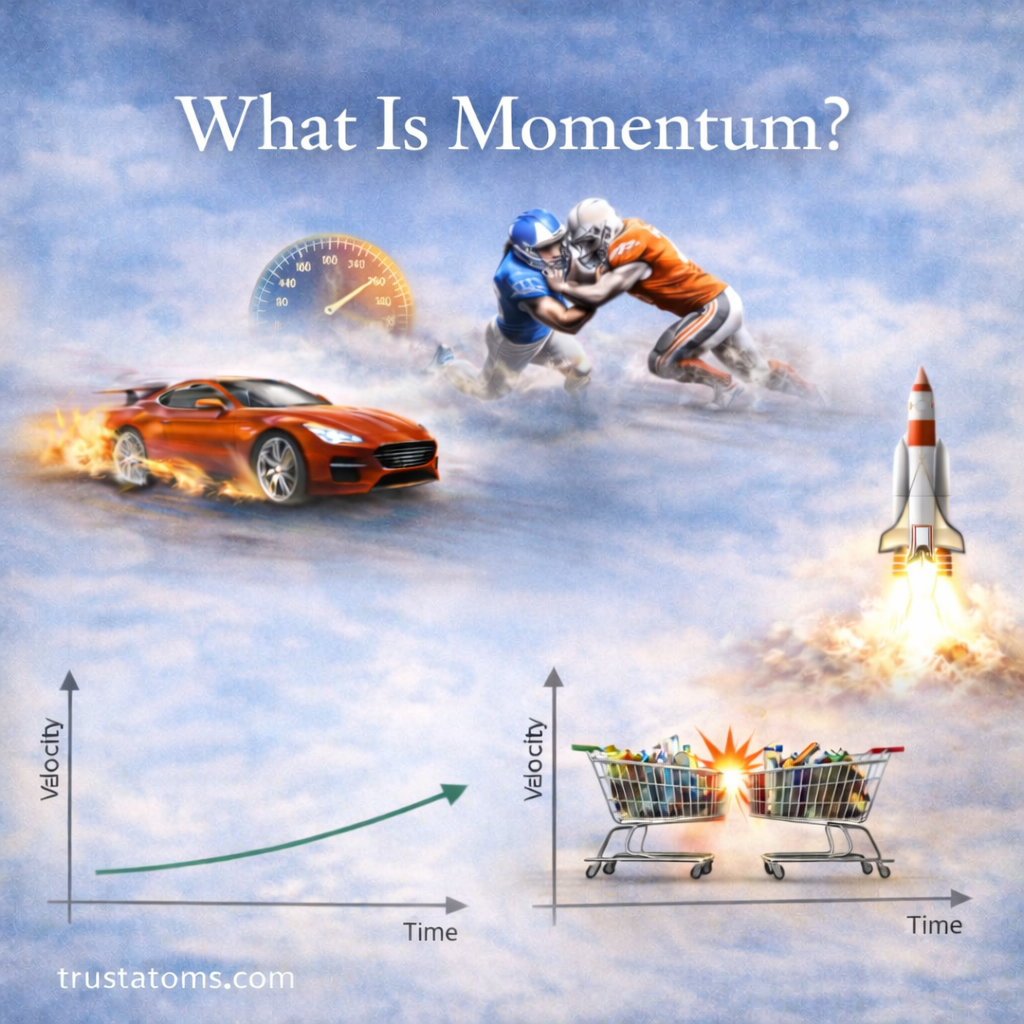
Simplified educational graphic explaining momentum with examples of a speeding car, football collision, rocket launch, and shopping cart crash on a soft sky background.
Visual examples of momentum including a moving car, football players colliding, a rocket launch, and shopping carts crashing. trustatoms.com.

Momentum is a fundamental concept in physics that describes how much motion an object has. The more momentum something has, the harder it is to stop.

Momentum helps explain car crashes, sports collisions, rocket propulsion, and even how objects move in space.

In this guide, you’ll learn what momentum is, how it’s calculated, and why it plays a crucial role in understanding motion.

Continue reading “What Is Momentum?”

Velocity vs Acceleration: Key Differences

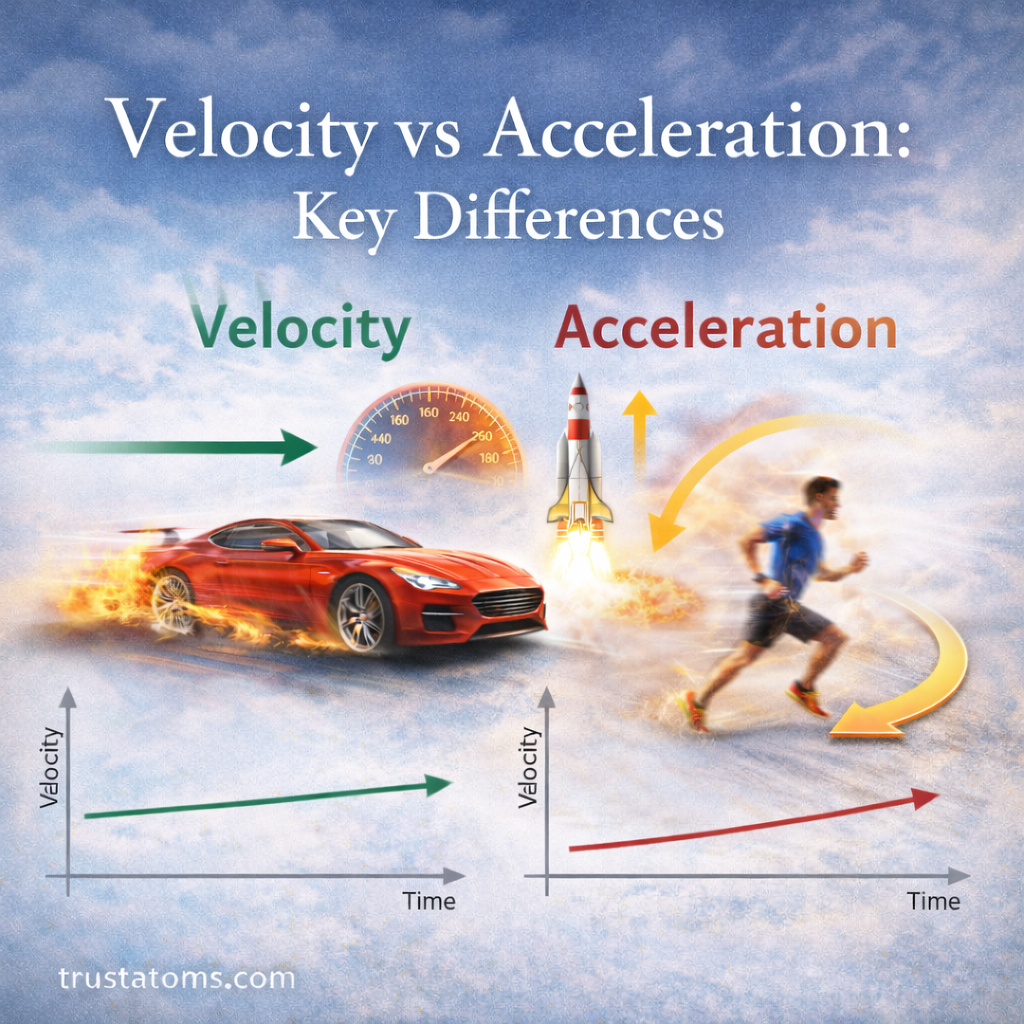
Illustration comparing velocity and acceleration with examples of a moving car, rocket launch, and runner turning, including motion graphs.
Visual comparison of velocity and acceleration showing motion versus change in motion. trustatoms.com

Velocity and acceleration are closely related concepts in physics, but they are not the same thing. Many people confuse the two because both describe motion.

Understanding the difference between velocity and acceleration is essential for grasping Newton’s laws, force, and motion.

In this guide, we’ll break down their definitions, formulas, units, and real-world differences in simple terms.

Continue reading “Velocity vs Acceleration: Key Differences”

What Is Acceleration?

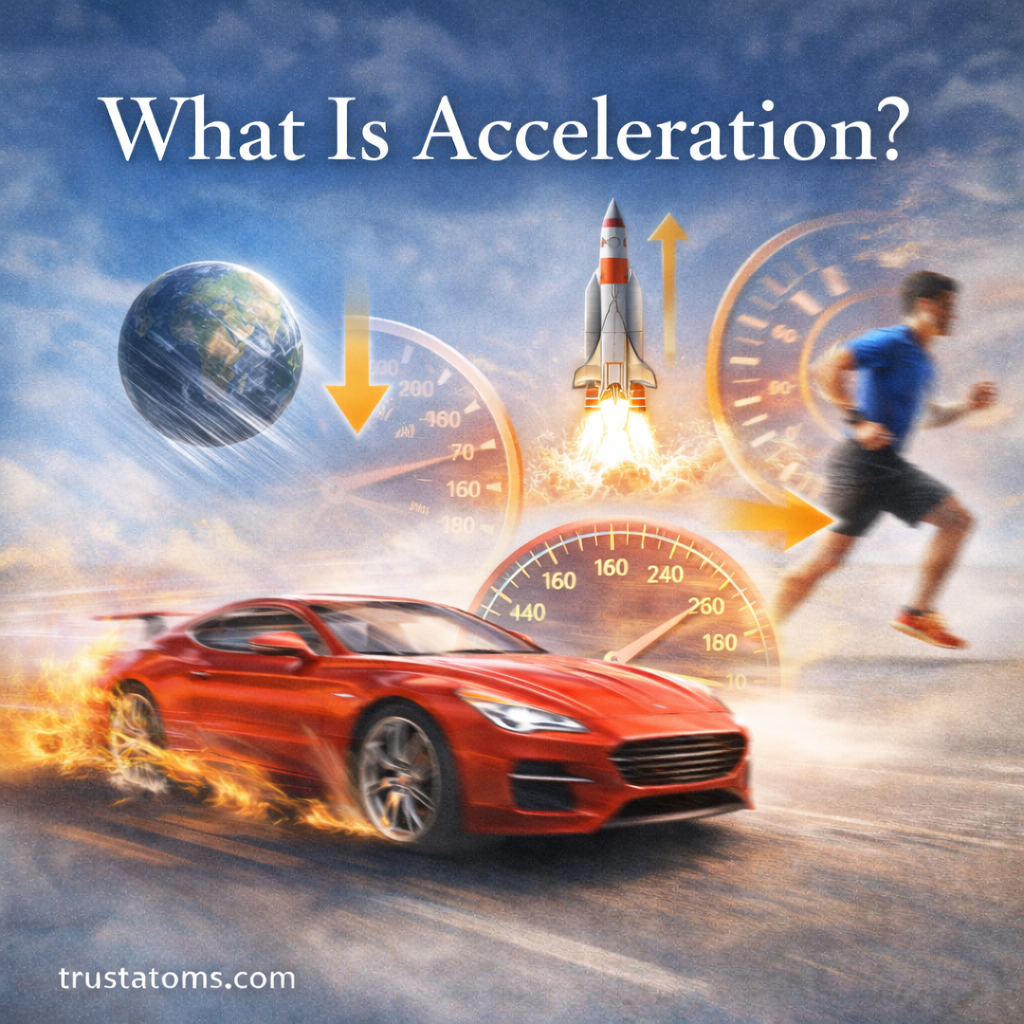
Illustration explaining acceleration in physics with examples of a speeding car, rocket launch, falling object due to gravity, and a runner changing speed.
Visual explanation of acceleration showing changes in speed and direction in everyday motion. trustatoms.com

Acceleration is one of the most important concepts in physics. It explains how motion changes over time — whether something speeds up, slows down, or changes direction.

Many people think acceleration only means “speeding up.” In physics, it has a broader and more precise meaning.

In this guide, you’ll learn what acceleration is, how it’s calculated, and how it applies to everyday motion and advanced physics.

Continue reading “What Is Acceleration?”

What Is Force in Physics?

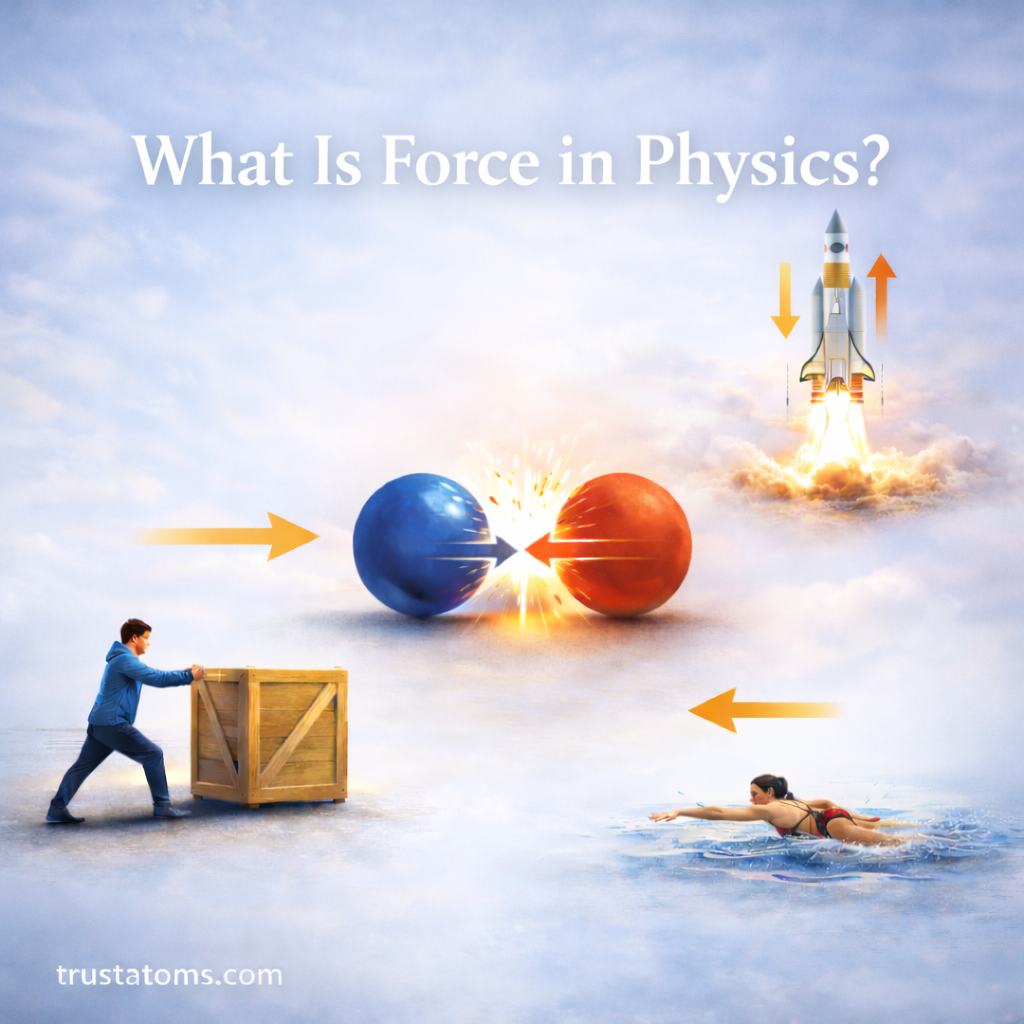
White title text reading “What Is Force in Physics?” over an illustration showing colliding spheres, a rocket launch, a person pushing a crate, and a swimmer demonstrating force in motion.
“What Is Force in Physics?” illustrated through collisions, pushing, rocket propulsion, and swimming examples. trustatoms.com.

Force is one of the most fundamental concepts in physics. It explains why objects move, stop, accelerate, change direction, or even change shape.

In simple terms, a force is a push or a pull acting on an object. But in physics, force is more than just movement — it is the cause of acceleration.

In this guide, we’ll break down what force means in physics, how it’s measured, the different types of forces, and how it affects the world around us.

Continue reading “What Is Force in Physics?”

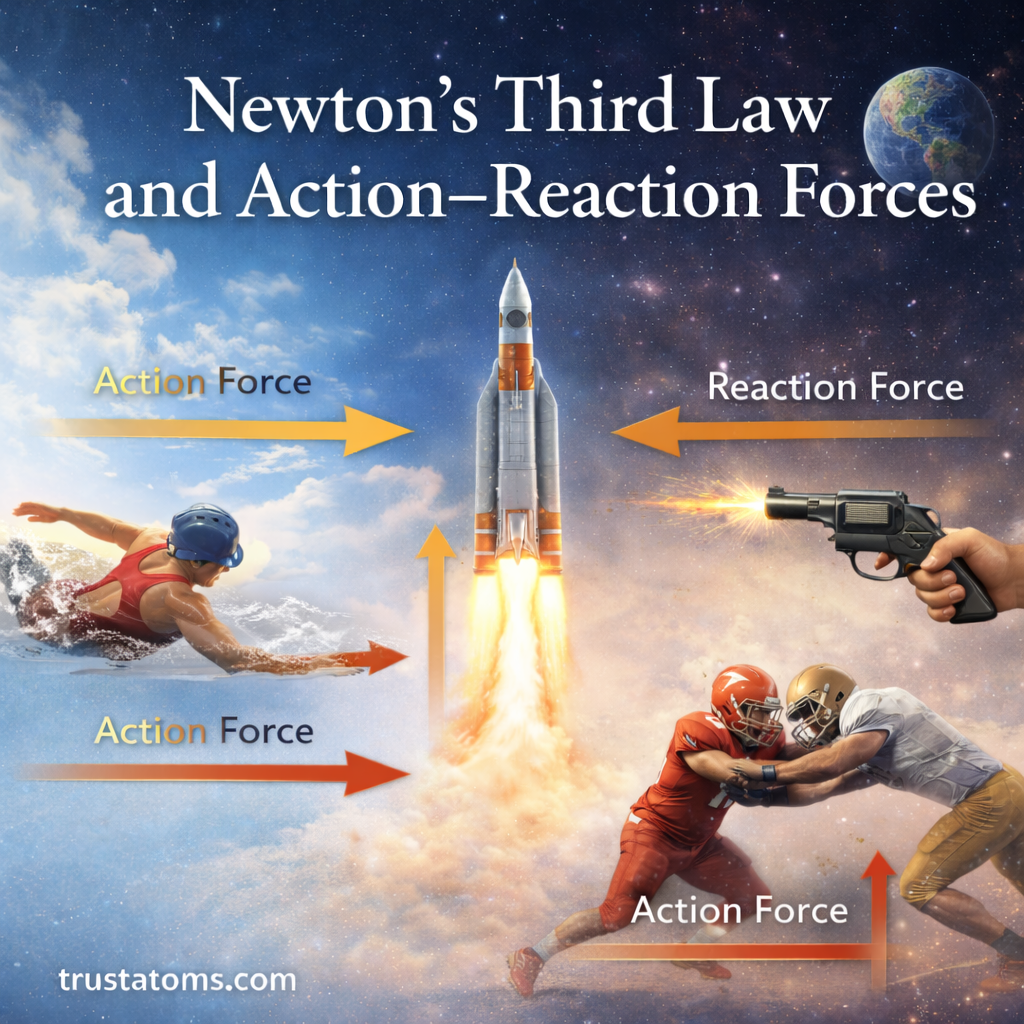
Newton’s Third Law and Action–Reaction Forces

Illustration explaining Newton’s Third Law with examples of a rocket launch, swimmer pushing water, gun recoil, and football collision demonstrating action and reaction forces.
Visual explanation of Newton’s Third Law showing equal and opposite action–reaction forces in real-world examples. trustatoms.com

Newton’s Third Law of Motion explains how forces interact between objects. It describes why rockets launch, why you move backward when you jump off a boat, and why walking is even possible.

The law introduces the concept of action–reaction forces, showing that forces always come in pairs.

In this guide, you’ll learn what Newton’s Third Law states, how action–reaction forces work, and where we see them in everyday life and advanced physics.

Continue reading “Newton’s Third Law and Action–Reaction Forces”

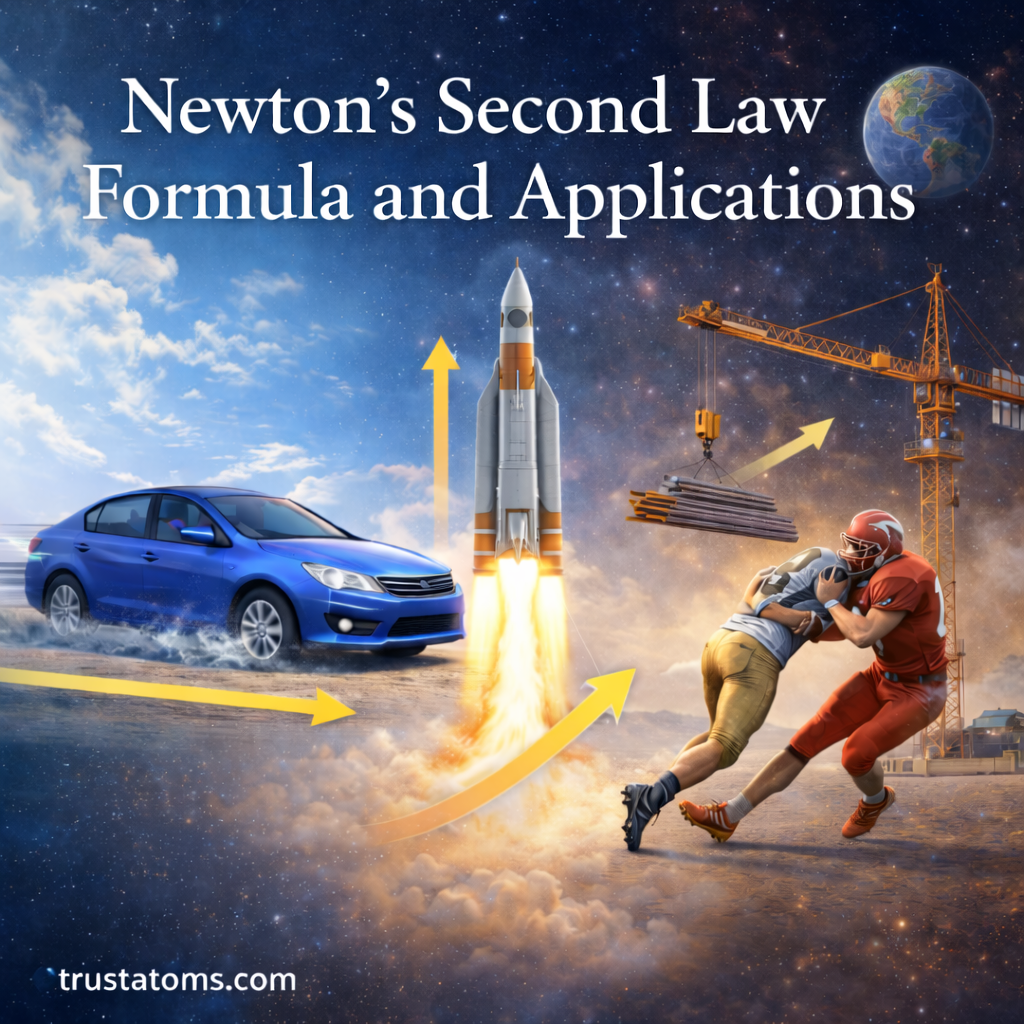
Newton’s Second Law Formula and Applications

Illustration showing Newton’s Second Law with a car accelerating, a rocket launching, construction crane lifting materials, and football players colliding to demonstrate force and motion.
Real-world examples of Newton’s Second Law showing how force affects motion in cars, rockets, construction, and sports. trustatoms.com.

Newton’s Second Law of Motion explains how force, mass, and acceleration are connected. It tells us exactly how much an object will accelerate when a certain force is applied.

This law is one of the most important formulas in physics because it allows us to calculate motion. From cars speeding up to rockets launching into space, Newton’s Second Law helps engineers and scientists predict how objects will behave.

In this guide, we’ll break down the formula, explain each variable, and explore real-world applications.

Continue reading “Newton’s Second Law Formula and Applications”

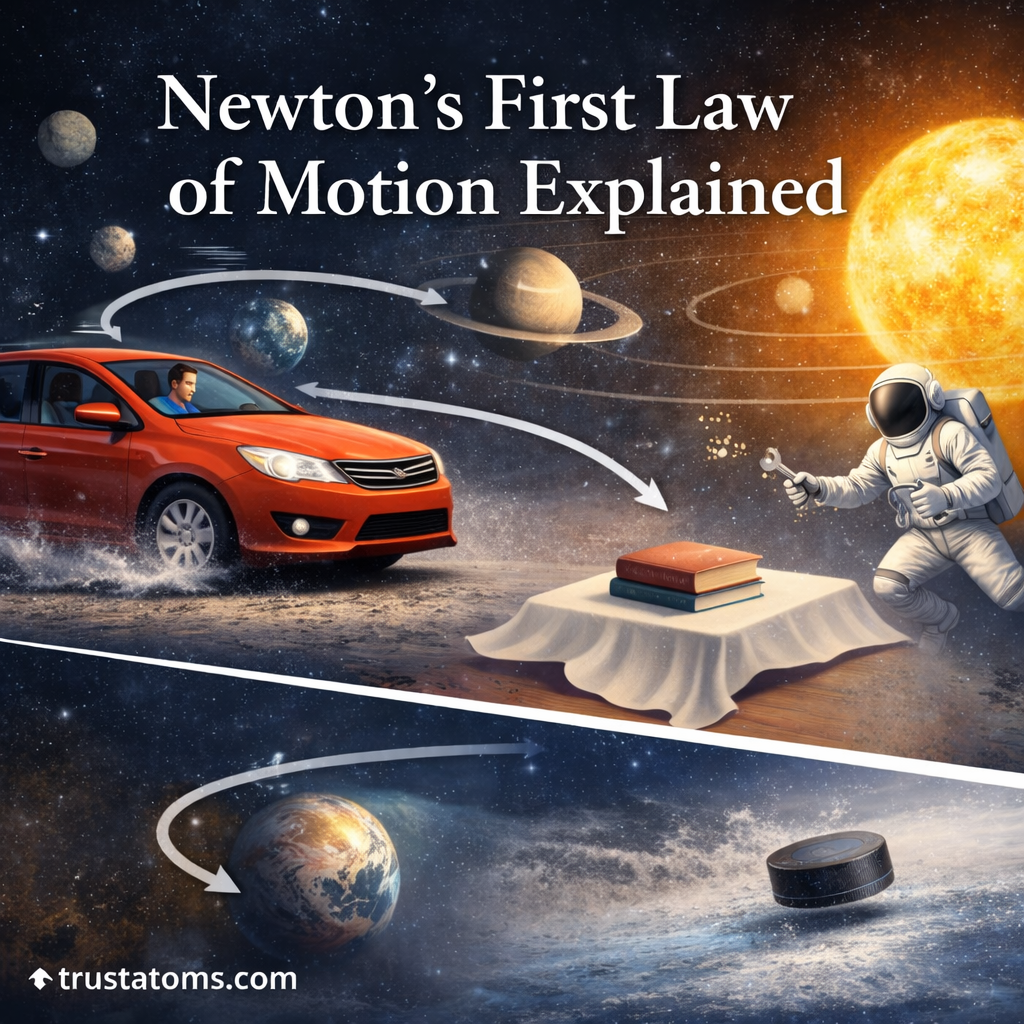
Newton’s First Law of Motion Explained

Illustration explaining Newton’s First Law of Motion with examples including a braking car, floating astronaut, book on tablecloth, hockey puck, and planetary motion.
Visual explanation of Newton’s First Law of Motion and inertia in everyday life and space. trustatoms.com

Newton’s First Law of Motion is one of the most important principles in physics. It explains why objects stay still, why moving objects keep moving, and why forces are needed to change motion.

Often called the Law of Inertia, this principle forms the foundation of classical mechanics and helps us understand everything from car safety to planetary motion.

In this guide, we’ll break down Newton’s First Law in simple terms, explore real-world examples, and explain why it matters.

Continue reading “Newton’s First Law of Motion Explained”