Fundamental Interactions in Theoretical Physics

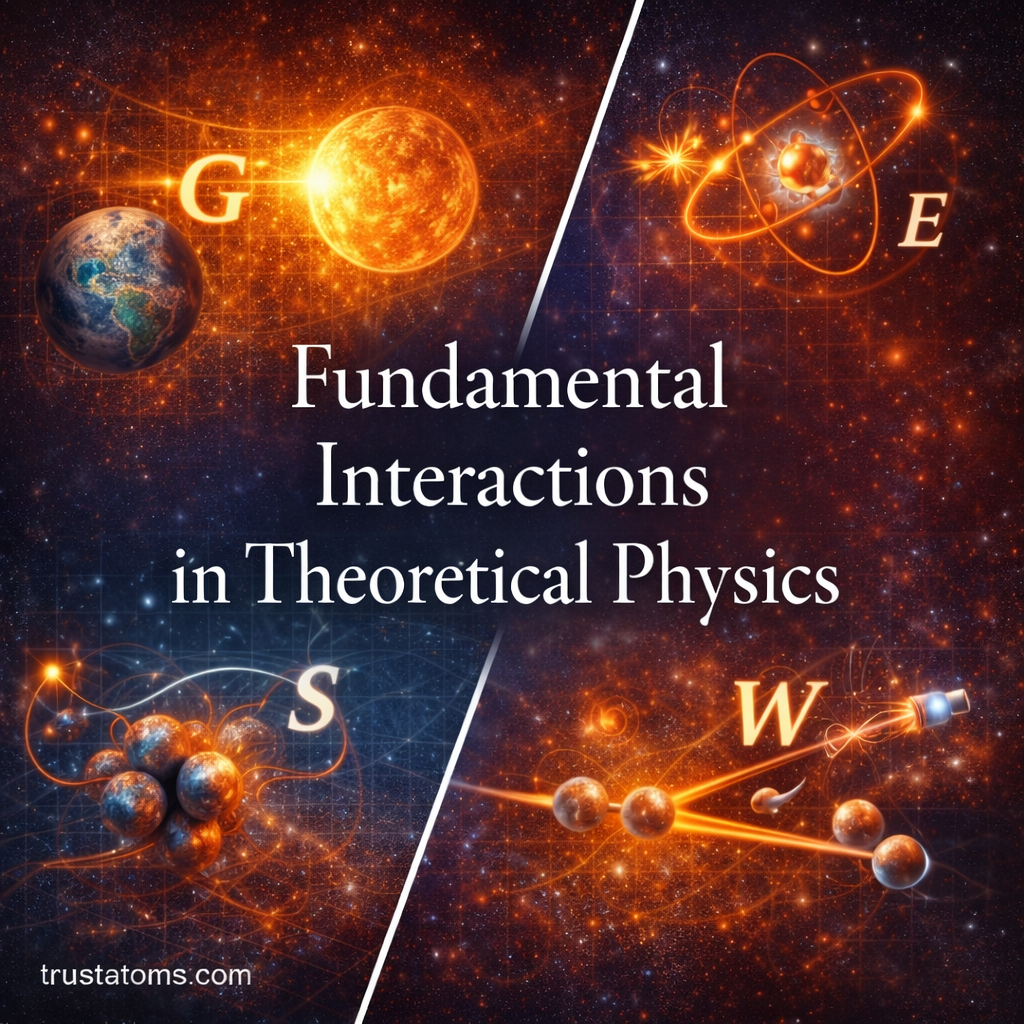
Illustration representing the four fundamental interactions in theoretical physics, including gravity, electromagnetism, strong force, and weak force in a cosmic setting.
Conceptual visualization of the four fundamental interactions shaping matter and the universe. trustatoms.com

At the deepest level, everything in the universe is governed by a small set of fundamental interactions.

From the motion of planets to the structure of atoms, from nuclear reactions in stars to the chemistry of life, all physical phenomena arise from just four fundamental forces.

In theoretical physics, understanding these interactions is the key to understanding reality itself.

In this guide, we’ll explore:

  • The four fundamental interactions
  • How they differ in strength and range
  • How modern physics describes them
  • The search for a unified theory
Continue reading “Fundamental Interactions in Theoretical Physics”

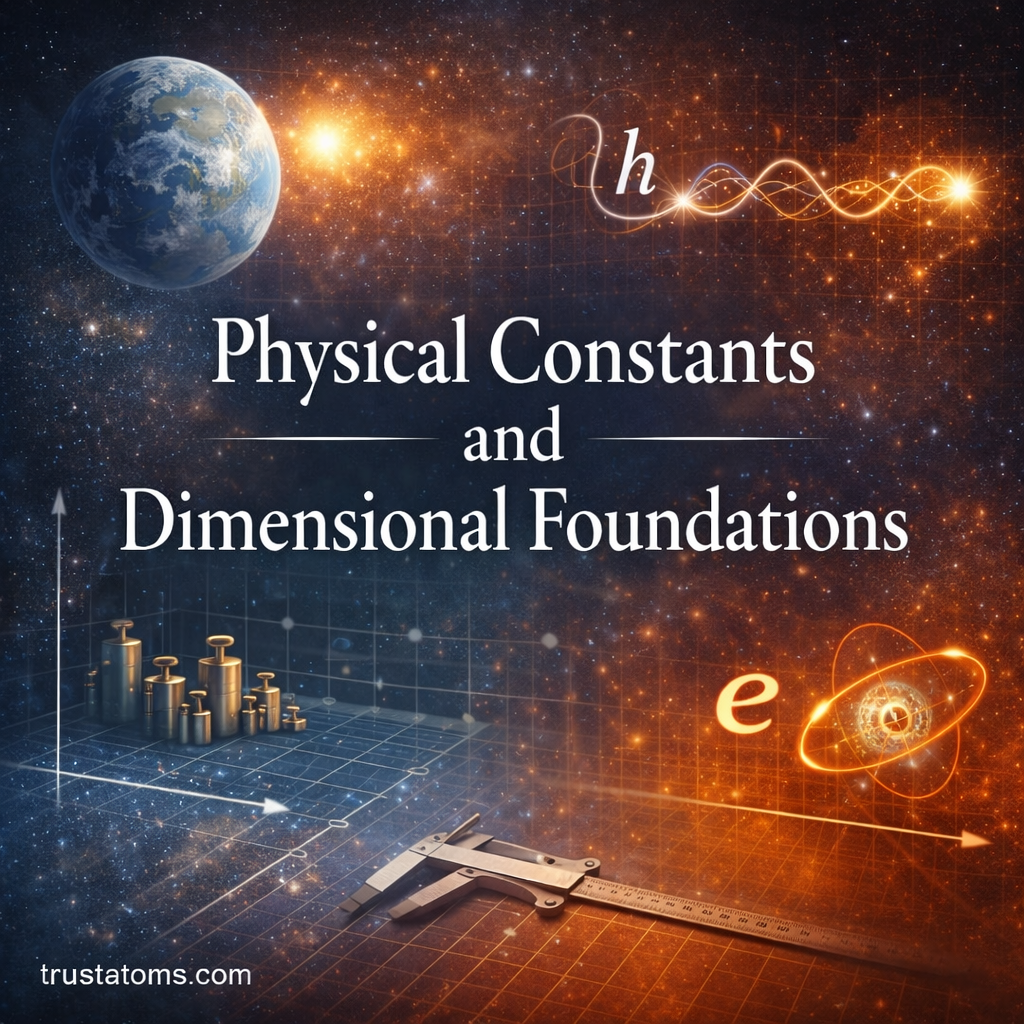
Physical Constants and Dimensional Foundations

Illustration representing physical constants and dimensional foundations with measurement tools, atomic model, planetary imagery, and conceptual physics elements.
Conceptual visualization of physical constants and dimensional foundations in physics. trustatoms.com

Every equation in physics rests on a deeper foundation — physical constants and dimensional structure.

From gravity to electromagnetism, from quantum mechanics to cosmology, the laws of nature depend on fixed quantities that do not change across space or time. These are called physical constants.

But constants alone are not enough. They only make sense within a dimensional framework — a system that defines how quantities like length, time, mass, and charge relate to one another.

In this guide, we’ll explore:

  • What physical constants are
  • Why dimensions matter
  • The structure of fundamental units
  • How constants shape the laws of physics
  • Why dimensional analysis is a powerful scientific tool
Continue reading “Physical Constants and Dimensional Foundations”

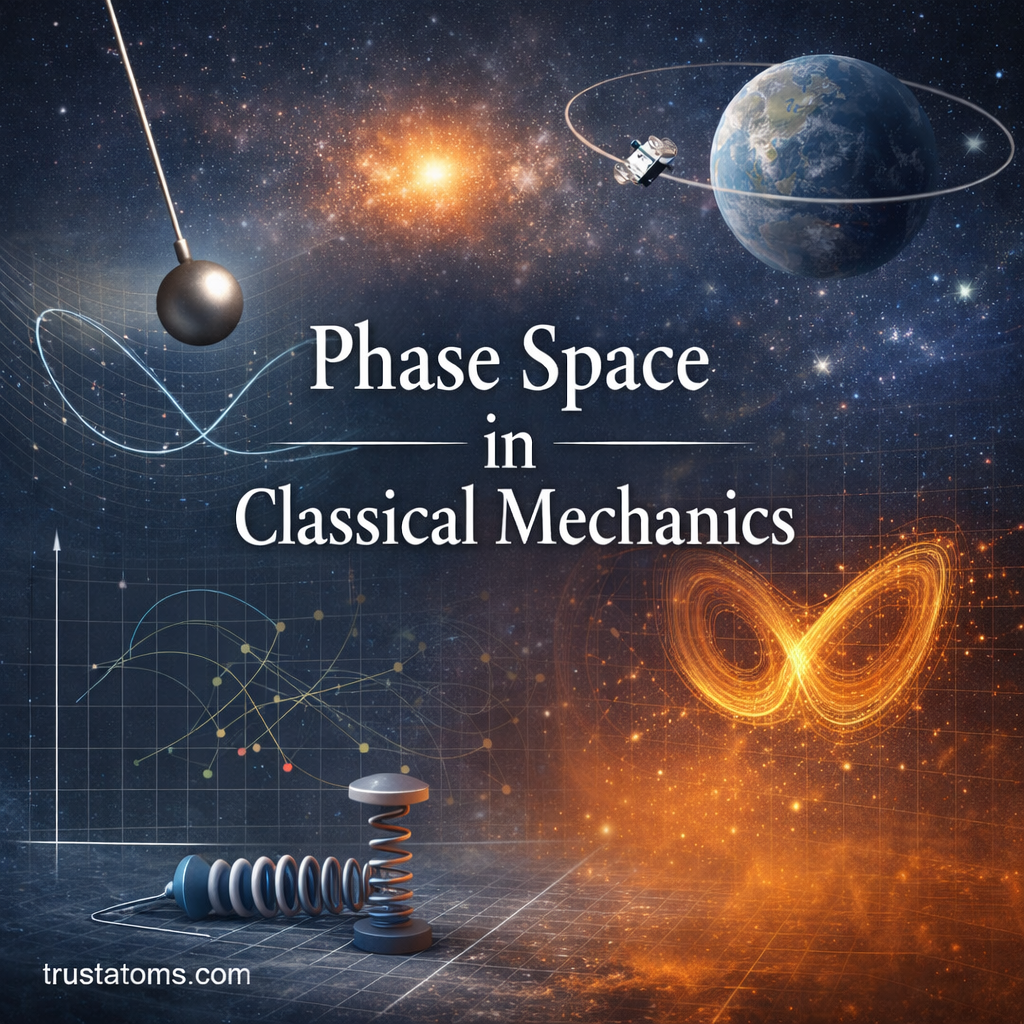
Phase Space in Classical Mechanics

Conceptual illustration of phase space in classical mechanics showing a pendulum, mass-spring system, orbital motion, and phase space trajectories with title overlay.
Conceptual visualization of phase space in classical mechanics highlighting motion, trajectories, and system dynamics. trustatoms.com

In classical mechanics, understanding motion is not just about tracking position over time. Physicists often need a deeper framework — one that captures the entire state of a system at once.

That framework is called phase space.

Phase space is one of the most powerful visualization tools in physics. It allows scientists to analyze stability, predict long-term behavior, and understand complex systems — from swinging pendulums to planetary motion.

In this guide, we’ll explain phase space in classical mechanics clearly and practically, without heavy mathematics.

Continue reading “Phase Space in Classical Mechanics”

Stability Analysis in Dynamical Systems

Illustration of stability analysis in dynamical systems featuring a pendulum, orbital motion, bridge, ocean waves, and phase space concept with title overlay.
Conceptual illustration representing stability analysis in dynamical systems across physics and engineering applications. trustatoms.com

Dynamical systems are everywhere — from planetary orbits and electrical circuits to ecosystems and financial markets. But one key question unites them all: Will the system remain stable, or will it spiral into chaos?

Stability analysis in dynamical systems helps physicists and engineers determine how systems respond to disturbances. Do they return to equilibrium? Drift away? Oscillate indefinitely?

In this guide, we’ll break down the core concepts of stability analysis in clear, practical terms — without heavy math — so you can understand how scientists predict system behavior over time.

Continue reading “Stability Analysis in Dynamical Systems”

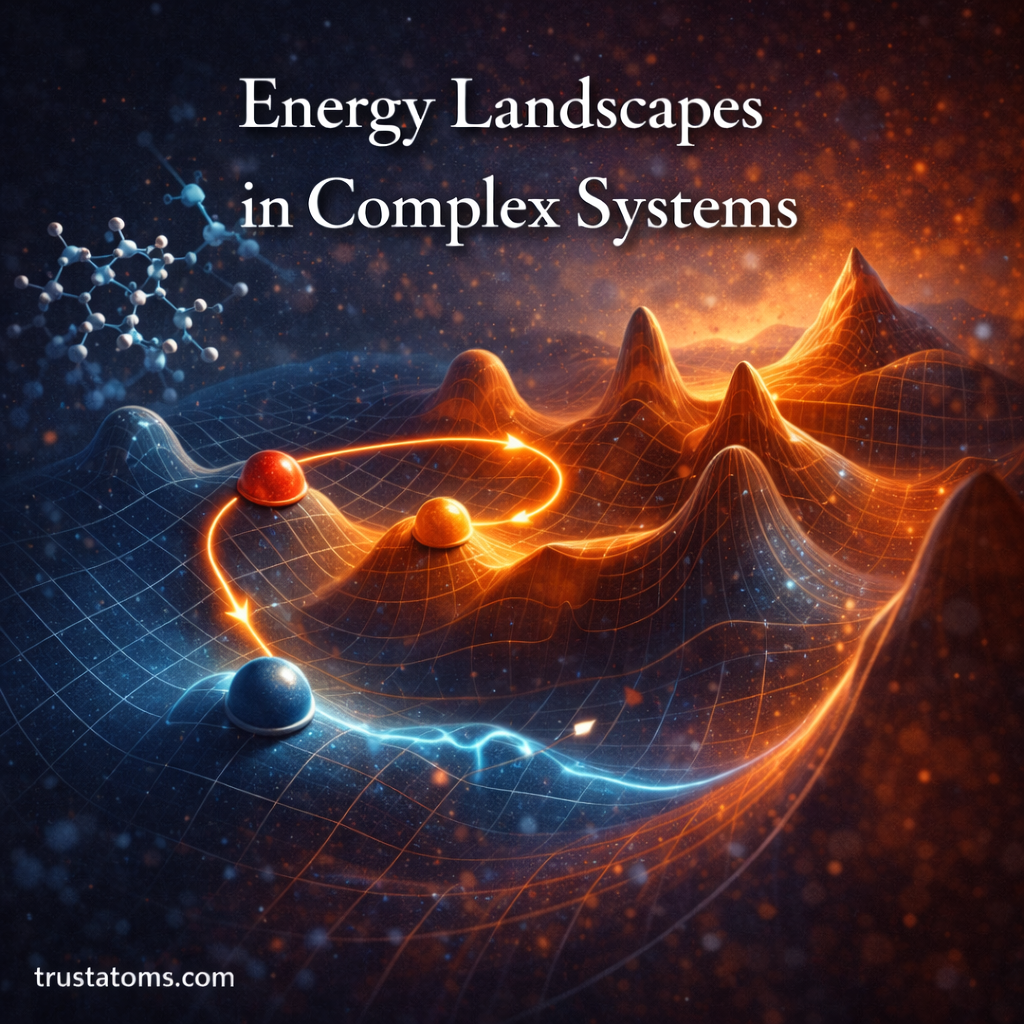
Energy Landscapes in Complex Systems

Illustration of energy landscapes in complex systems showing valleys, peaks, and particle transitions across a 3D terrain, trustatoms.com watermark.
Conceptual visualization of energy landscapes with valleys, barriers, and state transitions in complex physical systems. trustatoms.com.

Energy landscapes are a powerful way to visualize and understand how complex systems behave. Instead of thinking about a system as a single state, physicists imagine a vast landscape of hills, valleys, and pathways — where each position represents a possible configuration and its height represents energy.

This concept appears across physics, chemistry, biology, and materials science. From protein folding to phase transitions, energy landscapes explain why systems settle into certain states and how they transition between them.

In this guide, we’ll explore what energy landscapes are, why they matter, and how they help us understand complex systems.

Continue reading “Energy Landscapes in Complex Systems”

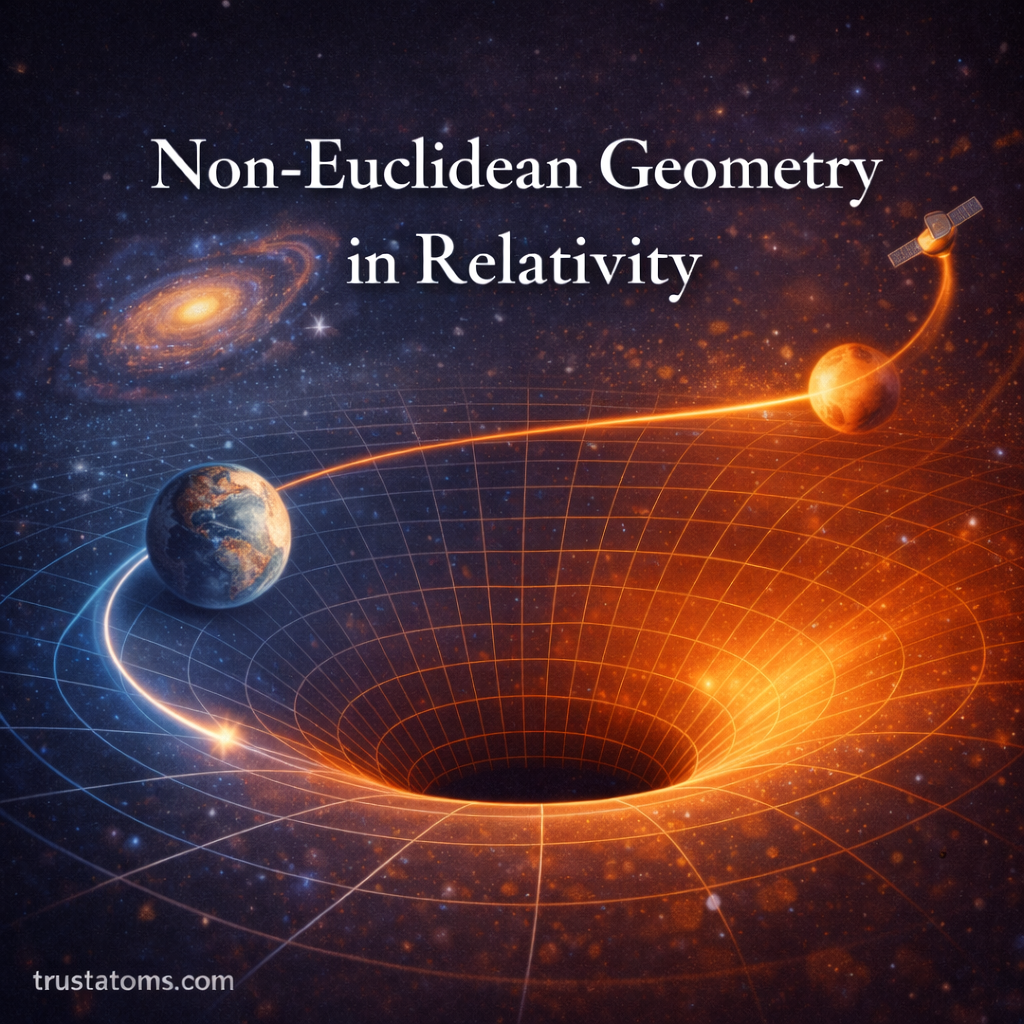
Non-Euclidean Geometry in Relativity

Illustration of non-Euclidean geometry in relativity showing curved spacetime grid around a massive object with planets and light bending, trustatoms.com watermark.
Conceptual illustration of curved spacetime and gravitational bending in non-Euclidean geometry. trustatoms.com.

Non-Euclidean geometry is one of the most profound ideas in modern physics. It reshaped our understanding of space, time, and gravity — and became the mathematical foundation of Einstein’s theory of relativity.

For centuries, geometry was based on Euclid’s rules: parallel lines never meet, triangles add up to 180 degrees, and space is flat. But relativity revealed something extraordinary — space and time are curved.

In this guide, we’ll explore what non-Euclidean geometry is, how it differs from classical geometry, and why it is essential for understanding relativity.

Continue reading “Non-Euclidean Geometry in Relativity”

Eigenvalue Problems in Physical Models

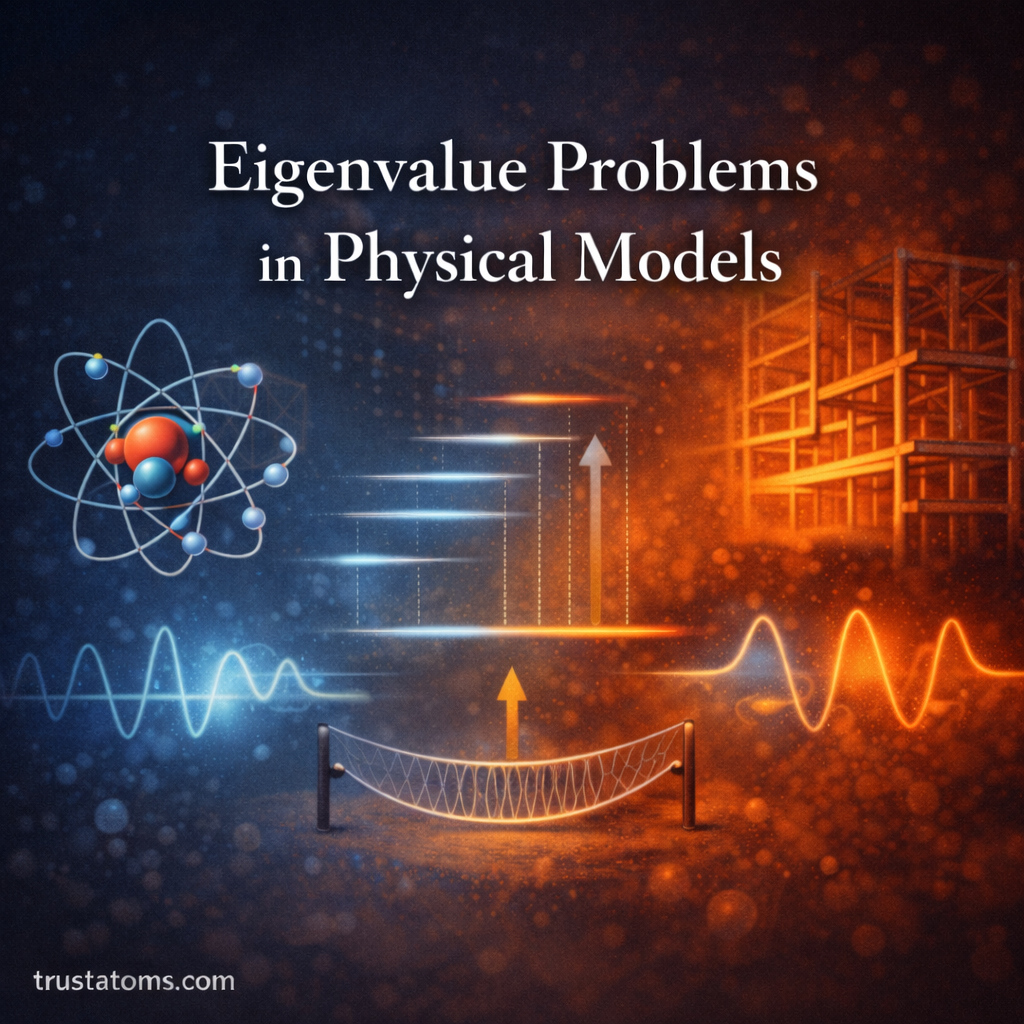
Illustration representing eigenvalue problems in physical models with atomic structure, vibration modes, structural framework, and wave patterns, trustatoms.com watermark.
Conceptual illustration showing vibration modes, atomic systems, and structural stability as examples of eigenvalue problems in physics. trustatoms.com.

Eigenvalue problems appear everywhere in physics. From vibrating strings to quantum mechanics, from structural engineering to electromagnetism, many physical systems are governed by equations that reduce to finding eigenvalues and eigenvectors.

At first glance, eigenvalues may seem like abstract mathematical objects. In reality, they represent measurable physical quantities such as energy levels, vibration frequencies, and stability conditions.

In this guide, we’ll explore what eigenvalue problems are, why they arise in physical models, and how they shape our understanding of the natural world.

Continue reading “Eigenvalue Problems in Physical Models”

Perturbation Theory in Quantum Systems

Illustration representing perturbation theory in quantum systems with atomic model, energy level shifts, and wave behavior, trustatoms.com watermark.
Conceptual illustration of perturbation theory showing atomic structure, energy level changes, and quantum wave behavior. trustatoms.com.

Perturbation theory is one of the most important approximation tools in quantum physics. It allows physicists to solve complex quantum systems by starting with a simple, solvable model and then gradually adding small corrections.

In reality, most quantum systems cannot be solved exactly. Atoms in external fields, interacting particles, and complex molecules all involve mathematical equations that are too difficult to handle directly. Perturbation theory provides a practical and elegant way to get accurate predictions without solving everything from scratch.

In this guide, we’ll explore how perturbation theory works, why it matters in quantum mechanics, and where it is used in modern physics.

Continue reading “Perturbation Theory in Quantum Systems”

Monte Carlo Methods in Statistical Physics

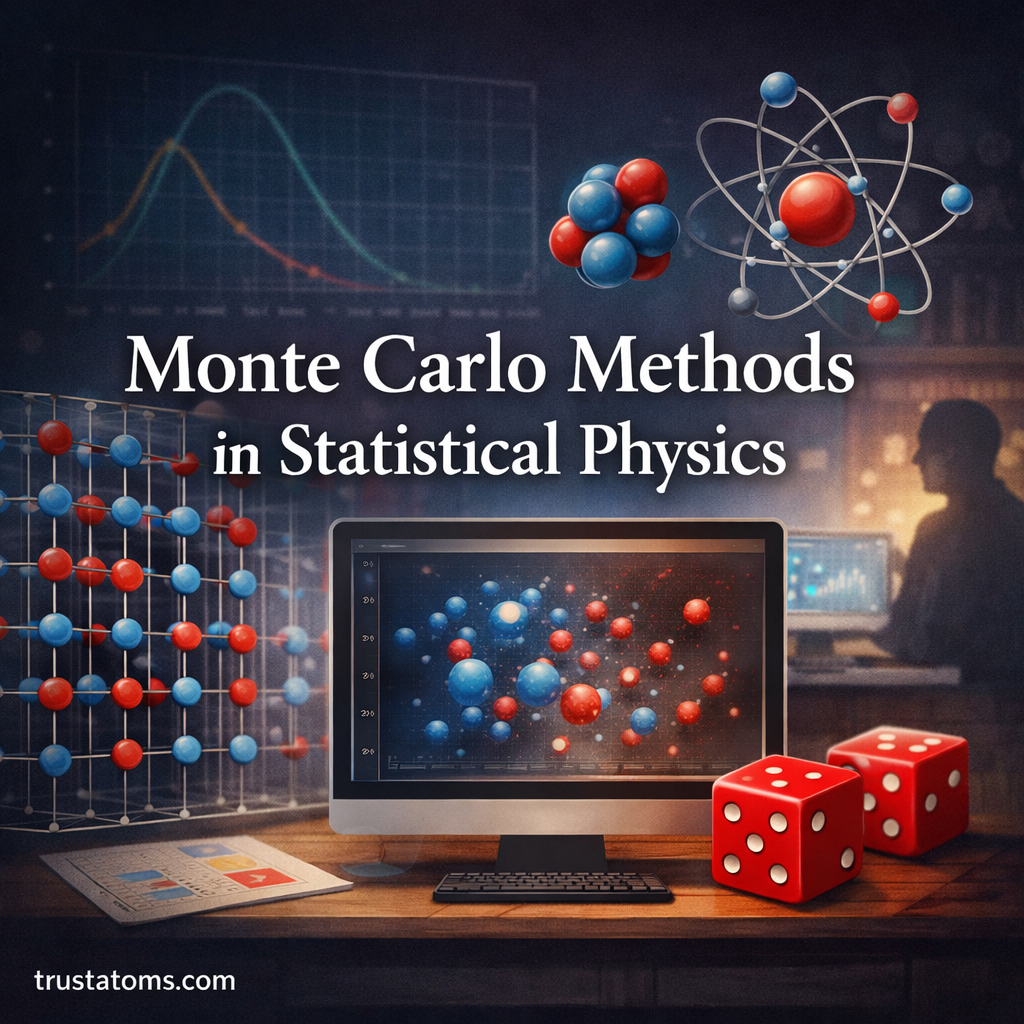
Illustration showing Monte Carlo methods in statistical physics with particle simulation on a computer screen, lattice model, dice symbolizing randomness, and trustatoms.com watermark.
Conceptual illustration of Monte Carlo methods in statistical physics, highlighting random sampling and particle simulations. trustatoms.com.

Monte Carlo methods are powerful computational techniques used to understand complex systems that are too difficult to solve with traditional equations alone. In statistical physics, they help scientists model systems made of many interacting particles — from atoms in a magnet to molecules in a gas.

Instead of trying to calculate every possible configuration exactly, Monte Carlo simulations use random sampling to approximate physical behavior. Surprisingly, randomness becomes a precise tool when used correctly.

In this guide, we’ll explore what Monte Carlo methods are, how they work in statistical physics, and why they are essential in modern research.

Continue reading “Monte Carlo Methods in Statistical Physics”

Computational Fluid Dynamics in Engineering

Illustration of computational fluid dynamics in engineering showing airflow over an airplane and car, turbine simulation, and CFD software visualization.
Illustration representing computational fluid dynamics simulations in aerospace, automotive, and turbine engineering applications. trustatoms.com

Computational Fluid Dynamics (CFD) is one of the most powerful tools in modern engineering. It allows scientists and engineers to simulate how liquids and gases behave under real-world conditions — without always needing costly physical prototypes.

From aircraft wings and wind turbines to car engines and HVAC systems, CFD helps engineers predict performance, reduce risk, and optimize designs before anything is built.

In this guide, we’ll break down what Computational Fluid Dynamics is, how it works, where it’s used, and why it’s essential in today’s engineering landscape.

Continue reading “Computational Fluid Dynamics in Engineering”