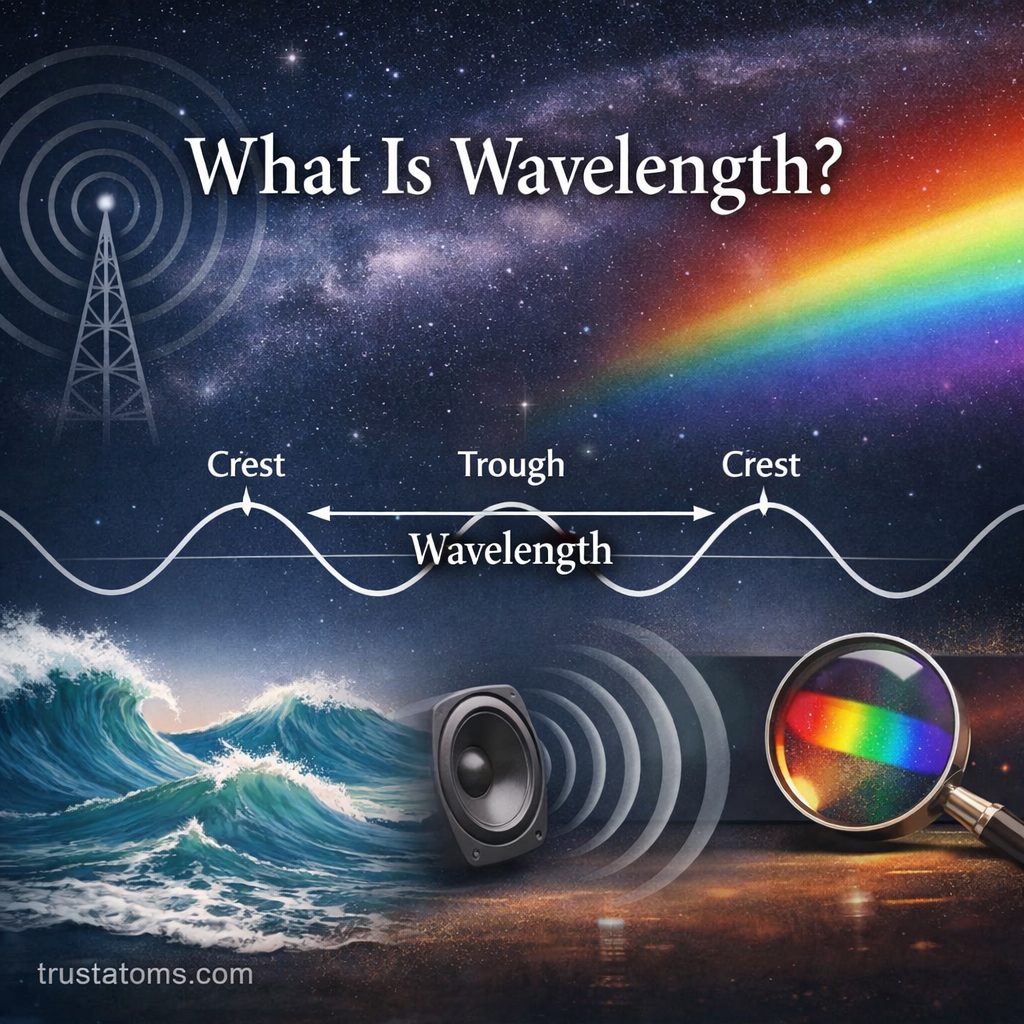
What Is Wavelength?

Illustration explaining wavelength with labeled wave crests and troughs, rainbow light spectrum, ocean waves, and sound waves.
Illustration showing the concept of wavelength across light, sound, and water waves. trustatoms.com

Wavelength is one of the most important concepts in physics because it helps us understand how waves behave — from light and sound to water and radio signals.

If you’ve ever seen ripples on water, heard music from a speaker, or noticed different colors of light, you’ve experienced wavelength in action.

In this guide, you’ll learn:

  • What wavelength means
  • How it’s measured
  • How it relates to frequency
  • Real-world examples
  • Why it matters in science and technology
Continue reading “What Is Wavelength?”

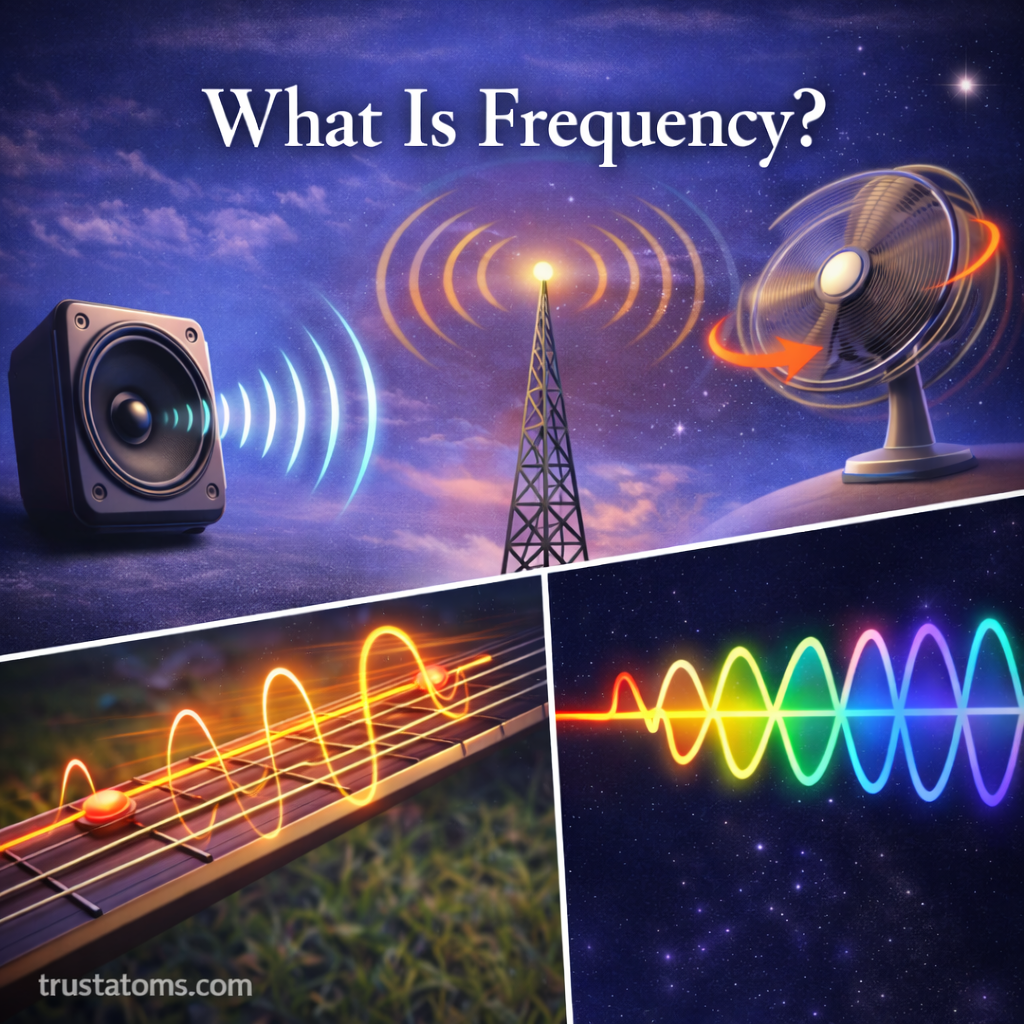
What Is Frequency?

Illustration showing sound waves from a speaker, radio waves from a tower, a rotating fan, a vibrating guitar string, and light waves to explain frequency, with title What Is Frequency? and trustatoms.com watermark.
Visual examples of frequency in sound, radio waves, rotation, vibration, and light. trustatoms.com

Frequency measures how often something happens within a specific amount of time.

In physics, frequency usually describes how many cycles, waves, vibrations, or oscillations occur per second. From sound waves to radio signals to rotating fans, frequency is a fundamental concept that helps us understand repeating motion.

In this guide, you’ll learn:

  • What frequency means in physics
  • The unit of frequency
  • The frequency formula
  • How frequency relates to wavelength and period
  • Real-world examples
Continue reading “What Is Frequency?”

What Is Rotational Motion?

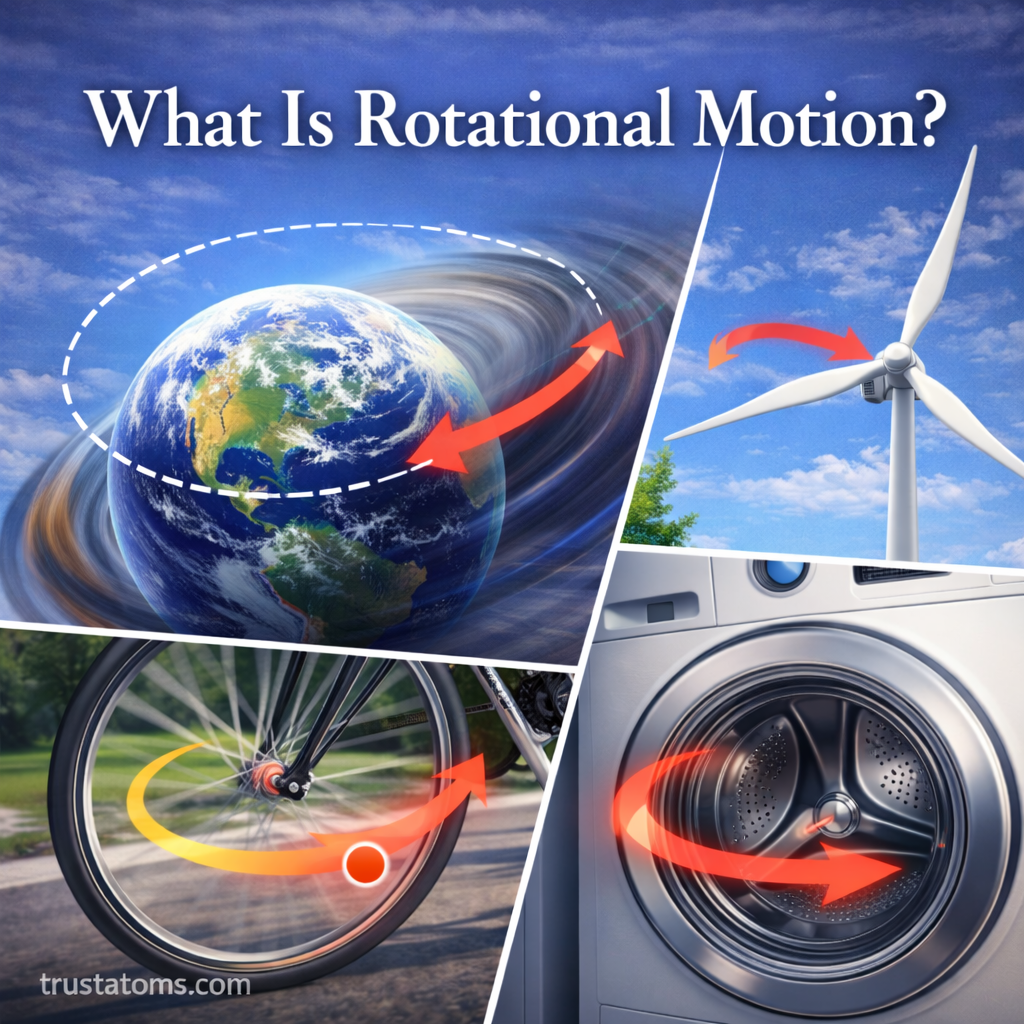
Illustration showing Earth rotating, a bicycle wheel spinning, a wind turbine turning, and a washing machine drum rotating, with title What Is Rotational Motion? and trustatoms.com watermark.
Examples of rotational motion including Earth, a wheel, a wind turbine, and a washing machine. trustatoms.com

Rotational motion is the movement of an object as it spins around an axis.

From a turning wheel to the rotation of Earth, rotational motion is everywhere. Unlike straight-line (linear) motion, rotational motion involves circular movement around a fixed point or axis.

Understanding rotational motion is essential in physics, engineering, astronomy, and everyday mechanics.

In this guide, you’ll learn:

  • What rotational motion means
  • The difference between linear and rotational motion
  • Key rotational quantities
  • Real-world examples
  • Why rotational motion matters
Continue reading “What Is Rotational Motion?”

Centripetal Force Explained

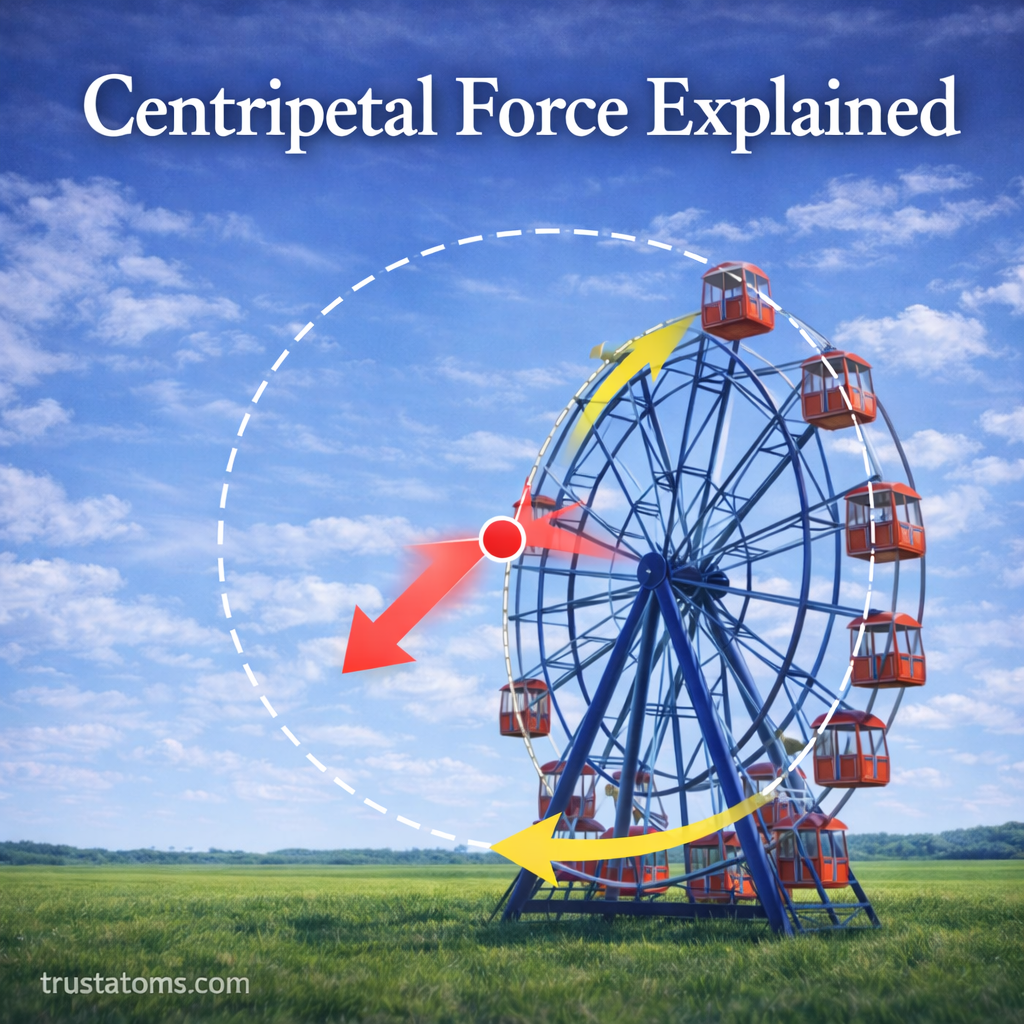
Illustration of a Ferris wheel demonstrating inward centripetal force in circular motion, with title Centripetal Force Explained and trustatoms.com watermark.
Ferris wheel illustration showing inward force required for circular motion. trustatoms.com

Centripetal force is the inward force that keeps an object moving in a circular path.

Without it, objects would move in straight lines due to inertia. From a car turning on a curved road to planets orbiting the Sun, centripetal force is what makes circular motion possible.

In this guide, you’ll learn:

  • What centripetal force really means
  • Why it’s not a “new” type of force
  • The formula and how it works
  • Real-world examples
  • Common mistakes students make
Continue reading “Centripetal Force Explained”

What Is Circular Motion?

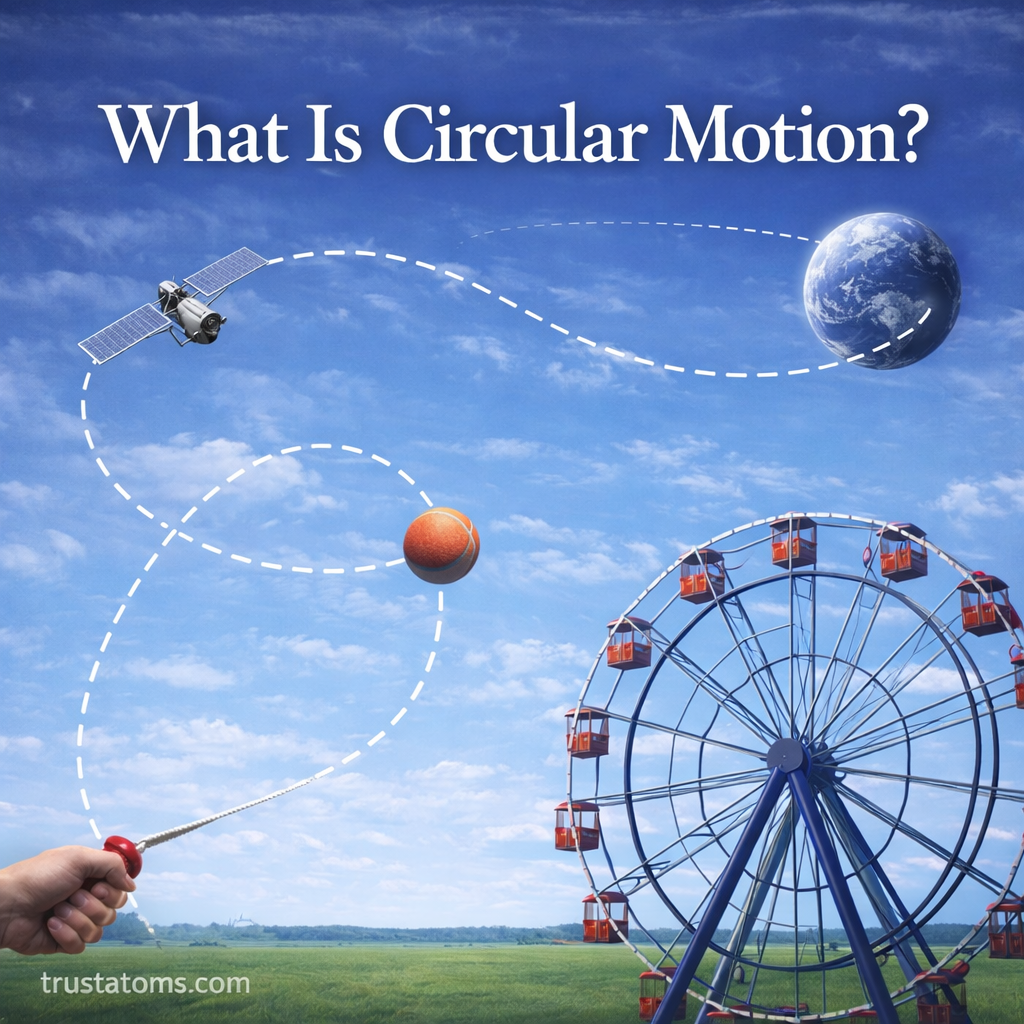
Illustration showing a satellite orbiting Earth, a Ferris wheel, and a ball on a string to demonstrate circular motion, with title What Is Circular Motion? and trustatoms.com watermark.
Illustration of everyday and space examples demonstrating circular motion paths. trustatoms.com

Circular motion is the movement of an object along a circular path.

From a spinning fan blade to a planet orbiting a star, circular motion appears everywhere in physics. Even though the object may move at a constant speed, its direction is always changing — and that means forces are involved.

In this guide, you’ll learn:

  • What circular motion is
  • The difference between speed and velocity
  • What centripetal force means
  • Key formulas
  • Real-world examples
Continue reading “What Is Circular Motion?”

What Is Projectile Motion?

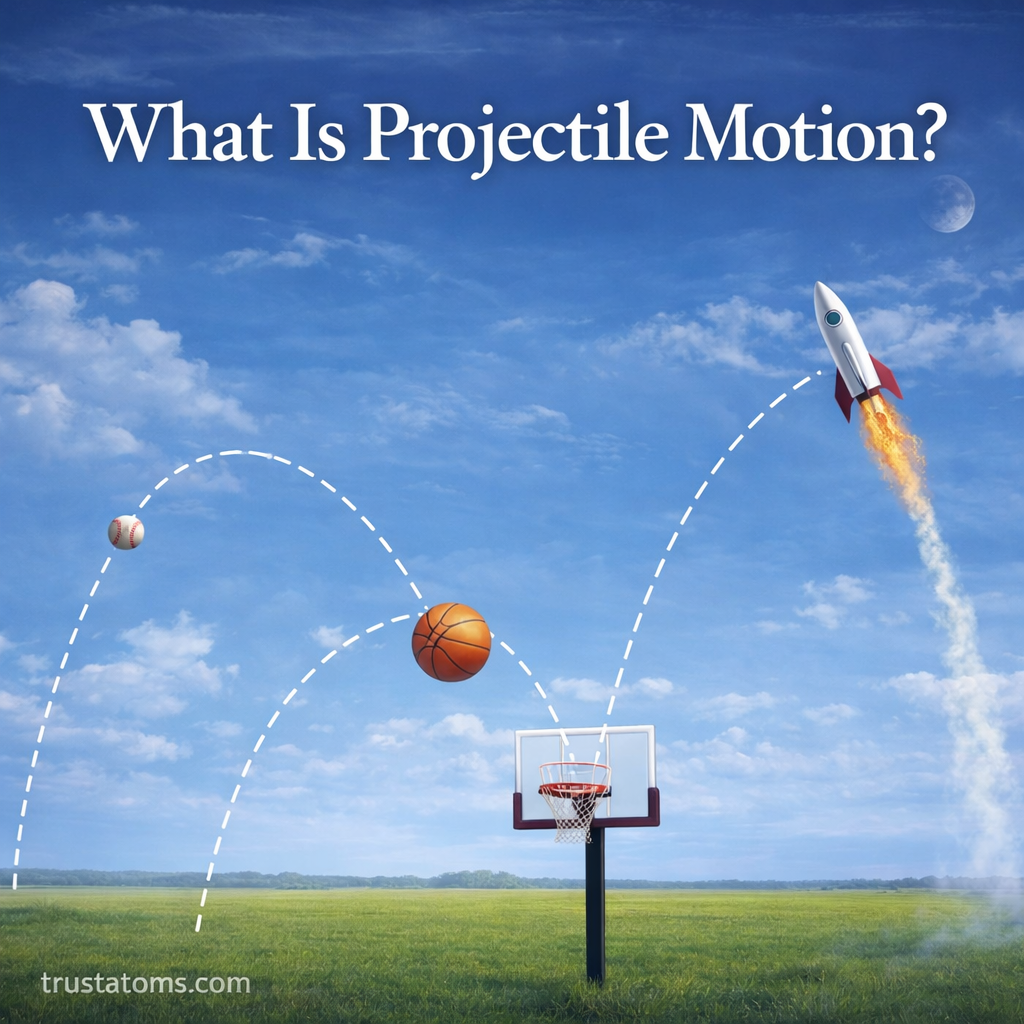
Illustration showing a baseball, basketball, and rocket following curved paths to demonstrate projectile motion, with title What Is Projectile Motion? and trustatoms.com watermark.
Illustration of curved projectile paths in sports and rocketry demonstrating motion under gravity. trustatoms.com

Projectile motion describes how an object moves through the air when it is launched and influenced only by gravity (ignoring air resistance).

From a thrown baseball to a launched rocket, projectile motion explains the curved path objects follow when they move under gravity alone.

In this guide, you’ll learn:

  • What projectile motion is
  • Why the path is curved
  • The two components of motion
  • Key formulas
  • Real-world examples
Continue reading “What Is Projectile Motion?”

Gravitational Force Formula

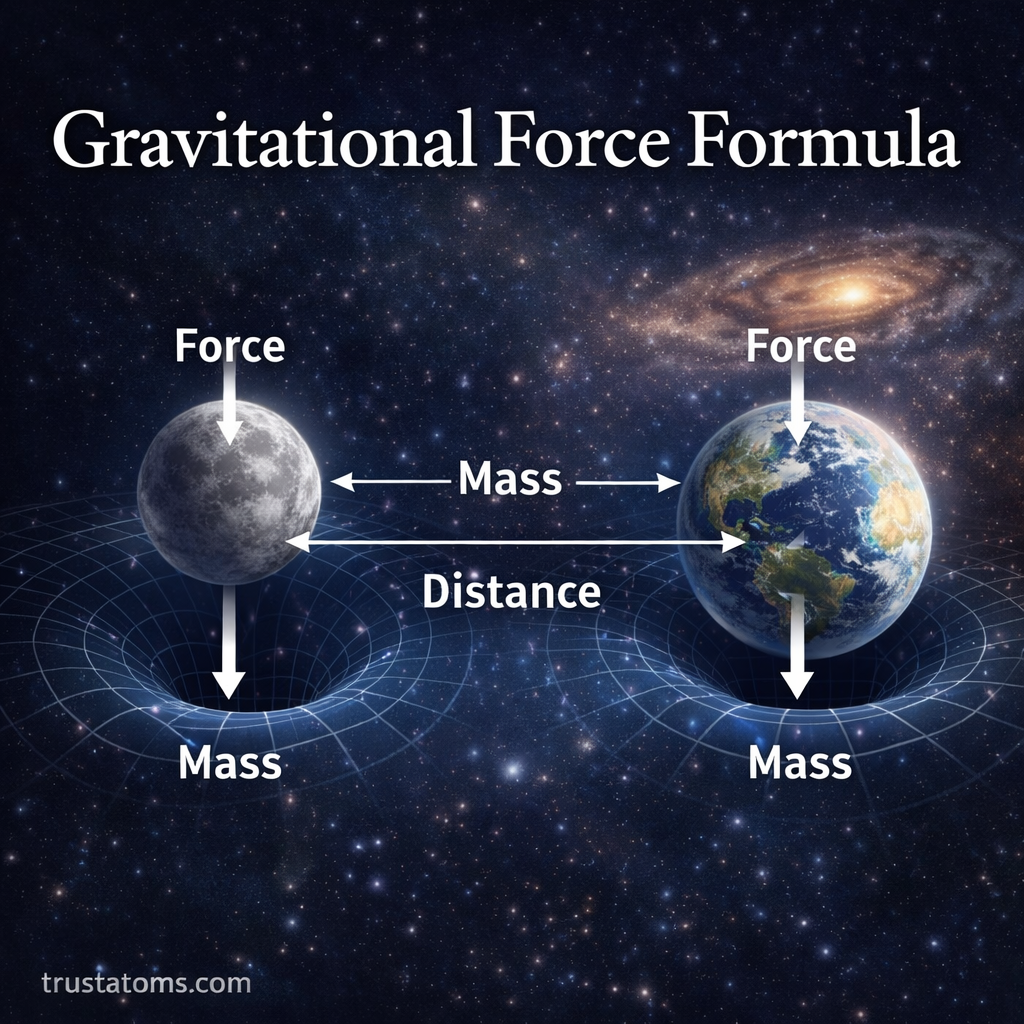
Diagram showing two celestial bodies attracting each other to explain the gravitational force formula, with title Gravitational Force Formula and trustatoms.com watermark.
Simple space diagram illustrating gravitational attraction between two massive objects. trustatoms.com

The gravitational force formula explains how strongly two objects attract each other.

From falling apples to orbiting planets, gravity governs motion throughout the universe. Understanding the formula behind gravitational force helps explain everything from your weight on Earth to how galaxies stay together.

In this guide, you’ll learn:

  • What the gravitational force formula is
  • What each variable means
  • Why distance matters so much
  • How the formula applies in real life
  • Common mistakes students make
Continue reading “Gravitational Force Formula”

What Is Gravity?

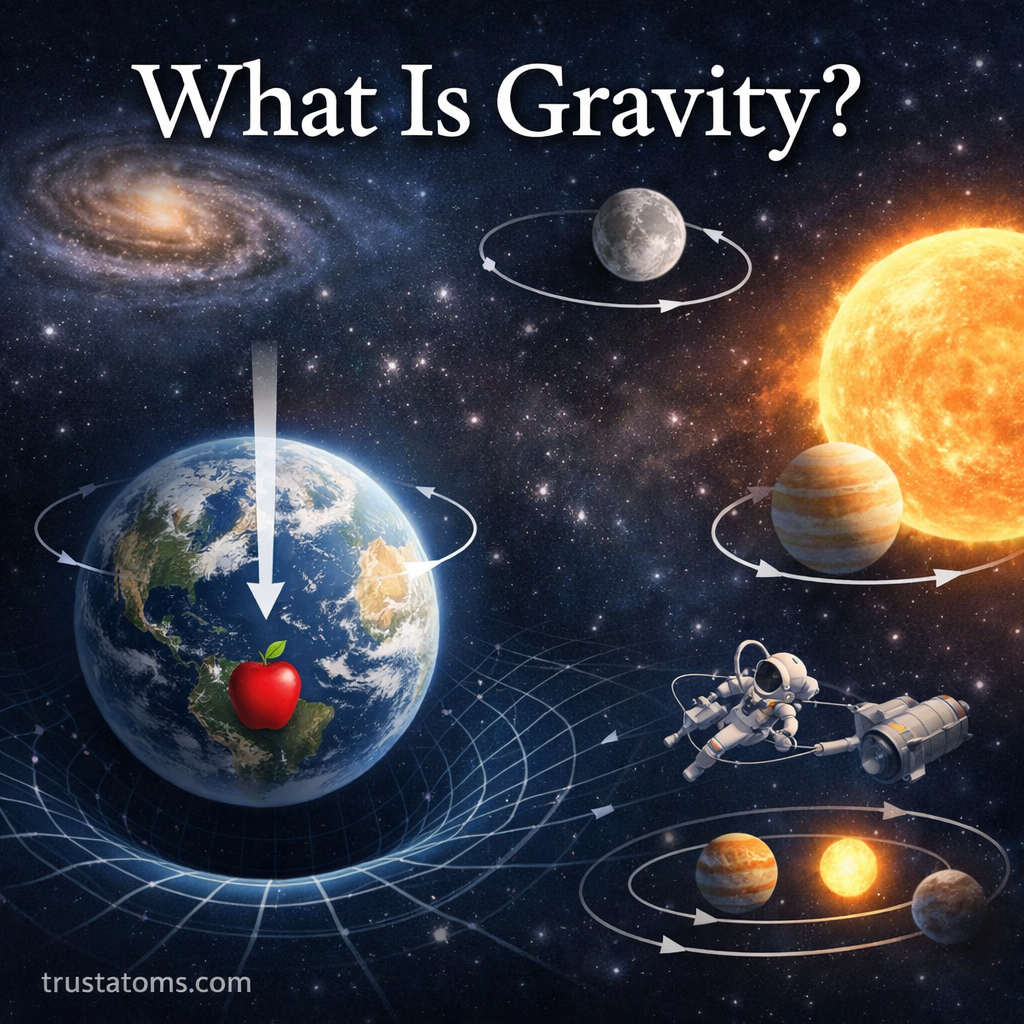
Illustration of Earth, the Moon, the Sun, and an astronaut in space demonstrating how gravity pulls objects together with title What Is Gravity? and trustatoms.com watermark.
Contextual space illustration showing how gravity pulls planets, moons, and objects together. trustatoms.com

Gravity is one of the most familiar forces in the universe — yet it’s also one of the most fascinating.

It’s the reason you stay grounded on Earth, why the Moon orbits our planet, and why galaxies hold together across billions of miles of space.

In this guide, you’ll learn what gravity is, how it works, why it matters, and how scientists understand it today.

Continue reading “What Is Gravity?”

What Is Angular Momentum?

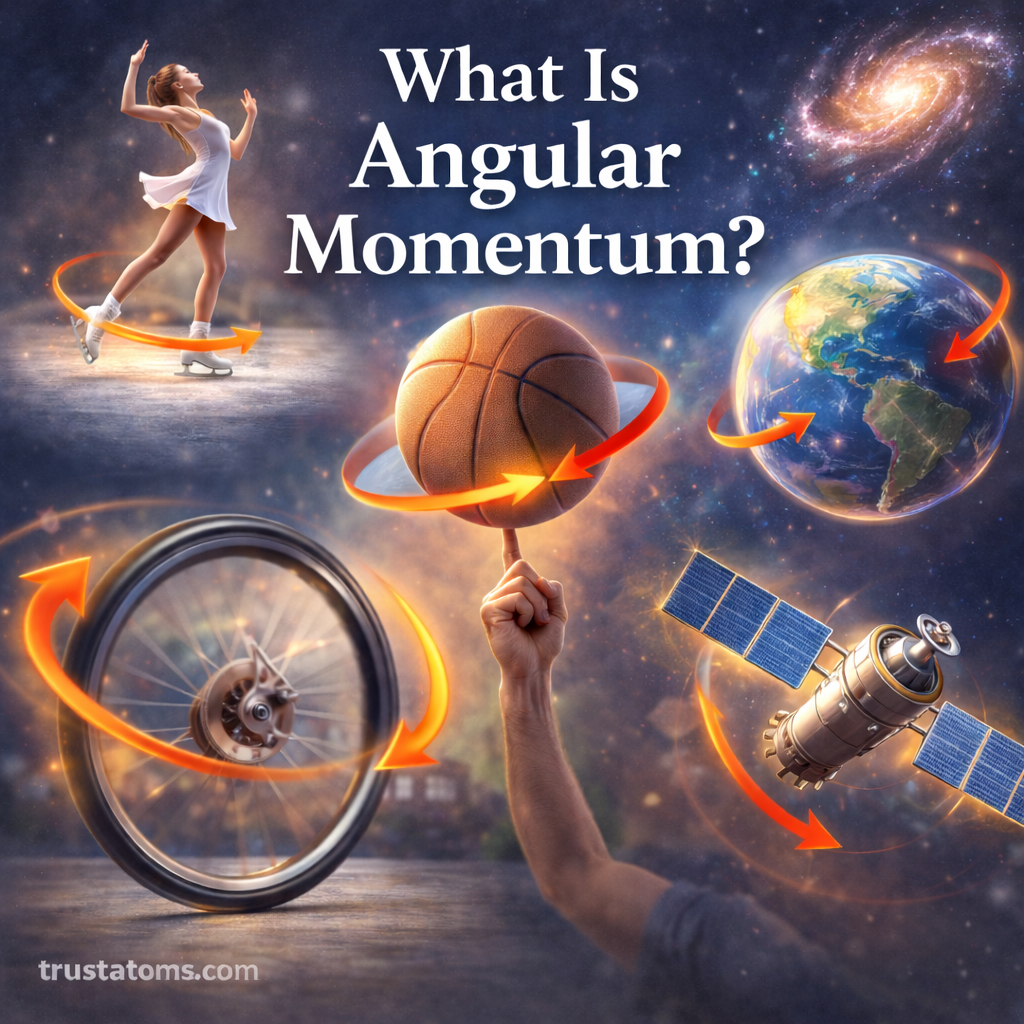
Educational illustration showing examples of angular momentum including a spinning figure skater, a rotating bicycle wheel, a basketball spinning on a finger, Earth rotating, and a satellite orbiting, with the title “What Is Angular Momentum?” and trustatoms.com watermark.
Examples of rotational motion demonstrating angular momentum in everyday life and space. trustatoms.com

Angular momentum is the rotational equivalent of linear momentum.

While linear momentum describes motion in a straight line, angular momentum describes motion around a point or axis. Whenever something spins, rotates, or orbits, angular momentum is involved.

From spinning ice skaters to orbiting planets, angular momentum is one of the most powerful and important concepts in physics.

In this guide, you’ll learn:

  • The definition of angular momentum
  • The angular momentum formula
  • What affects angular momentum
  • Real-world examples
  • Why conservation of angular momentum matters
Continue reading “What Is Angular Momentum?”

What Is Torque?

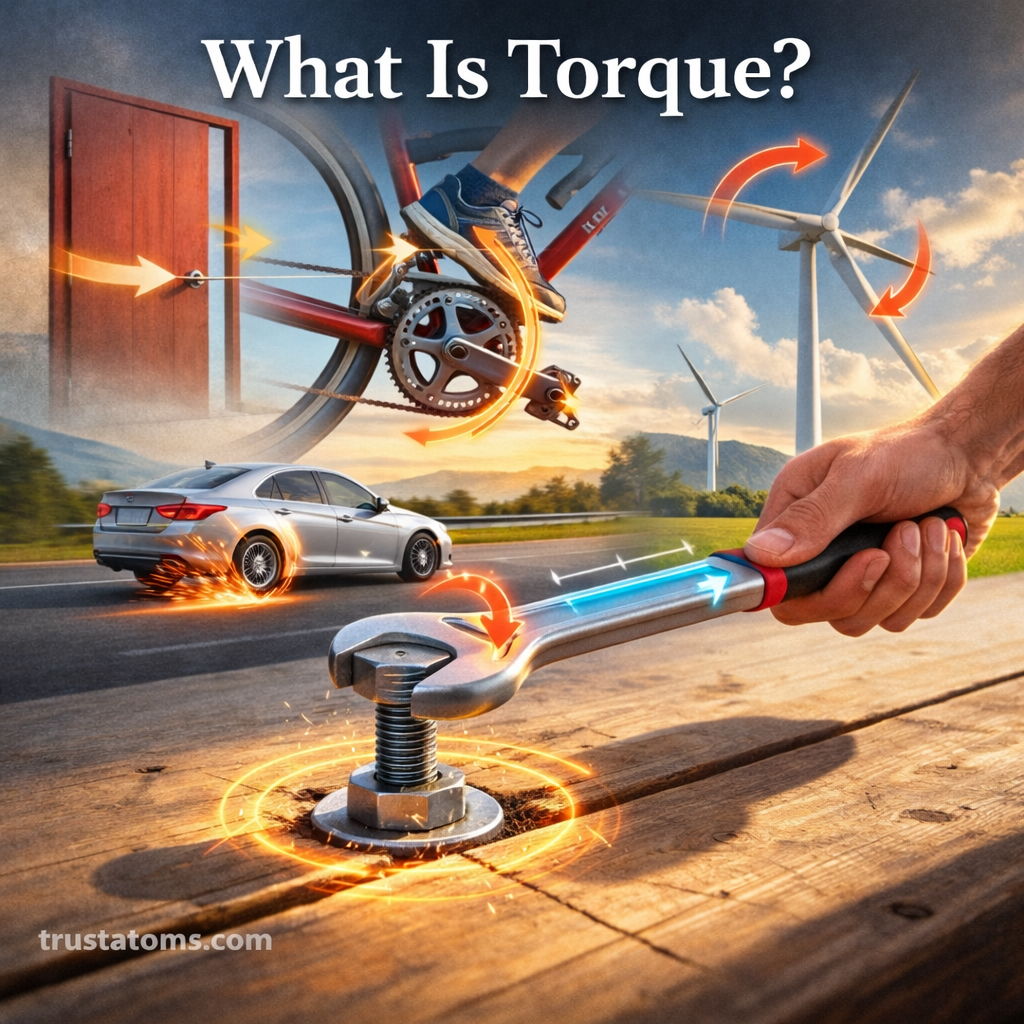
Educational illustration showing examples of torque including a wrench turning a bolt, a bicycle pedal rotating, a door opening on its hinges, a car wheel spinning, and a wind turbine rotating, with the title “What Is Torque?” and trustatoms.com watermark.
Real-world examples demonstrating how torque causes rotational motion. trustatoms.com

Torque is the rotational equivalent of force.

While force makes objects move in a straight line, torque makes objects rotate. Every time you open a door, turn a wrench, or pedal a bicycle, you are applying torque.

In this guide, you’ll learn:

  • What torque is in physics
  • The torque formula
  • How distance affects torque
  • Real-world examples
  • Why torque is important in engineering and mechanics
Continue reading “What Is Torque?”