Advanced Numerical Methods in Physical Simulation

Illustration of supercomputers and simulated spacetime grids representing advanced numerical methods used in physical simulation, with trustatoms.com watermark.
Conceptual visualization of computational grids and supercomputing power used in advanced physical simulations. trustatoms.com.

Modern physics does not rely on equations alone.

Many real-world systems are too complex to solve exactly. From turbulent airflow to black hole mergers, physical systems often require numerical simulation rather than closed-form mathematical solutions.

Advanced numerical methods allow scientists and engineers to approximate solutions to complex equations using computational power. These techniques power everything from climate models to spacecraft design.

In this article, we’ll explore what advanced numerical methods are, why they matter in physics, and how they are applied in real-world simulations.

Continue reading “Advanced Numerical Methods in Physical Simulation”
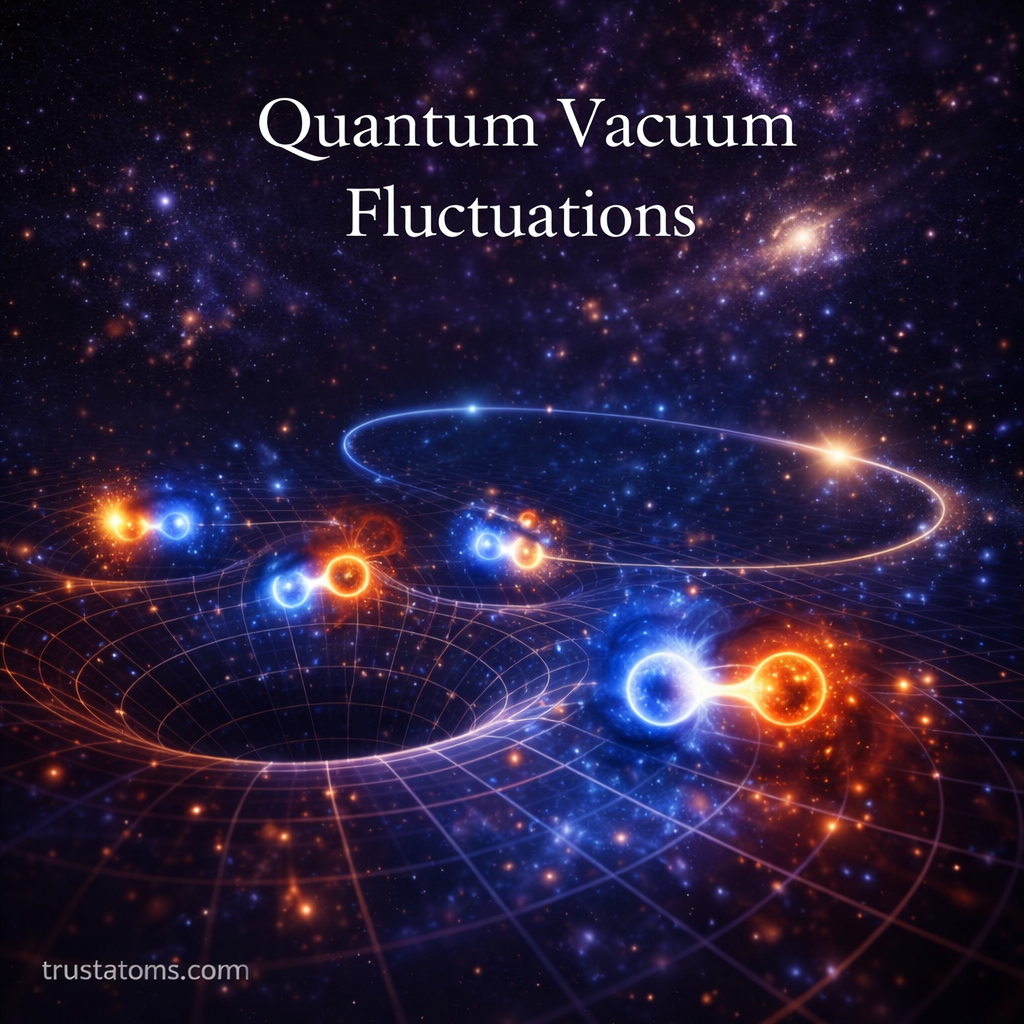
Quantum Vacuum Fluctuations

Illustration of quantum vacuum fluctuations showing virtual particle pairs appearing and disappearing in a curved spacetime grid, with trustatoms.com watermark.
Conceptual visualization of virtual particle pairs emerging from quantum vacuum fluctuations in empty space. trustatoms.com.

Empty space is not truly empty.

In classical physics, a vacuum is simply a region with no matter. But in quantum physics, even the most perfect vacuum is alive with activity. Fields constantly fluctuate. Energy briefly appears and disappears. Particles flicker into existence for incredibly short times.

This phenomenon is known as quantum vacuum fluctuations, and it is one of the most fascinating consequences of quantum field theory.

In this article, we’ll explore what quantum vacuum fluctuations are, why they occur, and how they influence the physical universe.

Continue reading “Quantum Vacuum Fluctuations”

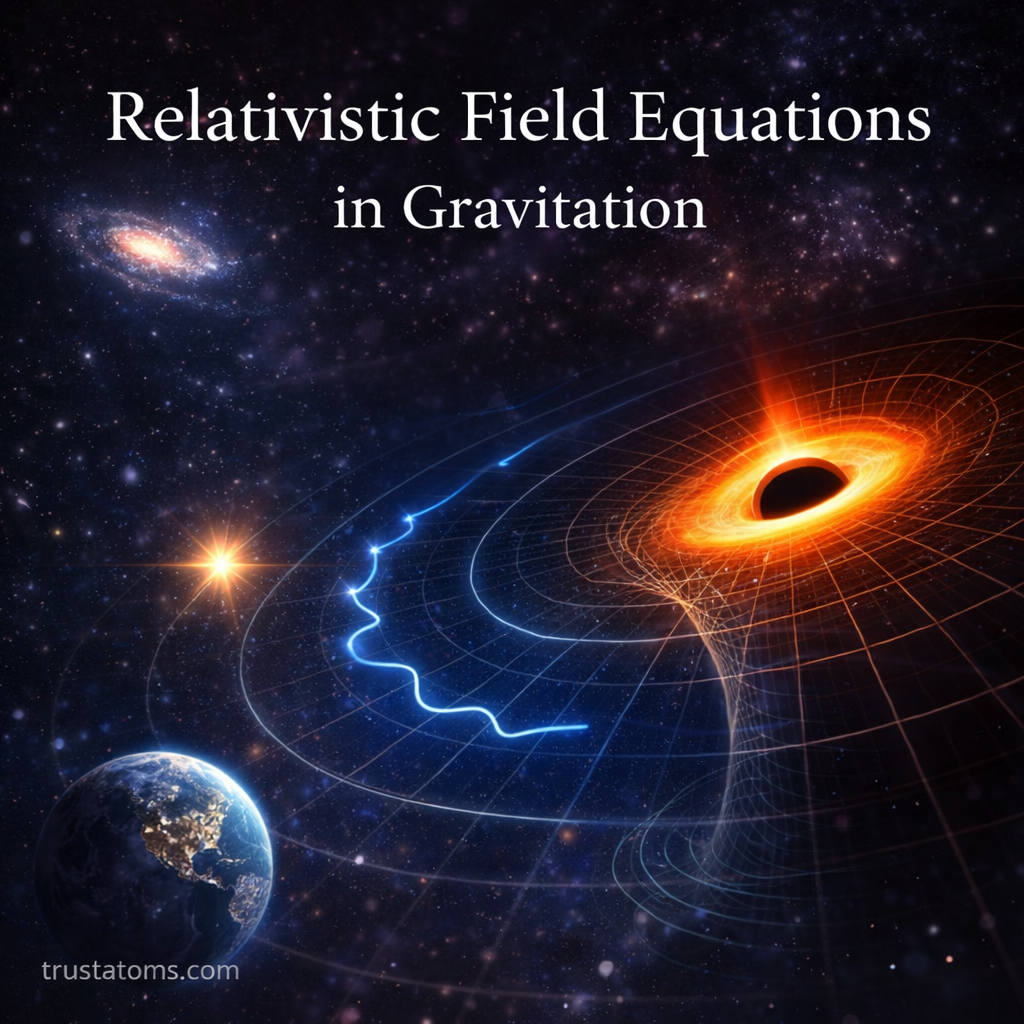
Relativistic Field Equations in Gravitation

Illustration of curved spacetime around a black hole with light bending and gravitational waves, representing relativistic field equations in gravitation, with trustatoms.com watermark.
Conceptual visualization of spacetime curvature around a massive object as described by relativistic gravitational field equations. trustatoms.com.

Gravity is not just a force pulling objects together.

According to modern physics, gravity is the curvature of spacetime itself. Massive objects bend the geometry around them, and that curvature tells matter how to move.

The mathematical description of this idea is contained in the relativistic field equations of gravitation, commonly known as Einstein’s field equations. These equations form the foundation of general relativity and modern gravitational physics.

In this article, we’ll explore what relativistic field equations are, what they describe, and why they revolutionized our understanding of gravity.

Continue reading “Relativistic Field Equations in Gravitation”

Blackbody Radiation in Thermal Physics

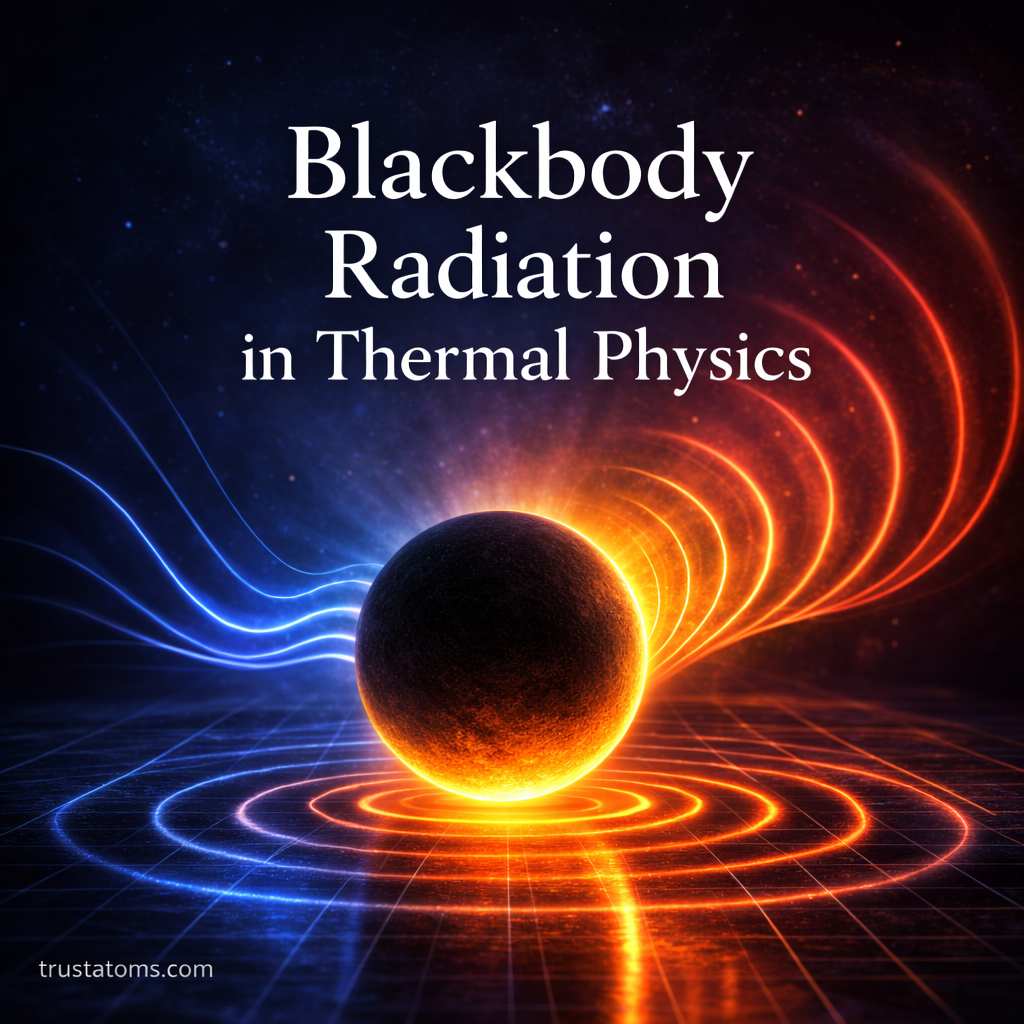
Illustration of a glowing blackbody sphere emitting blue to red thermal radiation waves across a grid background, representing blackbody radiation in thermal physics, with trustatoms.com watermark.
Conceptual illustration of thermal radiation emitted by an ideal blackbody as temperature increases. trustatoms.com.

Every object around you emits radiation.

A warm cup of coffee, a glowing stove coil, even your own body continuously radiate energy in the form of electromagnetic waves. This emission depends on temperature — and it follows remarkably precise physical laws.

The study of this phenomenon is called blackbody radiation, and it played a crucial role in the birth of modern physics.

In this article, we’ll explore what blackbody radiation is, the laws that describe it, why classical physics failed to explain it, and how it led to quantum theory.

Continue reading “Blackbody Radiation in Thermal Physics”

Cosmological Redshift in Expanding Universes

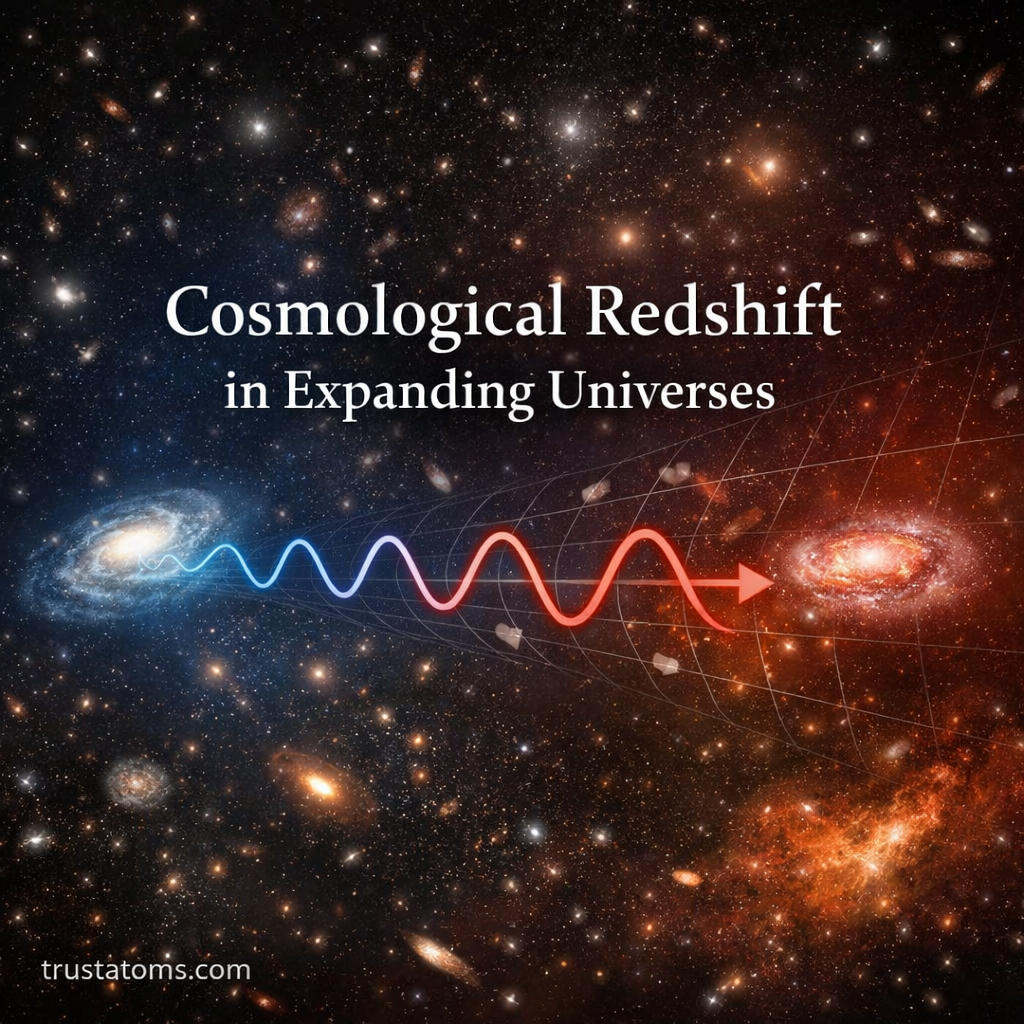
Illustration of cosmological redshift showing light waves stretching from blue to red between distant galaxies in an expanding universe, with trustatoms.com watermark.
Conceptual illustration of cosmological redshift as space expands and stretches light across the universe. trustatoms.com.

When we look into deep space, we are also looking back in time. The light from distant galaxies travels billions of years before reaching us. Along the way, something remarkable happens: its wavelength stretches.

This phenomenon is called cosmological redshift, and it is one of the strongest pieces of evidence that our universe is expanding.

In this article, we’ll break down what cosmological redshift is, how it differs from other types of redshift, and why it plays a central role in modern cosmology.

Continue reading “Cosmological Redshift in Expanding Universes”

Magnetohydrodynamics in Plasma Physics

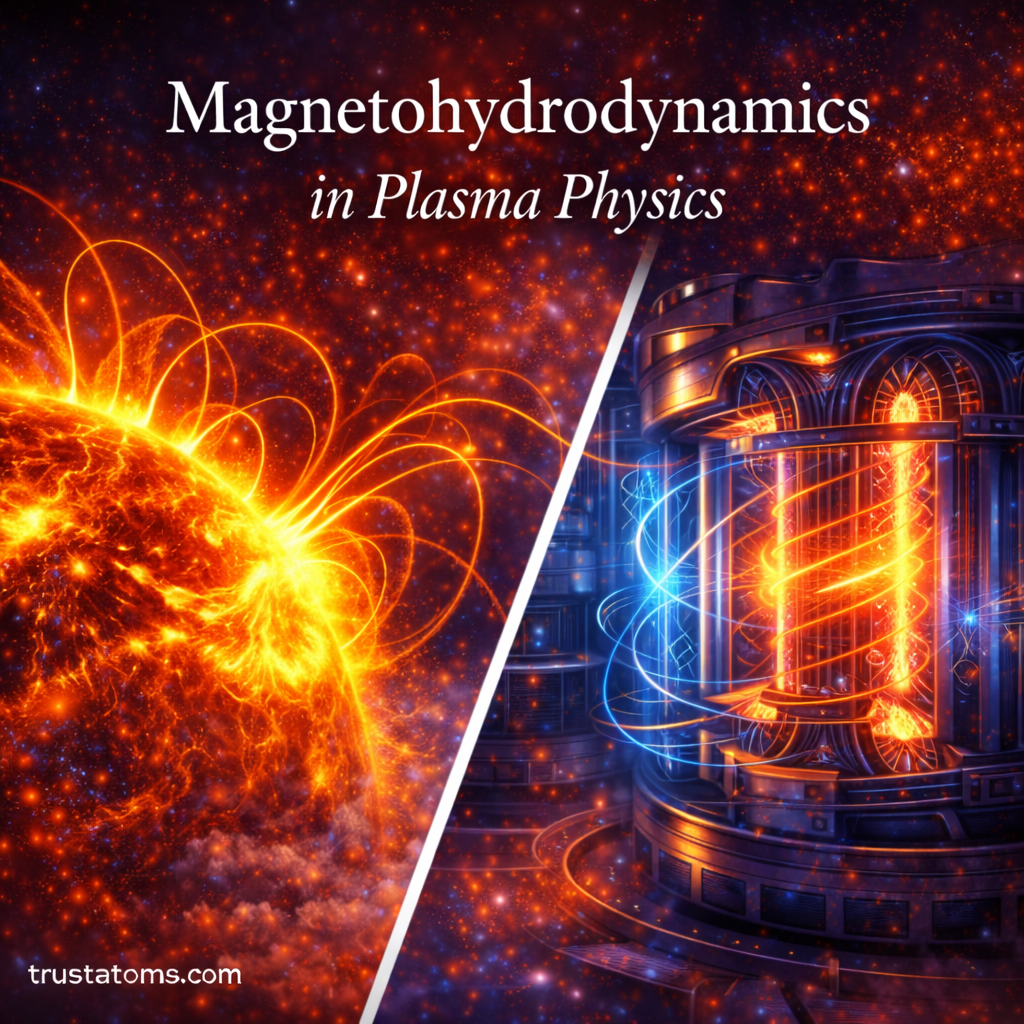
Split illustration showing solar plasma magnetic loops and a fusion reactor with magnetically confined plasma representing magnetohydrodynamics in plasma physics with trustatoms.com watermark.
Illustration of magnetohydrodynamics showing solar magnetic activity and magnetic confinement in a fusion plasma device. trustatoms.com

Magnetohydrodynamics (MHD) is the study of how electrically conducting fluids behave in the presence of magnetic fields. In plasma physics, this framework becomes especially powerful because plasma — often called the fourth state of matter — responds strongly to electromagnetic forces.

From the Sun’s solar flares to fusion reactors on Earth, magnetohydrodynamics helps scientists understand how plasma flows, twists, and sometimes becomes unstable.

In this guide, we’ll explore what magnetohydrodynamics is, how it applies to plasma physics, and why it plays a central role in astrophysics and energy research.

Continue reading “Magnetohydrodynamics in Plasma Physics”

Quantum Hall Effect in Two-Dimensional Systems

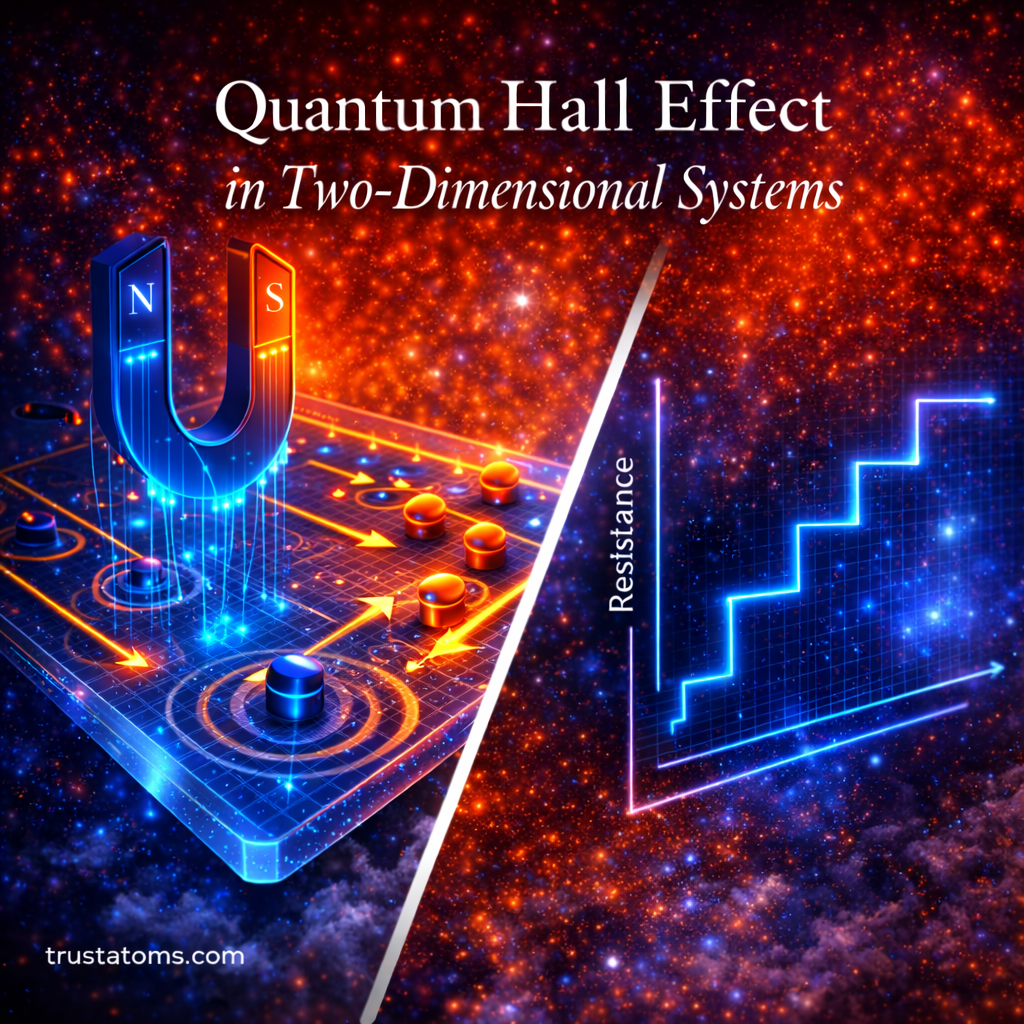
Split illustration showing a two-dimensional electron system under a magnetic field and a step-like Hall resistance graph representing the Quantum Hall Effect with trustatoms.com watermark.
Illustration of the Quantum Hall Effect in a two-dimensional electron system showing magnetic field influence and quantized Hall resistance plateaus. trustatoms.com

The Quantum Hall Effect (QHE) is one of the most remarkable discoveries in modern condensed matter physics. It reveals how electrons behave in extreme conditions — low temperatures, strong magnetic fields, and confined to two dimensions.

Under these conditions, electrical resistance does something astonishing: instead of changing smoothly, it becomes precisely quantized in discrete steps.

The Quantum Hall Effect not only reshaped our understanding of electron behavior in two-dimensional systems, but it also provided deep insights into topology, quantum mechanics, and precision measurement.

In this guide, we’ll explore what the Quantum Hall Effect is, why it occurs, and why it remains one of the most important discoveries in physics.

Continue reading “Quantum Hall Effect in Two-Dimensional Systems”

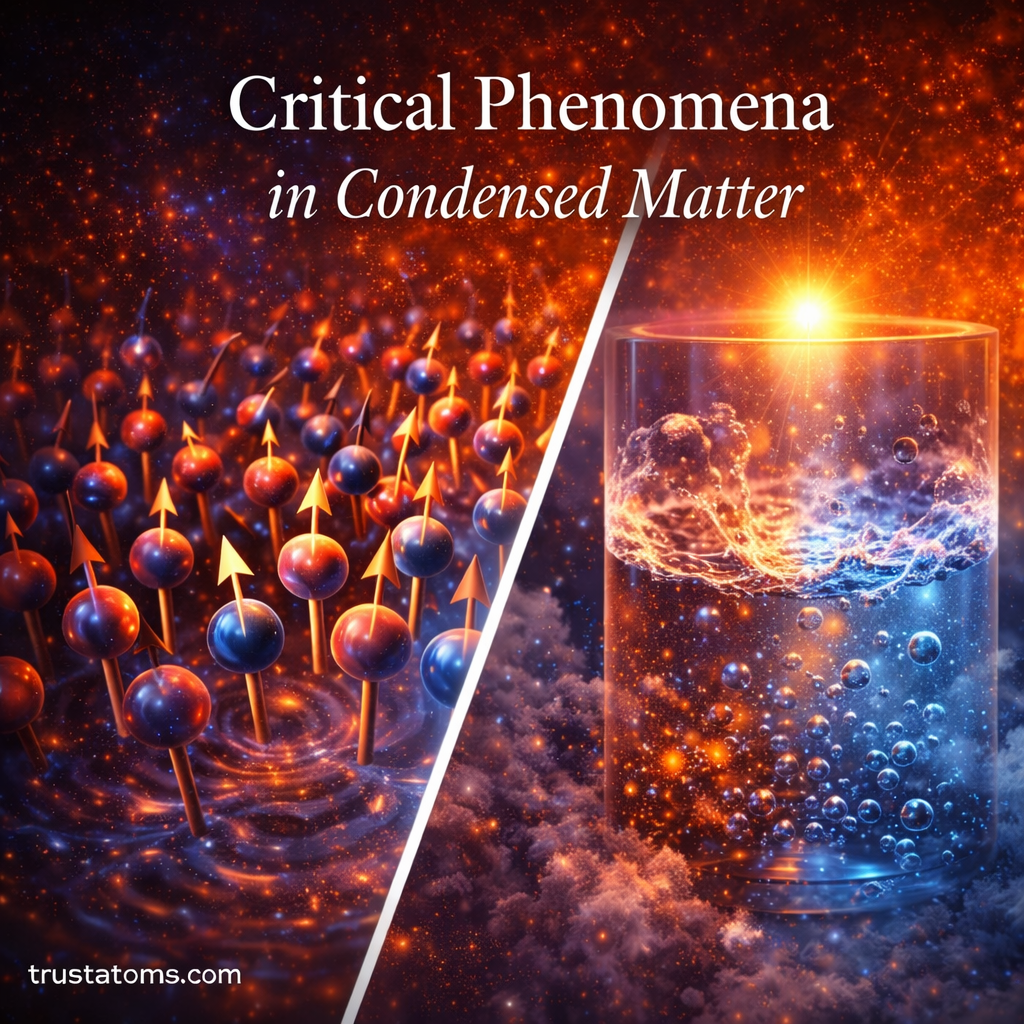
Critical Phenomena in Condensed Matter

Split illustration showing aligned magnetic spins near a critical temperature and a liquid-gas system at its critical point representing critical phenomena in condensed matter with trustatoms.com watermark.
Illustration of critical phenomena showing magnetic alignment and liquid-gas fluctuations near a critical point. trustatoms.com

When matter approaches a phase transition, something remarkable happens. Physical properties begin to fluctuate wildly, correlations extend across large distances, and small disturbances can have system-wide effects.

These dramatic behaviors are known as critical phenomena.

From magnets losing their magnetization to fluids at the brink of boiling, critical phenomena in condensed matter physics reveal deep principles about collective behavior, universality, and scaling. Surprisingly, very different materials can behave in almost identical ways near their critical points.

In this guide, we’ll explore what critical phenomena are, why they occur, and why they matter far beyond traditional materials science.

Continue reading “Critical Phenomena in Condensed Matter”

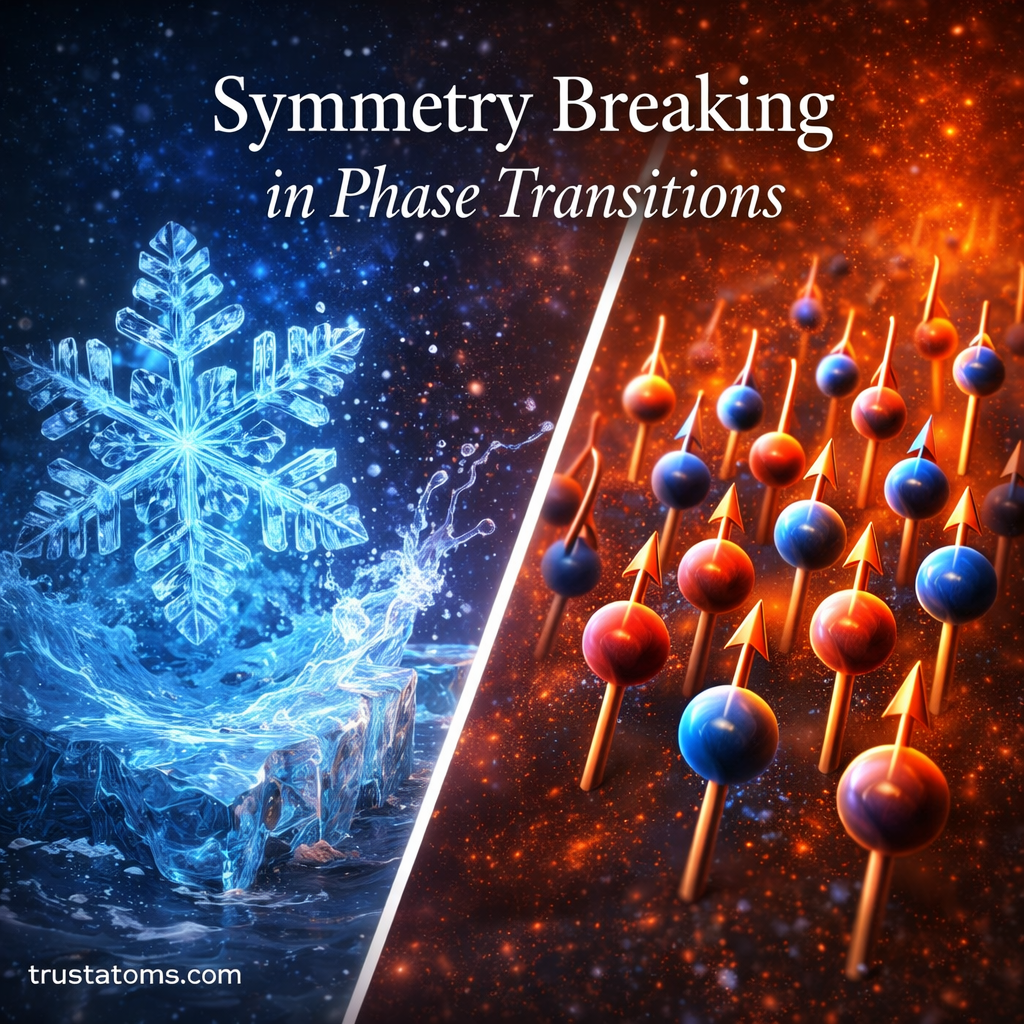
Symmetry Breaking in Phase Transitions

Split illustration showing ice crystal formation from liquid water and aligned atomic spins in a ferromagnet representing symmetry breaking in phase transitions with trustatoms.com watermark.
Illustration showing symmetry breaking during a phase transition, from crystal formation in ice to aligned spins in a magnet. trustatoms.com

Symmetry breaking is one of the most powerful ideas in modern physics. It explains why perfectly uniform systems suddenly develop structure, why forces in nature appear different at low energies, and why matter behaves differently as temperature changes.

From ice forming out of liquid water to the behavior of fundamental particles in the early universe, symmetry breaking in phase transitions helps us understand how order emerges from uniformity.

In this guide, we’ll explore what symmetry means in physics, how it breaks during phase transitions, and why this concept connects condensed matter physics to cosmology.

Continue reading “Symmetry Breaking in Phase Transitions”

Quantum Information in Physical Systems

Contextual illustration of quantum information in physical systems showing entangled particles, electron spin, and a quantum chip with title overlay and trustatoms.com watermark.
Conceptual illustration representing how quantum information is stored and processed in physical systems such as particles and quantum circuits. trustatoms.com

Quantum information is not just an abstract idea in theoretical physics — it is a measurable, physical property of real systems. From individual photons to superconducting circuits, information at the quantum level obeys rules that are fundamentally different from classical bits. Understanding how quantum information is stored, transformed, and measured inside physical systems is key to quantum computing, quantum cryptography, and modern condensed matter physics.

In this guide, we’ll explore what quantum information really is, how it exists in matter and energy, and why its physical nature reshapes our understanding of reality.

Continue reading “Quantum Information in Physical Systems”