Weak and Strong Nuclear Interactions

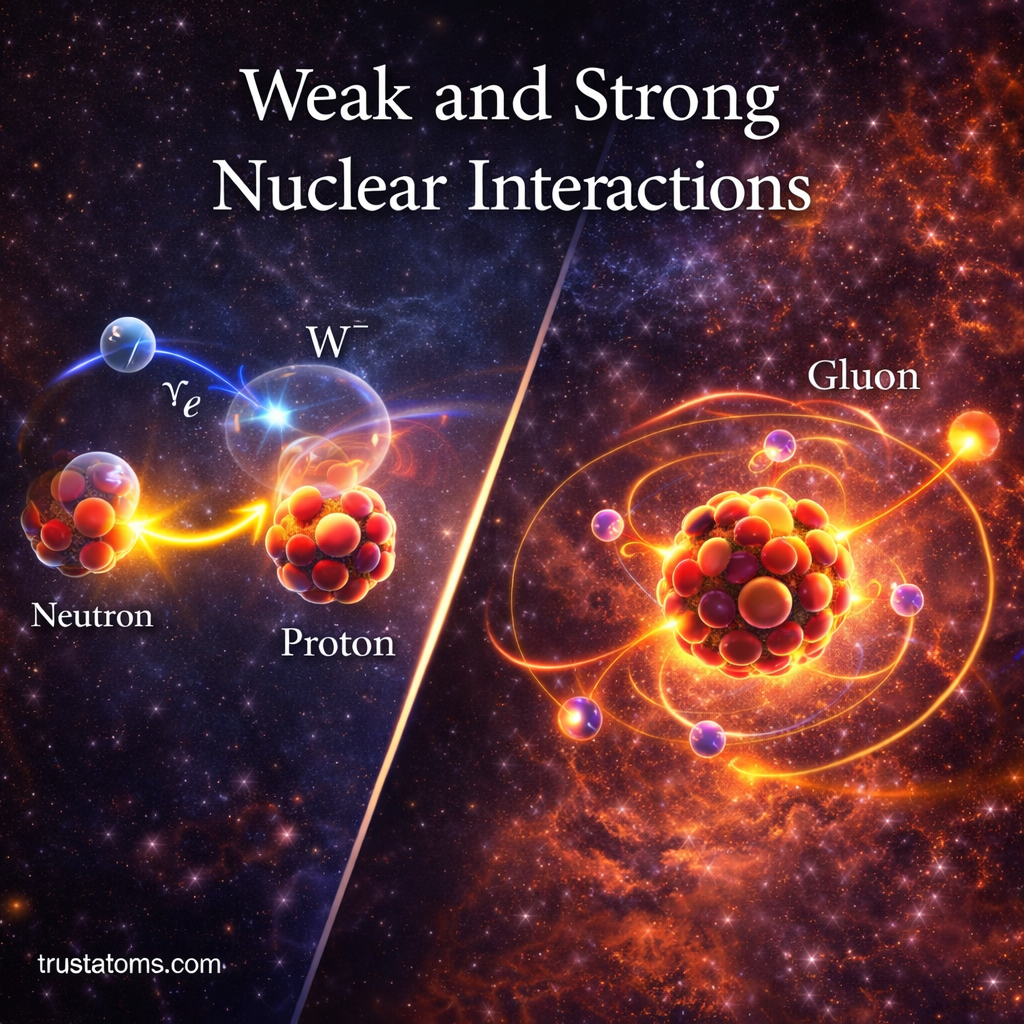
Split conceptual illustration showing beta decay for the weak interaction and nucleon binding for the strong nuclear force inside an atomic nucleus.
Conceptual diagram comparing weak nuclear decay and strong nuclear binding inside the atomic nucleus. trustatoms.com.

Inside every atom lies a world governed by forces far stronger than gravity and far more subtle than everyday electromagnetism. These are the nuclear interactions — the weak nuclear force and the strong nuclear force.

Together, they shape:

  • The stability of atoms
  • Radioactive decay
  • Nuclear fusion in stars
  • The very existence of matter

In this guide, we’ll clearly explain what the weak and strong nuclear interactions are, how they differ, and why they are fundamental to modern physics.

Continue reading “Weak and Strong Nuclear Interactions”
Spin–Orbit Coupling in Atomic Systems

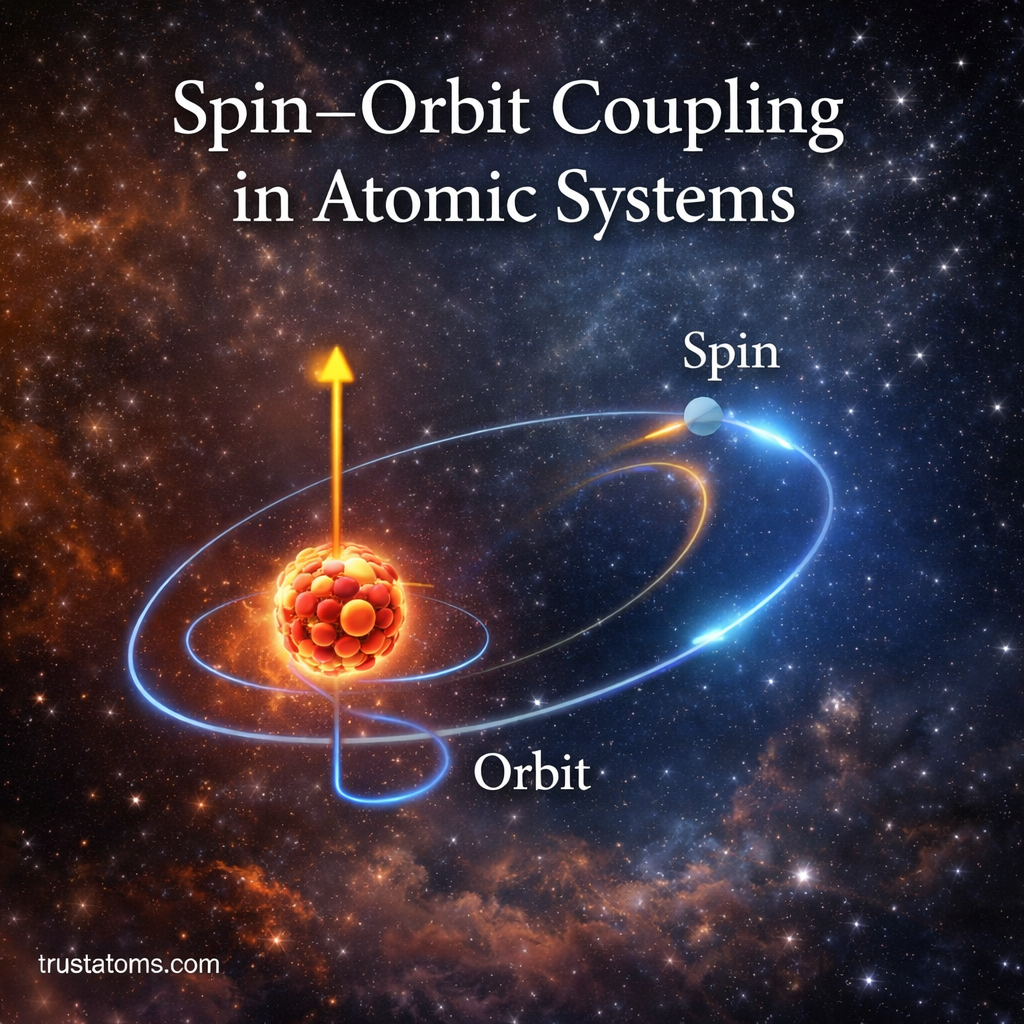
Conceptual atomic illustration showing an electron orbiting a nucleus with spin and orbital motion interacting, representing spin–orbit coupling in atomic systems.
Illustration of electron spin interacting with orbital motion around the nucleus, demonstrating spin–orbit coupling in atoms. trustatoms.com.

Spin–orbit coupling is one of the most fascinating effects in atomic physics. It explains why atomic energy levels split, why fine structure appears in spectral lines, and why quantum numbers matter in real, measurable ways.

At its core, spin–orbit coupling describes an interaction between:

  • An electron’s intrinsic spin
  • Its orbital motion around the nucleus

This subtle interaction has profound consequences — from atomic spectra to modern materials science.

Let’s break it down clearly and conceptually.

Continue reading “Spin–Orbit Coupling in Atomic Systems”

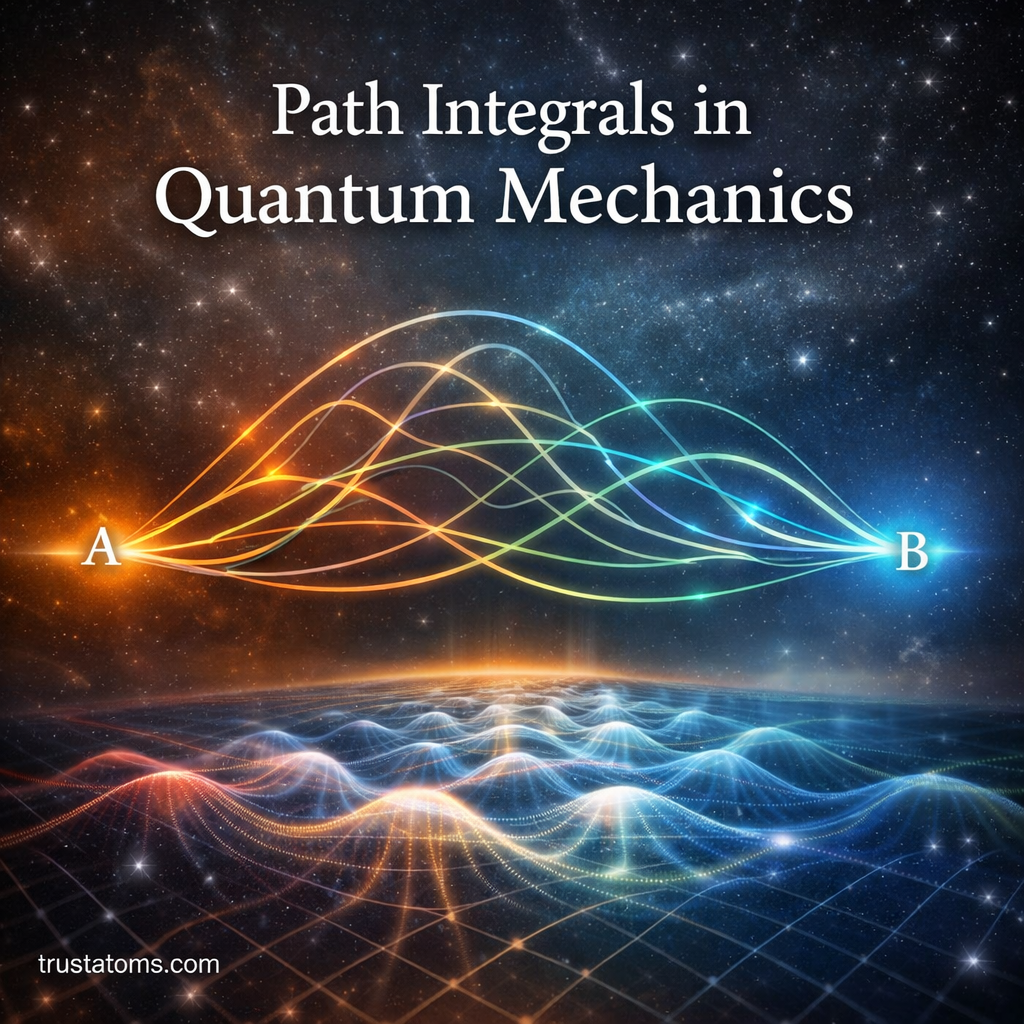
Path Integrals in Quantum Mechanics

Illustrated conceptual diagram of multiple glowing paths connecting two points in space representing path integrals in quantum mechanics.
Conceptual illustration of quantum particles exploring multiple paths between two points. trustatoms.com.

Quantum mechanics can feel abstract — wavefunctions, operators, Hilbert spaces. But there’s another powerful way to understand how particles move and interact: path integrals.

Instead of asking “What is the particle’s wavefunction doing?”, the path integral approach asks a different question:

What if a particle explores every possible path between two points?

In this guide, we’ll break down path integrals in plain language, explain why they matter in modern physics, and show how they connect quantum mechanics, relativity, and quantum field theory.

Continue reading “Path Integrals in Quantum Mechanics”

Renormalization in Quantum Field Theory

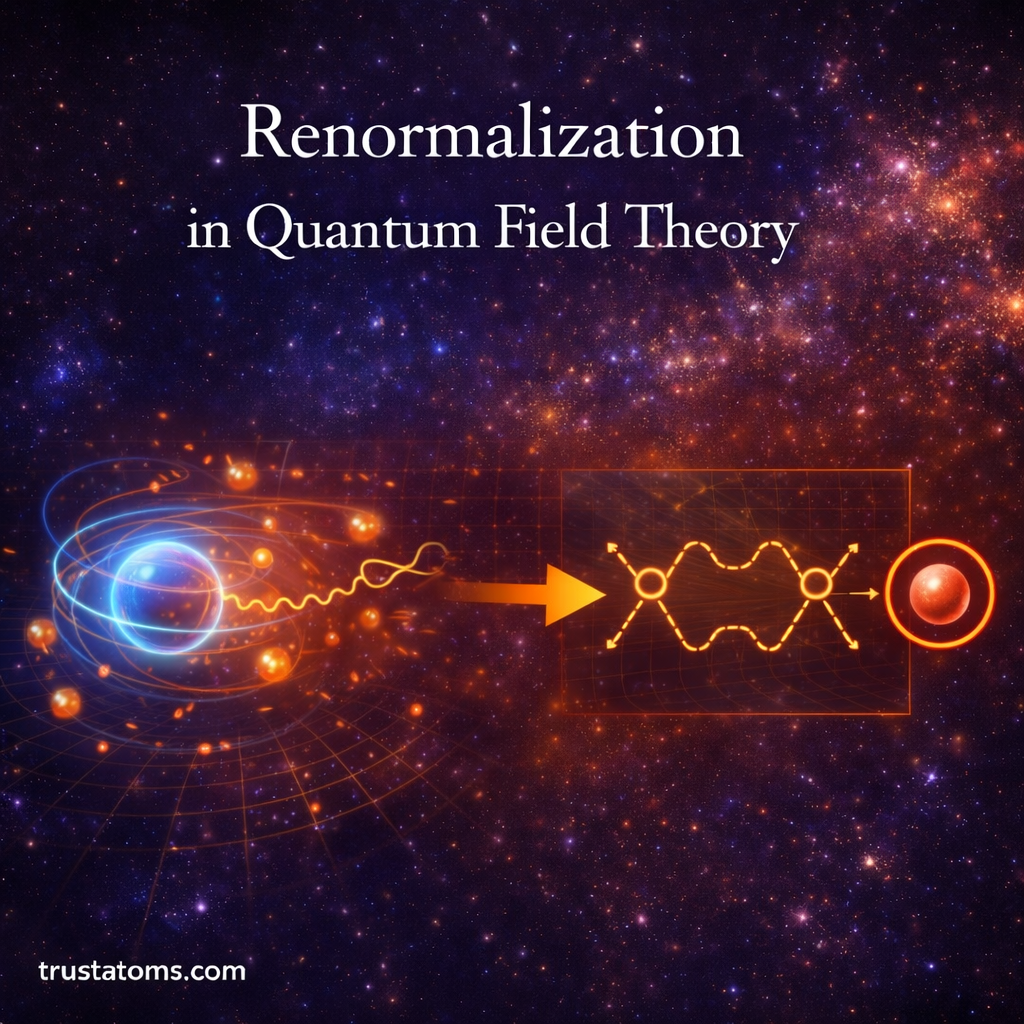
Illustration of renormalization in quantum field theory showing particle interactions and quantum corrections with overlay title and trustatoms.com watermark.
Conceptual illustration of quantum corrections and interaction flow representing renormalization in quantum field theory. trustatoms.com

Quantum Field Theory (QFT) is one of the most successful frameworks in physics. It explains:

  • The behavior of elementary particles
  • The electromagnetic, weak, and strong forces
  • Predictions verified to astonishing precision

But when physicists first developed QFT, they ran into a major problem:

The math kept producing infinities.

Renormalization is the method that makes sense of those infinities and turns QFT into a predictive, experimentally accurate theory.

This article explains what renormalization is, why infinities appear, and how physicists resolved the issue.

Continue reading “Renormalization in Quantum Field Theory”

Gauge Symmetry in Field Theories

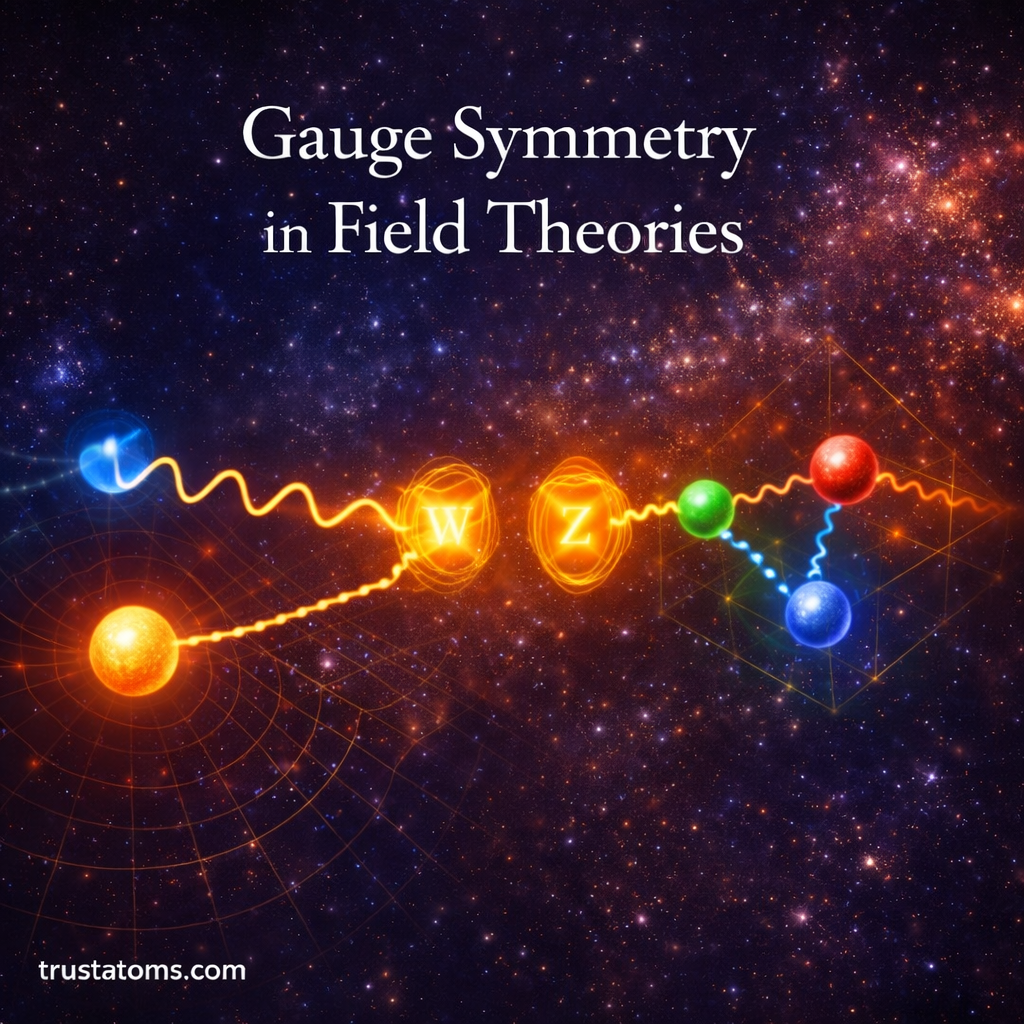
Illustration of gauge symmetry in field theories showing interacting field particles and symmetry connections with overlay title and trustatoms.com watermark.
Conceptual illustration of gauge symmetry showing interacting force carriers and field connections in modern particle physics. trustatoms.com

Modern physics rests on a powerful and elegant idea:

The fundamental forces of nature arise from symmetry.

More specifically, they arise from gauge symmetry — a principle that governs how fields transform without changing observable physics.

Gauge symmetry is not just a mathematical curiosity. It is the structural foundation of:

  • Electromagnetism
  • The weak nuclear force
  • The strong nuclear force
  • The Standard Model of particle physics

In this article, we’ll explore what gauge symmetry is, why it matters, and how it shapes our understanding of the universe.

Continue reading “Gauge Symmetry in Field Theories”

Tensor Analysis in Relativistic Frameworks

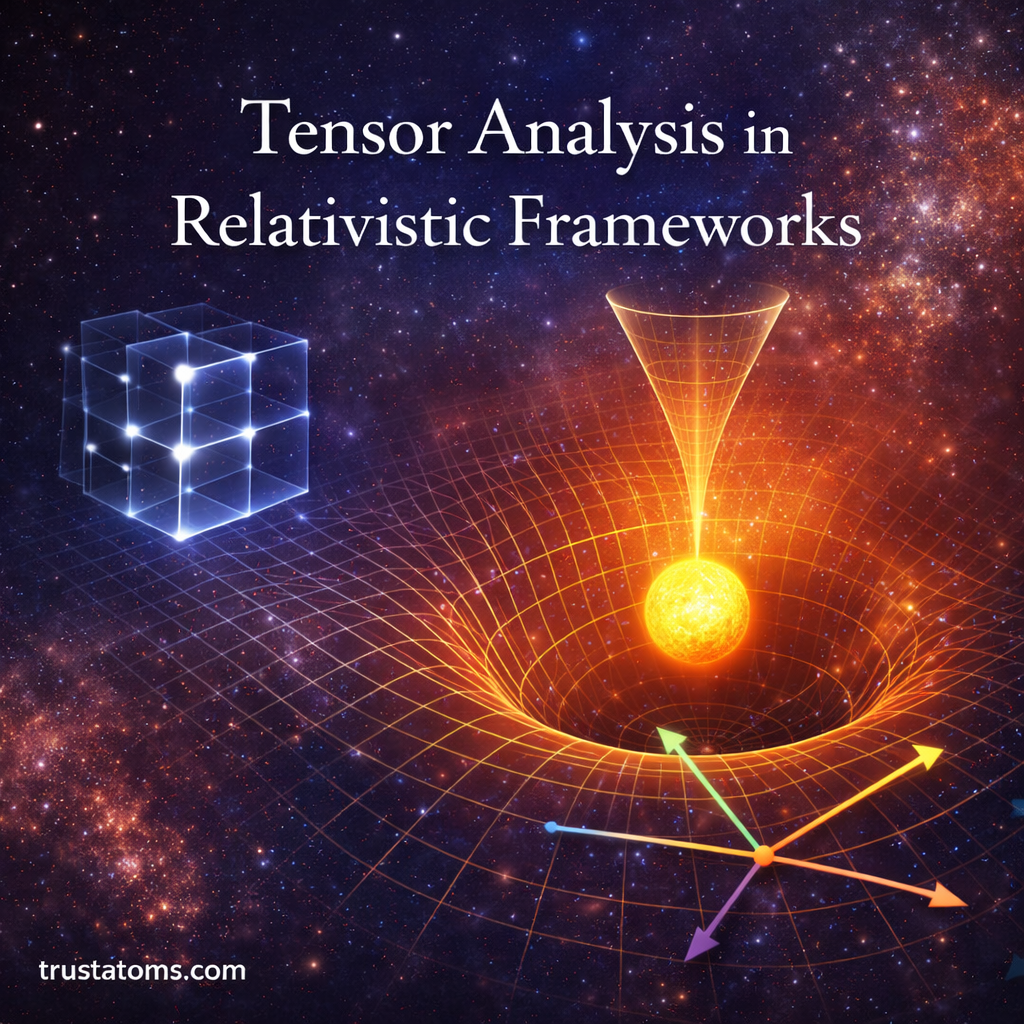
Illustration of tensor analysis in relativistic frameworks showing curved spacetime grid around a massive object with geometric tensor structures and overlay title, trustatoms.com watermark.
Conceptual illustration of spacetime curvature and tensor geometry in relativistic physics. trustatoms.com

When physics moved from Newton’s absolute space and time to Einstein’s curved spacetime, the mathematics had to evolve too.

Ordinary vectors were no longer enough.

To describe gravity, spacetime curvature, and high-speed motion consistently, physicists use tensor analysis — a mathematical framework that works naturally in relativistic physics.

This article explains what tensors are, why they are essential in relativity, and how tensor analysis forms the backbone of modern gravitational theory.

Continue reading “Tensor Analysis in Relativistic Frameworks”

Canonical Transformations in Analytical Mechanics

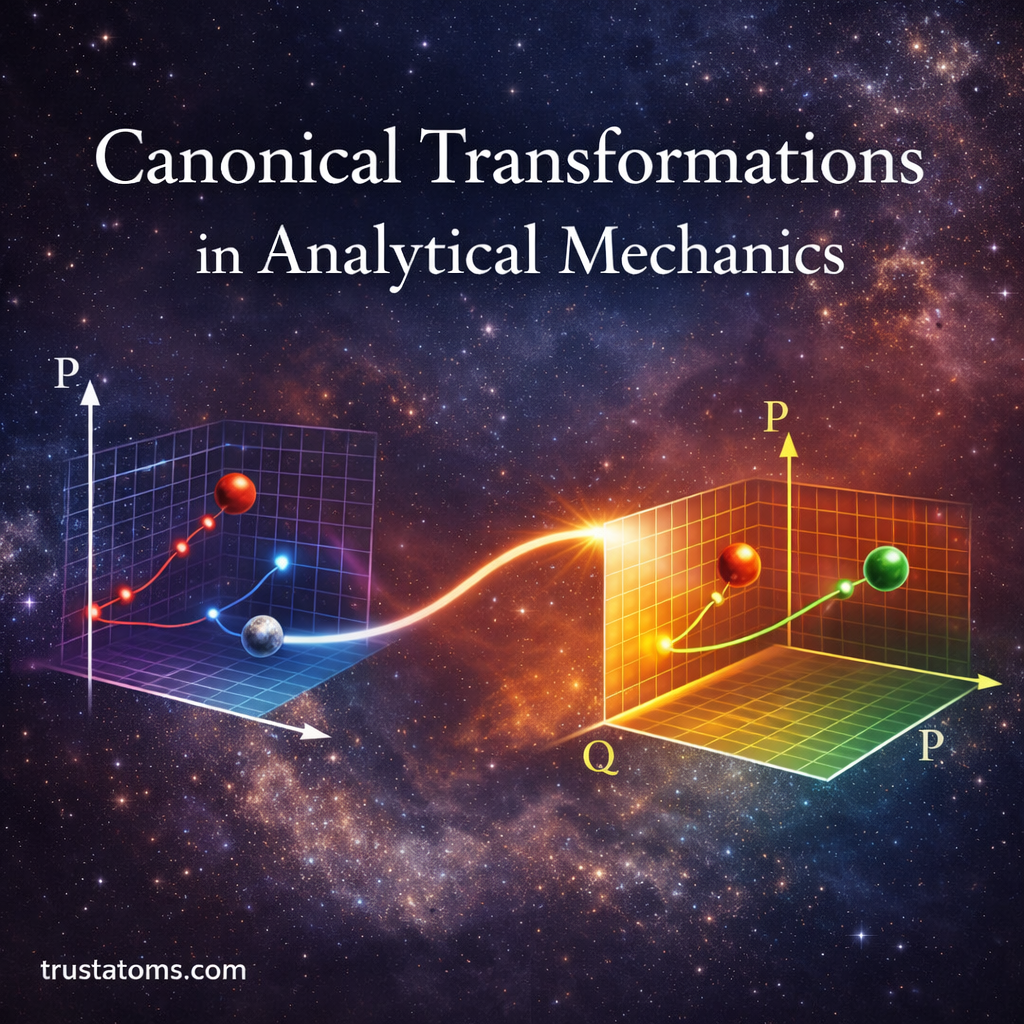
Illustration of canonical transformations in analytical mechanics showing phase space grids transforming between coordinate systems with overlay title and trustatoms.com watermark.
Conceptual illustration of phase space transformation between canonical coordinate systems in Hamiltonian mechanics. trustatoms.com

In classical mechanics, solving equations of motion can quickly become complicated.

But what if you could change coordinates in a way that preserves the physics while making the math easier?

That is exactly what canonical transformations do.

They are one of the most powerful tools in analytical mechanics, especially within Hamiltonian mechanics. Canonical transformations allow physicists to reformulate a problem into a simpler one — without changing the underlying physical behavior.

This article explains what canonical transformations are, why they matter, and how they connect to deeper ideas like symmetry and conservation laws.

Continue reading “Canonical Transformations in Analytical Mechanics”

Variational Principles in Physical Systems

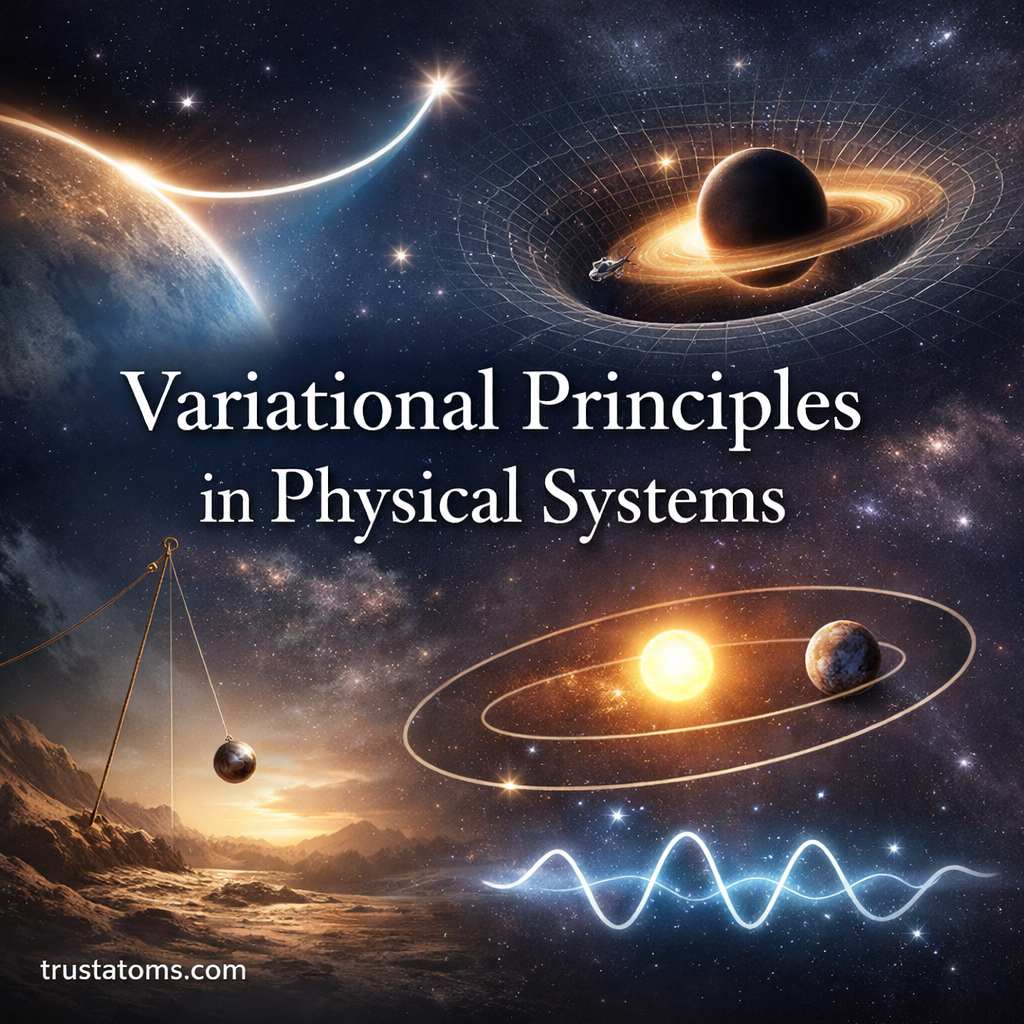
Contextual illustration of variational principles in physical systems showing light paths, planetary motion, spacetime curvature, and wave behavior with the title overlay and trustatoms.com watermark.
Illustration representing how physical systems follow optimization principles across mechanics, optics, relativity, and quantum physics. trustatoms.com

Why does light take the fastest path?
Why do planets follow smooth elliptical orbits?
Why does a hanging chain curve the way it does?

Across physics, the answer often comes down to one powerful idea: nature optimizes.

Variational principles reveal that many physical systems behave as if they are minimizing (or extremizing) something. Instead of focusing on forces directly, we focus on what quantity is optimized.

This article breaks down variational principles in a clear, practical way—connecting classical mechanics, optics, relativity, and even quantum theory.

Continue reading “Variational Principles in Physical Systems”

Lagrangian Formulation of Motion

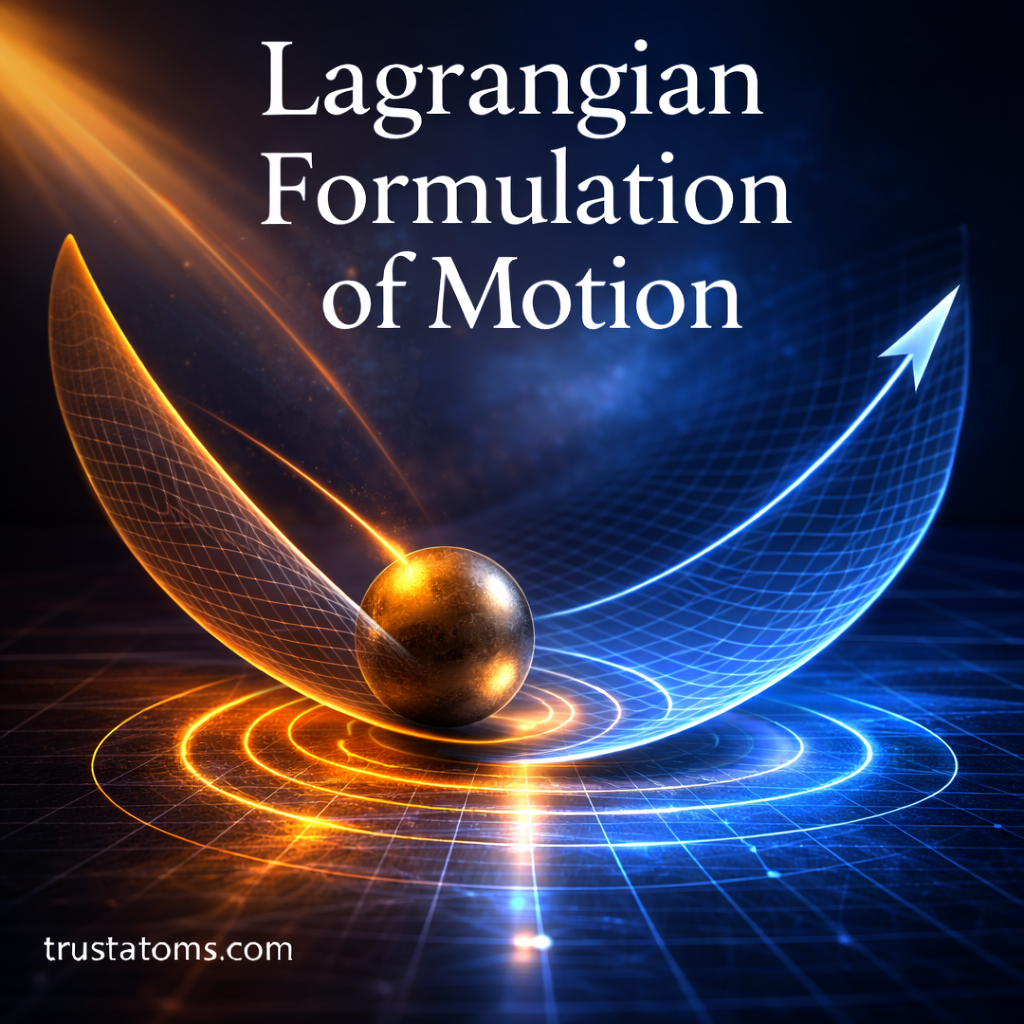
Illustration of the Lagrangian formulation of motion showing an energy surface and particle trajectory, with trustatoms.com watermark.
Conceptual diagram representing the Lagrangian formulation of motion, highlighting energy landscapes and optimal motion paths. trustatoms.com.

The Lagrangian formulation of motion is one of the most elegant ways to describe how physical systems evolve over time. Instead of focusing directly on forces — as Newtonian mechanics does — the Lagrangian approach focuses on energy.

This reformulation simplifies complex systems, reveals deep physical symmetries, and lays the groundwork for modern physics, including quantum mechanics and field theory.

In this article, we’ll explore what the Lagrangian formulation is, how it works, and why it remains essential in classical and modern physics.

Continue reading “Lagrangian Formulation of Motion”

Hamiltonian Mechanics in Classical Systems

Illustration of Hamiltonian mechanics in classical systems showing phase space motion and energy surfaces, with trustatoms.com watermark.
Conceptual diagram representing Hamiltonian mechanics in classical systems, highlighting phase space trajectories and energy-based motion. trustatoms.com.

Hamiltonian mechanics is one of the most elegant and powerful formulations of classical mechanics. While Newton’s laws describe motion in terms of forces, and Lagrangian mechanics focuses on energy differences, Hamiltonian mechanics reformulates motion using energy functions and phase space.

This framework not only simplifies many complex mechanical systems but also serves as a bridge between classical physics and quantum mechanics.

In this article, we’ll explore what Hamiltonian mechanics is, how it works, and why it remains essential in modern physics.

Continue reading “Hamiltonian Mechanics in Classical Systems”