Quantum Tunneling in Potential Barriers

Illustration of quantum tunneling in potential barriers showing a particle wave passing through an energy barrier in a quantum system.
Conceptual illustration of quantum tunneling in potential barriers, depicting wave behavior and probability transmission in quantum mechanics. trustatoms.com

Quantum tunneling is one of the most fascinating and counterintuitive phenomena in physics. In classical mechanics, a particle must have enough energy to overcome a barrier. If it does not, it simply reflects back.

In quantum mechanics, that rule no longer strictly applies.

Particles described by wave functions can pass through potential barriers—even when they do not have enough classical energy to climb over them. This phenomenon is known as quantum tunneling.

Quantum tunneling is not just theoretical. It plays a crucial role in nuclear physics, semiconductor devices, and even the fusion reactions powering the Sun.

Continue reading “Quantum Tunneling in Potential Barriers”


Energy Density in Field Theories

Illustration of energy density in field theories showing electromagnetic waves, gravitational curvature around a massive object, and quantum field fluctuations in space.
Conceptual illustration of energy density in field theories highlighting electromagnetic fields, spacetime curvature, and quantum fluctuations. trustatoms.com

Energy is one of the most fundamental concepts in physics. In classical mechanics, we often talk about the energy of objects—kinetic energy, potential energy, thermal energy.

But in field theories, energy is not just stored in objects.

It is distributed continuously throughout space.

Energy density describes how much energy exists per unit volume within a field. This concept is central to electromagnetism, general relativity, quantum field theory, and modern cosmology.

Understanding energy density helps physicists describe how fields carry, store, and transfer energy across the universe.

Continue reading “Energy Density in Field Theories”

Experimental Uncertainty in Measurement

Illustration of experimental uncertainty in measurement showing precision gauge, digital scale, statistical confidence curve, and laboratory microscope experiment.
Conceptual illustration of experimental uncertainty in measurement highlighting precision instruments, statistical confidence, and laboratory analysis. trustatoms.com

No measurement in physics is perfectly exact.

No matter how advanced the instrument or how careful the observer, every experimental result carries some degree of uncertainty. Understanding and quantifying that uncertainty is essential to scientific accuracy, credibility, and progress.

Experimental uncertainty is not a mistake. It is a natural and measurable part of observation.

In physics, acknowledging uncertainty strengthens conclusions rather than weakening them.

Continue reading “Experimental Uncertainty in Measurement”

Scaling Laws in Physical Systems

Illustration of scaling laws in physical systems showing an elephant, skyscraper, planet Earth, wind turbine, ship, and natural forces representing size-dependent physical behavior.
Conceptual illustration of scaling laws in physical systems highlighting how size influences mechanics, gravity, fluid dynamics, and energy systems. trustatoms.com

Scaling laws describe how physical quantities change when the size of a system changes. They reveal powerful patterns in nature—showing how length, area, volume, force, and energy relate across different scales.

From tiny atoms to massive galaxies, scaling principles help physicists understand how systems behave when dimensions grow larger or smaller. These laws are foundational in physics, engineering, biology, and even cosmology.

Understanding scaling laws allows scientists to predict how changes in size affect performance, stability, and energy requirements.

Continue reading “Scaling Laws in Physical Systems”

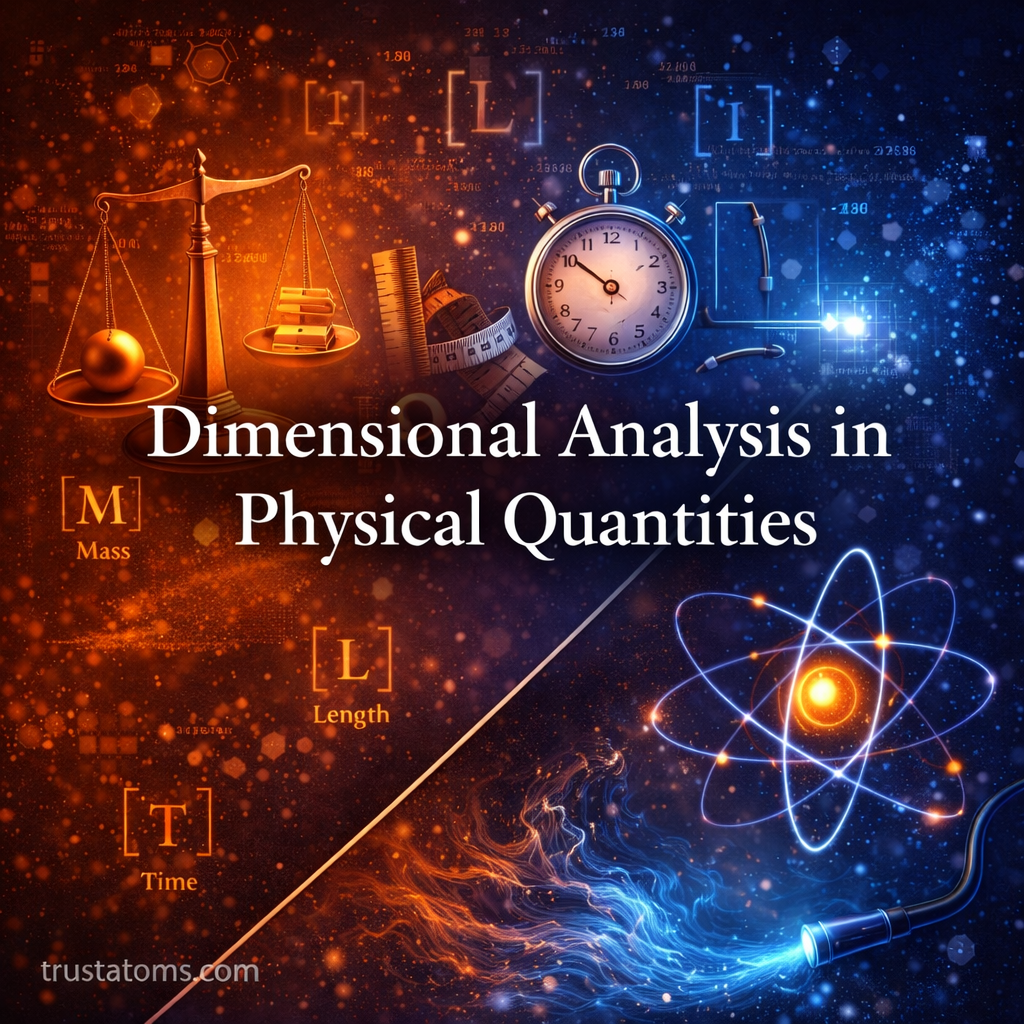
Dimensional Analysis in Physical Quantities

Illustration representing dimensional analysis in physical quantities with mass scale, ruler, stopwatch, atomic structure, and fundamental measurement symbols.
Conceptual illustration of dimensional analysis in physical quantities highlighting mass, length, time, and fundamental measurement principles. trustatoms.com

Dimensional analysis is one of the most powerful and practical tools in physics. It allows scientists and engineers to check equations, derive relationships, simplify problems, and even predict physical behavior—without solving complex mathematics.

At its core, dimensional analysis ensures that physical equations make sense.

If the dimensions do not match, the equation cannot be correct.

Continue reading “Dimensional Analysis in Physical Quantities”

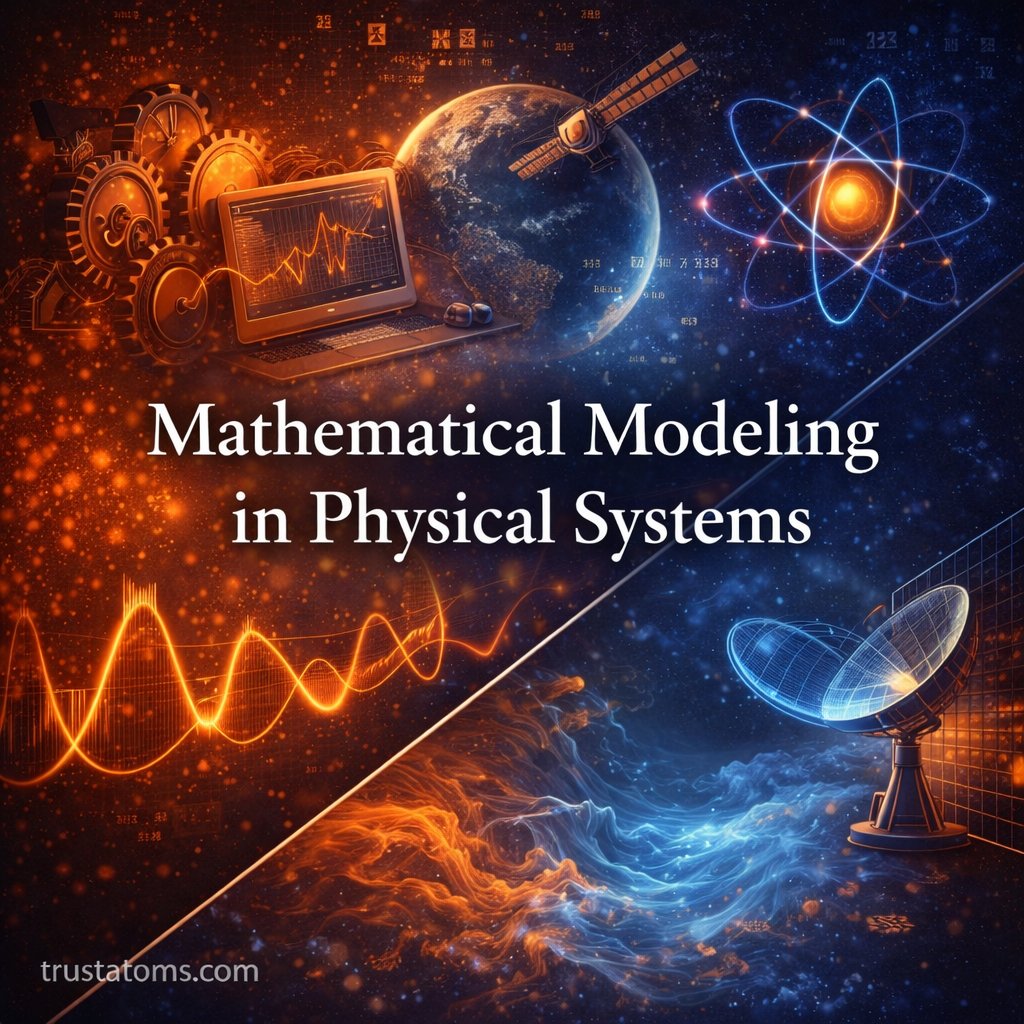
Mathematical Modeling in Physical Systems

Illustration representing mathematical modeling in physical systems with mechanical gears, satellite orbit, atomic structure, wave patterns, and simulation graphics.
Conceptual illustration of mathematical modeling in physical systems, highlighting mechanics, orbital motion, wave behavior, and computational simulation. trustatoms.com

Mathematical modeling is one of the most powerful tools in physics. It allows scientists to describe, predict, and understand physical systems using equations, logical structures, and computational simulations.

From planetary motion to quantum particles, mathematical models translate physical laws into forms that can be analyzed and tested. Without modeling, modern science and engineering would not exist in their current form.

In applied and theoretical physics alike, modeling connects observation to prediction.

Continue reading “Mathematical Modeling in Physical Systems”

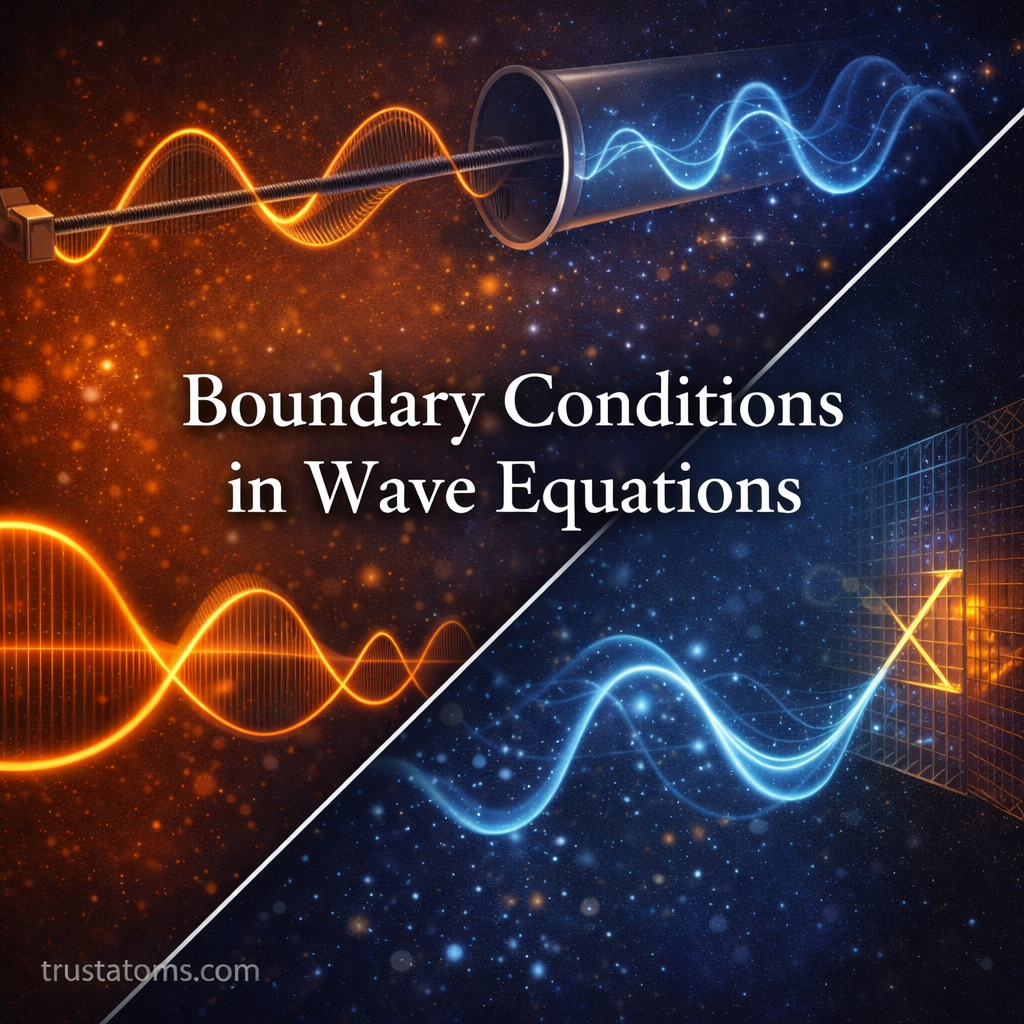
Boundary Conditions in Wave Equations

Illustration of boundary conditions in wave equations showing standing waves on a fixed string, sound waves in an open pipe, and wave reflection at a surface.
Conceptual illustration of boundary conditions in wave equations demonstrating fixed, free, and reflective wave behavior. trustatoms.com

Wave equations describe how vibrations, oscillations, and disturbances move through space and time. From sound traveling through air to light propagating in space, wave behavior is governed by precise mathematical relationships.

But solving a wave equation is only part of the story.

To determine the actual physical behavior of a system, we must also specify boundary conditions. These conditions define what happens at the edges of the system and ultimately determine which wave patterns are allowed.

In physics, boundary conditions transform general equations into meaningful, real-world solutions.

Continue reading “Boundary Conditions in Wave Equations”

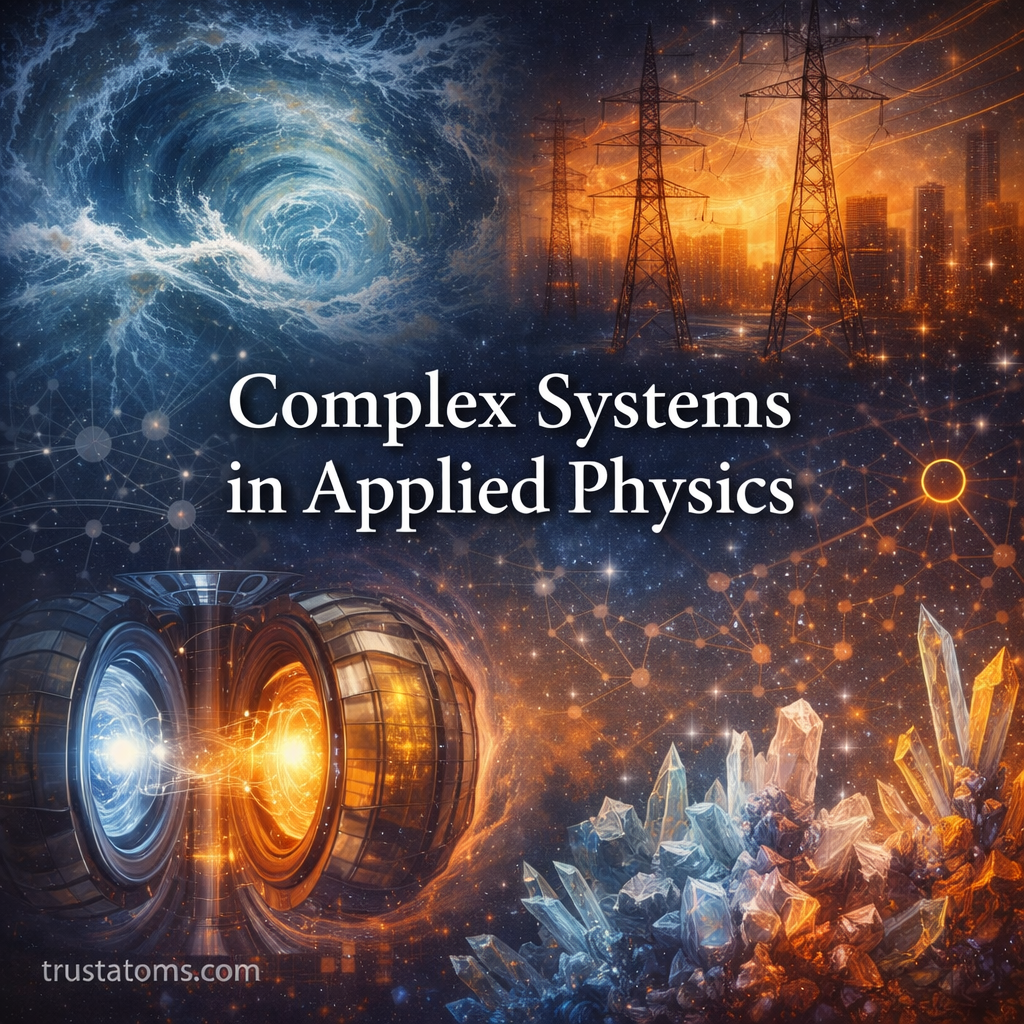
Complex Systems in Applied Physics

Illustration of complex systems in applied physics showing turbulence, power grid networks, plasma confinement, and crystal formation interconnected in a dynamic composition.
Conceptual illustration representing complex systems in applied physics, including turbulence, energy grids, plasma dynamics, and material structures. trustatoms.com

Complex systems are everywhere in applied physics—from turbulent air flowing over an aircraft wing to electrical grids powering entire cities. Unlike simple systems that can be described with a few equations and predictable outcomes, complex systems involve many interacting parts whose collective behavior produces surprising, emergent patterns.

Understanding complex systems is essential for solving real-world engineering and scientific challenges. In applied physics, it bridges theory and practical problem-solving across energy, materials, climate, medicine, and technology.

Continue reading “Complex Systems in Applied Physics”

Chaos Theory in Deterministic Models

Illustration representing chaos theory in deterministic models with a double pendulum, strange attractor pattern, Earth’s atmosphere, and nonlinear system visualization.
Conceptual illustration of chaos theory in deterministic models showing nonlinear dynamics and sensitive dependence on initial conditions. trustatoms.com

Chaos theory explores how systems governed by clear, fixed rules can still produce unpredictable and highly complex behavior. At first glance, that sounds contradictory. If something is deterministic—meaning its future is completely determined by its current state—shouldn’t it be predictable?

Surprisingly, the answer is no.

From weather systems to planetary motion, deterministic models can generate outcomes that look random, even though they follow strict physical laws. Understanding this paradox is the foundation of chaos theory.

Continue reading “Chaos Theory in Deterministic Models”

Nonlinear Dynamics in Mechanical Systems

Illustration showing nonlinear dynamics in mechanical systems including a chaotic double pendulum, vibrating suspension bridge, and strange attractor pattern.
Conceptual visualization of nonlinear behavior in mechanical systems, including chaos, structural instability, and complex motion patterns. trustatoms.com

Most introductory physics problems assume something comforting:

Small inputs produce small outputs.

Push a pendulum gently, and it swings gently. Stretch a spring slightly, and it responds proportionally.

But many real-world mechanical systems do not behave this way.

When forces, motion, or energy interactions stop following simple proportional rules, we enter the world of nonlinear dynamics — a field that explains complex motion, chaos, instability, and surprising behavior in mechanical systems.

In this guide, we’ll explore what nonlinear dynamics means, how it differs from linear motion, and why it matters in engineering and physics.

Continue reading “Nonlinear Dynamics in Mechanical Systems”