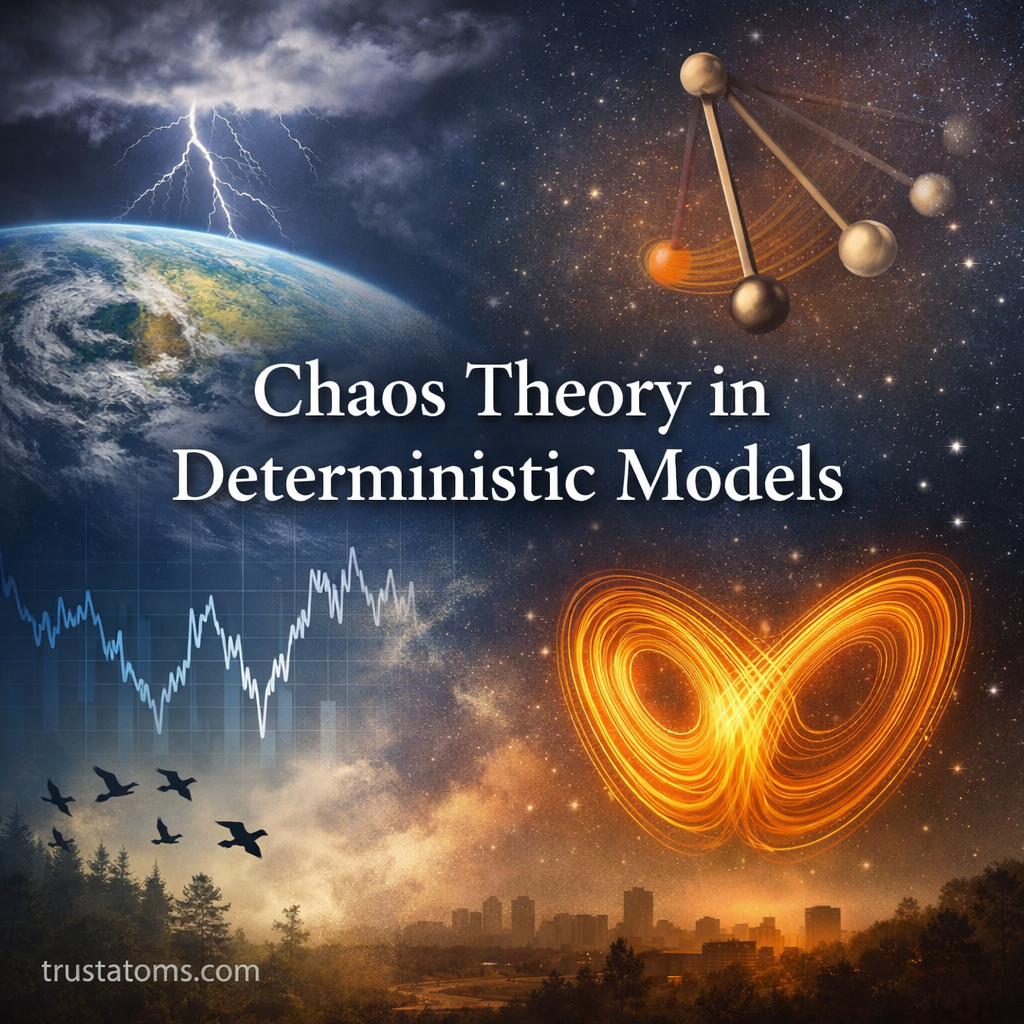
Chaos theory explores how systems governed by clear, fixed rules can still produce unpredictable and highly complex behavior. At first glance, that sounds contradictory. If something is deterministic—meaning its future is completely determined by its current state—shouldn’t it be predictable?
Surprisingly, the answer is no.
From weather systems to planetary motion, deterministic models can generate outcomes that look random, even though they follow strict physical laws. Understanding this paradox is the foundation of chaos theory.
What Is a Deterministic Model?
A deterministic model is a mathematical or physical system where:
- The present state fully determines the future state
- No randomness is built into the rules
- Identical starting conditions always produce identical outcomes
Classic examples include:
- Newton’s laws of motion
- Planetary orbits under gravity
- Ideal pendulum motion
- Certain population growth models
In theory, if you knew all initial conditions perfectly, you could predict the future forever.
Chaos theory shows why that assumption breaks down in practice.
What Is Chaos Theory?
Chaos theory studies deterministic systems that are extremely sensitive to initial conditions. Even tiny differences in starting values can grow exponentially over time.
This phenomenon is often called the “butterfly effect,” a term popularized by meteorologist Edward Lorenz while studying weather models.
In chaotic systems:
- Behavior appears random
- Long-term prediction becomes impossible
- Underlying rules remain strictly deterministic
Chaos is not disorder. It is structured unpredictability.
The Butterfly Effect Explained

In chaotic systems:
- A tiny change in initial conditions occurs
- That change grows over time
- Eventually, outcomes diverge dramatically
For example:
- A rounding difference in a computer simulation
- A slight variation in temperature
- A microscopic shift in position
Over time, these small differences amplify. The system’s future becomes practically unpredictable—even though it follows precise equations.
This sensitivity is a defining feature of deterministic chaos.
Key Features of Chaotic Deterministic Systems
1. Sensitivity to Initial Conditions
Two nearly identical starting states evolve into vastly different outcomes.
2. Nonlinearity
Most chaotic systems are nonlinear, meaning:
- Output is not proportional to input
- Small causes can produce large effects
- Feedback loops amplify disturbances
Linear systems do not typically exhibit chaotic behavior.
3. Deterministic Rules
There is no randomness built into the system’s equations.
The unpredictability arises from internal complexity—not chance.
4. Strange Attractors
Chaotic systems often evolve toward geometric structures in phase space called strange attractors. These:
- Never repeat exactly
- Have fractal structure
- Constrain motion without making it periodic
They represent hidden order inside apparent disorder.
Famous Examples of Chaos in Deterministic Systems
Weather Systems
Weather follows physical laws of fluid dynamics and thermodynamics. Yet long-term forecasting is limited because:
- Small measurement errors grow rapidly
- Atmospheric dynamics are nonlinear
- Feedback processes amplify disturbances
This is why reliable forecasts rarely extend far beyond about 10 days.
Double Pendulum Motion
A double pendulum consists of one pendulum attached to another. While the system follows classical mechanics:
- Small differences in starting angle lead to wildly different motion
- The movement appears irregular and unpredictable
Yet no randomness exists in the equations.
Population Models
Certain deterministic population growth equations show chaotic behavior when reproduction rates increase.
Outcomes may:
- Stabilize
- Oscillate
- Become chaotic
All under purely deterministic mathematical rules.
Why Chaos Does Not Mean Randomness
It’s important to distinguish chaos from randomness.
Random systems:
- Include inherent unpredictability
- Depend on probability
Chaotic systems:
- Are fully deterministic
- Have predictable short-term behavior
- Become unpredictable only over long timescales
If initial conditions were known with infinite precision, predictions would, in theory, remain accurate. In practice, measurement limits make this impossible.
Mathematical Foundations of Chaos
Chaos emerges primarily in nonlinear differential equations and iterative maps.
Key mathematical tools include:
- Phase space analysis
- Lyapunov exponents (measure sensitivity to initial conditions)
- Fractal geometry
- Bifurcation diagrams
These tools reveal patterns hidden within chaotic motion.
One surprising discovery of chaos theory is that simple equations can generate extraordinary complexity.
Real-World Applications of Chaos Theory
Chaos theory has practical impact across many fields:
Physics
- Turbulence modeling
- Plasma behavior
- Nonlinear oscillations
Engineering
- Mechanical vibrations
- Electrical circuit stability
- Control system design
Biology
- Heart rhythm dynamics
- Brain activity patterns
- Ecosystem fluctuations
Economics
- Market volatility modeling
- Nonlinear feedback in financial systems
Understanding chaos improves prediction limits and system stability design.
The Limits of Predictability
Chaos theory reshaped how scientists think about prediction.
Even with:
- Perfect laws
- Accurate equations
- Advanced computation
Long-term forecasting may remain impossible due to exponential error growth.
This realization changed fields like meteorology, astrophysics, and systems engineering.
The universe can be lawful—and still unpredictable.
Determinism vs. Predictability
Chaos theory separates two ideas often confused:
- Determinism: the future is fully determined by the present
- Predictability: the future can be calculated accurately
Chaotic systems prove that determinism does not guarantee predictability.
This distinction is one of the most profound conceptual shifts in modern physics.
Final Thoughts
Chaos theory in deterministic models reveals a powerful truth: complexity does not require randomness.
Simple laws can generate intricate, evolving, and unpredictable behavior. Systems governed by precise equations can still defy long-term prediction because of extreme sensitivity to initial conditions.
Rather than destroying order, chaos theory uncovers hidden structure within dynamic systems.
It shows that nature operates on a delicate balance between stability and unpredictability—where deterministic rules give rise to endlessly evolving patterns.