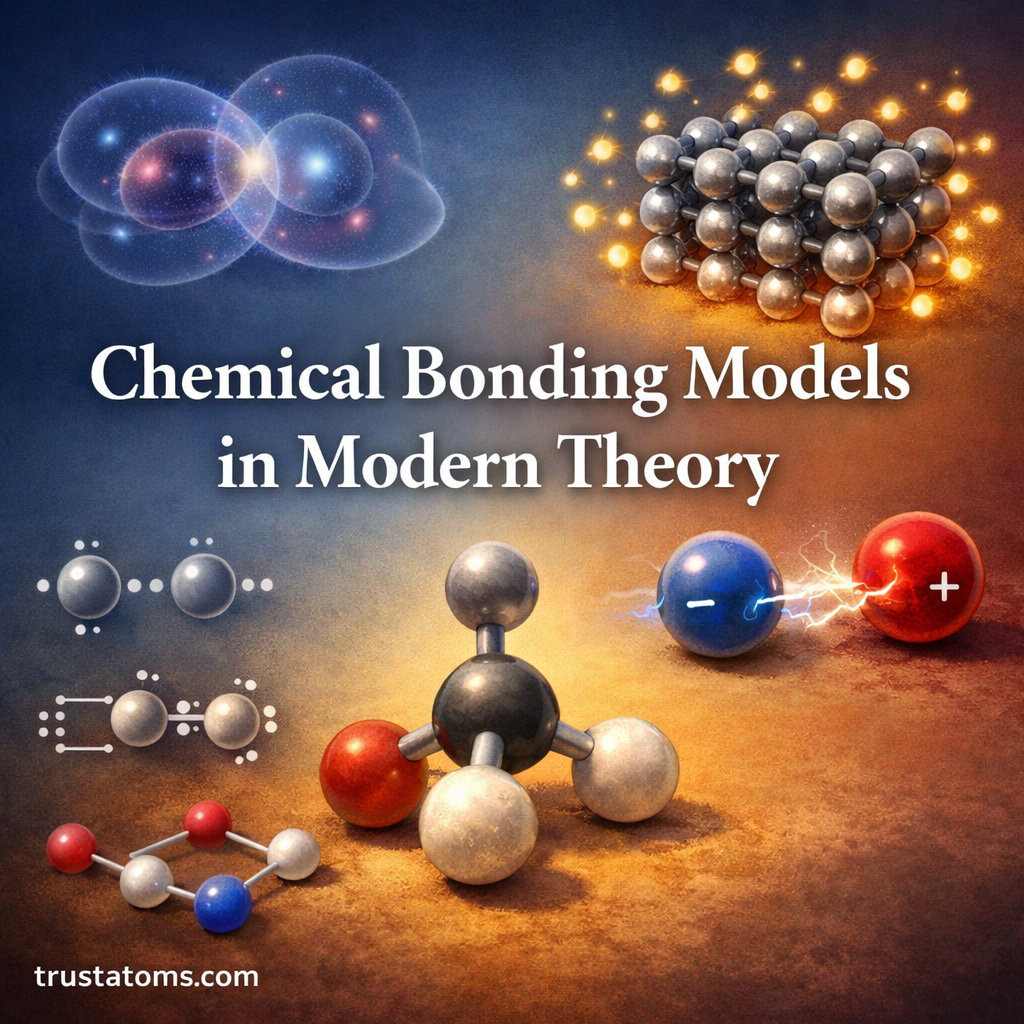
Chemical bonding is one of the most fundamental concepts in chemistry. It explains how atoms connect to form molecules and materials, shaping everything from water and proteins to metals and semiconductors.
Early scientists understood that atoms combine in predictable ratios, but modern chemistry goes much deeper. Today, several chemical bonding models help scientists explain how and why atoms share or transfer electrons. These models provide different perspectives on the same underlying reality of atomic interactions.
Understanding these bonding models helps students and researchers interpret molecular structure, predict chemical behavior, and design new materials.
Why Chemical Bonding Models Are Needed
Atoms bond because doing so often lowers their overall energy. However, describing exactly how electrons behave during bonding is complex. Electrons exist in probabilistic orbitals rather than simple paths.
Because of this complexity, chemists use multiple theoretical models to explain bonding. Each model emphasizes different aspects of electron behavior.
These models allow scientists to:
- Predict molecular shapes
- Understand bond strength
- Explain electrical and magnetic properties
- Interpret spectroscopy data
- Model chemical reactions
Rather than replacing each other, bonding models complement one another and are used depending on the situation.
Valence Bond Theory
Valence Bond (VB) theory focuses on how atomic orbitals overlap when atoms form bonds.
According to this model, a chemical bond forms when:
- Two atomic orbitals overlap
- Electrons with opposite spins pair together
- Electron density concentrates between the two nuclei
This shared electron density creates the attractive force that holds atoms together.
Orbital Overlap
The strength of a bond depends on how effectively orbitals overlap. Greater overlap leads to stronger bonding interactions.
Two common overlap types are:
- Sigma (σ) bonds – formed by head-on orbital overlap
- Pi (π) bonds – formed by sideways orbital overlap
Sigma bonds are generally stronger because the overlap occurs directly along the axis connecting the nuclei.
Hybridization
Valence Bond theory also explains molecular geometry through orbital hybridization.
Hybrid orbitals form when atomic orbitals mix to create new orbitals with different shapes and orientations.
Common hybridizations include:
- sp
- sp²
- sp³
These hybrid orbitals help explain the shapes of many molecules, such as linear, trigonal planar, and tetrahedral structures.
Molecular Orbital Theory
Molecular Orbital (MO) theory provides a more quantum-mechanical view of bonding.
Instead of focusing on localized bonds between atoms, MO theory treats electrons as occupying molecular orbitals that extend across the entire molecule.
Formation of Molecular Orbitals
When atomic orbitals combine, they form two types of molecular orbitals:
- Bonding orbitals – lower energy, stabilize the molecule
- Antibonding orbitals – higher energy, destabilize the molecule
Electrons fill these orbitals according to the same principles that govern atomic orbitals:
- Aufbau principle
- Pauli exclusion principle
- Hund’s rule
The balance between bonding and antibonding electrons determines overall bond strength.
Bond Order
MO theory introduces the concept of bond order, which measures the stability of a bond.
Bond order is determined by comparing the number of electrons in bonding and antibonding orbitals.
A higher bond order typically indicates:
- Stronger bonds
- Shorter bond lengths
- Greater molecular stability
Lewis Bonding Model
The Lewis bonding model is one of the earliest and simplest bonding descriptions. It represents molecules using Lewis structures, which show valence electrons as dots around atoms.
In this model:
- Shared electron pairs form covalent bonds
- Transferred electrons form ionic bonds
Lewis structures help visualize:
- Bond connectivity
- Lone electron pairs
- Formal charges
Although this model does not describe electron motion or orbital structure, it remains extremely useful for introductory chemistry and quick structural predictions.
VSEPR Theory and Molecular Shape
Valence Shell Electron Pair Repulsion (VSEPR) theory predicts molecular geometry based on electron repulsion.
The central idea is simple:
Electron pairs repel each other and arrange themselves as far apart as possible.
This principle allows chemists to predict molecular shapes such as:
- Linear
- Bent
- Trigonal planar
- Tetrahedral
- Trigonal bipyramidal
- Octahedral
Importance of Geometry
Molecular shape strongly influences chemical properties, including:
- Reactivity
- Polarity
- Biological activity
- Physical behavior such as boiling points
Because of this, VSEPR remains an essential tool in molecular prediction.
Ionic Bonding Model
In ionic bonding, atoms transfer electrons rather than sharing them.
This typically occurs between:
- Metals, which tend to lose electrons
- Nonmetals, which tend to gain electrons
The resulting charged particles are called ions.
Oppositely charged ions attract each other through electrostatic forces, forming ionic compounds such as salts.
Properties of Ionic Compounds
Ionic substances commonly exhibit:
- High melting points
- Strong crystal structures
- Electrical conductivity when dissolved or melted
- Brittleness under stress
These properties arise from the ordered lattice arrangement of ions.
Metallic Bonding Model
Metallic bonding describes how atoms bond in metals.
Instead of localized electron pairs, metals contain a sea of delocalized electrons that move freely among positively charged atomic cores.
This electron mobility explains many metallic properties:
- Electrical conductivity
- Thermal conductivity
- Malleability
- Ductility
- Metallic luster
Because electrons are not tied to specific atoms, metals can conduct electricity and heat very efficiently.
Comparing the Major Bonding Models
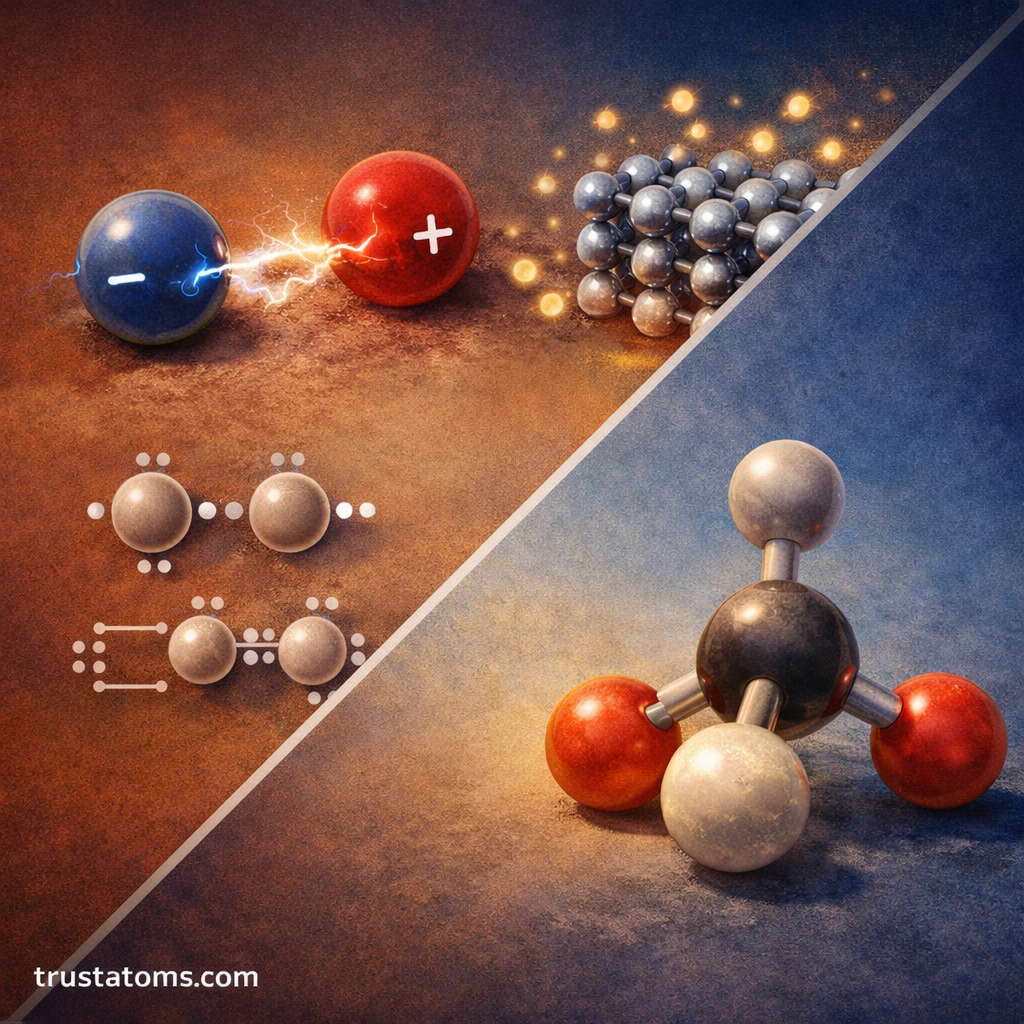
Each bonding model explains different aspects of chemical structure and behavior.
Lewis structures are useful for visualizing electron pairs and bonding patterns. Valence Bond theory focuses on orbital overlap and hybridization, while Molecular Orbital theory provides a quantum description of electron distribution across entire molecules.
Meanwhile, VSEPR predicts molecular shape, ionic bonding explains electron transfer interactions, and metallic bonding accounts for the unique properties of metals.
Together, these models form the foundation of modern bonding theory.
Why Modern Chemistry Uses Multiple Models
No single bonding model fully captures the complexity of electron behavior in molecules. Instead, chemists use several complementary frameworks depending on the problem being studied.
For example:
- Lewis structures help determine connectivity
- VSEPR predicts molecular shape
- Valence Bond theory explains hybridization
- Molecular Orbital theory explains spectroscopy and magnetism
Using multiple models allows scientists to build a more complete picture of molecular behavior.
Final Thoughts
Chemical bonding models are essential tools that allow chemists to understand how atoms combine and why molecules behave the way they do.
From the simplicity of Lewis structures to the quantum depth of Molecular Orbital theory, each model contributes valuable insights into the nature of atomic interactions.
Together, these theories form the backbone of modern chemistry, helping scientists explore everything from biological molecules to advanced materials and nanotechnology.