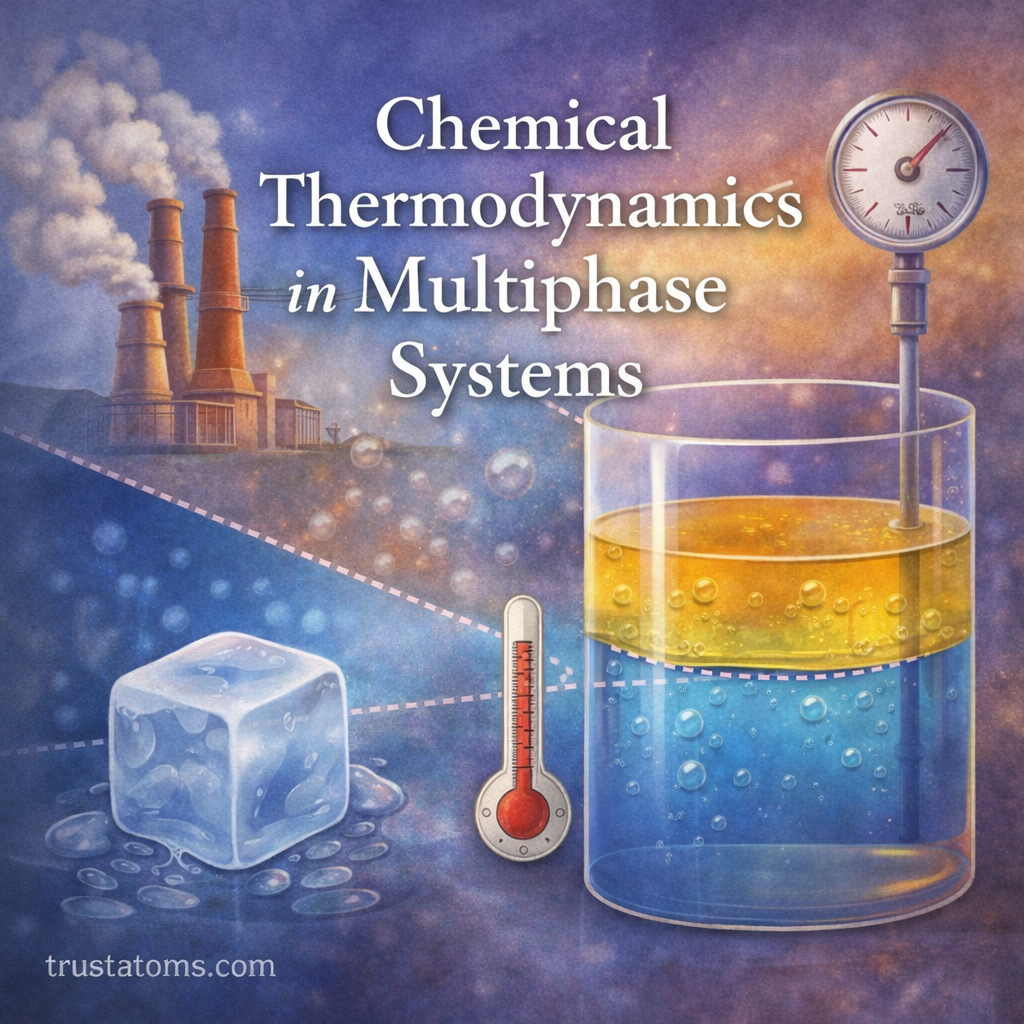
Chemical thermodynamics studies how energy, heat, and work influence chemical systems. When a system contains more than one physical phase—such as solids, liquids, and gases—it becomes a multiphase system. Understanding thermodynamics in these systems helps scientists predict how substances behave when phases interact, separate, or reach equilibrium.
Multiphase thermodynamics plays a central role in fields such as chemical engineering, environmental science, materials science, and geochemistry. From boiling water to oil–water mixtures and industrial reactors, many real-world processes involve interactions between multiple phases.
What Is a Multiphase System?
A multiphase system contains two or more physically distinct phases that coexist within the same chemical environment. A phase is defined as a uniform region of matter with consistent chemical composition and physical properties.
Common examples include:
- Ice floating in liquid water
- Oil and water mixtures
- Gas bubbles in liquids
- Solid catalysts interacting with gases
Each phase behaves differently, but thermodynamic principles determine how these phases exchange energy and matter.
Phases and Phase Boundaries
In multiphase systems, the boundaries between phases play an important role in determining system behavior.
Characteristics of Phases
Each phase has specific thermodynamic properties, including:
- Temperature
- Pressure
- Chemical potential
- Composition
- Density
Within a phase, these properties remain uniform. However, when phases meet at a boundary, interactions occur that influence equilibrium and energy transfer.
Interfaces Between Phases
The region where two phases meet is called an interface. Interfaces are important because:
- Energy may accumulate at boundaries
- Molecules may rearrange at surfaces
- Chemical reactions may occur preferentially at interfaces
Surface phenomena become especially important in systems involving liquids, gases, and finely divided solids.
Thermodynamic Equilibrium in Multiphase Systems
A multiphase system reaches thermodynamic equilibrium when there are no net changes in macroscopic properties over time.
Three conditions must be satisfied:
- Thermal equilibrium – all phases have the same temperature.
- Mechanical equilibrium – pressures are balanced across phases.
- Chemical equilibrium – chemical potentials are equal for each component across phases.
When these conditions are met, matter and energy no longer flow between phases.
The Role of Chemical Potential
Chemical potential is one of the most important concepts in multiphase thermodynamics. It represents the change in system energy when an additional amount of a substance is introduced.
In equilibrium:
- The chemical potential of a component must be equal in every phase.
For example, if a substance exists in both liquid and vapor phases, equilibrium occurs when the chemical potential of that substance is the same in both phases. If the values differ, matter will transfer between phases until balance is reached.
Chemical potential therefore governs:
- Phase transitions
- Solubility
- Vapor–liquid equilibrium
- Reaction direction in multiphase systems
Phase Transitions and Energy Changes

Multiphase systems often involve phase transitions, where substances move from one phase to another.
Common phase transitions include:
- Melting (solid to liquid)
- Freezing (liquid to solid)
- Vaporization (liquid to gas)
- Condensation (gas to liquid)
- Sublimation (solid to gas)
Each transition involves energy changes known as latent heat.
Latent Heat
Latent heat is the energy absorbed or released during a phase change without changing temperature.
For example:
- Water absorbs heat during evaporation.
- Heat is released when vapor condenses into liquid.
These energy exchanges are central to thermodynamic calculations in multiphase systems.
The Phase Rule
One of the most useful tools in multiphase thermodynamics is the Gibbs phase rule. This rule describes how many independent variables can be changed without disturbing equilibrium.
The general form of the rule is:
F = C − P + 2
Where:
- F represents degrees of freedom
- C represents the number of chemical components
- P represents the number of phases
The rule helps determine how temperature, pressure, and composition affect multiphase systems.
Practical Meaning of the Phase Rule
Using the phase rule, scientists can determine:
- How many variables can be controlled independently
- Whether a system is fully constrained
- How phase diagrams should be interpreted
This rule is widely used when analyzing equilibrium systems involving multiple phases.
Phase Diagrams in Multiphase Systems
Phase diagrams provide visual representations of how phases behave under different conditions.
They typically show relationships between:
- Temperature
- Pressure
- Composition
Important features of phase diagrams include:
- Phase boundaries
- Triple points
- Critical points
Triple Point
The triple point represents the exact conditions where three phases coexist simultaneously in equilibrium.
For example, water can exist as solid, liquid, and gas at its triple point under specific temperature and pressure conditions.
Critical Point
The critical point marks the temperature and pressure where the distinction between liquid and gas disappears.
Beyond this point, the substance exists as a supercritical fluid, which has properties of both liquids and gases.
Multiphase Systems in Chemical Engineering
Industrial processes frequently involve multiphase systems. Chemical engineers must understand thermodynamic behavior to design efficient processes.
Examples include:
- Distillation columns separating liquid mixtures
- Gas absorption in liquid solvents
- Catalytic reactions on solid surfaces
- Oil–water separation systems
Thermodynamic models allow engineers to predict phase behavior and optimize industrial equipment.
Multiphase Systems in Natural Environments
Many natural systems are multiphase environments where chemical thermodynamics determines physical processes.
Examples include:
- Water cycles involving vapor, liquid, and ice
- Gas exchange between oceans and the atmosphere
- Mineral formation in geological environments
- Soil systems containing solids, liquids, and gases
Understanding these systems helps scientists predict environmental changes and natural resource behavior.
Factors That Influence Multiphase Thermodynamics
Several variables influence how multiphase systems behave.
Temperature
Temperature affects:
- Phase transitions
- Reaction rates
- Molecular motion
Higher temperatures often shift equilibrium toward phases with higher energy.
Pressure
Pressure strongly influences gas–liquid systems and phase transitions involving gases.
For example:
- Increasing pressure can promote condensation.
- Decreasing pressure can encourage vaporization.
Composition
Changes in chemical composition alter chemical potentials and can lead to new equilibrium states or phase separations.
Why Multiphase Thermodynamics Matters
Multiphase thermodynamics provides the framework for understanding how different forms of matter interact in complex systems.
Its applications include:
- Predicting phase behavior in chemical processes
- Designing industrial separation techniques
- Modeling environmental and atmospheric systems
- Developing advanced materials
- Understanding geological and planetary processes
By applying thermodynamic principles, scientists can analyze systems where energy and matter move across phase boundaries.
Final Thoughts
Chemical thermodynamics in multiphase systems explains how energy, matter, and phases interact under equilibrium conditions. By studying chemical potential, phase transitions, and thermodynamic equilibrium, scientists can predict how substances behave when solids, liquids, and gases coexist.
These principles are essential for understanding both natural phenomena and engineered processes. From atmospheric chemistry to industrial manufacturing, multiphase thermodynamics provides the tools needed to analyze complex chemical systems.