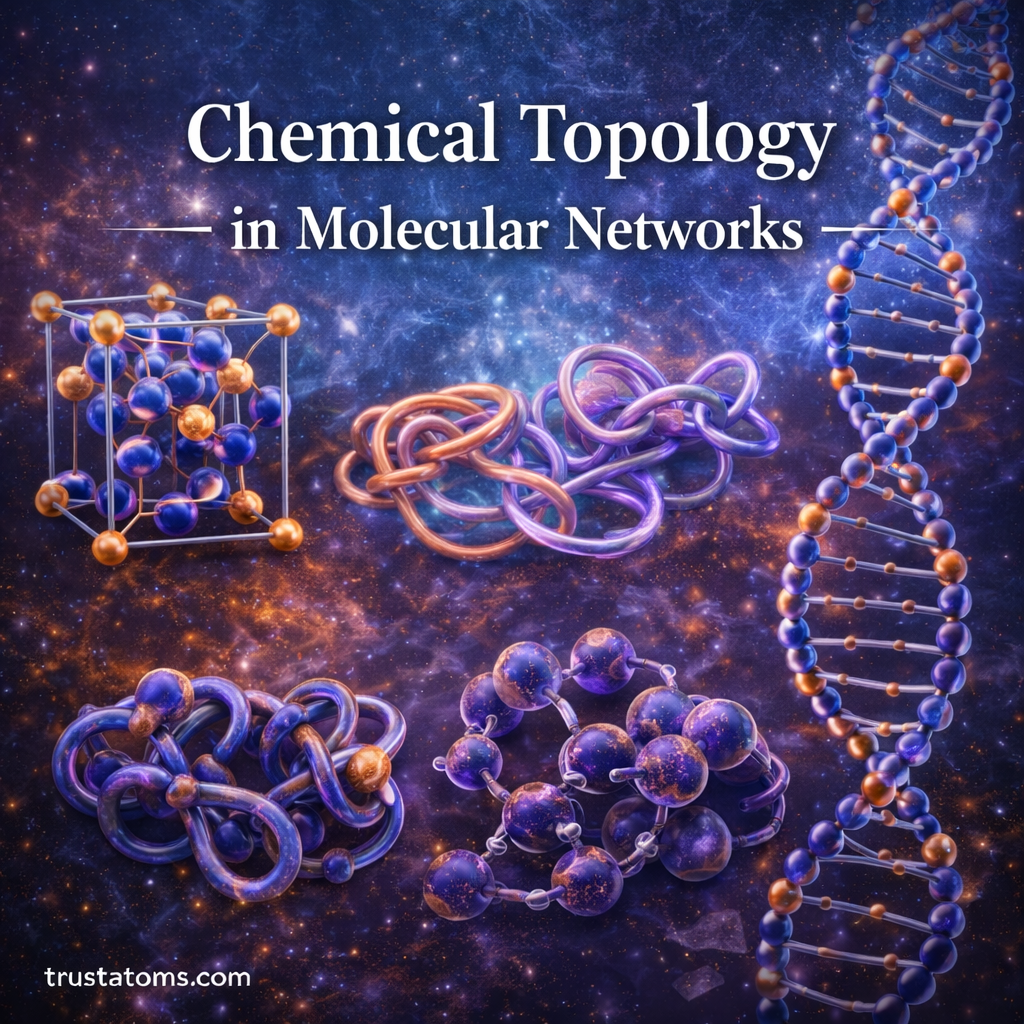
Chemical topology is a field of chemistry that studies how atoms connect and organize within molecular systems. Instead of focusing only on distances and angles between atoms, chemical topology examines the connectivity patterns that form molecular networks.
These patterns can reveal how molecules behave, how materials form complex structures, and how chemical systems organize themselves at both small and large scales.
Chemical topology plays an important role in fields such as materials science, polymer chemistry, nanotechnology, and biological chemistry. By understanding how molecules connect in networks, scientists can design new materials and predict how chemical systems will behave.
What Is Chemical Topology?
Chemical topology studies the connectivity relationships between atoms and bonds within molecules and extended structures.
In topology, the exact shape or geometry of an object is less important than how its components are connected.
For example:
- Two molecular structures may have different shapes but identical connectivity.
- A network may stretch or bend without changing its topological structure.
This perspective allows chemists to analyze molecules as networks of nodes and links, where:
- Atoms act as nodes
- Chemical bonds act as connections
By studying these relationships, chemists can better understand molecular stability, reactivity, and structural organization.
Molecular Networks in Chemistry
Many chemical systems form networks rather than isolated molecules.
A molecular network is a structure where repeating units connect together to create extended systems.
Examples of molecular networks include:
- Polymer chains
- Crystal frameworks
- Coordination networks
- Biological macromolecules
These systems often contain repeating connectivity patterns that determine how the entire structure behaves.
For instance:
- Polymers form long chains or branching networks.
- Metal-organic frameworks form highly ordered lattice networks.
- Biological molecules like proteins form intricate folded networks of bonds.
Understanding these networks requires a topological perspective.
Nodes and Links in Molecular Structures
Chemical topology often describes molecular systems using network terminology.
Nodes
Nodes represent atoms or molecular units that serve as connection points.
Examples include:
- Carbon atoms in organic molecules
- Metal ions in coordination compounds
- Molecular clusters in extended frameworks
Nodes determine how many connections a structure can form.
Links
Links represent the bonds or interactions that connect nodes.
These may include:
- Covalent bonds
- Ionic interactions
- Coordination bonds
- Hydrogen bonding interactions
The pattern formed by nodes and links defines the topological structure of the molecule or material.
Types of Molecular Topologies
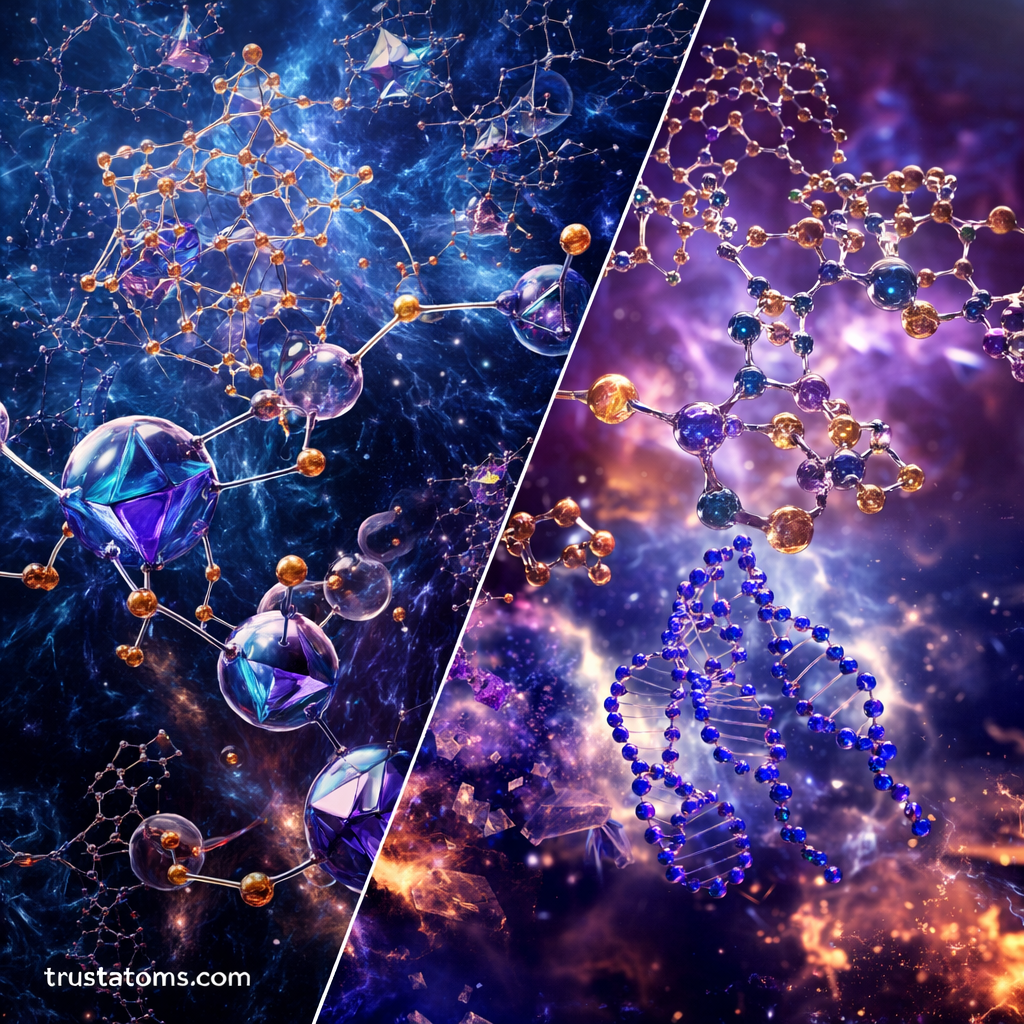
Different connectivity patterns produce different molecular topologies. Several important forms appear frequently in chemistry.
Linear Topology
In linear topology, atoms connect in a simple chain-like arrangement.
Examples include:
- Polymer backbones
- Simple organic chains
- Certain inorganic coordination chains
Linear structures often show flexibility and can form long molecular strands.
Branched Topology
Branched structures contain multiple connection points where chains divide.
These structures are common in:
- Branched polymers
- Complex organic molecules
- Certain macromolecular frameworks
Branching increases structural complexity and often changes material properties such as density and solubility.
Cyclic Topology
Cyclic structures form closed loops within molecular networks.
Examples include:
- Aromatic rings
- Cyclic polymers
- Molecular cages
These structures can provide additional stability and unique electronic properties.
Network Topology
Network topologies form extended three-dimensional structures with repeating connections.
Examples include:
- Crystal frameworks
- Covalent network solids
- Metal-organic frameworks (MOFs)
These materials often show remarkable mechanical strength and chemical stability.
Topological Isomers
Chemical topology also helps explain topological isomers, molecules that share the same chemical composition but differ in connectivity.
Unlike geometric isomers, topological isomers cannot be converted into each other through simple bond rotations.
Examples include:
- Knotted molecules
- Linked molecular rings
- Interlocked molecular structures
These unique molecules have become an exciting area of research in modern chemistry.
Topological isomers demonstrate how connectivity alone can create fundamentally different chemical structures.
Applications of Chemical Topology
Understanding molecular topology allows chemists to design materials with precise structural features.
Key applications include:
Materials Science
Topological design helps develop advanced materials such as:
- Porous frameworks
- High-strength polymers
- Nanostructured materials
These materials often rely on carefully engineered network connectivity.
Nanotechnology
At the nanoscale, molecular networks can form intricate structures that perform specialized tasks.
Examples include:
- Molecular machines
- Self-assembling nanostructures
- Nanoporous materials
Topological principles guide how these systems assemble and operate.
Drug Design and Biochemistry
Biological molecules often rely on complex network structures.
For example:
- Protein folding involves intricate bonding networks
- DNA structures form topological loops and supercoils
- Enzyme activity depends on precise molecular connectivity
Studying these structures through topology helps scientists understand biological function.
Polymer Engineering
Polymer properties depend strongly on molecular topology.
Different topological arrangements lead to different material behaviors.
Examples include:
- Linear polymers with flexible chains
- Cross-linked polymers with strong networks
- Dendritic polymers with highly branched structures
These structural differences influence strength, elasticity, and durability.
Chemical Topology and Self-Assembly
Many molecular networks form through self-assembly, a process where molecules spontaneously organize into ordered structures.
Topological interactions guide this organization.
Self-assembling systems often rely on:
- Repeating bonding patterns
- Molecular recognition
- Directional chemical interactions
Examples include:
- Supramolecular assemblies
- Metal-organic frameworks
- Biological macromolecular complexes
Chemical topology helps predict how these systems form and evolve.
The Role of Topology in Modern Chemistry
Chemical topology has become an important interdisciplinary field connecting chemistry, mathematics, and materials science.
Its influence continues to grow in areas such as:
- Molecular architecture design
- Advanced functional materials
- Supramolecular chemistry
- Synthetic molecular machines
As chemists develop increasingly complex molecular systems, topological analysis becomes essential for understanding how these systems behave.
Final Thoughts
Chemical topology offers a powerful way to understand molecular structures beyond simple geometric descriptions. By focusing on connectivity patterns within molecular networks, chemists can uncover the underlying organization of complex chemical systems.
From polymers and crystal frameworks to biological macromolecules and nanomaterials, molecular topology shapes how materials behave and interact. As research continues, chemical topology will remain a key tool for designing new materials and exploring the architecture of the molecular world.