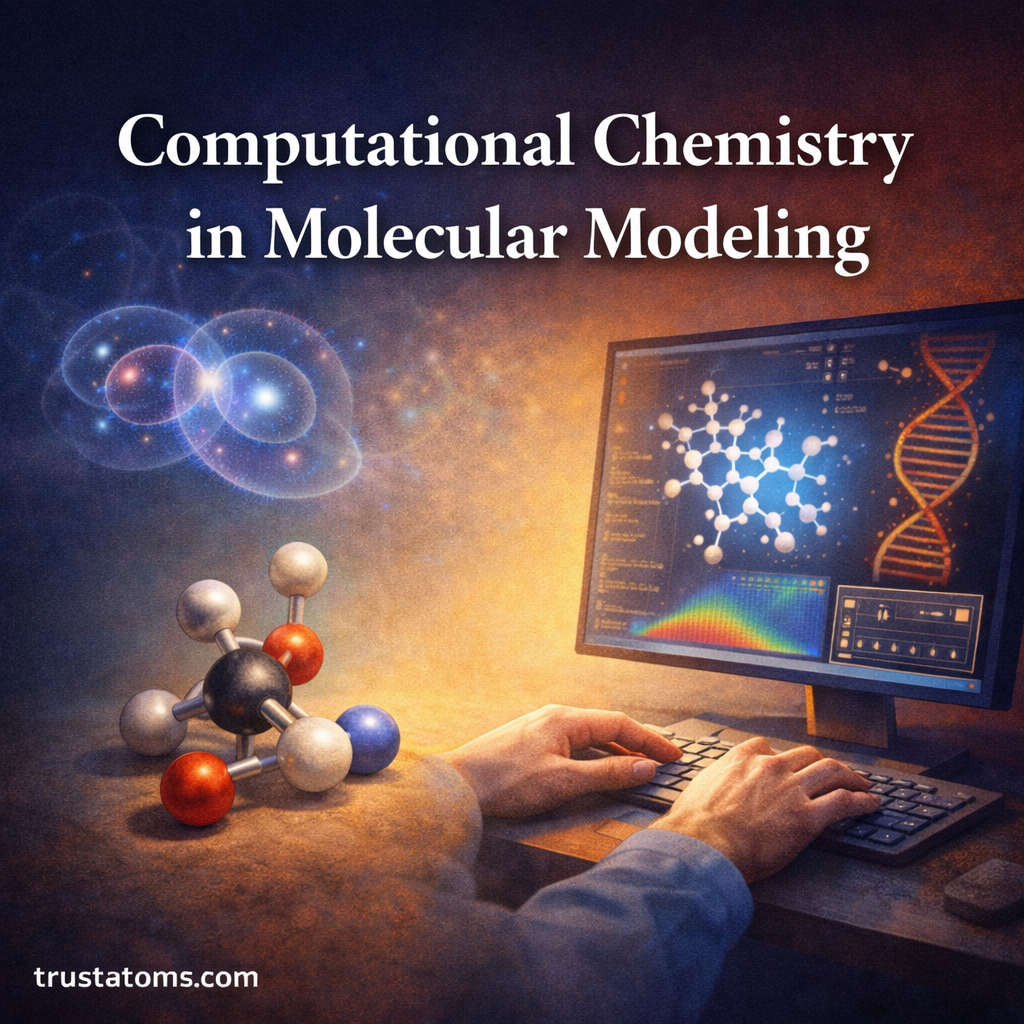
Computational chemistry has transformed how scientists study molecules and chemical reactions. Instead of relying only on laboratory experiments, researchers now use powerful computer simulations to analyze molecular behavior, predict chemical properties, and design new compounds.
This field combines chemistry, physics, mathematics, and computer science to model atoms and molecules digitally. By applying quantum mechanics and molecular physics through algorithms, computational chemistry allows scientists to explore chemical systems that may be difficult or expensive to study experimentally.
Today, computational chemistry plays an important role in areas such as drug discovery, materials science, environmental chemistry, and nanotechnology.
What Is Computational Chemistry?
Computational chemistry is the use of computer simulations and mathematical models to study chemical systems. It allows scientists to calculate molecular structures, reaction pathways, and energy changes without performing physical experiments.
Instead of measuring molecules directly, computational chemistry relies on theoretical principles and numerical methods to simulate molecular interactions.
These simulations can help scientists:
- Predict molecular geometry
- Calculate reaction energies
- Study electron behavior
- Analyze molecular stability
- Design new molecules and materials
Because computers can process enormous numbers of calculations quickly, computational chemistry can explore complex systems that would otherwise be impossible to analyze manually.
What Is Molecular Modeling?
Molecular modeling is a key application of computational chemistry. It refers to the use of computer-based methods to visualize, analyze, and simulate molecular structures.
Through molecular modeling, scientists can create digital representations of molecules and observe how atoms interact over time.
Molecular models can reveal:
- Bond lengths and angles
- Molecular shape and geometry
- Electron density distribution
- Interactions between molecules
- Reaction mechanisms
These insights help chemists understand molecular behavior at the atomic level.
Major Methods Used in Computational Chemistry

Several computational approaches are used to model chemical systems. Each method balances accuracy and computational cost.
Quantum Mechanical Methods
Quantum mechanical methods are based on the principles of quantum mechanics, which describe how electrons behave within atoms and molecules.
These methods attempt to solve equations that describe electron movement and energy.
Common quantum approaches include:
- Ab initio methods – calculations based strictly on fundamental physical principles
- Density Functional Theory (DFT) – widely used method that focuses on electron density
- Semi-empirical methods – simplified models using experimental parameters
Quantum mechanical methods are highly accurate but often require significant computational power.
Molecular Mechanics
Molecular mechanics treats molecules as systems of atoms connected by bonds similar to springs.
Instead of calculating electron behavior directly, this method uses classical physics equations to estimate molecular energy.
Molecular mechanics focuses on:
- Bond stretching
- Angle bending
- Torsional rotations
- Nonbonded interactions
Because it avoids complex quantum calculations, molecular mechanics is much faster and can model very large molecules such as proteins and polymers.
Molecular Dynamics
Molecular dynamics simulations model how molecules move over time.
By applying physical laws repeatedly across small time steps, computers can simulate molecular motion and interactions.
This method helps scientists study:
- Protein folding
- Diffusion of molecules
- Structural stability
- Temperature effects
- Molecular collisions
Molecular dynamics provides a dynamic view of molecular behavior rather than a static snapshot.
Monte Carlo Simulations
Monte Carlo methods use random sampling to explore possible molecular configurations.
By generating large numbers of possible structures and evaluating their energies, the system gradually identifies stable molecular arrangements.
Monte Carlo simulations are especially useful for:
- Studying thermodynamic properties
- Sampling molecular conformations
- Modeling equilibrium systems
How Computational Chemistry Predicts Molecular Properties
One of the most powerful uses of computational chemistry is predicting properties before molecules are synthesized in the lab.
Computational models can estimate:
- Molecular stability
- Reaction energy changes
- Bond strength
- Charge distribution
- Spectroscopic characteristics
These predictions help guide experimental chemists by narrowing down which molecules are most promising to study.
Applications of Computational Chemistry
Computational chemistry is widely used across scientific and industrial fields.
Drug Discovery
Pharmaceutical researchers use molecular modeling to predict how drug molecules interact with biological targets such as proteins.
Computational simulations help identify:
- Potential drug candidates
- Binding interactions
- Molecular stability
- Possible side effects
This approach significantly speeds up early drug development.
Materials Science
Scientists use computational chemistry to design new materials with specific properties.
Examples include:
- Stronger polymers
- Improved battery materials
- Catalysts for chemical reactions
- Advanced semiconductors
Computer modeling allows researchers to test thousands of material combinations before synthesizing them.
Environmental Chemistry
Computational simulations help scientists understand chemical reactions in the environment.
Researchers use modeling to study:
- Atmospheric chemistry
- Pollutant breakdown
- Climate-related chemical reactions
- Water purification processes
These insights support environmental protection and sustainability efforts.
Nanotechnology
Nanotechnology often involves manipulating materials at the atomic scale. Computational chemistry helps scientists predict how nanoscale structures behave.
Modeling tools allow researchers to explore:
- Nanoparticle stability
- Surface interactions
- Molecular self-assembly
- Nanomaterial properties
This makes computational chemistry essential for designing nanoscale technologies.
Advantages of Computational Chemistry
Computational methods offer several major advantages in chemical research.
Key benefits include:
- Reduced experimental costs
- Ability to test many molecules quickly
- Insight into atomic-scale behavior
- Ability to study dangerous or unstable compounds safely
- Prediction of chemical behavior before synthesis
These benefits make computational chemistry a powerful complement to laboratory research.
Limitations of Computational Chemistry
Despite its strengths, computational chemistry has limitations.
Some challenges include:
- High computational resource requirements
- Approximations that may reduce accuracy
- Complexity of modeling large systems
- Difficulty simulating long timescales
Because of these limitations, computational results are often combined with experimental data for verification.
The Future of Computational Molecular Modeling
Advances in computing power are rapidly expanding the capabilities of computational chemistry.
Emerging technologies are helping scientists simulate increasingly complex systems, including large biological molecules and chemical reactions in real time.
Future developments may include:
- Artificial intelligence-assisted molecular modeling
- Quantum computing for complex simulations
- Faster drug discovery pipelines
- Real-time chemical reaction prediction
As computational tools continue to improve, molecular modeling will play an even larger role in scientific discovery.
Final Thoughts
Computational chemistry has become an essential tool for understanding molecular structure and chemical behavior. By combining theoretical models with powerful computing technology, scientists can simulate molecules, predict reactions, and design new compounds with remarkable precision.
As computing capabilities continue to advance, computational chemistry will remain a driving force in modern chemical research, helping scientists explore molecular systems that were once beyond reach.