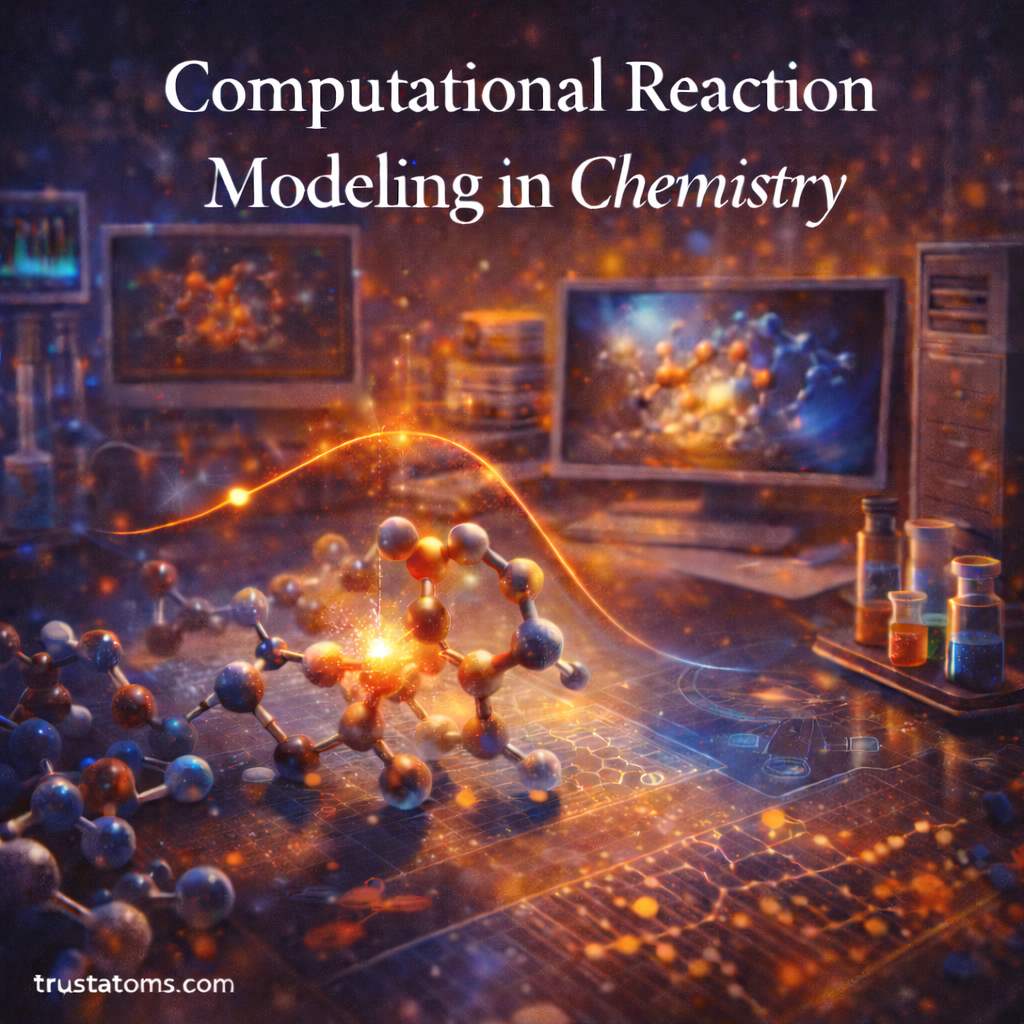
Computational reaction modeling is an important field within modern chemistry that uses computer simulations to study chemical reactions. By applying mathematical models and quantum mechanics, scientists can predict how molecules interact, how reactions proceed, and what products may form.
These computational tools allow chemists to examine reactions at the atomic and molecular level without performing physical experiments. This capability has transformed research in areas such as drug discovery, materials science, catalysis, and environmental chemistry.
With increasing computing power and improved algorithms, computational reaction modeling has become an essential complement to experimental chemistry.
What Is Computational Reaction Modeling?
Computational reaction modeling refers to the use of computer-based methods to simulate and analyze chemical reactions.
These models allow scientists to study:
- Molecular structures
- Reaction pathways
- Energy changes during reactions
- Reaction intermediates
- Transition states
By simulating reactions on a computer, chemists can understand complex chemical behavior that may be difficult or impossible to observe directly in laboratory experiments.
Why Computational Modeling Is Important in Chemistry
Computational chemistry offers several advantages that make it valuable for modern scientific research.
Key benefits include:
- Predicting reaction outcomes before experiments
- Reducing the need for costly laboratory trials
- Exploring reactions under extreme conditions
- Understanding molecular behavior at the atomic scale
- Accelerating chemical discovery and development
By combining computational predictions with laboratory experiments, scientists can design more efficient research strategies.
How Computational Reaction Modeling Works
Computational modeling relies on mathematical descriptions of how atoms and electrons interact.
The process typically involves several steps:
- Molecular structure input
Chemists define the structures of molecules involved in a reaction. - Selection of computational method
A suitable theoretical model is chosen based on the system being studied. - Energy calculations
The computer calculates the potential energy of molecular configurations. - Reaction pathway analysis
The model identifies possible reaction routes and intermediate states. - Prediction of reaction products
The system determines which products are most likely to form.
These simulations allow researchers to visualize how chemical reactions occur step by step.
Key Computational Methods in Reaction Modeling
Several computational techniques are commonly used to simulate chemical reactions.
Quantum Mechanical Methods
Quantum mechanics describes the behavior of electrons within molecules.
Common quantum methods include:
- Density Functional Theory (DFT)
- Hartree–Fock methods
- Post-Hartree–Fock techniques
These methods provide detailed information about electronic structure and reaction energetics.
Molecular Mechanics
Molecular mechanics treats molecules as collections of atoms connected by bonds, using classical physics rather than quantum mechanics.
Key features include:
- Fast computational calculations
- Useful for large molecular systems
- Often applied to biological molecules and polymers
However, molecular mechanics does not directly model electronic behavior.
Molecular Dynamics Simulations
Molecular dynamics (MD) simulations model how atoms and molecules move over time.
These simulations help researchers study:
- Molecular motion
- Temperature effects on reactions
- Structural changes during chemical processes
MD simulations are widely used in materials science and biochemistry.
Hybrid Methods
Hybrid approaches combine multiple computational techniques to improve accuracy.
One example is QM/MM (quantum mechanics/molecular mechanics) modeling, where:
- The reactive region of a molecule is treated with quantum mechanics.
- The surrounding environment is modeled with molecular mechanics.
This approach is commonly used for studying enzyme reactions.
Reaction Pathways and Energy Surfaces

A central concept in computational reaction modeling is the potential energy surface (PES).
The potential energy surface describes how the energy of a system changes as atoms move during a reaction.
Important features of a reaction energy surface include:
- Reactants
- Products
- Reaction intermediates
- Transition states
By mapping the energy surface, scientists can determine:
- The most favorable reaction pathway
- Activation energy required for reactions
- Stability of intermediate species
This information helps explain why some reactions occur quickly while others proceed slowly.
Applications of Computational Reaction Modeling
Computational modeling is widely used across many scientific disciplines.
Drug Discovery
Pharmaceutical researchers use computational modeling to predict how drug molecules interact with biological targets.
These simulations help scientists:
- Identify promising drug candidates
- Study enzyme reactions
- Optimize molecular structures
This approach reduces development time and research costs.
Catalysis Research
Catalysts accelerate chemical reactions without being consumed.
Computational methods help scientists:
- Design more efficient catalysts
- Understand catalytic mechanisms
- Improve industrial chemical processes
Catalysis modeling is especially important in energy production and chemical manufacturing.
Materials Science
Researchers use computational models to study chemical reactions that form new materials.
Applications include:
- Battery materials
- Nanomaterials
- Semiconductor fabrication
- Surface chemistry
Simulations help predict material properties before experimental synthesis.
Environmental Chemistry
Computational models help scientists understand chemical reactions in natural environments.
These studies include:
- Atmospheric chemical reactions
- Pollutant breakdown processes
- Climate-related chemical cycles
Modeling provides insights into environmental chemistry that are difficult to measure directly.
Challenges in Computational Reaction Modeling
Despite its advantages, computational modeling has limitations.
Common challenges include:
- High computational cost for complex systems
- Approximations in theoretical models
- Difficulty modeling extremely large molecules
- Uncertainty in predicting some reaction pathways
As computational resources improve, many of these limitations are gradually being addressed.
Advances in Computational Chemistry
Rapid technological progress is expanding the capabilities of computational reaction modeling.
Important developments include:
- High-performance computing systems
- Machine learning for chemical prediction
- Automated reaction pathway discovery
- Cloud-based computational chemistry platforms
These innovations allow scientists to analyze increasingly complex chemical systems.
The Future of Computational Reaction Modeling
Computational reaction modeling is becoming one of the most powerful tools in chemical research.
By combining theoretical chemistry, advanced algorithms, and powerful computing resources, scientists can explore chemical reactions in unprecedented detail.
As technology continues to evolve, computational modeling will play an even greater role in:
- Designing sustainable chemical processes
- Discovering new medicines
- Developing advanced materials
- Understanding complex biological systems
The ability to simulate chemistry at the molecular level is helping researchers unlock new insights into how chemical reactions shape the world around us.