Heat moves in predictable ways. Whether you’re cooking food, feeling sunlight on your skin, or turning on a heater in winter, you’re witnessing heat transfer in action.
In physics, heat transfer occurs through three main mechanisms:
- Conduction
- Convection
- Radiation
Understanding the difference between conduction vs convection vs radiation helps explain everything from weather systems to engine design.
Let’s break them down clearly and compare how each works.
What Is Heat Transfer?
Heat transfer is the movement of thermal energy from a region of higher temperature to a region of lower temperature.
Heat always flows from hot to cold until thermal equilibrium is reached.
The difference between conduction, convection, and radiation lies in how that energy moves.
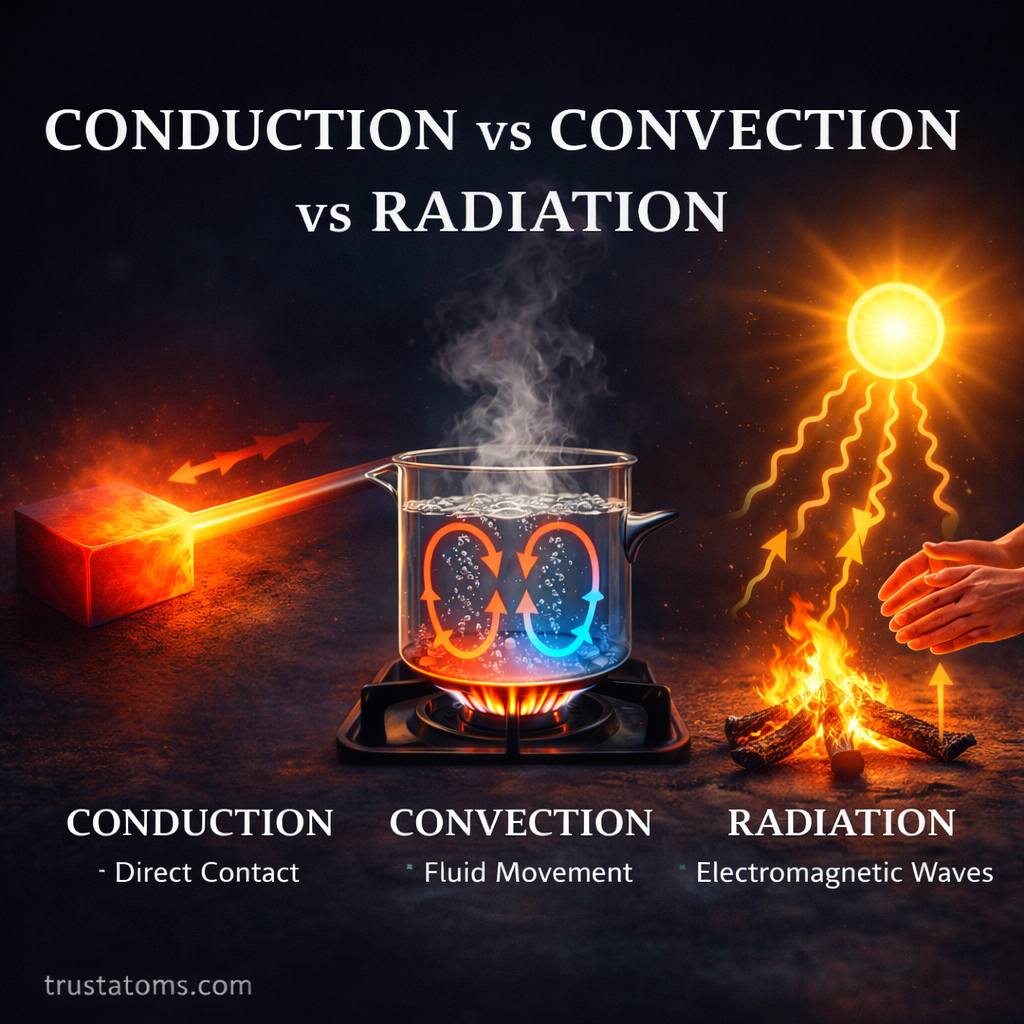
Conduction: Heat Through Direct Contact
Conduction is heat transfer that occurs through direct particle-to-particle contact.
When one object touches another, faster-moving particles in the hotter object collide with slower-moving particles in the cooler object, transferring energy.
How Conduction Works
- Occurs mainly in solids
- Requires physical contact
- Transfers energy through collisions
Everyday Examples
- A metal spoon heating up in hot soup
- Walking barefoot on hot pavement
- Ironing clothes
Metals are good conductors because their free electrons move energy quickly. Materials like wood, rubber, and plastic are poor conductors and act as insulators.
Key Point
Conduction does not involve movement of the material itself — only energy moves through particle vibrations and collisions.
Convection: Heat Through Fluid Movement
Convection is heat transfer that occurs through the movement of liquids or gases.
Unlike conduction, convection involves the physical movement of matter.
How Convection Works
- A fluid is heated
- It expands and becomes less dense
- It rises
- Cooler, denser fluid sinks
- A circulation pattern forms (convection current)
Everyday Examples
- Boiling water circulating in a pot
- Warm air rising from a heater
- Ocean currents
- Wind patterns
Convection only occurs in fluids (liquids and gases). It cannot occur in solids because solid particles cannot flow freely.
Key Point
Convection transfers heat by moving the substance itself.
Radiation: Heat Through Electromagnetic Waves
Radiation is heat transfer through electromagnetic waves.
Unlike conduction and convection, radiation does not require matter. It can travel through empty space.
How Radiation Works
All objects emit electromagnetic radiation. The hotter the object, the more radiation it emits.
This radiation carries energy through space until it is absorbed by another object.
Everyday Examples
- Sunlight warming Earth
- Feeling heat from a fire without touching it
- Infrared heat lamps
Key Point
Radiation is the only type of heat transfer that works in a vacuum.
Side-by-Side Comparison
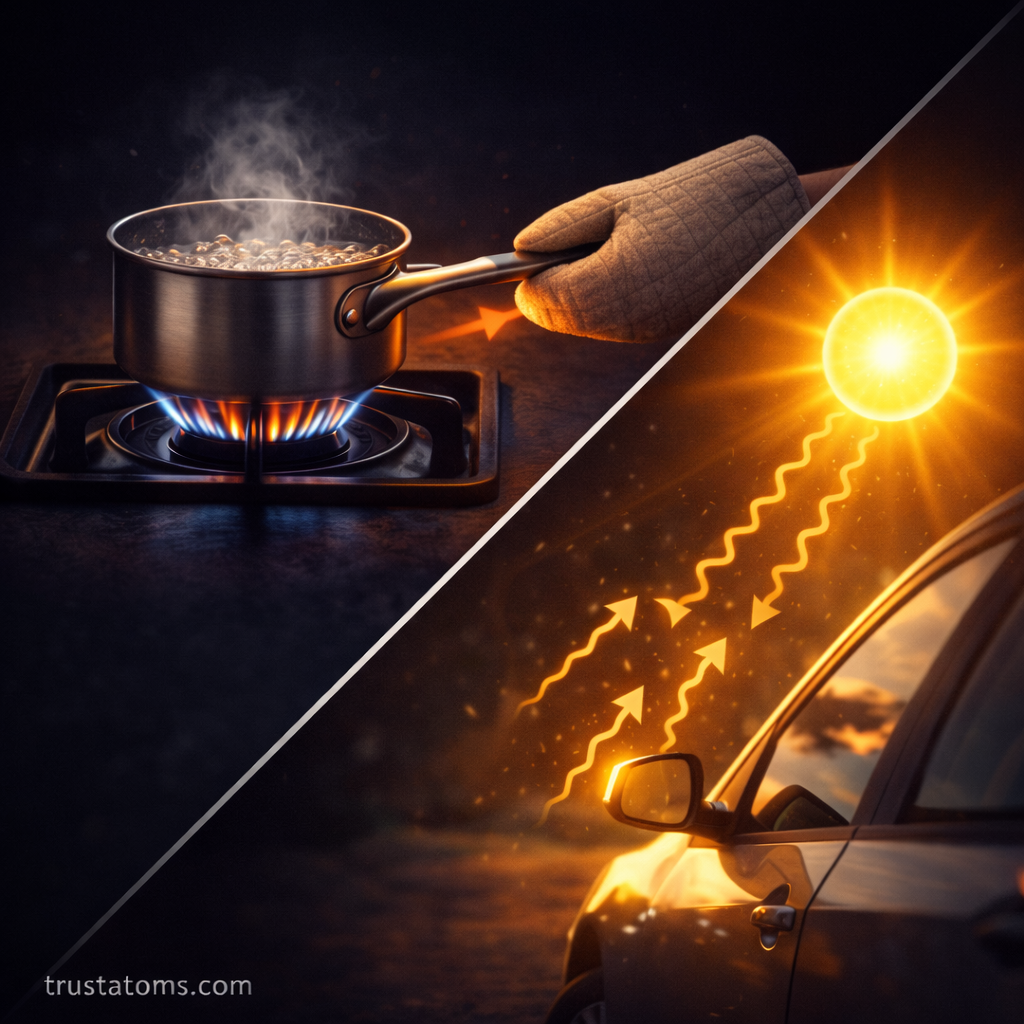
Here’s a simplified comparison of conduction vs convection vs radiation:
Conduction:
- Requires direct contact
- Occurs mostly in solids
- No bulk movement of matter
Convection:
- Requires a fluid (liquid or gas)
- Involves movement of matter
- Forms convection currents
Radiation:
- Requires no medium
- Travels through space
- Uses electromagnetic waves
In real-world situations, all three often happen at the same time.
For example, when heating soup on a stove:
- The burner conducts heat to the pot
- The liquid circulates through convection
- The pot emits heat through radiation
Why Understanding the Difference Matters
Knowing the difference between conduction, convection, and radiation is essential in many fields.
Engineering
- Designing heat shields for spacecraft
- Building insulation systems
- Creating efficient cooling systems
Environmental Science
- Understanding global climate
- Studying atmospheric circulation
- Modeling ocean currents
Everyday Life
- Choosing proper cookware
- Dressing appropriately for weather
- Designing heating and air conditioning systems
Heat transfer shapes both natural systems and modern technology.
Common Misconceptions
“Heat Rises”
Heat itself does not rise. Warm air rises because it becomes less dense. That process is convection, not heat floating upward.
“Radiation Is Dangerous”
All objects emit thermal radiation. Radiation in heat transfer is usually infrared and completely natural.
“Only One Type Happens at a Time”
In most real-life situations, multiple heat transfer mechanisms occur simultaneously.
Final Summary
Conduction, convection, and radiation are the three fundamental ways heat moves.
- Conduction transfers heat through direct contact.
- Convection transfers heat through fluid movement.
- Radiation transfers heat through electromagnetic waves.
Each plays a unique role in physics, engineering, and everyday life.
Understanding these mechanisms gives you a clearer picture of how energy flows through the world around you.