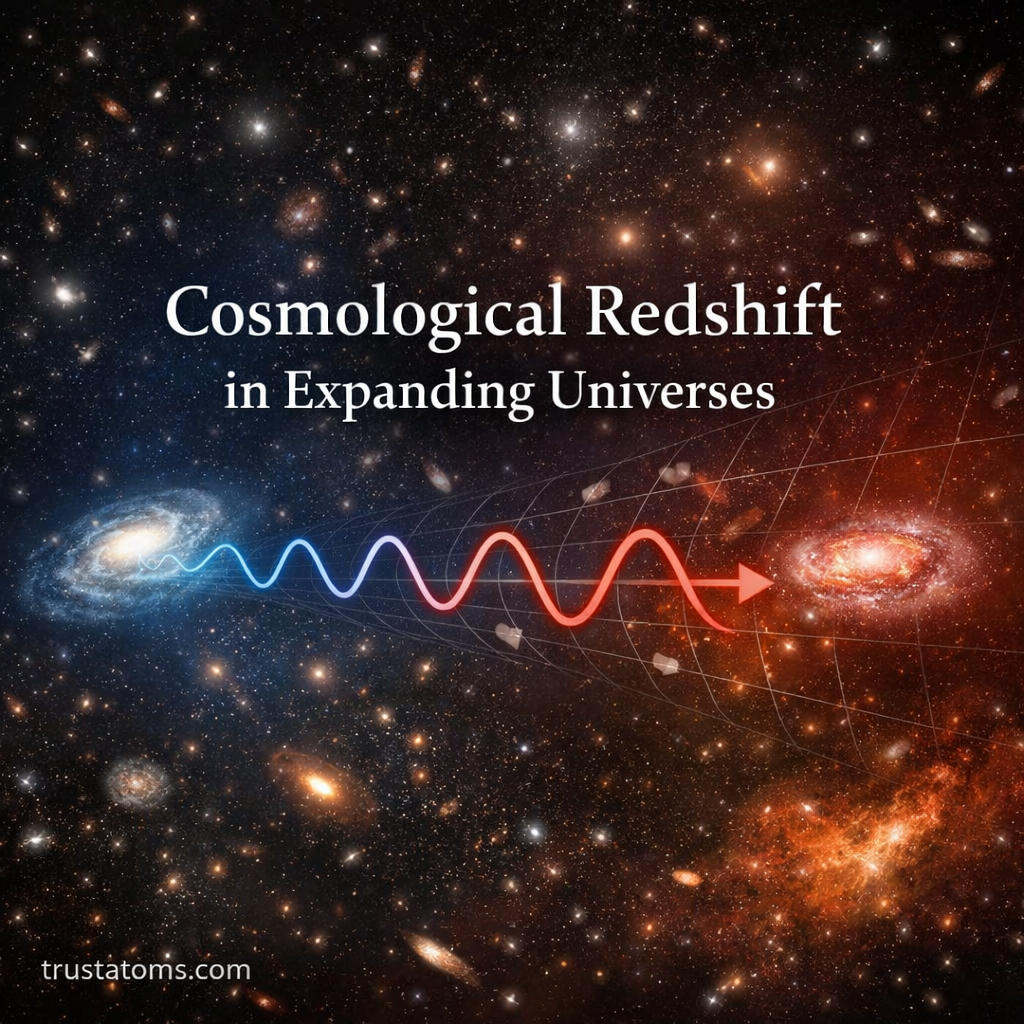
When we look into deep space, we are also looking back in time. The light from distant galaxies travels billions of years before reaching us. Along the way, something remarkable happens: its wavelength stretches.
This phenomenon is called cosmological redshift, and it is one of the strongest pieces of evidence that our universe is expanding.
In this article, we’ll break down what cosmological redshift is, how it differs from other types of redshift, and why it plays a central role in modern cosmology.
What Is Redshift?
Redshift occurs when light shifts toward the red end of the electromagnetic spectrum, meaning its wavelength increases.
Light behaves as a wave. Shorter wavelengths appear bluer. Longer wavelengths appear redder. If a light wave stretches, it becomes “redshifted.”
There are three main types of redshift:
- Doppler redshift – caused by motion through space.
- Gravitational redshift – caused by strong gravitational fields.
- Cosmological redshift – caused by the expansion of space itself.
Cosmological redshift is fundamentally different from the other two.
The Expanding Universe
In 1929, Edwin Hubble observed that distant galaxies appear to be moving away from us. The farther away a galaxy is, the faster it seems to recede. This discovery led to the conclusion that space itself is expanding.
It is not that galaxies are flying through empty space away from a central point. Instead, the fabric of space between galaxies is stretching.
An analogy often used is a balloon with dots drawn on its surface:
- As the balloon inflates, the dots move away from each other.
- No single dot is the “center” on the surface.
- The expansion happens everywhere at once.
In the same way, galaxies move apart because space between them expands.
What Is Cosmological Redshift?
Cosmological redshift happens because space stretches while light is traveling through it.
Imagine a light wave moving across expanding space:
- As space expands,
- The wavelength of the light stretches with it,
- Increasing its wavelength,
- Shifting it toward the red end of the spectrum.
The key idea is this:
The light is not redshifted because the galaxy is moving through space in a conventional sense. It is redshifted because the space between us and the galaxy expands while the light is in transit.
The Redshift Formula
Cosmological redshift is represented by the symbol z.
It is calculated as:
z = (observed wavelength − emitted wavelength) / emitted wavelength
If:
- z = 0 → no redshift
- z > 0 → redshift (expansion)
- z < 0 → blueshift (contraction or approaching motion)
Large redshift values correspond to very distant objects and very early times in the universe.
Some galaxies have redshifts greater than 10, meaning their light has stretched more than ten times its original wavelength.
Hubble’s Law and Distance
Hubble’s Law connects redshift to distance:
The farther away a galaxy is, the faster it appears to recede.
This relationship allows astronomers to:
- Estimate distances to faraway galaxies.
- Measure the expansion rate of the universe.
- Infer the age of the cosmos.
The expansion rate is described by the Hubble constant (H₀), which is still being refined through modern observations.
How Cosmological Redshift Differs from Doppler Redshift
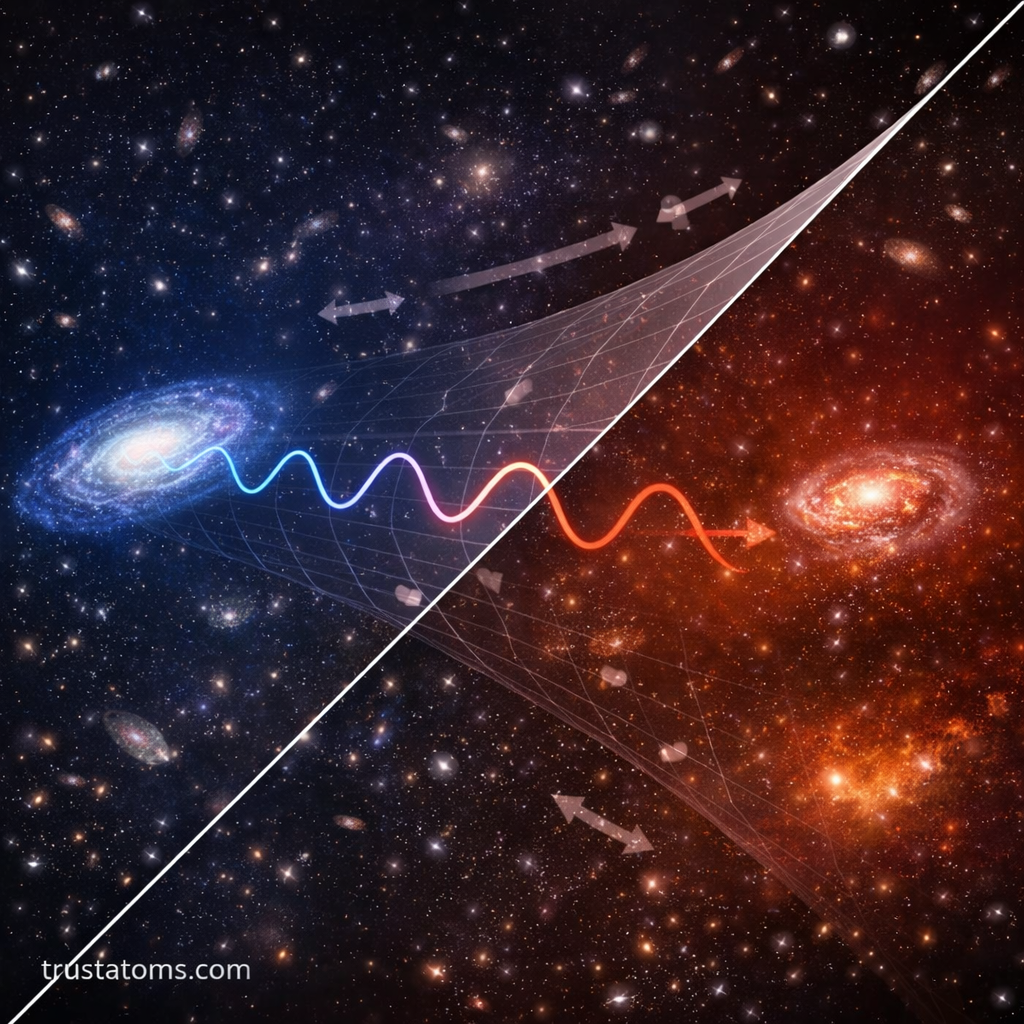
It is important not to confuse cosmological redshift with the Doppler effect.
Doppler redshift:
- Happens when an object moves through space.
- Similar to how a siren lowers in pitch as an ambulance drives away.
- Caused by relative motion through a static space.
Cosmological redshift:
- Happens because space itself expands.
- Light stretches even if galaxies are not “moving” in the usual sense.
- Becomes dominant at very large cosmic scales.
At small distances, Doppler effects can approximate expansion. But at large scales, the expansion of space must be used to correctly describe what’s happening.
What Cosmological Redshift Reveals About the Universe
Cosmological redshift tells us several profound things:
1. The Universe Is Expanding
Nearly all distant galaxies are redshifted. This consistent pattern shows that expansion is universal, not localized.
2. The Universe Had a Beginning
If the universe is expanding today, then in the past it must have been smaller and denser. Tracing expansion backward leads to the Big Bang model.
3. We See the Early Universe
High-redshift objects allow astronomers to observe:
- Early galaxy formation
- The cosmic microwave background
- The first stars and quasars
Light from distant galaxies is ancient light.
The Role of Dark Energy
Observations in the late 1990s revealed something unexpected: the universe’s expansion is accelerating.
This discovery came from measuring redshifts of distant supernovae. The results suggested that some unknown energy—called dark energy—is driving accelerated expansion.
Cosmological redshift continues to be one of the primary tools for studying:
- Dark energy
- Cosmic acceleration
- The fate of the universe
Common Misconceptions
There are several misunderstandings about cosmological redshift.
It does not mean:
- Galaxies are moving away from a central explosion point.
- We are at the center of the universe.
- Light is “losing energy” due to friction in space.
Instead:
- Space itself expands.
- Every observer sees distant galaxies moving away.
- Redshift reflects the stretching of spacetime.
Why Cosmological Redshift Matters
Cosmological redshift is not just a theoretical concept. It is measurable, consistent, and foundational to modern physics.
Without it, we would not understand:
- The size of the observable universe
- The timeline of cosmic history
- The evolution of galaxies
- The nature of dark energy
It transforms the night sky from a static backdrop into a dynamic, evolving universe.
Final Thoughts
Cosmological redshift provides a window into the deepest scales of reality. It shows that space is not fixed or rigid—it stretches and evolves over time.
Every redshift measurement is more than just a number. It is a record of cosmic expansion, a timestamp from the early universe, and a reminder that the cosmos is still changing.
By studying how light stretches across billions of years, we continue to refine our understanding of where we came from—and where the universe may be headed next.