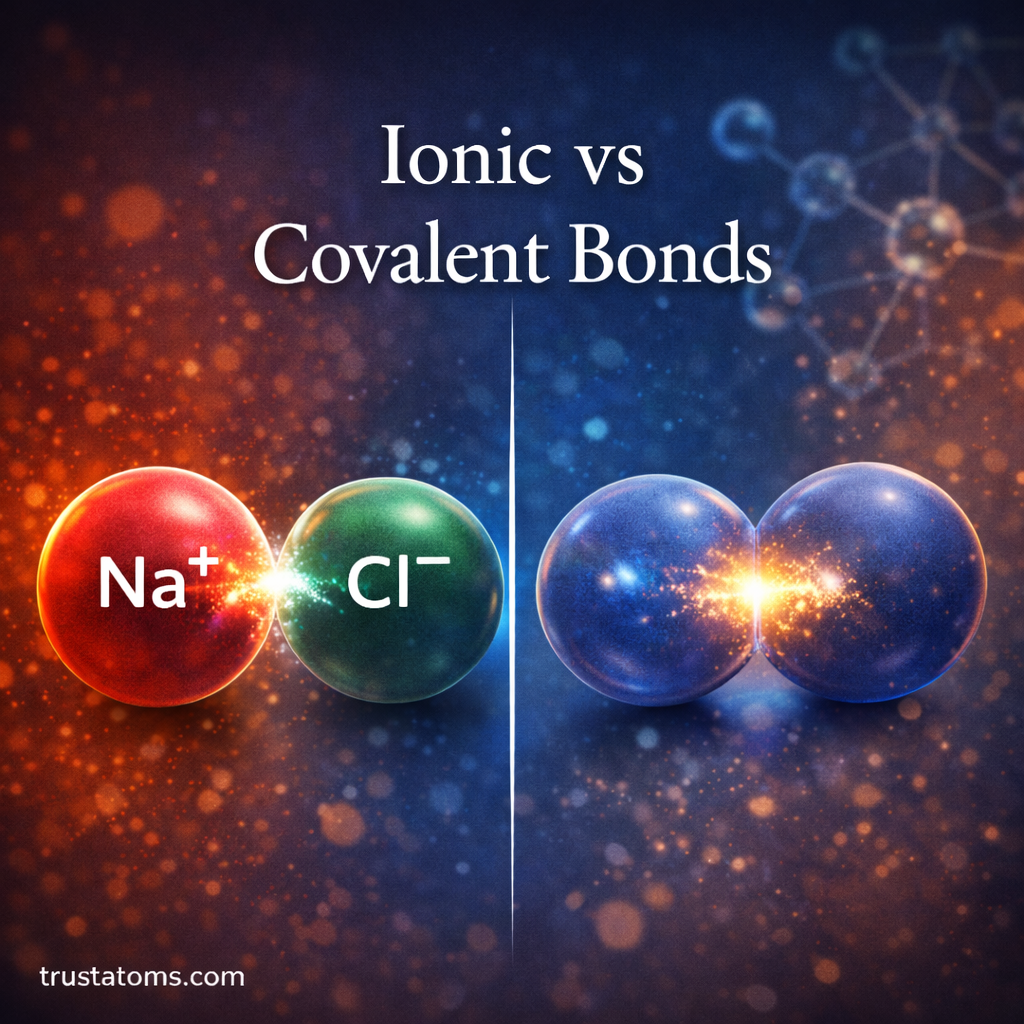
At the microscopic level, solid materials are not random collections of atoms. Instead, their atoms are arranged in highly ordered, repeating patterns known as crystal lattice structures.
These structures determine many of a material’s physical properties — including strength, conductivity, hardness, and optical behavior. In solid state physics, understanding crystal lattices is essential for explaining how metals conduct electricity, how semiconductors power electronics, and how diamonds achieve extreme hardness.
In this article, we’ll explore what crystal lattice structures are, how they form, and why they are foundational to modern physics and materials science.
What Is a Crystal Lattice?
A crystal lattice is a three-dimensional, repeating arrangement of atoms, ions, or molecules in a solid.
Instead of being placed randomly, particles in crystalline solids:
- Follow a specific geometric pattern
- Repeat in all directions
- Form a stable, low-energy structure
This repeating pattern is called periodic order.
The smallest repeating unit of a crystal lattice is known as the unit cell.
The Unit Cell: Building Block of Crystals
The unit cell is the fundamental structural unit of a crystal. When repeated in space, it recreates the entire lattice.
Each unit cell contains:
- Lattice points (positions of atoms or ions)
- Specific geometric dimensions
- Defined angles between edges
Although the entire crystal may be large, its structure can be described by analyzing just one unit cell.
This simplification allows physicists to predict material behavior mathematically and experimentally.
Types of Crystal Systems
In three dimensions, there are seven major crystal systems. These systems classify crystals based on symmetry and geometry.
1. Cubic System
- All sides equal length
- All angles are 90 degrees
- Highly symmetrical
Examples include salt (sodium chloride) and many metals.
2. Tetragonal System
- Two sides equal
- One side different
- All angles are 90 degrees
3. Orthorhombic System
- All sides different lengths
- All angles 90 degrees
4. Hexagonal System
- Two sides equal
- Angles of 120 degrees in one plane
- One axis perpendicular
5. Trigonal (Rhombohedral) System
- Equal sides
- Angles equal but not 90 degrees
6. Monoclinic System
- Unequal sides
- One angle not equal to 90 degrees
7. Triclinic System
- All sides and angles different
- Lowest symmetry
These classifications help physicists understand how materials behave under stress, heat, and electromagnetic fields.
Common Lattice Structures in Metals
In solid state physics, three metallic lattice types are especially important.
Body-Centered Cubic (BCC)
- One atom at each corner
- One atom in the center
- Found in iron (at certain temperatures)
BCC structures tend to be strong but less densely packed.
Face-Centered Cubic (FCC)
- One atom at each corner
- One atom at each face center
- Found in aluminum, copper, and gold
FCC metals are typically more ductile and conductive.
Hexagonal Close-Packed (HCP)
- Layered hexagonal structure
- Efficient packing of atoms
- Found in magnesium and titanium
Each structure influences mechanical strength, flexibility, and electrical behavior.
Why Crystal Structure Matters
The arrangement of atoms affects nearly every physical property of a solid.
1. Electrical Conductivity
In metals, electrons move through the lattice.
- Regular atomic spacing enables electron flow.
- Defects can scatter electrons and increase resistance.
In semiconductors, lattice structure determines band gaps — crucial for electronic devices.
2. Mechanical Strength
- Closely packed lattices resist deformation.
- Slip planes in certain lattices allow materials to bend without breaking.
3. Thermal Properties
Heat travels through lattice vibrations known as phonons.
Crystal symmetry influences how efficiently heat moves through a material.
Crystal Defects and Imperfections
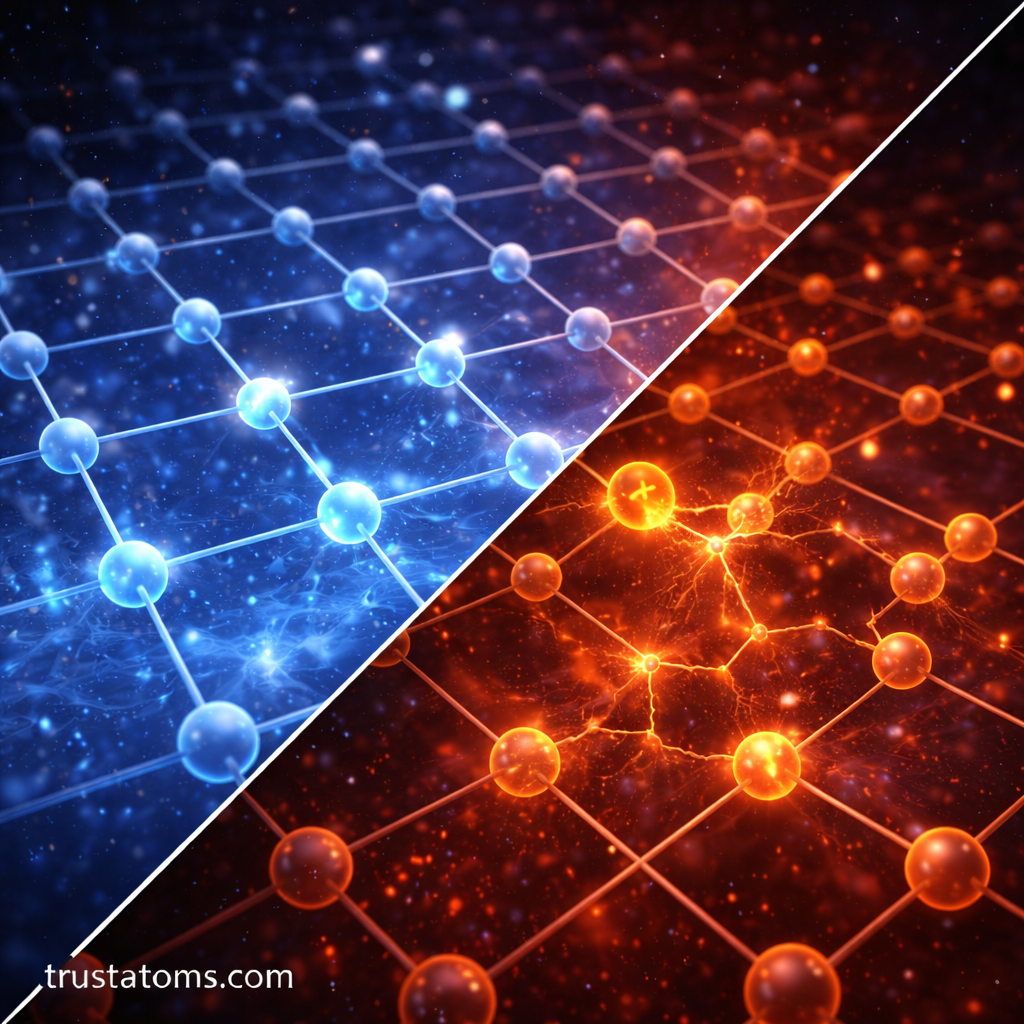
Real crystals are not perfect.
Common lattice defects include:
- Vacancies (missing atoms)
- Interstitial atoms (extra atoms between lattice points)
- Dislocations (misaligned layers)
These imperfections can:
- Increase electrical resistance
- Strengthen metals through hardening
- Alter optical properties
Defects are not always undesirable — they are often engineered intentionally in materials science.
Ionic, Covalent, and Metallic Crystals
Different types of bonding produce different lattice behaviors.
Ionic Crystals
- Composed of positive and negative ions
- Strong electrostatic forces
- High melting points
Example: table salt
Covalent Network Crystals
- Atoms share electrons
- Extremely strong bonds
- Very hard materials
Example: diamond
Metallic Crystals
- Positive ions in a sea of free electrons
- Excellent conductivity
- Flexible structures
Example: copper
Bond type directly influences lattice structure and material performance.
Crystal Lattices and Band Theory
One of the most important applications of lattice theory is band theory in solid state physics.
In solids:
- Electron energy levels form bands.
- The spacing between bands determines conductivity.
- Metals have overlapping bands.
- Insulators have large gaps.
- Semiconductors have moderate gaps.
The periodic lattice structure creates these energy band patterns.
Without crystal lattices, modern electronics would not exist.
Amorphous Solids vs. Crystalline Solids
Not all solids have a crystal lattice.
Crystalline solids:
- Have long-range order
- Exhibit sharp melting points
- Show predictable symmetry
Amorphous solids:
- Lack repeating patterns
- Have irregular atomic arrangement
- Soften over a temperature range
Glass is a common example of an amorphous solid.
Solid state physics primarily focuses on crystalline materials because their ordered structure allows predictable behavior.
Why Crystal Lattice Structures Matter in Modern Technology
Crystal lattice structures are foundational to:
- Microchips and semiconductors
- Solar panels
- Superconductors
- Structural alloys
- Optical materials
Controlling lattice arrangement at the atomic level enables the design of materials with tailored properties.
Advances in nanotechnology and quantum materials research depend heavily on understanding and manipulating crystal structures.
Final Thoughts
Crystal lattice structures form the backbone of solid state physics.
By arranging atoms in precise, repeating patterns, nature creates materials with unique mechanical, electrical, and thermal properties. From everyday metals to advanced semiconductor devices, crystal lattices determine how matter behaves at both microscopic and macroscopic scales.
Understanding these structures is not just an academic exercise — it is essential for building the technologies that power the modern world.