Dimensional analysis is one of the most powerful and practical tools in physics. It allows scientists and engineers to check equations, derive relationships, simplify problems, and even predict physical behavior—without solving complex mathematics.
At its core, dimensional analysis ensures that physical equations make sense.
If the dimensions do not match, the equation cannot be correct.
What Is Dimensional Analysis?
Dimensional analysis is a method used to examine the units (dimensions) of physical quantities to ensure consistency in equations and relationships.
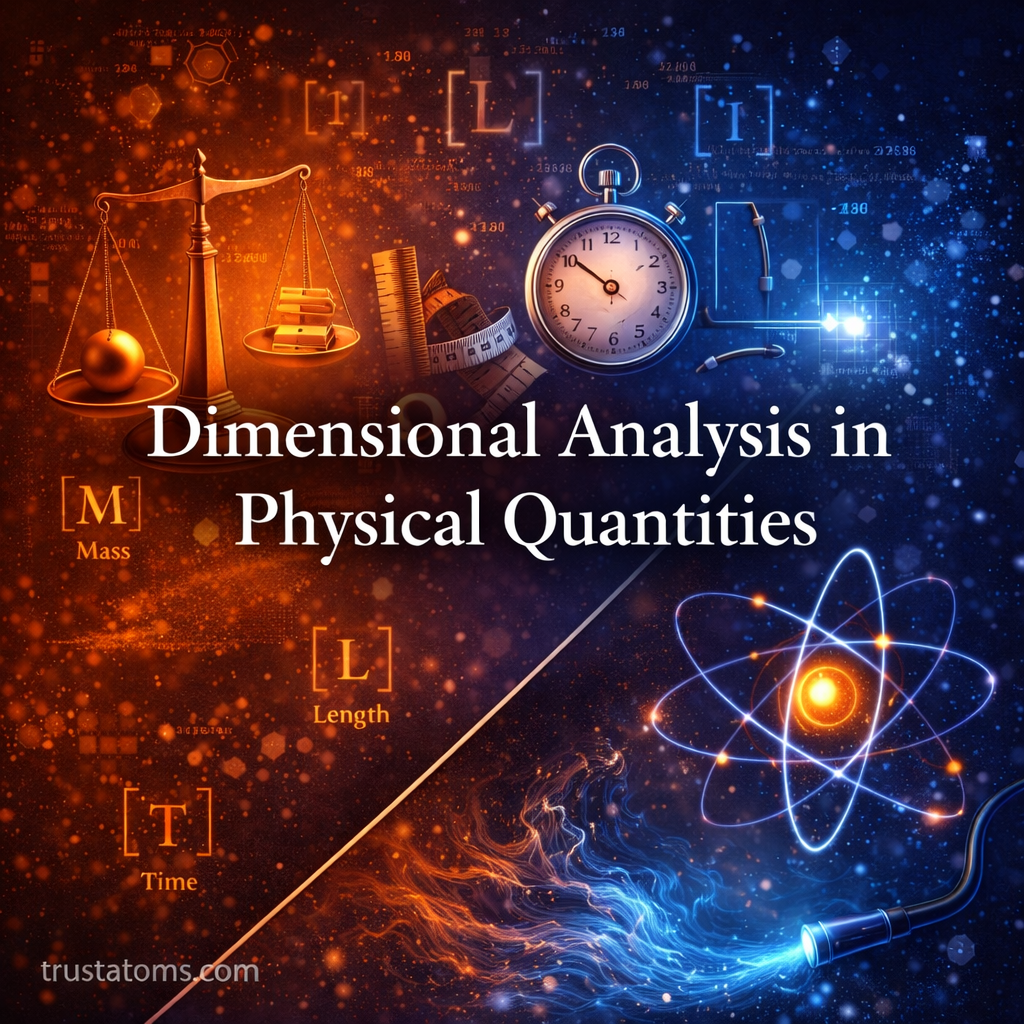
In physics, every measurable quantity has dimensions, such as:
- Length (L)
- Mass (M)
- Time (T)
- Electric current
- Temperature
- Amount of substance
These fundamental dimensions combine to form derived quantities like velocity, force, and energy.
Dimensional analysis focuses on the structure of these units—not the numerical values.
Why Dimensional Analysis Matters
Dimensional analysis serves several essential purposes:
- Checks whether equations are dimensionally consistent
- Helps derive formulas when full equations are unknown
- Simplifies complex physical problems
- Identifies scaling relationships
- Reduces errors in calculations
It acts as a built-in quality control system for physical reasoning.
Fundamental vs. Derived Quantities
Fundamental Quantities
These are base dimensions that cannot be expressed in terms of others.
Common fundamental quantities include:
- Length
- Mass
- Time
- Electric current
- Temperature
All other physical quantities are built from combinations of these.
Derived Quantities
Derived quantities are formed from fundamental dimensions.
Examples:
- Velocity → length divided by time
- Acceleration → length divided by time squared
- Force → mass multiplied by acceleration
- Energy → force multiplied by distance
Dimensional analysis tracks how these dimensions combine.
The Principle of Dimensional Homogeneity
A physical equation must be dimensionally homogeneous.
This means:
- All terms added or equated must have the same dimensions.
For example:
- You cannot add time to distance.
- You cannot equate force to energy.
If dimensions differ, the equation is invalid.
Dimensional homogeneity is a strict requirement in physics.
How Dimensional Analysis Works
The process typically involves:
- Identifying the relevant physical variables
- Expressing each variable in fundamental dimensions
- Constructing relationships that maintain dimensional consistency
- Solving for unknown exponents
Even without knowing the exact equation, dimensional analysis can often determine how quantities depend on each other.
Example: Deriving a Relationship
Suppose you want to determine how the period of a pendulum depends on:
- Length
- Gravitational acceleration
By analyzing dimensions, you can determine:
- The period depends on the square root of length divided by gravitational acceleration
This method works without solving differential equations.
Dimensional reasoning reveals structure before detailed mathematics is applied.
Buckingham Pi Theorem
One of the most important results in dimensional analysis is the Buckingham Pi Theorem.
It states:
If a physical problem involves n variables and k fundamental dimensions, the system can be reduced to (n − k) independent dimensionless parameters.
This reduces complexity significantly.
Dimensionless quantities help compare systems of different scales.
Importance of Dimensionless Numbers
Dimensionless numbers appear throughout physics and engineering.
Examples include:
- Ratios comparing forces
- Numbers describing flow regimes
- Parameters characterizing oscillations
Dimensionless analysis allows scientists to:
- Scale laboratory experiments to real-world systems
- Compare physical systems regardless of size
- Identify dominant physical effects
These tools are essential in fluid dynamics, thermodynamics, and material science.
Scaling Laws in Physics

Dimensional analysis helps uncover scaling relationships.
For example:
- How does air resistance scale with speed?
- How does wave energy scale with amplitude?
- How does gravitational force scale with distance?
Scaling laws explain how systems behave when size or conditions change.
They are crucial in:
- Aerospace engineering
- Climate modeling
- Astrophysics
- Nanotechnology
Error Checking in Equations
One of the simplest but most valuable uses of dimensional analysis is equation verification.
Before solving a problem, you can:
- Check whether units match on both sides
- Detect algebra mistakes
- Prevent conceptual errors
This technique is widely used in physics education and professional research.
Limitations of Dimensional Analysis
Dimensional analysis cannot:
- Determine numerical constants
- Reveal exact functional forms (such as sine or exponential functions)
- Replace full physical derivations
It provides structure, not complete solutions.
Still, it dramatically narrows possibilities and improves intuition.
Applications Across Physics
Dimensional analysis plays a role in nearly every branch of physics.
Mechanics
- Motion relationships
- Force scaling
- Energy expressions
Electromagnetism
- Field strength relationships
- Wave propagation behavior
Fluid Dynamics
- Flow similarity
- Turbulence scaling
Thermodynamics
- Heat transfer relationships
- Pressure–volume scaling
Astrophysics
- Stellar structure scaling
- Gravitational dynamics
Its versatility makes it a universal analytical tool.
Dimensional Analysis in Engineering
Engineers use dimensional reasoning to:
- Design wind tunnel experiments
- Scale prototype models
- Predict structural loads
- Analyze heat and fluid systems
By maintaining similarity through dimensionless parameters, engineers can safely scale models up or down.
This reduces cost and improves efficiency.
Common Mistakes in Dimensional Reasoning
Some frequent errors include:
- Confusing units with dimensions
- Ignoring hidden variables
- Forgetting fundamental constants
- Misidentifying fundamental quantities
Careful bookkeeping of dimensions prevents these mistakes.
Final Thoughts
Dimensional analysis in physical quantities provides clarity, simplicity, and logical consistency in physics.
It verifies equations, reveals scaling laws, and simplifies complex relationships. While it cannot replace detailed mathematical solutions, it often guides physicists toward correct answers with remarkable efficiency.
In many cases, dimensional reasoning uncovers the structure of physical laws before deeper mathematical work begins.
In physics, understanding dimensions means understanding how the universe measures itself.