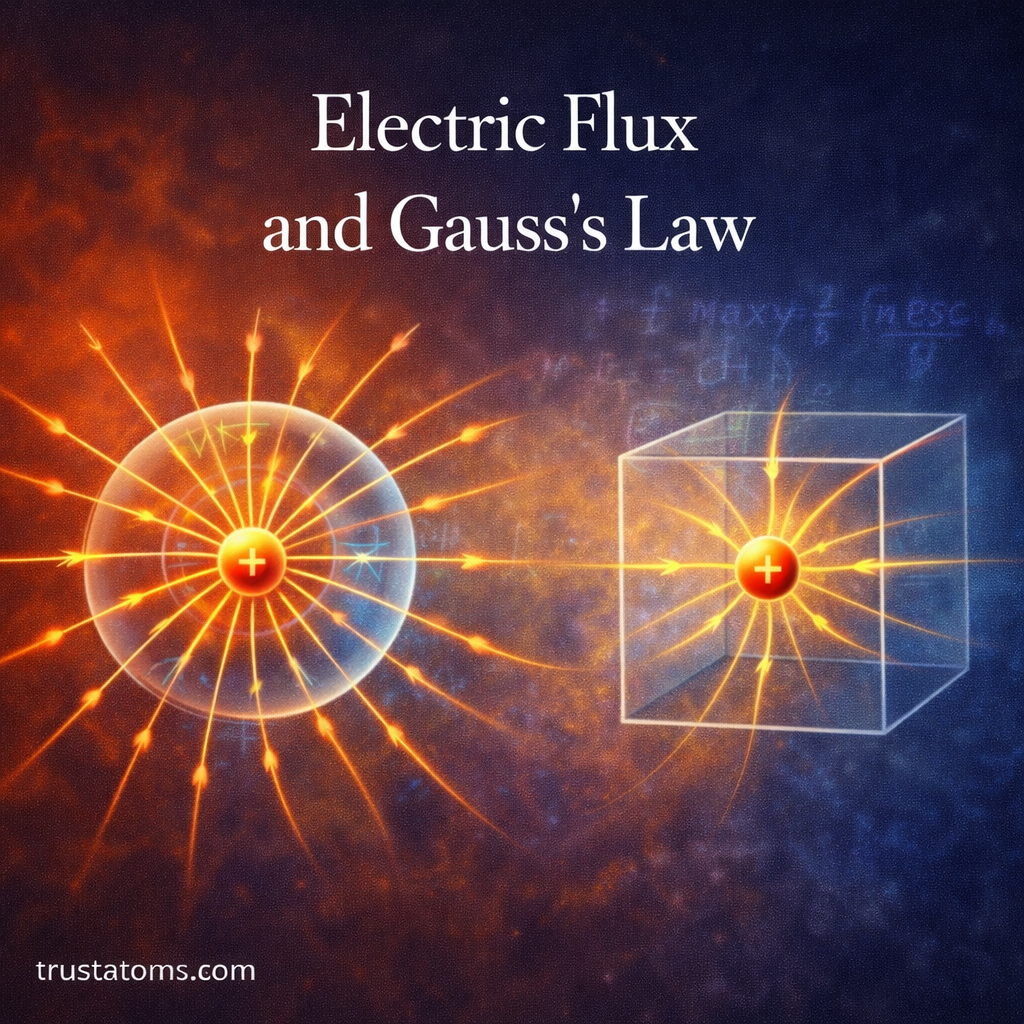
Electric flux and Gauss’s Law are foundational concepts in electromagnetism. They help us understand how electric fields behave around charges and how symmetry simplifies complex problems.
Instead of calculating electric fields point by point, Gauss’s Law allows us to analyze entire charge distributions using geometry and symmetry. It’s one of the most powerful tools in classical physics.
In this guide, we’ll break down electric flux, explain Gauss’s Law, and show how it applies to real physical systems.
What Is Electric Flux?
Electric flux measures how much electric field passes through a surface.
Think of it like this:
- Imagine electric field lines flowing through space.
- A surface placed in that space will “capture” some of those lines.
- The number of lines passing through represents the electric flux.
Electric flux depends on:
- The strength of the electric field
- The size of the surface
- The orientation of the surface
If the field is stronger or the surface larger, more flux passes through.
Understanding Field Lines and Surfaces
Electric field lines:
- Point away from positive charges
- Point toward negative charges
- Represent the direction of force on a positive test charge
Flux increases when:
- The surface is perpendicular to the field
- The field strength increases
- The surface area increases
Flux decreases when:
- The surface tilts away from the field direction
- The field weakens
If a surface is parallel to the field, no flux passes through it.
The Concept of a Closed Surface
Gauss’s Law applies to closed surfaces — surfaces that completely enclose a volume.
Examples include:
- A sphere
- A cube
- A cylinder
- Any sealed 3D shape
These are called Gaussian surfaces.
The key question becomes:
How much electric field flows through the entire closed surface?
Gauss’s Law Explained
Gauss’s Law states:
The total electric flux through a closed surface equals the enclosed electric charge divided by the permittivity of free space.
This means:
- Only charges inside the surface matter.
- Charges outside do not affect the total flux through the surface.
Even though external charges influence the field locally, their net contribution to total flux through a closed surface cancels out.
Why Gauss’s Law Is Powerful
Gauss’s Law transforms a difficult electric field problem into a symmetry problem.
Instead of calculating forces from every charge:
- Identify symmetry
- Choose an appropriate Gaussian surface
- Apply the law
When symmetry is high, calculations become simple.
Symmetry and Gaussian Surfaces

Gauss’s Law is especially useful for systems with:
- Spherical symmetry
- Cylindrical symmetry
- Planar symmetry
Examples:
- Point charge → spherical symmetry
- Infinite line charge → cylindrical symmetry
- Infinite charged plane → planar symmetry
The correct Gaussian surface matches the symmetry of the charge distribution.
Example: Point Charge
For a single point charge:
- Choose a spherical Gaussian surface centered on the charge.
- Electric field strength is the same everywhere on the sphere.
- Field lines radiate outward uniformly.
This leads directly to Coulomb’s Law, showing the inverse-square dependence of electric field strength.
Example: Infinite Line of Charge

For a long straight line of charge:
- Choose a cylindrical Gaussian surface.
- Electric field is radial and symmetric around the line.
- Field strength decreases with distance from the line.
Gauss’s Law simplifies what would otherwise require complicated integration.
Example: Infinite Charged Plane
For a uniformly charged infinite sheet:
- Choose a cylindrical “pillbox” Gaussian surface.
- Field lines are perpendicular to the plane.
- Electric field strength is constant and does not depend on distance.
This surprising result comes directly from symmetry and Gauss’s Law.
Electric Flux and Charge Relationship
A crucial idea:
Electric flux depends only on enclosed charge, not on surface shape.
This means:
- A spherical surface and a cubic surface enclosing the same charge have identical total flux.
- The shape does not matter.
- Only the total enclosed charge matters.
This reveals a deep relationship between electric fields and charge.
Gauss’s Law and Maxwell’s Equations
Gauss’s Law is one of Maxwell’s four equations of electromagnetism.
These equations describe:
- Electric fields
- Magnetic fields
- Light
- Electromagnetic waves
Gauss’s Law connects electric fields directly to electric charge density.
In differential form, it relates the divergence of the electric field to local charge density.
This makes it fundamental in advanced physics and engineering.
Applications in Real-World Physics
Gauss’s Law is used in:
- Designing capacitors
- Understanding electric shielding
- Calculating fields in conductors
- Semiconductor physics
- Plasma physics
- Electromagnetic field simulations
It also explains why:
- The electric field inside a conductor in equilibrium is zero
- Excess charge resides on the surface of conductors
Electric Shielding and Faraday Cages
A direct application of Gauss’s Law is the Faraday cage.
Inside a conducting enclosure:
- External electric fields cancel out
- Net electric field inside is zero
This protects sensitive equipment from electromagnetic interference.
The principle follows directly from Gauss’s Law and charge redistribution.
Common Misconceptions
- Electric flux is not the same as electric field strength.
- Gauss’s Law works best with symmetry — not all problems are simplified by it.
- Charges outside a closed surface do not contribute to net flux.
- Zero flux does not always mean zero electric field everywhere on the surface.
Understanding these distinctions prevents conceptual errors.
Why Electric Flux Matters
Electric flux provides a bridge between:
- Geometry
- Field theory
- Charge distribution
It shifts the perspective from local forces to global field behavior.
Gauss’s Law reveals a deep principle:
Electric fields are fundamentally tied to charge, and this relationship holds for any closed surface in space.
Final Thoughts
Electric flux and Gauss’s Law form a cornerstone of electromagnetism.
They allow physicists and engineers to:
- Simplify electric field calculations
- Understand charge distributions
- Analyze symmetric systems
- Connect geometry with physical law
From basic electrostatics to advanced electromagnetic theory, Gauss’s Law remains one of the most elegant and powerful tools in physics.
Mastering it opens the door to deeper understanding of electric fields, Maxwell’s equations, and modern technology.