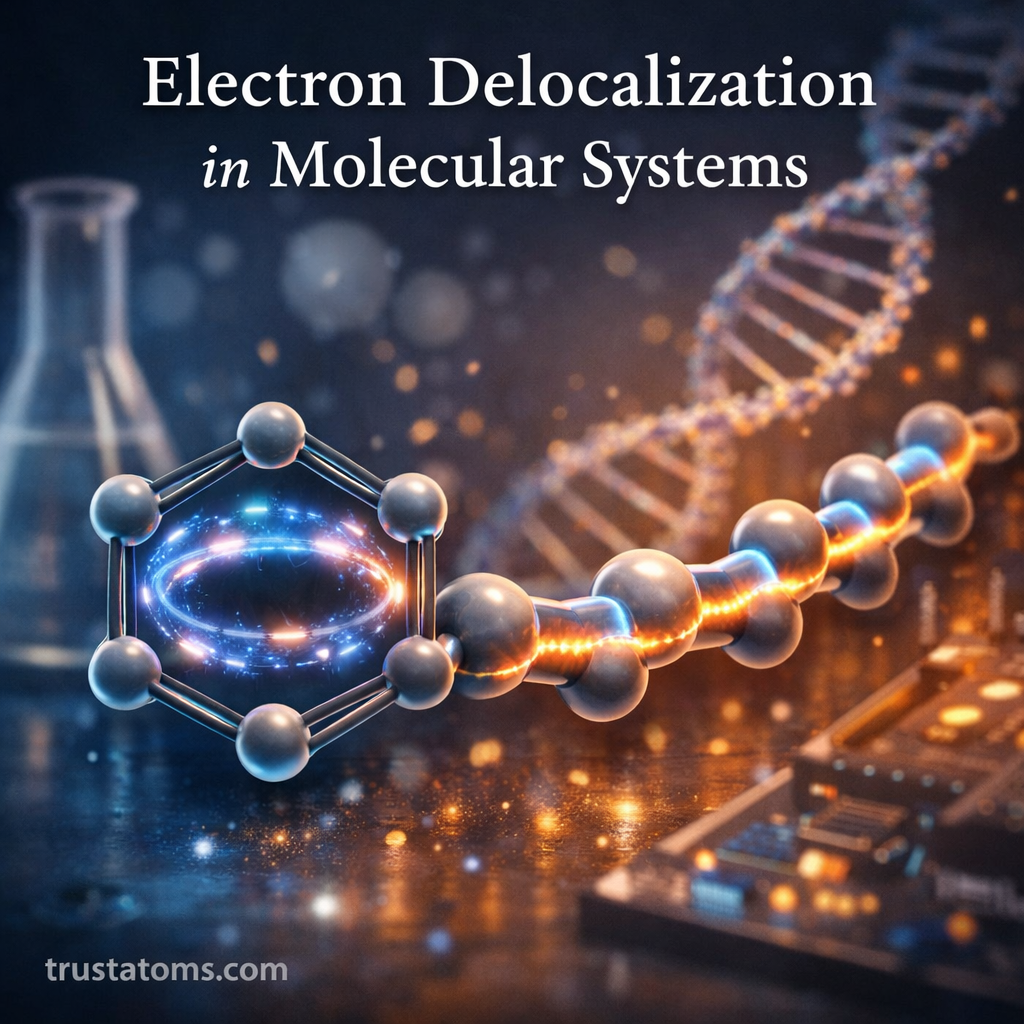
Electron delocalization is a fundamental concept in chemistry that helps explain why some molecules are unusually stable, reactive, or capable of conducting electricity. Rather than being confined to a single bond or atom, delocalized electrons are shared across multiple atoms within a molecule.
This phenomenon appears in many important chemical systems, including aromatic rings, conjugated molecules, and biological compounds such as DNA bases and pigments. Understanding electron delocalization helps chemists predict molecular stability, chemical behavior, and physical properties like color and conductivity.
What Is Electron Delocalization?
Electron delocalization occurs when electrons are not restricted to a single atom or bond but instead spread across several atoms within a molecule.
In many simple molecules, electrons are localized. For example, in a typical single bond between two atoms, the bonding electrons remain concentrated between those atoms.
In contrast, delocalized systems allow electrons to move across a larger framework of atoms.
Key characteristics of delocalized electrons include:
- Electrons distributed across multiple atoms
- Increased molecular stability
- Often associated with overlapping p-orbitals
- Common in conjugated and aromatic systems
This sharing of electrons over multiple atoms lowers the overall energy of the molecule, making it more stable.
How Electron Delocalization Occurs

Electron delocalization typically happens when atomic orbitals overlap in a way that allows electrons to move across several neighboring atoms.
This is most common in molecules with conjugated systems, where alternating single and double bonds create continuous orbital overlap.
Conditions that allow delocalization include:
- Adjacent p-orbitals aligned for overlap
- Conjugated double bonds
- Planar molecular geometry
- Resonance structures that distribute electrons
When these conditions are met, electrons can move throughout the system rather than remaining confined to a single bond.
Resonance and Delocalized Electrons
One of the most common ways chemists represent electron delocalization is through resonance structures.
Resonance structures are multiple valid Lewis structures that represent the same molecule. Each structure shows a different placement of electrons, but none individually describes the molecule perfectly.
Instead, the real molecule is a hybrid of all resonance structures.
Important points about resonance:
- Resonance structures do not represent molecules switching forms
- They illustrate electron distribution possibilities
- The actual molecule is more stable than any single structure
Delocalization explains why the real molecule has properties that differ from any individual Lewis structure.
Electron Delocalization in Aromatic Systems
A classic example of electron delocalization occurs in aromatic compounds such as benzene.
In aromatic systems:
- Electrons from double bonds spread evenly around the ring
- All bonds become equivalent in length
- The molecule gains exceptional stability
Aromatic molecules must meet several criteria:
- The molecule must be cyclic.
- It must be planar.
- It must have continuous orbital overlap.
- It must follow the 4n + 2 electron rule (Hückel’s rule).
These conditions allow electrons to circulate throughout the ring, producing strong delocalization.
Delocalization in Conjugated Molecules
Conjugated systems contain alternating single and double bonds that allow p-orbitals to overlap across multiple atoms.
Examples include:
- Organic dyes
- Biological pigments
- Polyenes
- Conductive organic materials
The larger the conjugated system, the more extensive the delocalization.
This often leads to important physical properties:
- Light absorption and color
- Electrical conductivity
- Enhanced chemical stability
Many materials used in organic electronics rely on extended electron delocalization.
Why Electron Delocalization Increases Stability
Delocalization stabilizes molecules by distributing electron density across a larger area.
This reduces electron repulsion and lowers the overall energy of the system.
Benefits of delocalization include:
- Lower molecular energy
- Increased chemical stability
- Reduced localized charge buildup
- Enhanced resonance stabilization
For example, carboxylate ions are stabilized because the negative charge is shared across two oxygen atoms rather than confined to one.
Real-World Importance of Electron Delocalization
Electron delocalization plays a role in many chemical and biological systems.
Important applications include:
Organic Chemistry
Many reactions depend on the stability of intermediates stabilized by delocalized electrons.
Biochemistry
DNA bases and aromatic amino acids rely on delocalized electrons for structural stability.
Materials Science
Organic semiconductors and conductive polymers depend on extended delocalized electron systems.
Color Chemistry
Pigments and dyes absorb visible light due to conjugated electron systems.
These examples show how delocalization influences both natural processes and modern technologies.
Common Misconceptions About Delocalized Electrons
Students often misunderstand electron delocalization when first learning resonance theory.
Common misconceptions include:
- Thinking electrons physically move between resonance structures
- Assuming only double bonds can delocalize electrons
- Believing resonance structures exist separately
In reality, resonance structures are simply models used to describe electron distribution. The true structure is always a hybrid representation.
Final Thoughts
Electron delocalization is one of the key principles that explains why certain molecules behave the way they do. By spreading electron density across multiple atoms, molecules gain stability, unique physical properties, and interesting chemical behavior.
From aromatic rings in organic chemistry to advanced materials used in electronics, delocalized electrons play a vital role in both natural systems and technological innovations. Understanding this concept provides deeper insight into molecular structure, reactivity, and stability across chemistry.