In ideal physics problems, energy is often perfectly conserved. But in the real world, energy rarely stays neatly within mechanical systems. Instead, it spreads, transforms, and dissipates.
Energy dissipation in non-conservative systems explains why machines heat up, why objects slow down due to friction, and why perpetual motion machines are impossible. Understanding this concept is essential in physics, engineering, thermodynamics, and real-world system design.
What Is a Non-Conservative System?
A non-conservative system involves forces that do not conserve mechanical energy.
In conservative systems:
- Mechanical energy remains constant.
- Energy transforms between kinetic and potential forms.
- No energy is permanently lost from the system.
In non-conservative systems:
- Mechanical energy decreases.
- Energy converts into forms like heat, sound, or internal energy.
- The total energy of the universe remains conserved — but mechanical energy does not.
The most common non-conservative force is friction.
Conservative vs Non-Conservative Forces
Understanding the difference is key.
Conservative Forces
- Gravitational force
- Elastic (spring) force
Properties:
- Work done depends only on initial and final positions.
- Energy can be fully recovered.
- No permanent energy loss.
Non-Conservative Forces
- Friction
- Air resistance
- Viscous drag
Properties:
- Work depends on path taken.
- Mechanical energy is reduced.
- Energy transforms into thermal or other forms.
This distinction explains why a sliding block slows down but a falling object in a vacuum does not.
What Is Energy Dissipation?
Energy dissipation occurs when mechanical energy transforms into less useful forms, typically thermal energy.
Examples include:
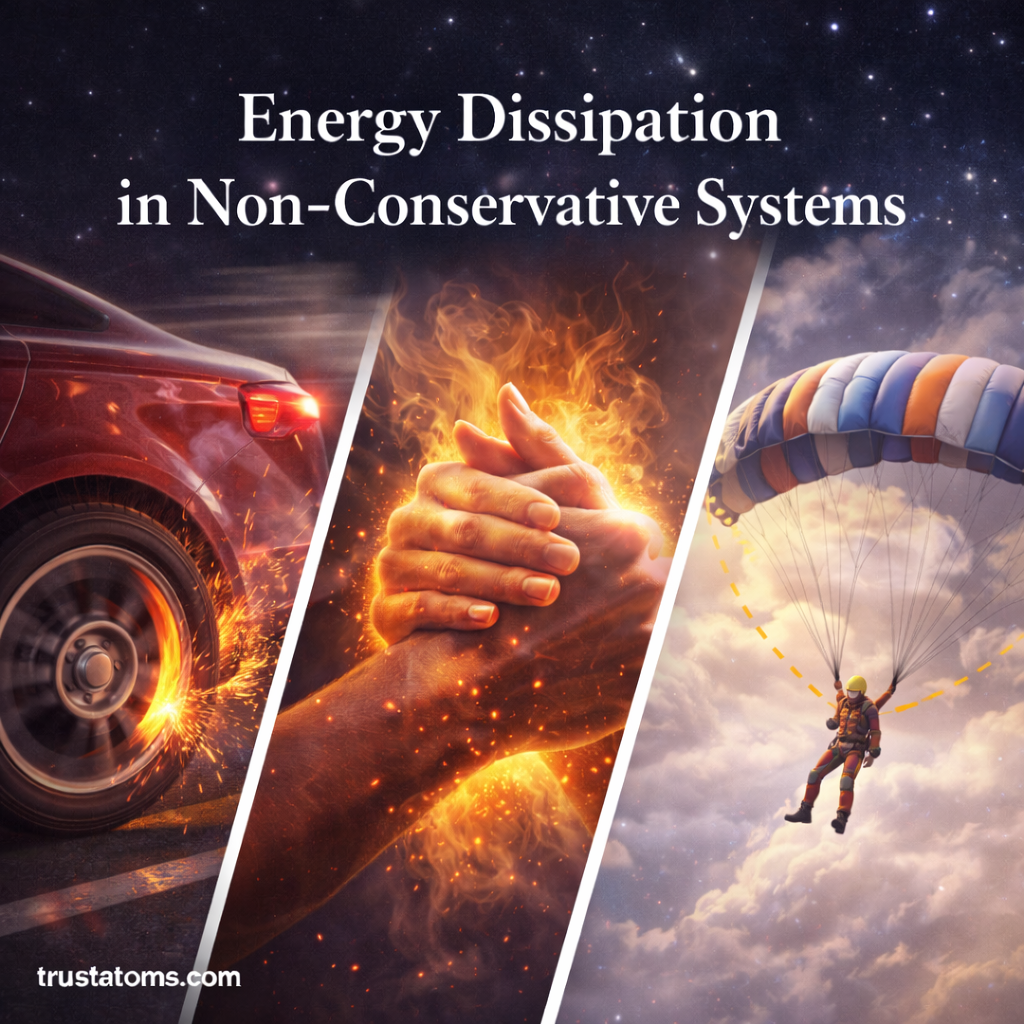
- Brakes heating during stopping.
- Rubbing hands together to produce warmth.
- A bouncing ball gradually losing height.
In each case:
- Mechanical energy decreases.
- Thermal energy increases.
- Total energy remains conserved overall.
Dissipation spreads energy into the environment.
Friction and Energy Loss
Friction is the most common cause of energy dissipation.
When two surfaces interact:
- Microscopic irregularities collide.
- Energy converts into internal vibrations.
- Temperature increases.
This is why:
- Engines require cooling systems.
- Machinery needs lubrication.
- Moving parts wear down over time.
Friction reduces efficiency but also provides useful control, such as braking.
Air Resistance and Drag

Air resistance is another non-conservative force.
As objects move through air:
- Collisions with air molecules occur.
- Energy transfers to surrounding air.
- Motion gradually slows.
Examples:
- A parachute slowing a skydiver.
- A cyclist experiencing wind resistance.
- A falling leaf drifting slowly to the ground.
Drag increases with speed, making high-speed motion energy-intensive.
Mechanical Energy Equation with Non-Conservative Forces
In systems with non-conservative forces:
- Initial mechanical energy is not equal to final mechanical energy.
- The difference equals energy dissipated.
This concept helps engineers calculate:
- Heat generated in braking systems.
- Energy loss in pipelines.
- Efficiency of engines.
Understanding where energy goes is crucial in system design.
Real-World Examples of Energy Dissipation
1. Car Braking Systems
When brakes are applied:
- Kinetic energy converts into heat.
- Brake pads warm significantly.
- Energy dissipates into the air.
Without dissipation, vehicles could not safely stop.
2. Roller Coasters
A roller coaster gradually slows due to:
- Track friction.
- Air resistance.
- Mechanical losses.
Engineers compensate by:
- Adding lift hills.
- Designing smooth tracks.
- Minimizing unnecessary drag.
3. Electrical Systems
Even electrical systems experience dissipation:
- Resistance converts electrical energy into heat.
- Wires warm during current flow.
- Energy efficiency becomes a design challenge.
Energy dissipation is not limited to mechanical systems.
Efficiency and Energy Loss
Efficiency measures how much input energy becomes useful output energy.
Efficiency is always less than 100% in real systems due to dissipation.
For example:
- An engine converts chemical energy into motion.
- Some energy becomes heat.
- Only a portion performs useful work.
Improving efficiency means reducing unwanted dissipation.
Thermodynamics Connection
Energy dissipation connects directly to thermodynamics.
The second law of thermodynamics states:
- Energy naturally spreads out.
- Systems tend toward increased disorder.
- Some energy becomes unavailable for useful work.
This explains why:
- Motion eventually stops without continued input.
- Heat spreads from hot objects to cooler surroundings.
- Perfect energy recycling is impossible.
Dissipation reflects nature’s tendency toward equilibrium.
Why Non-Conservative Systems Matter
In real-world physics, almost all systems are non-conservative.
Understanding energy dissipation helps:
- Design safer machines.
- Prevent overheating.
- Improve fuel efficiency.
- Model realistic motion.
- Optimize energy systems.
Ignoring dissipation leads to inaccurate predictions.
Common Misconceptions
Many students believe:
- Energy disappears in friction.
- Mechanical energy is always conserved.
- Dissipated energy is “lost.”
Important clarifications:
- Energy never disappears.
- It transforms into other forms.
- Mechanical energy decreases, but total energy remains conserved.
Recognizing this distinction is fundamental to physics.
Key Takeaways
- Non-conservative forces reduce mechanical energy.
- Friction and air resistance are primary causes of dissipation.
- Dissipated energy typically becomes heat.
- Mechanical energy is not conserved in non-conservative systems.
- Total energy of the universe remains conserved.
- Efficiency depends on minimizing unwanted energy loss.
Final Thoughts
Energy dissipation in non-conservative systems explains why real-world motion behaves differently from idealized physics problems. While textbooks often assume perfect conservation, reality includes friction, drag, resistance, and thermal transfer.
Understanding how and why energy dissipates allows scientists and engineers to design better machines, safer systems, and more efficient technologies.
In physics, conservation laws provide the foundation — but dissipation reveals how nature truly operates.