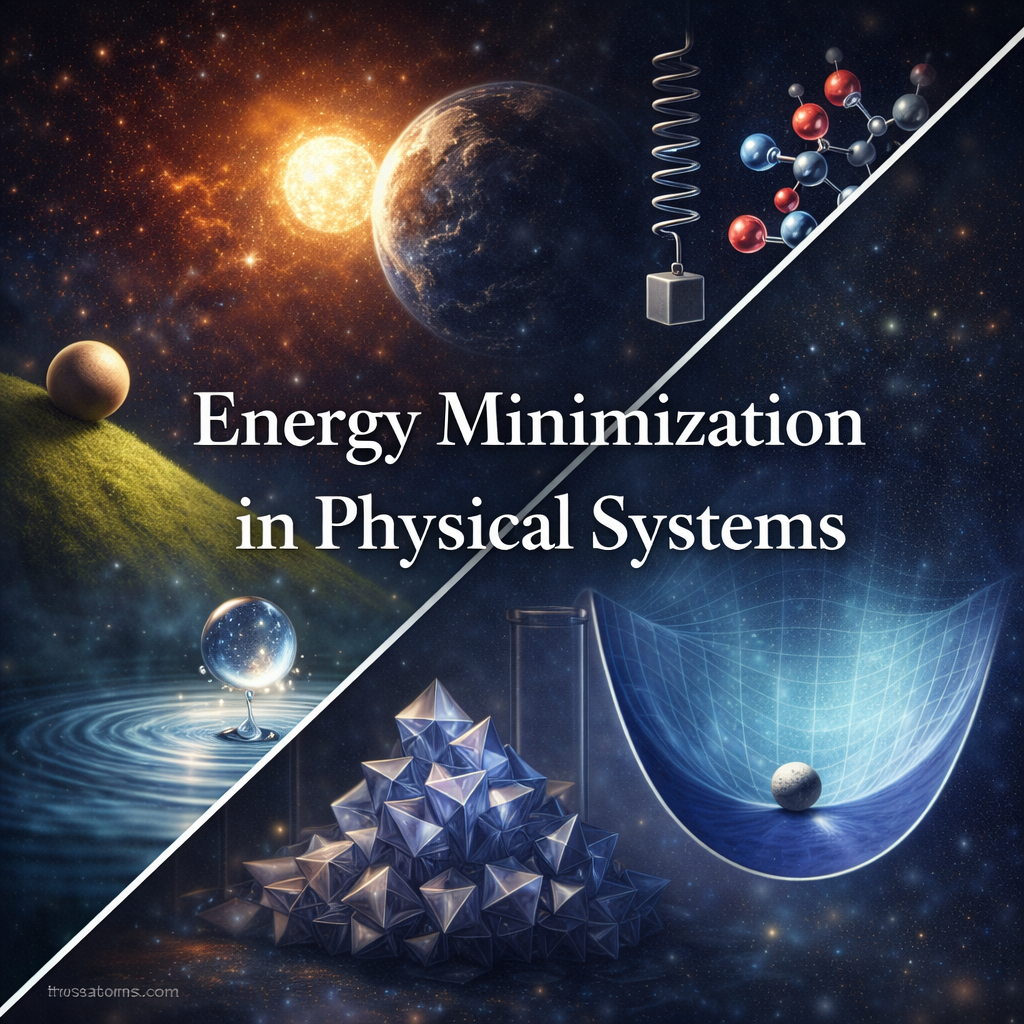
Energy minimization is one of the most powerful unifying ideas in physics. From falling objects and planetary orbits to chemical bonds and crystal structures, physical systems tend to evolve toward states of lower energy.
This principle explains stability, equilibrium, and spontaneous change across nearly every branch of science.
In this article, we’ll explore what energy minimization means, why it occurs, how it relates to equilibrium, and where it appears in real-world physical systems.
What Does Energy Minimization Mean?
Energy minimization refers to the tendency of a system to move toward a configuration with the lowest possible energy under given constraints.
In simple terms:
- Systems “prefer” stable states.
- Stable states usually correspond to lower energy.
- Higher energy states are less stable and often temporary.
This does not mean energy disappears — it means systems redistribute energy to reach more stable arrangements.
Why Do Physical Systems Minimize Energy?
The reason lies in fundamental physical laws.
Key ideas include:
- Systems evolve according to conservation laws.
- Forces act in ways that reduce potential energy.
- Equilibrium corresponds to minimum energy configurations.
When a system can release energy (for example, as heat or radiation), it will often shift toward a lower-energy state.
Potential Energy and Stability
Potential energy plays a central role in energy minimization.
Examples:
- A ball held above the ground has gravitational potential energy.
- A compressed spring stores elastic potential energy.
- Two like charges close together have electric potential energy.
When allowed to move freely, these systems shift toward lower potential energy.
Example: A Ball Rolling Downhill
A ball at the top of a hill:
- Has high gravitational potential energy.
- Is unstable.
When released:
- It rolls downward.
- Potential energy decreases.
- Kinetic energy increases.
Eventually, it reaches a lower position where energy is minimized.
Energy Landscapes and Equilibrium
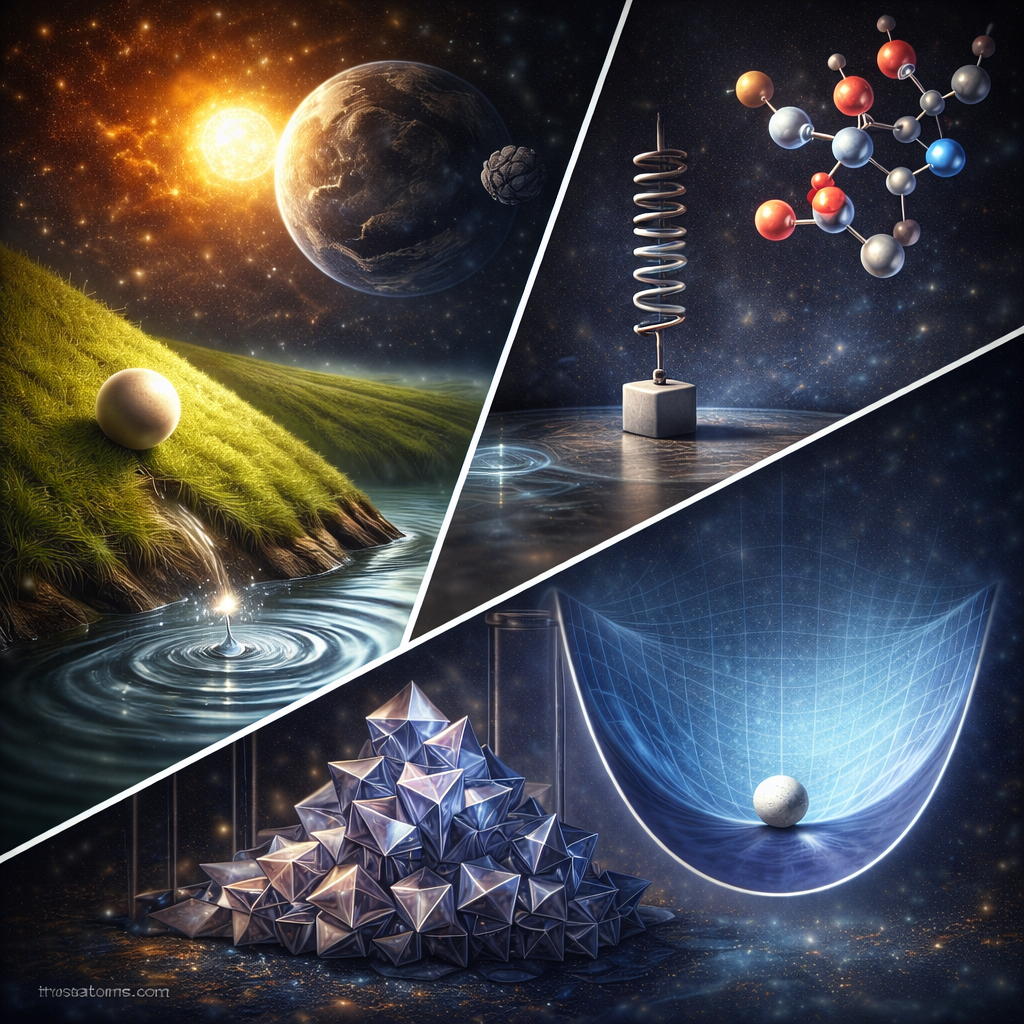
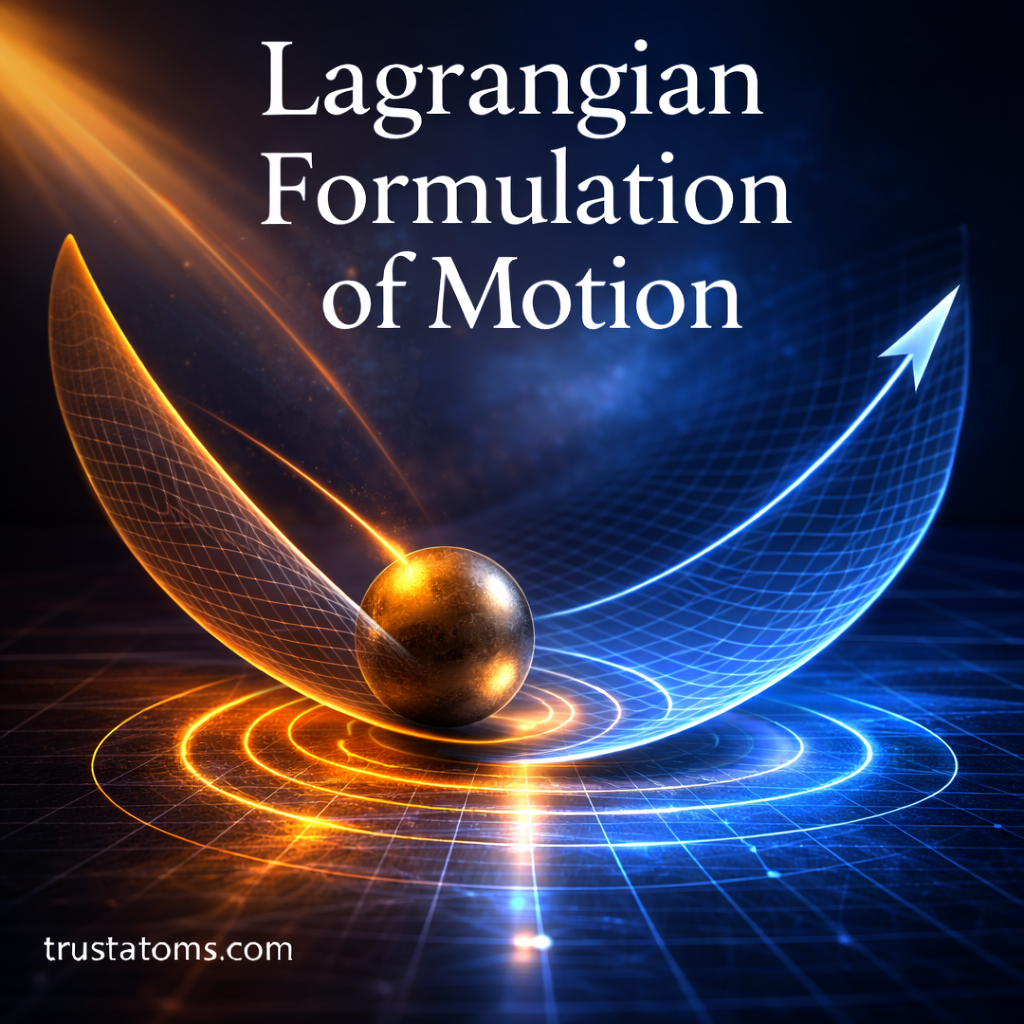
Physicists often visualize energy as a landscape.
- Valleys represent low-energy states.
- Peaks represent high-energy states.
- The lowest valley represents stable equilibrium.
There are three types of equilibrium:
Stable Equilibrium
- Small disturbances return the system to its original state.
- Corresponds to a minimum in energy.
Unstable Equilibrium
- Small disturbances move the system away.
- Corresponds to a maximum in energy.
Neutral Equilibrium
- Energy does not change significantly with displacement.
Energy minimization naturally leads systems toward stable equilibrium.
Energy Minimization in Mechanics
In classical mechanics, many systems settle into minimum energy configurations.
Examples include:
- Pendulums hanging straight down.
- Springs returning to natural length.
- Structures distributing stress efficiently.
The principle of least potential energy helps engineers design stable systems.
Energy Minimization in Thermodynamics
Thermodynamics expands the concept further.
At constant temperature and pressure, systems minimize:
- Gibbs free energy.
At constant volume and temperature, systems minimize:
- Helmholtz free energy.
This explains:
- Chemical reactions.
- Phase transitions.
- Mixing and separation processes.
Thermodynamic equilibrium corresponds to minimum free energy under constraints.
Surface Tension and Energy Minimization
Surface tension is a direct example of energy minimization.
Liquids form spherical droplets because:
- Surface molecules have higher energy.
- Reducing surface area lowers total energy.
- A sphere has the smallest surface area for a given volume.
This is why bubbles and raindrops tend to form rounded shapes.
Energy Minimization in Electrostatics
In electrostatics:
- Opposite charges attract.
- Like charges repel.
Systems arrange themselves to reduce total electric potential energy.
Examples:
- Electrons distribute evenly on conductors.
- Capacitors store energy in stable configurations.
- Molecules form stable charge arrangements.
Energy Minimization in Astrophysics
Energy minimization also governs large-scale systems.
Examples:
- Stars form when gravitational collapse lowers potential energy.
- Planetary orbits settle into stable configurations.
- Galaxies form rotating structures that balance gravitational and kinetic energy.
Even black holes represent extremely compact, low-energy configurations for a given mass.
Constraints and Local Minima
Not all systems reach the absolute lowest energy state.
Sometimes they get trapped in:
- Local minima (metastable states).
These states:
- Are stable under small disturbances.
- Are not the lowest possible energy overall.
Examples:
- Supercooled liquids.
- Stretched rubber bands.
- Certain crystal structures.
Energy barriers prevent the system from reaching the global minimum.
The Principle of Least Action
A deeper connection to energy minimization appears in the principle of least action.
This principle states:
The path taken by a system between two states is the one that minimizes (or makes stationary) a quantity called action.
This unifies:
- Mechanics
- Electromagnetism
- Relativity
Although more general than simple energy minimization, it reflects the same underlying idea: nature follows optimal paths.
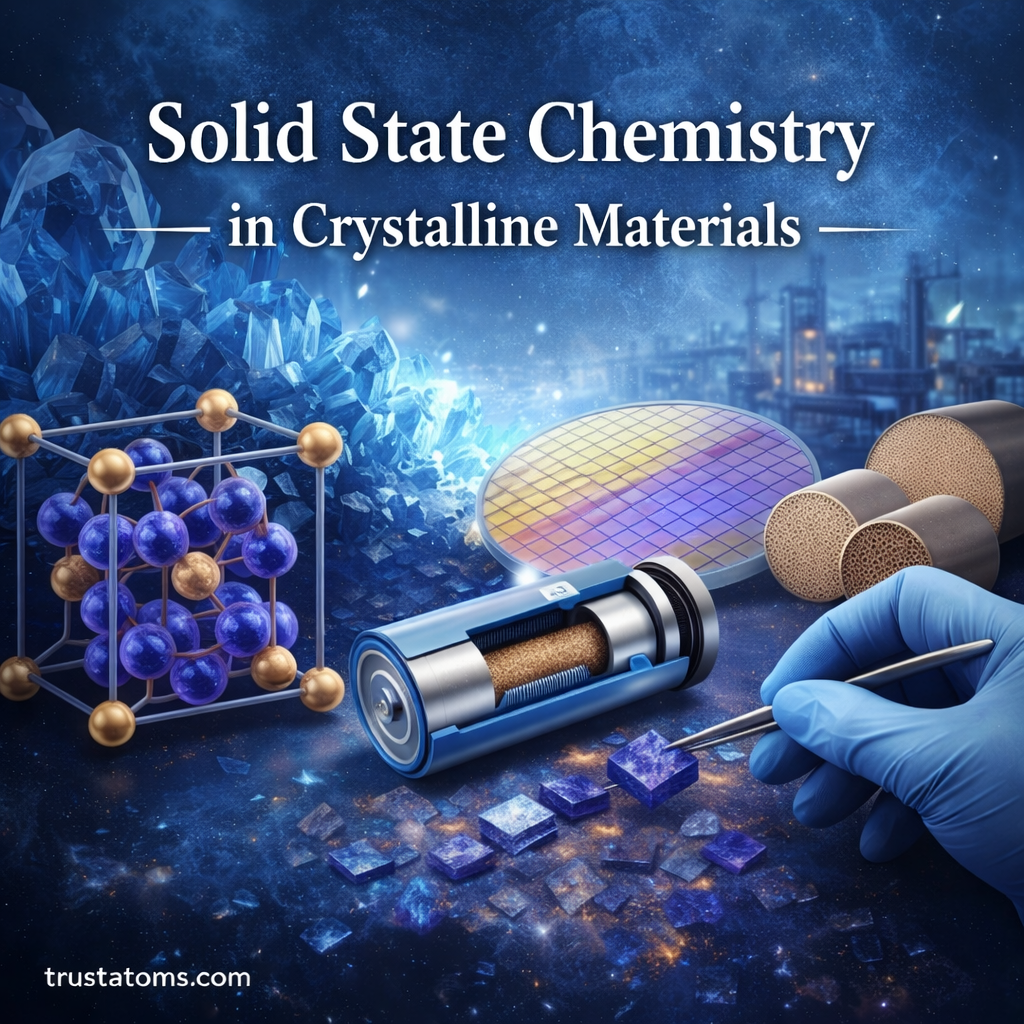
Energy Minimization in Materials Science
In materials science, atoms arrange themselves to minimize energy.
This leads to:
- Crystal lattice formation.
- Molecular bonding.
- Defect structures.
- Phase changes.
Metals, semiconductors, and polymers all exhibit structures determined by energy minimization.
Why Energy Minimization Is Universal
Energy minimization appears across physics because:
- Stable states correspond to minimum energy.
- Systems naturally evolve toward stability.
- Conservation laws guide energy redistribution.
Whether examining:
- A rolling ball,
- A forming star,
- A chemical reaction,
- Or a crystal lattice,
The same principle applies.
Common Misconceptions
“Systems Always Reach the Lowest Possible Energy”
Not necessarily.
Systems may:
- Be constrained.
- Encounter energy barriers.
- Remain in metastable states.
Energy minimization depends on available pathways.
“Energy Minimization Violates Conservation of Energy”
It does not.
Total energy is conserved in isolated systems.
Minimization typically involves:
- Converting potential energy to kinetic energy.
- Transferring energy as heat.
- Redistributing energy internally.
Final Thoughts
Energy minimization in physical systems is a unifying principle across mechanics, thermodynamics, electromagnetism, materials science, and astrophysics.
It explains:
- Stability and equilibrium.
- Shape formation.
- Chemical reactions.
- Structural organization.
From microscopic atoms to massive galaxies, physical systems evolve toward configurations that reduce energy under given constraints.
Understanding this principle provides deep insight into why nature organizes itself the way it does.