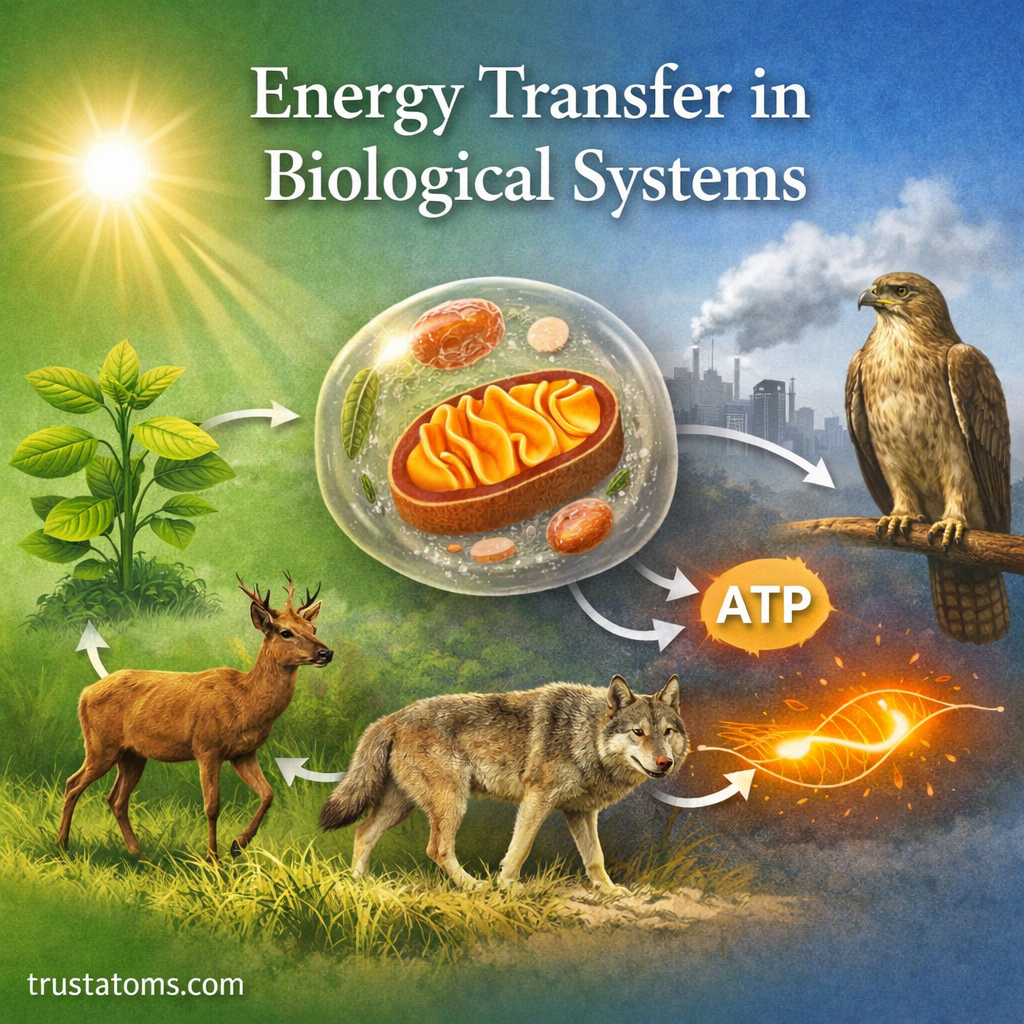
Energy transfer is one of the most fundamental processes that sustains life. Every biological activity — from muscle contraction and nerve signaling to growth and reproduction — depends on the movement and transformation of energy within living organisms.
In biology, energy does not appear from nowhere. Instead, it flows through ecosystems and moves through cells in highly organized biochemical pathways. Organisms capture energy from their environment, convert it into usable forms, and distribute it to power cellular processes.
Understanding how energy moves through biological systems helps explain how life functions at the cellular, organismal, and ecological levels.
What Is Energy Transfer in Biology?
Energy transfer in biological systems refers to the movement and conversion of energy from one form to another within living organisms.
Cells cannot directly use many energy sources found in nature. Instead, organisms convert external energy into chemical energy stored in molecules.
Examples include:
- Plants converting sunlight into chemical energy through photosynthesis
- Animals converting food molecules into usable cellular energy
- Cells converting stored energy into ATP for metabolic work
Energy flows through biological systems in a continuous cycle:
- Energy enters ecosystems (usually from sunlight)
- Organisms capture and convert the energy
- Cells store energy in chemical bonds
- Energy is released to perform cellular work
- Some energy is lost as heat
This process follows the laws of thermodynamics, particularly the principle that energy transformations are never 100% efficient.
The Role of ATP: The Cell’s Energy Currency
The most important molecule involved in biological energy transfer is ATP (adenosine triphosphate).
ATP acts as the primary energy carrier inside cells.
Why ATP Is Important
ATP stores energy in the bonds between its phosphate groups. When a phosphate bond is broken, energy is released and can be used by the cell.
Cells use ATP to power:
- Active transport across membranes
- Muscle contractions
- Protein synthesis
- DNA replication
- Cell division
- Nerve impulses
The ATP Cycle
The ATP cycle constantly regenerates energy.
- Energy from food or sunlight is captured
- ADP + phosphate is converted into ATP
- ATP releases energy by losing a phosphate group
- ATP becomes ADP again
- The cycle repeats
Because ATP is constantly used and regenerated, cells must continually produce new ATP molecules.
Photosynthesis: Capturing Energy from Sunlight
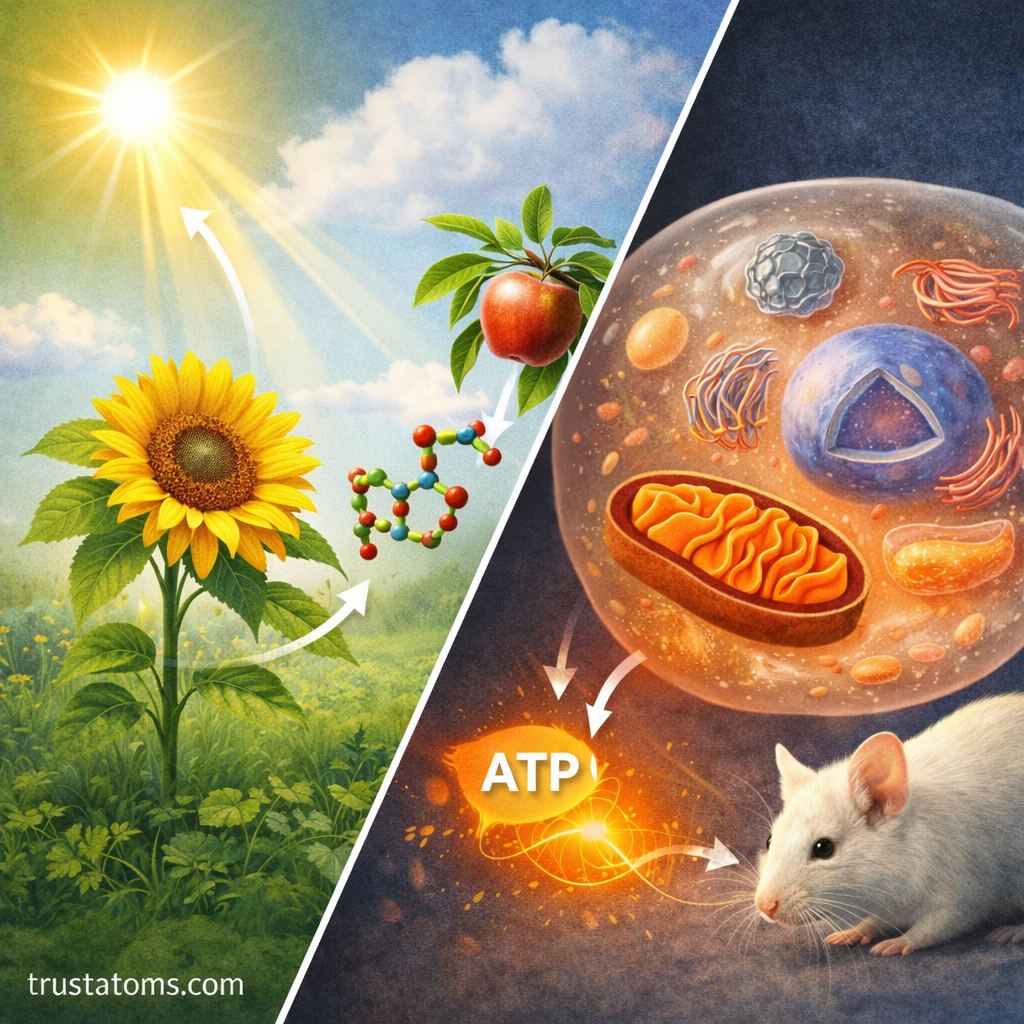
Photosynthesis is the process by which plants, algae, and some bacteria convert light energy into chemical energy.
This process occurs in the chloroplasts of plant cells.
The Basic Photosynthesis Equation
Carbon dioxide + water + sunlight → glucose + oxygen
Through this process, solar energy becomes stored in the chemical bonds of glucose molecules.
Two Major Stages of Photosynthesis
Light Reactions
These reactions occur in the thylakoid membranes of chloroplasts.
Key steps include:
- Light absorption by chlorophyll
- Splitting of water molecules
- Production of ATP and NADPH
- Release of oxygen as a byproduct
Calvin Cycle
The Calvin cycle uses ATP and NADPH from the light reactions to convert carbon dioxide into glucose.
Glucose then serves as an energy-rich molecule that can be used or stored by the plant.
Photosynthesis is crucial because it introduces energy into most ecosystems.
Cellular Respiration: Releasing Stored Energy
Cellular respiration is the process by which cells break down glucose to release energy stored in chemical bonds.
This process occurs in the mitochondria of eukaryotic cells.
The overall equation for cellular respiration is essentially the reverse of photosynthesis.
Glucose + oxygen → carbon dioxide + water + ATP
Stages of Cellular Respiration
Cellular respiration occurs in three major stages.
1. Glycolysis
Location: Cytoplasm
Key features:
- Glucose is split into two smaller molecules
- Small amount of ATP produced
- NADH generated as an electron carrier
Glycolysis does not require oxygen.
2. Krebs Cycle (Citric Acid Cycle)
Location: Mitochondrial matrix
Key functions:
- Further breakdown of glucose derivatives
- Production of NADH and FADH₂
- Release of carbon dioxide
3. Electron Transport Chain
Location: Inner mitochondrial membrane
This stage produces the majority of ATP.
Electrons move through a chain of proteins, generating a proton gradient that powers ATP synthesis.
Oxygen acts as the final electron acceptor, forming water.
Energy Transfer in Food Chains
Energy also transfers between organisms through ecological interactions.
This process occurs through food chains and food webs.
Trophic Levels
Energy moves through ecosystems in levels known as trophic levels.
- Producers (plants and algae)
- Primary consumers (herbivores)
- Secondary consumers (carnivores)
- Tertiary consumers (top predators)
Producers capture solar energy through photosynthesis and form the base of the food chain.
The 10% Energy Rule
Energy transfer between trophic levels is inefficient.
On average:
- Only about 10% of energy passes to the next level
- The remaining energy is lost as heat or used for metabolism
For example:
- Plants capture solar energy
- Herbivores consume plants
- Carnivores consume herbivores
Each step transfers only a fraction of the original energy.
This is why ecosystems support fewer predators than plants.
Energy Transfer Inside Cells
Within individual cells, energy moves through complex biochemical pathways.
Key processes include:
- Enzyme-controlled reactions
- Electron transfer reactions
- Proton gradients across membranes
- Energy storage in chemical bonds
Cells maintain efficient energy flow by carefully regulating metabolic pathways.
Role of Enzymes
Enzymes are proteins that speed up chemical reactions.
They allow energy transformations to occur efficiently without requiring extreme conditions.
Enzymes help:
- Break down food molecules
- Build new biological structures
- Transfer electrons in metabolic reactions
- Control the rate of energy release
Without enzymes, cellular metabolism would occur far too slowly to sustain life.
Energy Storage in Biological Systems
Organisms must also store energy for later use.
Different organisms use different molecules for energy storage.
Common Biological Energy Storage Molecules
Glucose
- Short-term energy source
- Easily metabolized
Glycogen
- Energy storage in animals
- Stored in liver and muscle cells
Starch
- Energy storage in plants
- Stored in roots, seeds, and tubers
Lipids (Fats)
- Long-term energy storage
- High energy density
- Used during fasting or prolonged activity
Lipids store significantly more energy per gram than carbohydrates.
Energy Efficiency in Living Systems
Although biological systems are highly efficient, energy transfer is never perfect.
Energy losses occur through:
- Heat production
- Metabolic inefficiencies
- Movement and maintenance processes
However, organisms have evolved strategies to maximize energy efficiency, including:
- Specialized cellular organelles
- Efficient enzyme systems
- Metabolic regulation
- Energy storage mechanisms
These adaptations allow living systems to maintain order despite constant energy loss.
Why Energy Transfer Is Essential for Life
Every living process depends on energy flow.
Energy transfer enables organisms to:
- Grow and develop
- Repair tissues
- Move and interact with the environment
- Maintain internal balance (homeostasis)
- Reproduce
Without continuous energy transformation, cells could not maintain the chemical reactions required for life.
From the capture of sunlight by plants to ATP production in mitochondria, energy transfer forms the foundation of all biological activity.
Key Takeaways
- Energy transfer refers to the movement and conversion of energy within living systems.
- ATP functions as the primary energy carrier in cells.
- Photosynthesis converts sunlight into chemical energy stored in glucose.
- Cellular respiration releases stored energy to produce ATP.
- Energy flows through ecosystems via food chains and trophic levels.
- Biological energy transfer is not perfectly efficient, with energy often lost as heat.
Understanding these processes provides insight into how organisms survive, interact, and evolve within complex biological systems.