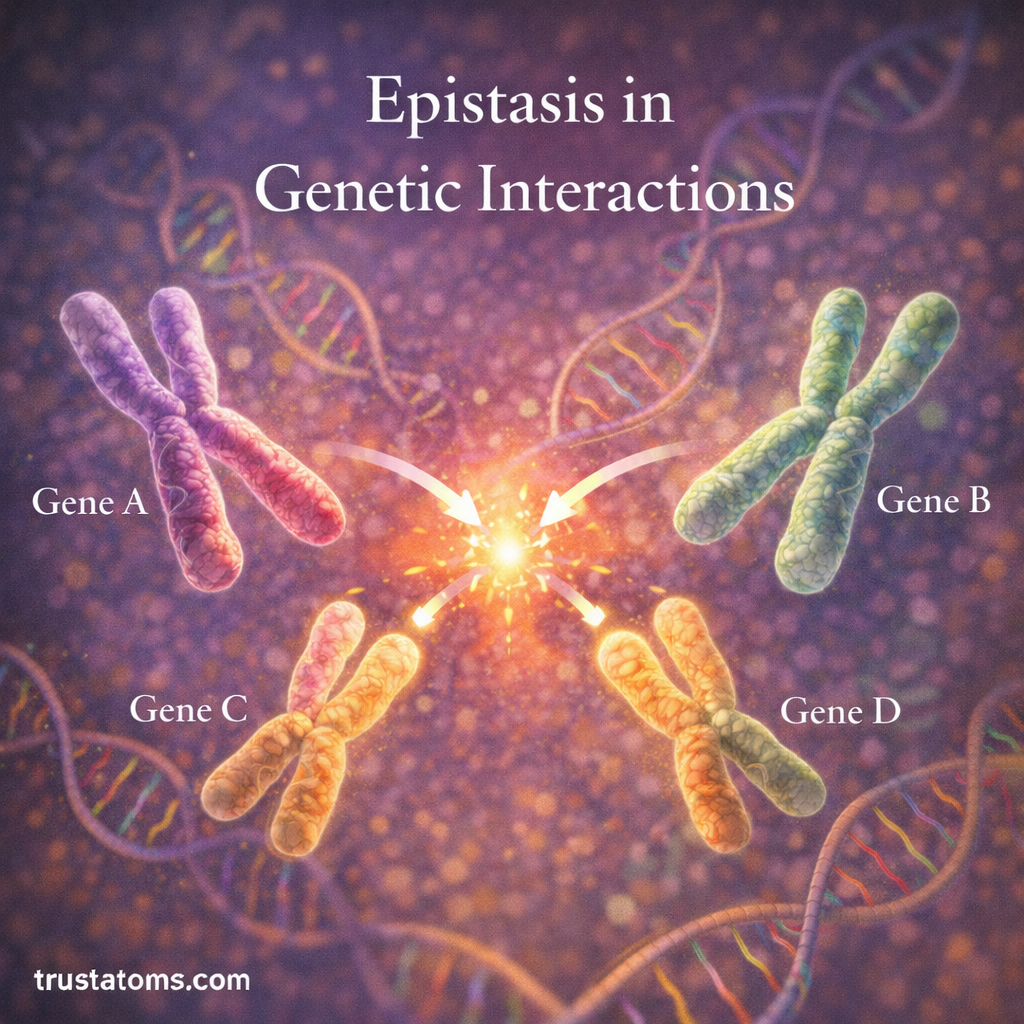
In genetics, traits are often influenced by more than one gene. While some genes contribute independently to characteristics, others interact in ways that modify or mask each other’s effects. One important form of gene interaction is epistasis.
Epistasis occurs when the expression of one gene is influenced by one or more other genes. These interactions can alter how traits appear in an organism and can complicate inheritance patterns beyond simple Mendelian genetics.
Understanding epistasis helps scientists explain complex trait inheritance, evolutionary processes, and many biological mechanisms involved in health and disease.
What Is Epistasis?
Epistasis refers to a genetic interaction where the effect of one gene depends on the presence of one or more other genes.
In this relationship:
- One gene can mask the effect of another gene
- One gene can modify the expression of another
- Multiple genes can interact to shape a single trait
The gene that masks or suppresses another gene’s expression is often called the epistatic gene, while the affected gene is referred to as the hypostatic gene.
These interactions can change expected inheritance patterns and lead to outcomes that differ from classic dominant–recessive relationships.
Epistasis vs Mendelian Inheritance
Traditional Mendelian genetics describes traits controlled by a single gene with dominant and recessive alleles. However, many biological traits involve interactions between multiple genes.
Epistasis expands on Mendelian principles by showing that:
- Genes do not always act independently
- Interactions between genes can alter phenotype
- Genetic pathways often involve multiple regulatory steps
For example, a gene responsible for pigment production may only function if another gene activates the biochemical pathway required to produce pigment.
If the activating gene is inactive, pigment will not form regardless of the pigment gene’s alleles.
Types of Epistasis
Several forms of epistasis exist depending on how genes interact.
Recessive Epistasis
Recessive epistasis occurs when two copies of a recessive allele mask the expression of another gene.
In this case:
- The recessive genotype prevents the second gene from affecting the trait
- The epistatic gene must be present in two recessive copies
A classic example occurs in coat color inheritance in certain animals.
Dominant Epistasis
Dominant epistasis occurs when a single dominant allele masks the expression of another gene.
This means:
- Only one copy of the dominant allele is required
- The epistatic gene overrides the effect of the second gene
Dominant epistasis can significantly alter predicted trait ratios in genetic crosses.
Duplicate Gene Epistasis
In duplicate gene epistasis, two genes perform similar functions in a pathway.
Either gene alone can produce the same effect.
As a result:
- Only when both genes are inactive does the trait change
- The presence of either dominant allele produces the same phenotype
This type of epistasis demonstrates redundancy in genetic systems.
Complementary Gene Interaction
Complementary epistasis occurs when two different genes must both be active for a trait to appear.
In this interaction:
- Each gene contributes to a step in the same biological pathway
- If either gene is inactive, the trait cannot develop
This type of gene interaction often occurs in biochemical processes.
How Epistasis Affects Phenotypes
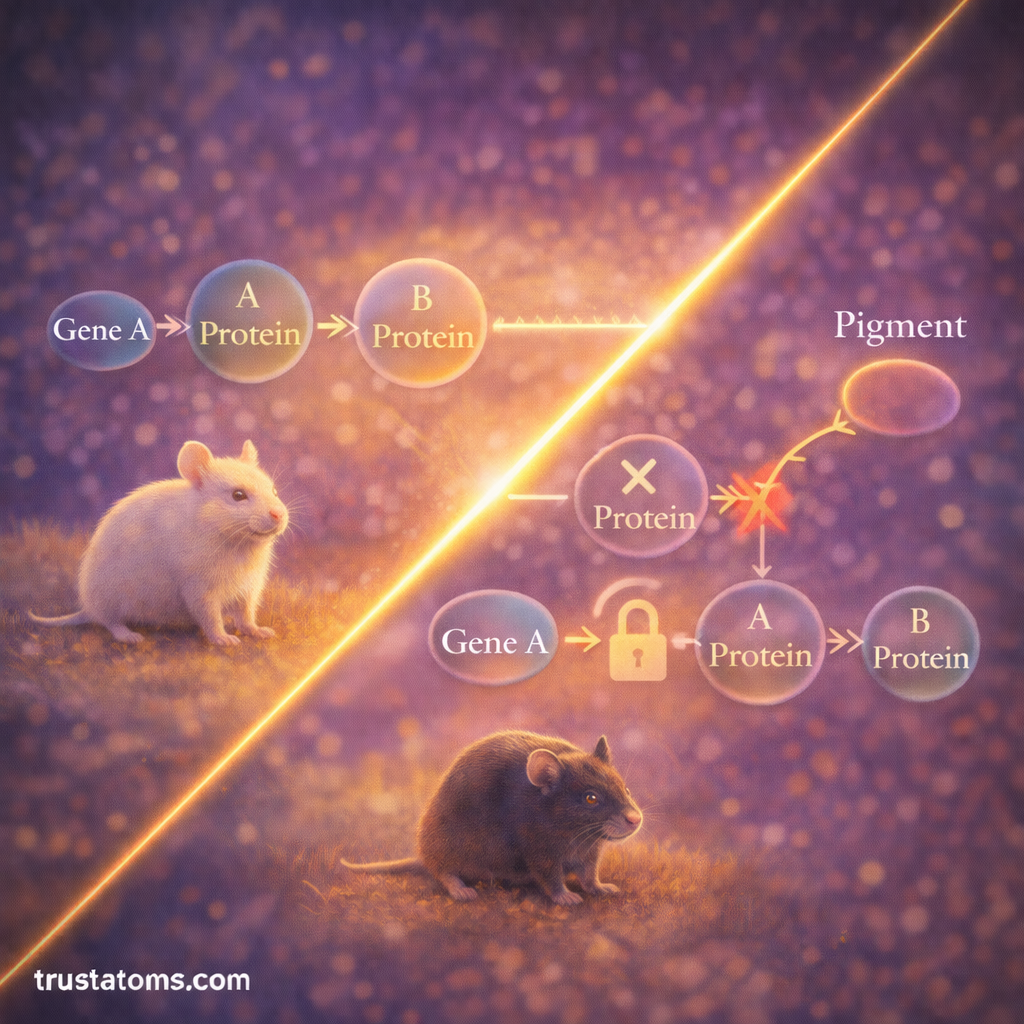
Epistasis influences how traits appear in organisms by altering gene expression pathways.
Genes rarely operate alone; instead, they participate in networks of biochemical reactions.
These networks may involve:
- Enzyme activation
- Signal transduction
- Metabolic pathways
- Developmental regulation
If one gene in the pathway is disrupted, the entire pathway may fail, affecting the final phenotype.
For example, in pigment production:
- One gene may produce an enzyme required for pigment synthesis.
- Another gene may control pigment distribution.
If pigment synthesis fails, distribution genes become irrelevant.
Epistasis in Biological Pathways
Epistasis often reflects the structure of biological pathways.
Many cellular processes involve multiple steps controlled by different genes.
These pathways may include:
- Metabolic reactions
- Developmental signaling pathways
- Hormone regulation
- Immune system responses
In such systems, genes operate in sequence or in coordinated networks.
If an early step in a pathway fails, downstream genes may not influence the final trait.
This explains why epistatic genes often appear to override other genes.
Epistasis and Evolution
Epistasis plays an important role in evolution because gene interactions can influence how traits respond to natural selection.
Gene interactions may:
- Enhance beneficial traits
- Buffer harmful mutations
- Create new phenotypic variation
Epistasis can also affect evolutionary trajectories by altering how genetic changes combine.
In some cases, beneficial mutations only produce advantages when combined with specific other genetic variants.
This complexity contributes to the diversity seen in biological systems.
Epistasis in Human Genetics
Epistasis is also relevant to human biology and disease.
Many complex conditions result from interactions among multiple genes rather than a single genetic mutation.
Examples include:
- Diabetes
- Cardiovascular disease
- Neurological disorders
- Immune system conditions
Gene interactions may influence disease risk, severity, and response to treatments.
Understanding epistatic interactions helps researchers identify genetic networks involved in health and disease.
Studying Epistasis in Modern Genetics
Modern genetics uses advanced technologies to analyze gene interactions.
Researchers study epistasis using methods such as:
- Genome-wide association studies (GWAS)
- Gene knockout experiments
- CRISPR gene editing
- Computational modeling of genetic networks
These tools allow scientists to identify how genes interact across the genome and influence complex traits.
As genomic data grows, understanding epistasis has become increasingly important for interpreting genetic variation.
Final Thoughts
Epistasis highlights the complexity of genetic systems by showing how genes interact to shape biological traits. Rather than acting independently, many genes function within interconnected pathways where the activity of one gene can modify or mask the effects of another.
These interactions influence trait inheritance, evolutionary change, and disease development. By studying epistasis, scientists gain a deeper understanding of how genetic networks operate and how multiple genes combine to produce the diversity of traits observed in living organisms.
As genetic research advances, epistasis continues to play a central role in explaining complex inheritance patterns and the dynamic relationships within genomes.