Faraday’s Laws of Electrolysis are foundational principles in electrochemistry that describe how electrical energy drives chemical reactions. These laws explain the relationship between the amount of electric charge passing through a substance and the amount of chemical change that occurs.
First formulated by the scientist Michael Faraday in the 19th century, these laws remain essential for understanding processes such as electroplating, metal refining, battery charging, and hydrogen production.
By linking electricity and chemical reactions quantitatively, Faraday’s work helped establish electrochemistry as a major scientific field and continues to influence modern energy technologies.
What Is Electrolysis?
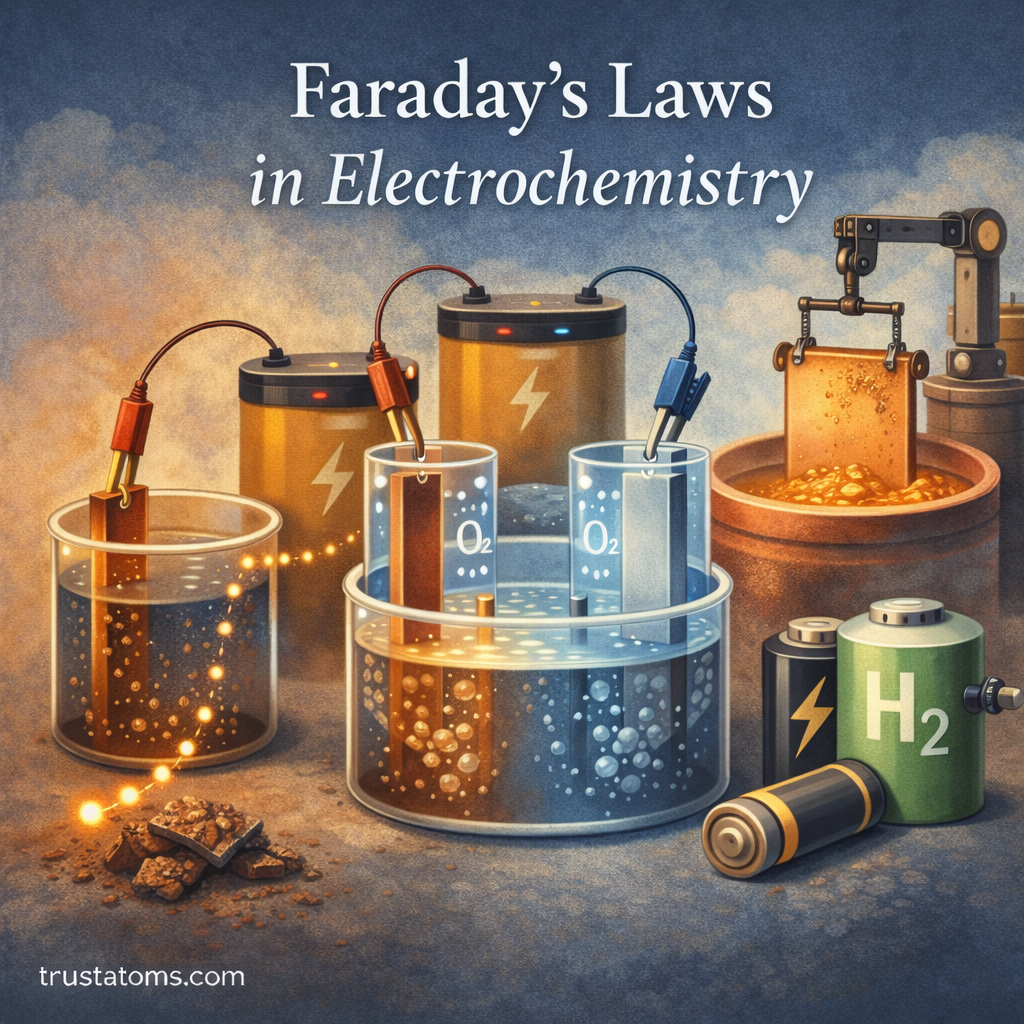
Electrolysis is the process of using electrical energy to drive a chemical reaction that would not occur spontaneously.
In an electrolytic system:
- Electrical current flows through an electrolyte
- Ions move within the solution
- Chemical reactions occur at electrodes
Electrolysis is used in many industrial and scientific applications, including:
- Metal extraction
- Electroplating
- Water splitting for hydrogen production
- Chemical manufacturing
Faraday’s laws describe how much chemical change occurs during these processes.
Overview of Faraday’s Laws
Faraday developed two laws that relate electrical charge to chemical reactions occurring in electrolytic systems.
These laws quantify how much material is deposited, dissolved, or produced during electrolysis.
Faraday’s First Law of Electrolysis
Faraday’s First Law states that:
The amount of chemical substance produced at an electrode is directly proportional to the amount of electric charge passed through the electrolyte.
In simple terms, this means:
- More electric current results in more chemical change.
- If twice the charge passes through a solution, twice as much material is produced.
This law explains why controlling electric current allows precise control over electrochemical processes.
Key Factors Affecting the Reaction
Several variables influence the amount of substance produced:
- Electric current
- Duration of the current
- Properties of the substance undergoing electrolysis
These factors determine how many electrons move through the circuit and participate in the reaction.
Faraday’s Second Law of Electrolysis
Faraday’s Second Law states that:
When the same amount of electric charge passes through different electrolytes, the amount of substance produced depends on the chemical equivalent of each substance.
In practice, this means:
- Different materials react differently to the same electrical charge.
- The mass of material produced depends on atomic structure and electron transfer requirements.
Substances that require fewer electrons for reduction will produce larger amounts of material for the same charge.
Understanding the Role of Electric Charge
Electric current represents the flow of electrons through a circuit.
In electrochemical systems:
- Electrons travel through the external circuit.
- Ions move through the electrolyte.
- Chemical reactions occur at the electrodes.
Each electron transferred corresponds to a specific amount of chemical transformation.
Because of this relationship, electrochemists can predict reaction outcomes by measuring electrical charge.
The Faraday Constant
The Faraday constant represents the amount of electric charge carried by one mole of electrons.
Its value is approximately:
96,485 coulombs per mole of electrons.
This constant allows scientists to calculate the amount of substance produced during electrolysis based on the charge that passes through the system.
The Faraday constant connects three key ideas:
- Electrical charge
- Electron transfer
- Chemical change
It is one of the most important constants in electrochemistry.
Applications of Faraday’s Laws
Faraday’s Laws are widely applied in industrial chemistry, materials science, and energy technologies.
Electroplating
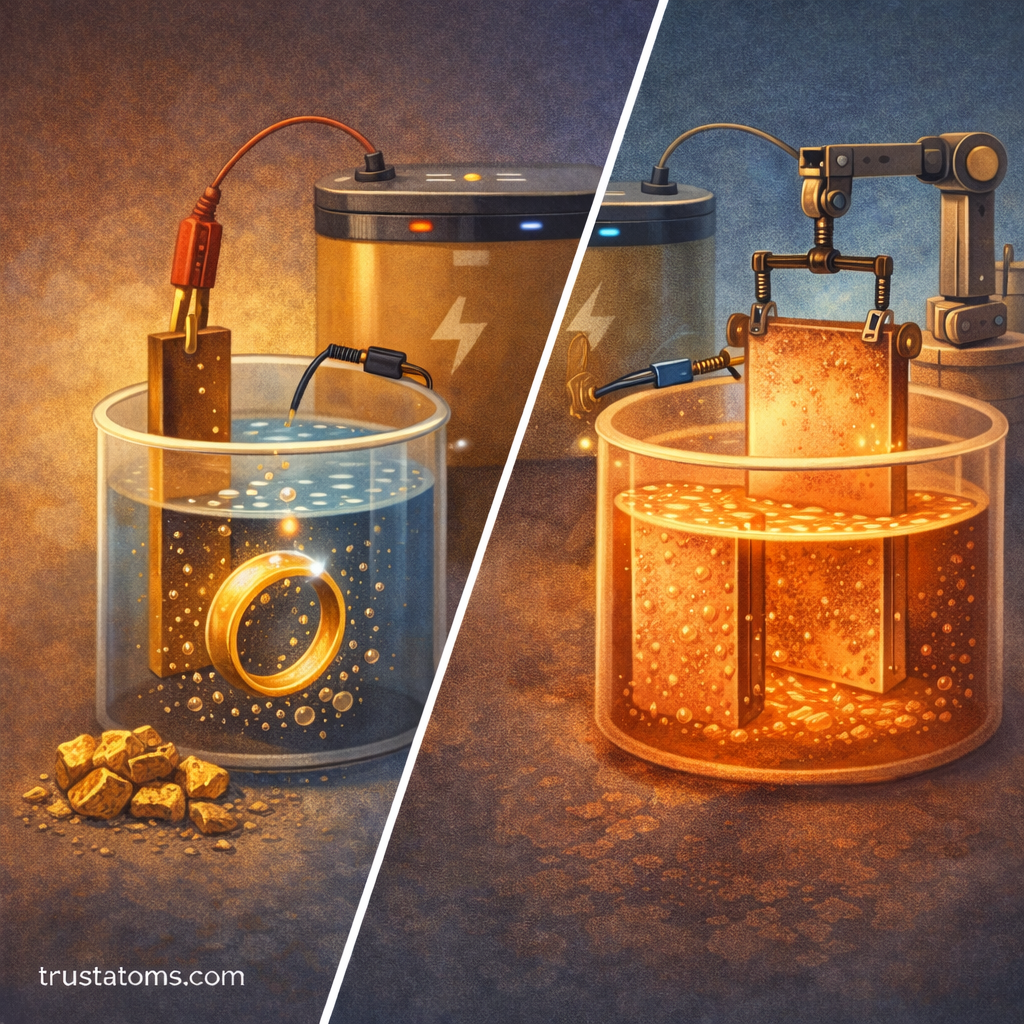
Electroplating uses electrical current to deposit a thin layer of metal onto another material.
Common uses include:
- Jewelry finishing
- Corrosion protection
- Decorative metal coatings
- Electronics manufacturing
Faraday’s laws help engineers determine how long the plating process should run to achieve the desired thickness.
Metal Refining
Electrolysis is used to purify metals such as copper and aluminum.
The process works by:
- Dissolving impure metal at one electrode
- Depositing pure metal at another electrode
Precise control of electric charge ensures efficient purification.
Hydrogen Production
Electrolysis of water splits water molecules into hydrogen and oxygen.
Hydrogen produced through electrolysis is increasingly important in renewable energy systems.
Applications include:
- Hydrogen fuel cells
- Industrial fuel sources
- Long-term renewable energy storage
Faraday’s laws help determine how much hydrogen can be produced from a given electrical input.
Battery Charging and Energy Storage
Rechargeable batteries operate through reversible electrochemical reactions.
When charging a battery:
- Electrical energy drives chemical reactions
- Ions move through the electrolyte
- Electrode materials change composition
Faraday’s laws help engineers estimate charge capacity and efficiency in battery systems.
Why Faraday’s Laws Are Important
Faraday’s Laws remain essential because they connect electrical measurements with chemical reactions.
They allow scientists and engineers to:
- Predict electrochemical reaction outcomes
- Design efficient industrial processes
- Calculate material production rates
- Optimize energy storage systems
- Control electrochemical manufacturing
These principles help ensure precision and efficiency in systems that rely on electrolysis.
Modern Relevance in Energy Technology
Faraday’s insights are especially relevant in today’s transition toward renewable energy technologies.
Electrochemical systems using Faraday’s principles include:
- Hydrogen electrolyzers
- Lithium-ion battery manufacturing
- Grid-scale energy storage
- Fuel cell technologies
Understanding these laws helps scientists design better materials and improve the efficiency of energy systems.
As the world continues developing sustainable energy technologies, electrochemical processes guided by Faraday’s laws will remain a key part of the solution.
Final Thoughts
Faraday’s Laws of Electrolysis provide a quantitative link between electricity and chemical change. By describing how electrical charge determines the amount of material produced during electrochemical reactions, these laws form the foundation of modern electrochemistry.
From electroplating and metal refining to hydrogen production and battery technology, Faraday’s principles guide a wide range of industrial and scientific applications. Even today, more than a century after their discovery, these laws continue to shape the technologies that power modern society.