Metabolic processes in living organisms involve thousands of chemical reactions occurring simultaneously inside cells. These reactions must be carefully controlled so that the cell produces exactly what it needs—no more and no less. One of the most efficient control mechanisms used by biological systems is feedback regulation.
Feedback regulation allows cells to monitor the levels of molecules they produce and automatically adjust metabolic pathways when necessary. This mechanism helps maintain homeostasis, conserve energy, and prevent harmful imbalances in cellular chemistry.
What Is Feedback Regulation?
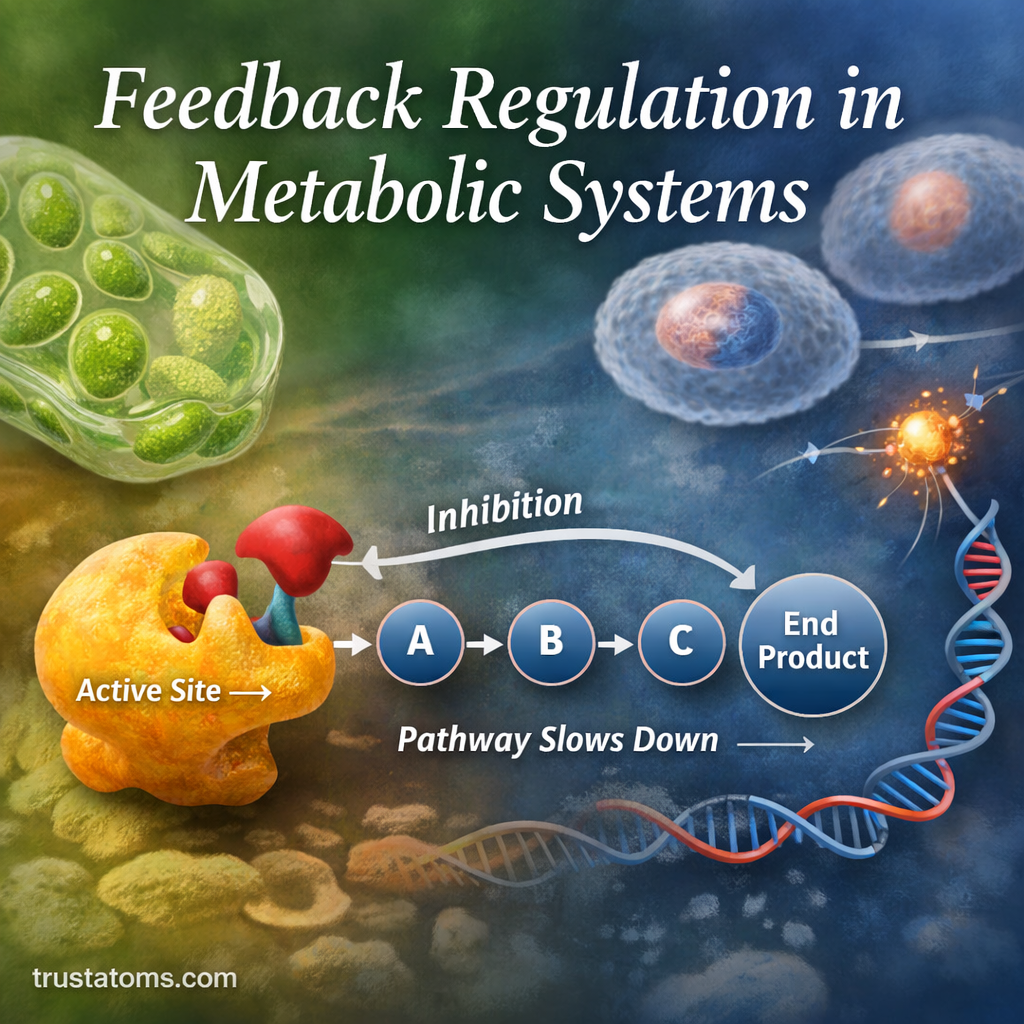
Feedback regulation is a control mechanism in which the end product of a metabolic pathway influences the activity of an earlier step in the same pathway.
In most cases, the final product inhibits an enzyme that acts earlier in the pathway, slowing or stopping further production once enough of the product has accumulated.
This form of regulation ensures that cells do not waste resources synthesizing molecules that are already abundant.
Key characteristics of feedback regulation include:
- Control by the final product of a pathway
- Regulation that occurs early in the metabolic sequence
- Adjustment of enzyme activity rather than gene expression
- Rapid response to changing cellular conditions
Because enzymes are involved in nearly every metabolic reaction, regulating enzyme activity is an efficient way to control metabolism.
Why Feedback Regulation Is Important
Cells operate under strict energy constraints. Every chemical reaction requires resources such as ATP, enzymes, and precursor molecules. Without regulation, cells could waste large amounts of energy producing unnecessary compounds.
Feedback regulation helps maintain balance by:
- Conserving energy and resources
- Preventing accumulation of toxic intermediates
- Stabilizing metabolic pathways
- Coordinating complex biochemical networks
- Supporting cellular homeostasis
By adjusting metabolic activity dynamically, feedback mechanisms allow organisms to respond quickly to environmental changes.
How Feedback Inhibition Works
The most common form of feedback regulation is feedback inhibition.
In feedback inhibition, the final product of a metabolic pathway binds to a regulatory site on an enzyme earlier in the pathway. This binding reduces the enzyme’s activity and slows down the entire pathway.
Step-by-Step Example
A simplified metabolic pathway might work as follows:
- Substrate A is converted to intermediate B.
- B is converted to intermediate C.
- C is converted to intermediate D.
- D is converted to final product E.
When enough E accumulates, it binds to the enzyme that converts A to B, preventing further production.
This process creates a self-regulating loop:
- High product levels → pathway slows down
- Low product levels → pathway speeds up again
This dynamic balance keeps metabolic systems efficient.
Role of Allosteric Enzymes
Many enzymes involved in feedback regulation are allosteric enzymes.
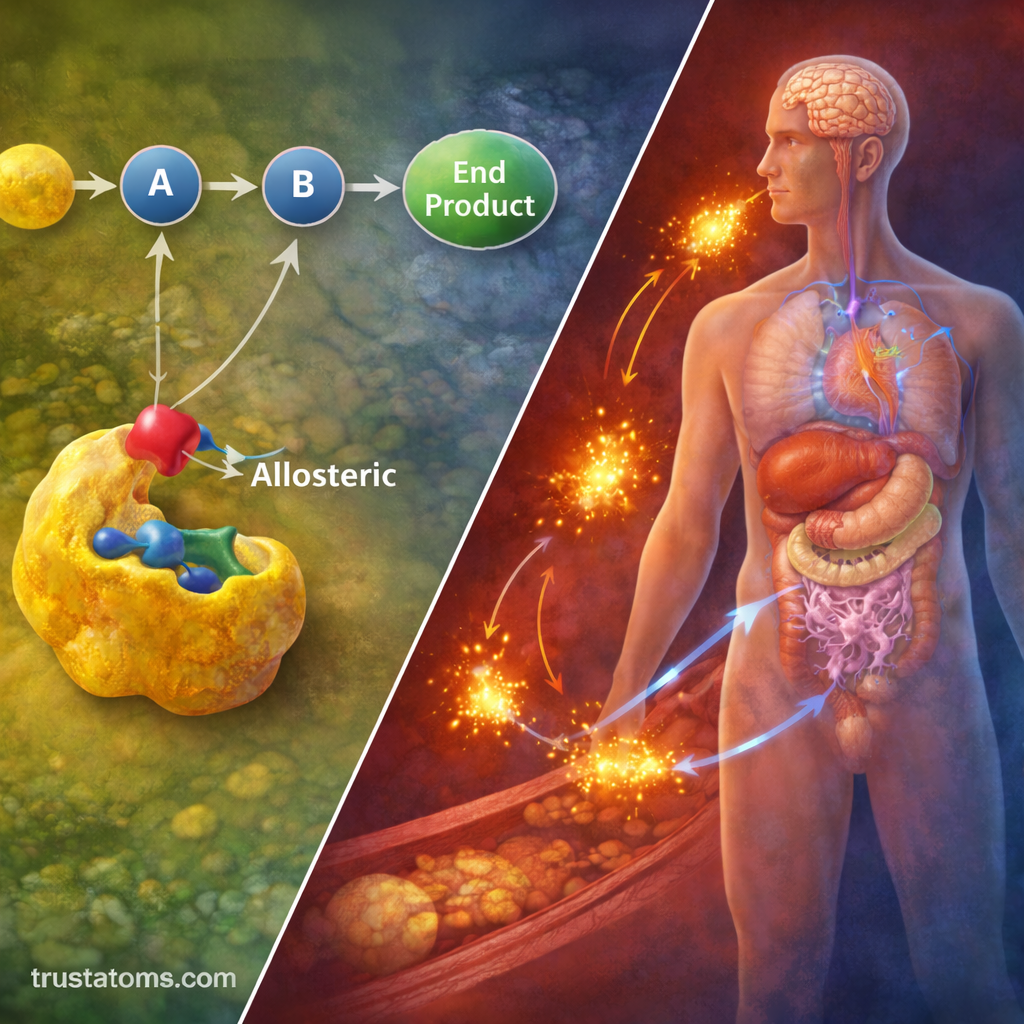
Allosteric enzymes contain regulatory sites separate from their active sites. When molecules bind to these regulatory sites, they change the enzyme’s shape and activity.
Two possible effects
Binding can either:
- Inhibit enzyme activity (common in feedback inhibition)
- Activate enzyme activity in some pathways
Allosteric regulation allows cells to adjust enzyme function almost instantly, without needing to synthesize new enzymes.
Characteristics of allosteric enzymes include:
- Multiple binding sites
- Conformational shape changes
- Rapid response to regulatory molecules
- High sensitivity to metabolic signals
These properties make them ideal for controlling complex metabolic networks.
Negative vs Positive Feedback in Metabolism
Feedback systems can be divided into two main types: negative feedback and positive feedback.
Negative Feedback
Negative feedback is the most common type in metabolic pathways.
In this system:
- The final product inhibits earlier steps
- Production slows when product levels rise
- Production resumes when levels fall
Negative feedback maintains stable metabolic equilibrium.
Examples include regulation of:
- Amino acid synthesis
- Cholesterol production
- Nucleotide biosynthesis
Positive Feedback
Positive feedback amplifies a process rather than suppressing it.
In metabolic contexts, positive feedback occurs when a product stimulates earlier steps in the pathway, increasing production.
Although less common in metabolism, positive feedback plays roles in:
- Blood clotting cascades
- Hormonal signaling pathways
- Developmental processes
Positive feedback typically occurs in systems where rapid activation is necessary.
Example: Isoleucine Biosynthesis
A classic example of feedback inhibition occurs in the synthesis of the amino acid isoleucine.
The pathway begins with the amino acid threonine, which is converted into several intermediate molecules before forming isoleucine.
The first enzyme in this pathway is threonine deaminase.
Regulation mechanism
When isoleucine accumulates:
- It binds to threonine deaminase.
- The enzyme changes shape.
- The reaction slows or stops.
This prevents the cell from producing excess isoleucine once sufficient levels exist.
When isoleucine levels decrease, the inhibition is removed and the pathway resumes normal activity.
This system ensures efficient amino acid production.
Multi-Level Regulation in Metabolic Systems
Feedback regulation is often just one layer of metabolic control.
Cells frequently regulate pathways at multiple levels, including:
Enzyme Activity Control
Rapid adjustments through:
- Allosteric inhibition
- Feedback inhibition
- Covalent modification of enzymes
Gene Expression Control
Long-term adjustments through:
- Increasing or decreasing enzyme production
- Transcriptional regulation of metabolic genes
Hormonal Regulation
In multicellular organisms, hormones coordinate metabolism across tissues.
Examples include:
- Insulin regulating glucose metabolism
- Glucagon stimulating glucose release
- Adrenaline activating energy mobilization
These additional regulatory layers help organisms maintain metabolic stability under changing physiological conditions.
Feedback Regulation and Cellular Homeostasis
Homeostasis refers to the ability of biological systems to maintain stable internal conditions.
Feedback regulation plays a crucial role in achieving this balance.
Without feedback control, metabolic pathways could lead to:
- Excessive accumulation of metabolic products
- Resource depletion
- Toxic intermediate buildup
- Loss of cellular efficiency
Instead, feedback loops allow cells to maintain precise control over:
- Energy production
- Biomolecule synthesis
- Waste removal
- Cellular growth and repair
These systems are fundamental to life at both the cellular and organismal level.
Feedback Regulation in Human Health
Disruptions in metabolic feedback systems can contribute to disease.
For example:
- Diabetes involves impaired regulation of glucose metabolism.
- Metabolic syndrome affects lipid and carbohydrate balance.
- Cancer cells often bypass normal metabolic regulation.
Understanding feedback mechanisms has therefore become an important area of research in:
- Medicine
- Biochemistry
- Pharmacology
- Systems biology
Many modern drugs target enzymes involved in metabolic feedback pathways to restore proper regulation.
Final Thoughts
Feedback regulation is one of the most elegant control mechanisms found in biology. By allowing the products of metabolic pathways to regulate their own production, cells achieve efficient and stable biochemical activity.
Through mechanisms such as feedback inhibition, allosteric enzyme control, and hormonal regulation, metabolic systems remain adaptable and balanced.
These regulatory networks ensure that organisms produce exactly what they need, when they need it—no more and no less—making feedback regulation a cornerstone of cellular metabolism.