The First Law of Thermodynamics states:
Energy cannot be created or destroyed — only transferred or transformed.
This is the principle of energy conservation applied to heat and work.
In simple terms:
The total energy in a closed system remains constant.
If energy enters a system, something inside must change. If energy leaves, something inside must decrease.
This law explains how engines run, why refrigerators need electricity, and how your body uses food for fuel.
What Is the First Law of Thermodynamics?
The First Law connects three key quantities:
- Internal energy
- Heat
- Work
It tells us that:
Any change in a system’s internal energy equals the heat added to the system minus the work done by the system.
You don’t need equations to understand the idea:
Energy in = Energy stored + Energy used for work
Nothing disappears. It simply changes form.
Key Concepts You Need to Understand
Before going deeper, let’s define the main terms.
Internal Energy
Internal energy is the total energy stored inside a system.
It includes:
- Molecular motion (thermal energy)
- Chemical energy
- Atomic interactions
For example, hot gas has more internal energy than cold gas because its molecules move faster.
Heat
Heat is energy transferred due to a temperature difference.
Important rule:
Heat flows naturally from hot to cold.
When you place a hot object next to a cold one, energy transfers until temperatures equalize.
Work
Work happens when energy causes motion against a force.
Examples:
- Expanding gas pushes a piston.
- Steam turns a turbine.
- Compressed air moves a mechanical part.
In thermodynamics, work often involves gases expanding or compressing.
Everyday Examples of the First Law
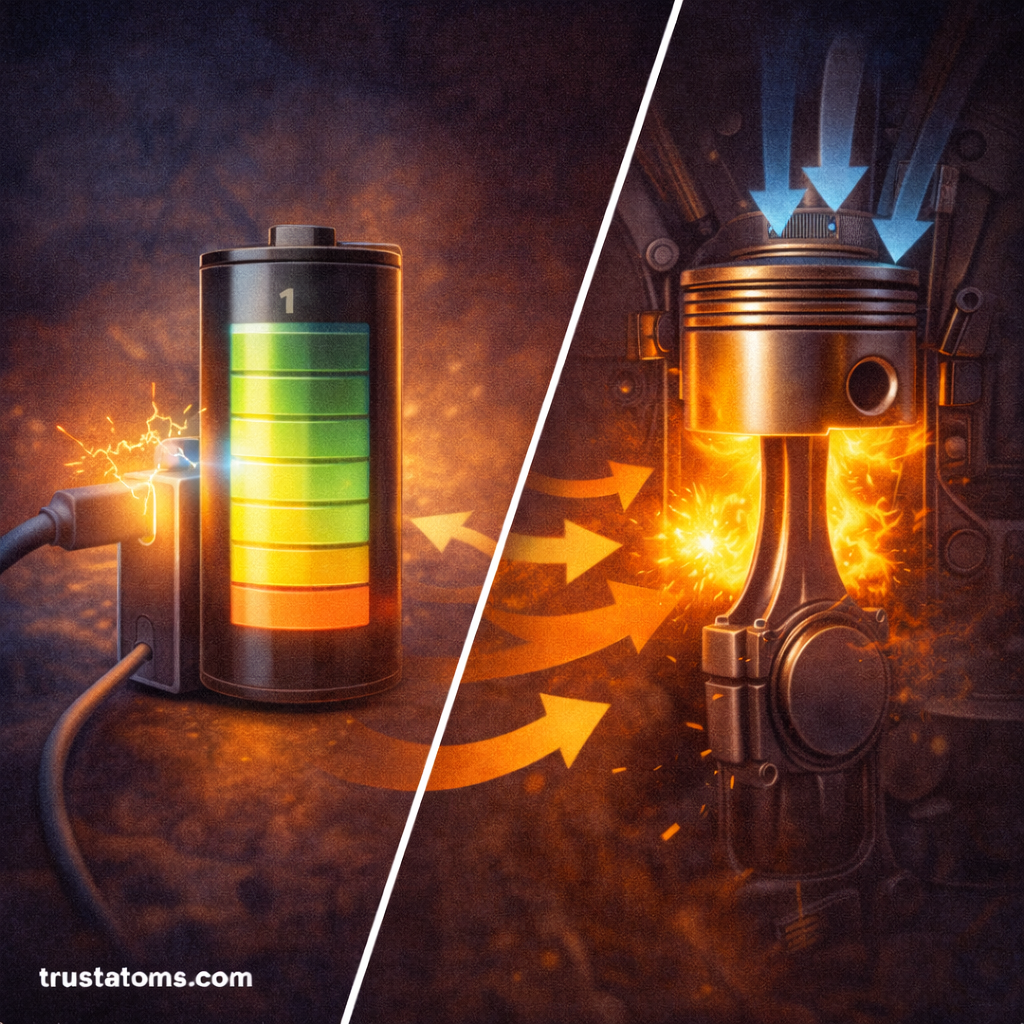
The First Law is constantly at work around you.
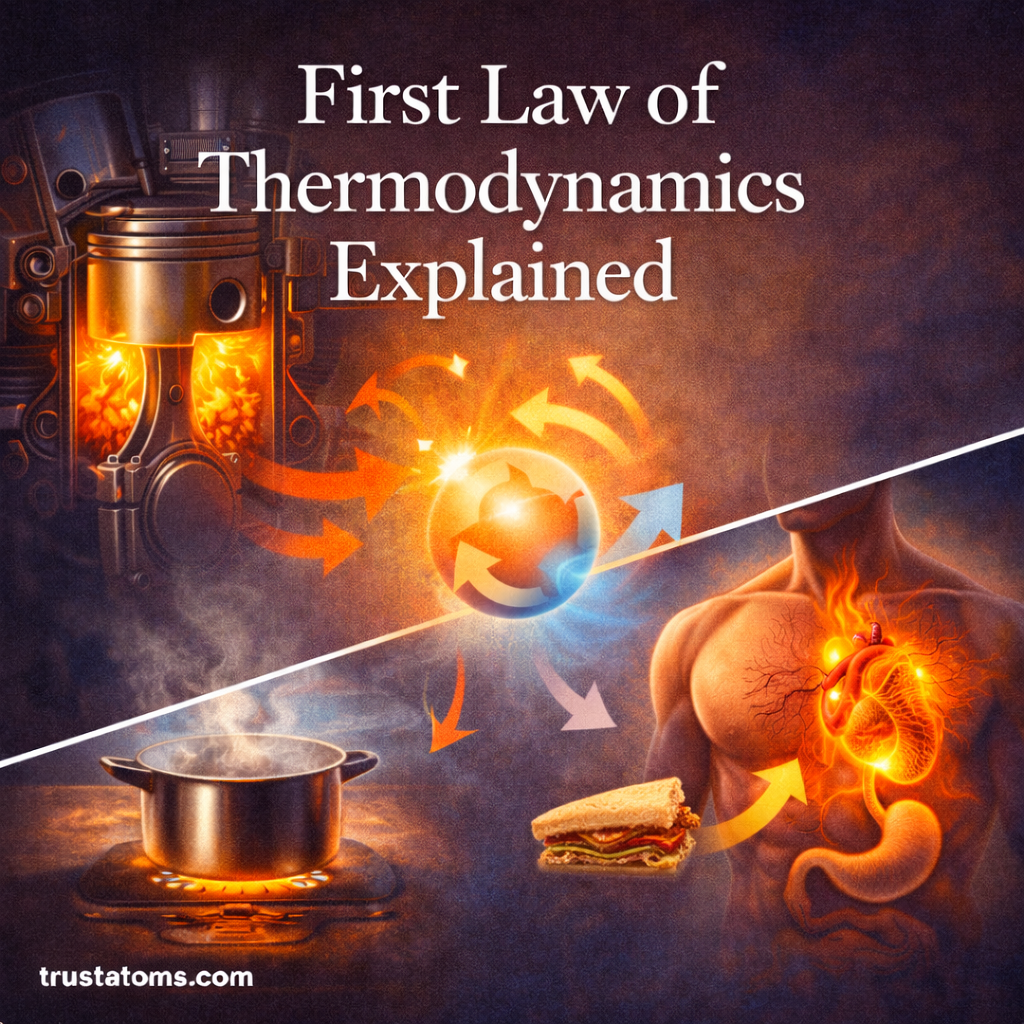
1. A Car Engine
Inside an engine:
- Fuel burns.
- Chemical energy becomes heat.
- Hot gas expands.
- Gas pushes a piston.
- Motion powers the car.
Some energy becomes useful work.
Some becomes waste heat.
But total energy remains conserved.
2. Boiling Water
When you heat water:
- Energy enters from the stove.
- Water molecules move faster.
- Temperature increases.
- Eventually, water changes phase to steam.
The added heat increases internal energy and enables phase change.
3. Human Metabolism
Your body follows the First Law.
Food contains chemical energy.
Your body converts it into:
- Motion
- Heat
- Stored fat
- Cellular activity
Energy transforms — it never vanishes.
Closed vs. Open Systems
Understanding systems is essential in thermodynamics.
Closed System
- Energy can enter or leave.
- Matter cannot.
Example: A sealed piston containing gas.
Open System
- Both energy and matter can enter or leave.
Example: A boiling pot without a lid.
The First Law applies to both — but calculations differ.
Why the First Law Matters
The First Law is foundational in:
- Mechanical engineering
- Power plant design
- Automotive systems
- Aerospace engineering
- Climate science
- Biology
It ensures engineers account for every energy transfer.
No design can ignore energy conservation.
What the First Law Does Not Say
The First Law tells us energy is conserved.
It does NOT tell us:
- Whether a process is efficient
- Whether energy is useful
- Whether a process happens naturally
That’s where the Second Law of Thermodynamics comes in.
The First Law is about quantity.
The Second Law is about quality and direction.
Common Misconceptions
“Energy Gets Used Up”
Energy doesn’t get used up.
It becomes dispersed or transformed into less useful forms (often heat).
“Engines Create Energy”
Engines don’t create energy.
They convert energy from one form into another.
The First Law in Simple Form
If you remember nothing else, remember this:
Energy entering a system must either:
- Increase internal energy
- Or leave as work
There is no third option.
This simple rule governs everything from power plants to living cells.
Key Takeaways
- The First Law of Thermodynamics is the law of energy conservation.
- Energy cannot be created or destroyed.
- Heat and work are forms of energy transfer.
- Internal energy changes when heat enters or work is done.
- Every physical and biological system obeys this law.
It’s one of the most powerful and universal principles in physics.
Final Thoughts
The First Law of Thermodynamics explains how energy behaves in every system — mechanical, biological, or cosmic.
It ensures that energy accounting always balances.
From engines and electricity to metabolism and climate systems, energy transforms but never disappears.
Understanding this law is the first step toward understanding how the physical world operates.