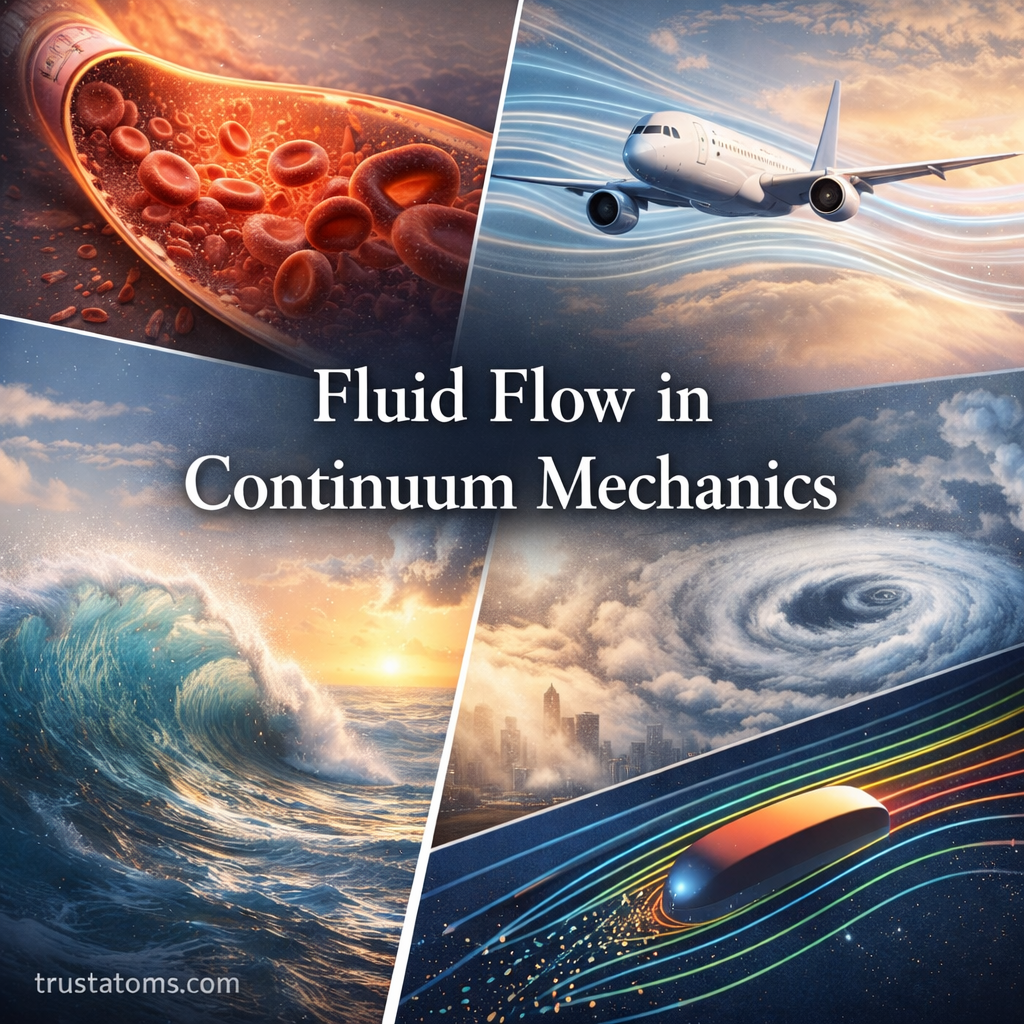
Fluid flow is everywhere — from rivers and blood circulation to air moving over airplane wings.
To analyze these motions, physicists and engineers rely on continuum mechanics, a framework that treats fluids as continuous substances rather than collections of individual molecules. This approach allows us to model and predict how liquids and gases behave under different conditions.
In this article, we’ll explore what fluid flow means in continuum mechanics, the core equations that describe it, and why it matters in real-world physics and engineering.
What Is Continuum Mechanics?
Continuum mechanics is the branch of physics that studies the mechanical behavior of materials — solids and fluids — by treating them as continuous media.
Instead of tracking individual molecules, it assumes:
- Matter is smoothly distributed.
- Properties like density and pressure vary continuously.
- Microscopic structure is averaged out.
This simplification works extremely well at everyday scales.
What Is a Fluid?
A fluid is a substance that continuously deforms under applied shear stress.
Unlike solids:
- Fluids cannot resist shear forces indefinitely.
- They flow when a force is applied.
Fluids include:
- Liquids (water, oil, blood)
- Gases (air, steam, helium)
- Plasmas (ionized gases at high energy)
Describing Fluid Flow
To understand fluid flow, we describe how properties change in space and time.
Key quantities include:
- Velocity field (how fast and in what direction the fluid moves)
- Pressure
- Density
- Temperature
These are treated as continuous fields that vary from point to point.
Two Ways to View Fluid Motion
There are two primary perspectives in fluid mechanics.
1. Eulerian Description
Focuses on specific locations in space.
- Observes how fluid properties change at fixed points.
- Common in engineering and atmospheric science.
Example: Measuring wind speed at a weather station.
2. Lagrangian Description
Follows individual fluid particles as they move.
- Tracks position and velocity over time.
- Useful for particle tracing and simulations.
Both approaches describe the same physics but from different viewpoints.
The Fundamental Equations of Fluid Flow
Fluid motion in continuum mechanics is governed by conservation laws.
1. Conservation of Mass (Continuity Equation)
Mass cannot be created or destroyed.
This principle ensures that:
- Fluid entering a region equals fluid leaving (if density remains constant).
- Density changes are properly accounted for.
For incompressible fluids (like water at normal conditions):
- Density remains constant.
- Flow must adjust accordingly.
2. Conservation of Momentum (Navier–Stokes Equations)
Momentum conservation leads to the Navier–Stokes equations.
These equations describe how:
- Velocity changes due to forces.
- Pressure gradients drive motion.
- Viscosity resists deformation.
They account for:
- Inertia
- Pressure forces
- Viscous forces
- External forces (like gravity)
The Navier–Stokes equations are central to fluid mechanics — and solving them remains one of the biggest challenges in mathematical physics.
3. Conservation of Energy
Energy conservation describes how:
- Heat transfer affects fluid motion.
- Temperature influences density.
- Work and internal energy interact.
This is especially important in:
- Combustion
- Meteorology
- Aerospace engineering
Laminar vs Turbulent Flow

Fluid flow can behave very differently depending on conditions.
Laminar Flow
- Smooth, orderly motion
- Layers slide past one another
- Predictable behavior
Example: Slow-moving honey.
Turbulent Flow
- Chaotic, swirling motion
- Vortices and fluctuations
- Harder to predict
Example: Smoke rising from a fire.
The transition between laminar and turbulent flow depends on the Reynolds number, which compares inertial forces to viscous forces.
Viscosity and Its Role
Viscosity measures a fluid’s resistance to deformation.
- High viscosity → flows slowly (e.g., syrup)
- Low viscosity → flows easily (e.g., air)
Viscosity affects:
- Drag on moving objects
- Boundary layers
- Energy dissipation
Without viscosity, fluids would behave very differently — and real-world flow patterns wouldn’t exist as we observe them.
Boundary Conditions
Fluid flow is heavily influenced by boundaries.
At solid surfaces:
- Fluids typically satisfy the no-slip condition.
- Velocity at the boundary matches the surface velocity.
This explains:
- Drag on airplanes
- Friction in pipes
- Formation of boundary layers
Boundary effects are often where complexity begins.
Applications of Fluid Flow in Continuum Mechanics
Fluid mechanics is essential in many fields.
Engineering
- Aircraft design
- Hydraulic systems
- Wind turbines
- Automotive aerodynamics
Earth and Environmental Science
- Ocean currents
- Atmospheric circulation
- Climate modeling
Biology and Medicine
- Blood flow in arteries
- Respiratory airflow
- Drug delivery systems
Astrophysics
- Stellar formation
- Accretion disks
- Interstellar gas dynamics
Understanding fluid flow allows scientists and engineers to design safer structures, improve efficiency, and predict natural phenomena.
Why Continuum Mechanics Works So Well
Even though fluids are made of molecules, the continuum assumption works because:
- Molecular scales are tiny compared to engineering scales.
- Statistical averaging smooths microscopic fluctuations.
- Collective behavior dominates.
Only in extreme cases — such as very high vacuum or microfluidics — does the continuum model begin to break down.
The Big Picture
Fluid flow in continuum mechanics connects microscopic physics to large-scale motion.
It relies on:
- Conservation of mass
- Conservation of momentum
- Conservation of energy
These principles allow us to describe everything from a dripping faucet to global weather systems.
Though the equations can be complex, the underlying ideas are simple:
- Matter moves.
- Forces act.
- Conservation laws govern change.
By treating fluids as continuous media, we gain a powerful framework for understanding motion across science and engineering.
Final Thoughts
Fluid flow in continuum mechanics is one of the most practical and mathematically rich areas of physics.
It explains:
- Why airplanes fly
- How blood circulates
- Why turbulence forms
- How oceans and atmospheres move
From smooth laminar streams to chaotic turbulence, fluid behavior reflects fundamental conservation principles operating in a continuous medium.
Mastering these concepts opens the door to deeper insight into both natural systems and technological innovation.