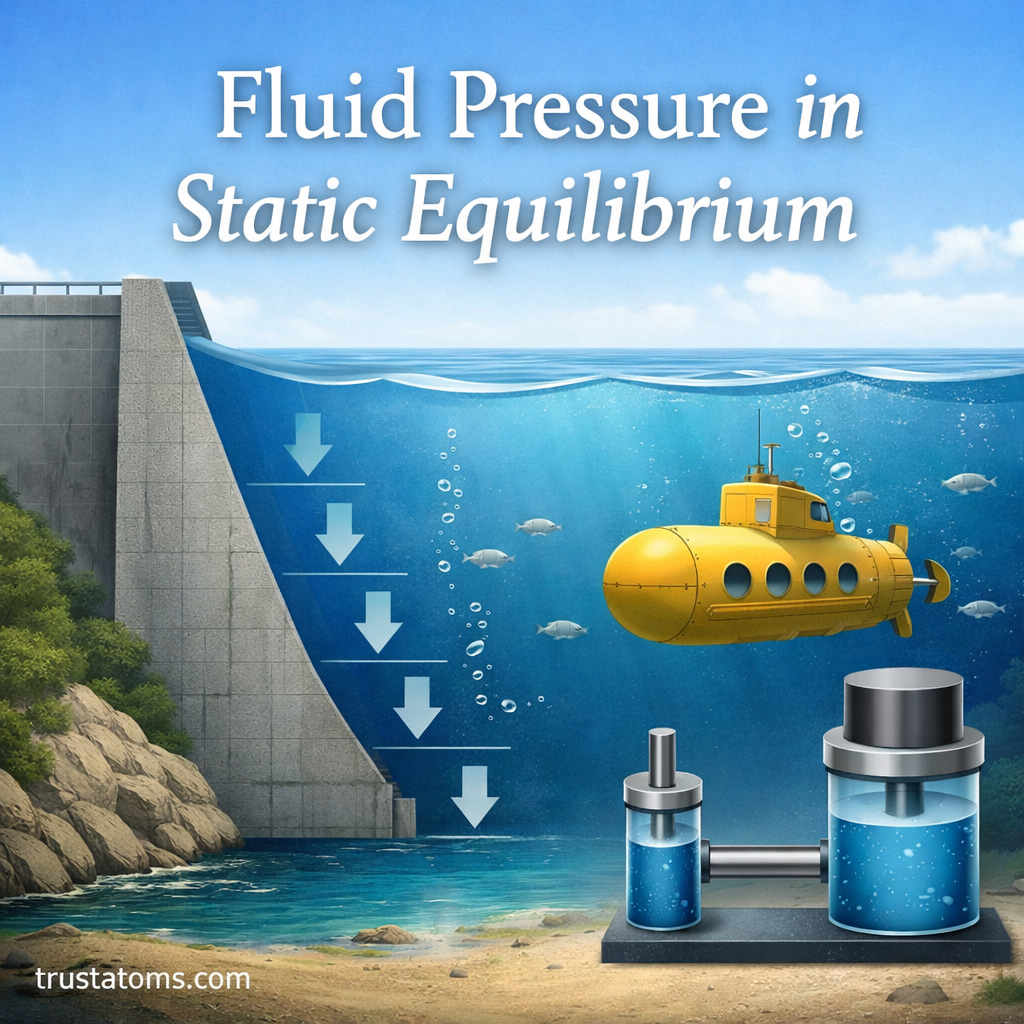
Fluid pressure in static equilibrium is one of the most important foundations in physics. It explains how liquids and gases behave when they are at rest — from water sitting in a glass to pressure deep in the ocean.
Understanding this concept helps you make sense of hydrostatic pressure, dams, blood pressure, hydraulic systems, and even why your ears pop underwater.
In this guide, we’ll break it down clearly and practically.
What Is Static Equilibrium in Fluids?
A fluid is in static equilibrium when:
- The fluid is at rest (no motion).
- The net force on every small portion of the fluid is zero.
- Pressure forces balance gravitational forces.
In simple terms: nothing is moving, and all forces cancel out.
If forces didn’t balance, the fluid would start flowing.
What Is Fluid Pressure?
Pressure is defined as:P=AF
Where:
- P = pressure
- F = force
- A = area
Pressure measures how much force is applied per unit area.
In fluids at rest:
- Pressure acts equally in all directions
- Pressure increases with depth
- Pressure depends on density and gravity
Why Pressure Increases with Depth

Imagine a column of water. The deeper you go, the more water sits above you.
That weight creates greater pressure.
The hydrostatic pressure formula is:P=P0+ρgh
Where:
- P0 = surface pressure (often atmospheric pressure)
- ρ = fluid density
- g = gravitational acceleration
- h = depth
This equation tells us:
- Pressure increases linearly with depth.
- Denser fluids create greater pressure.
- Stronger gravity increases pressure.
Key Principles of Fluid Pressure in Static Equilibrium
1. Pressure Is the Same at the Same Depth
In a connected fluid system:
- Pressure at equal depths is equal.
- Container shape does not matter.
This explains why water levels align in connected tubes.
2. Pressure Acts in All Directions
In static fluids:
- Pressure is isotropic (same in every direction).
- There are no sideways pressure differences at the same depth.
If pressure were uneven, the fluid would move until equilibrium was restored.
3. No Shear Stress in Static Fluids
A fluid at rest cannot support shear stress.
That means:
- It cannot resist sideways deformation.
- Any shear force would cause motion.
This is a defining property of fluids.
Real-World Examples
Water in a Dam
At the bottom of a dam:
- Pressure is highest.
- The wall must be thicker at the base.
- Engineers calculate forces using hydrostatic pressure.
Submarines and Deep-Sea Diving
As depth increases:
- Pressure increases rapidly.
- Structures must withstand massive compressive forces.
At just 10 meters underwater, pressure increases by about one atmosphere.
Hydraulic Systems
Hydraulic lifts work because:
- Pressure applied at one point transfers equally throughout the fluid.
- This principle is related to Pascal’s law.
It allows small forces to lift heavy objects.
Deriving the Hydrostatic Pressure Equation (Conceptually)
Let’s look at a small fluid element:
- Gravity pulls it downward.
- Pressure below pushes upward.
- Pressure above pushes downward.
For equilibrium:
Upward force = Downward forces
That balance leads directly to:P=P0+ρgh
This is a force-balance condition.
Common Misconceptions
“Pressure depends on container shape.”
False. Only depth matters.
A tall narrow column and a wide tank produce the same pressure at equal depths.
“Heavier objects sink because pressure pushes them down.”
Incorrect.
Sinking and floating are determined by buoyant force and density differences — not simply pressure magnitude.
“Pressure only acts downward.”
Wrong.
In static fluids, pressure acts equally in all directions.
Applications in Physics and Engineering
Fluid pressure in static equilibrium is used in:
- Civil engineering (dams, water towers)
- Oceanography
- Atmospheric science
- Human physiology (blood pressure)
- Industrial hydraulics
- Fluid storage tank design
It forms the foundation for more advanced topics like:
- Buoyancy
- Fluid dynamics
- Bernoulli’s equation
- Pascal’s law
Why This Concept Matters
Fluid pressure in static equilibrium connects simple physics principles:
- Newton’s laws
- Force balance
- Gravity
- Density
It shows how large-scale engineering systems rely on basic force equilibrium.
If you understand this concept deeply, you’re well-prepared for:
- College-level physics
- Engineering mechanics
- Fluid dynamics
Final Takeaway
Fluid pressure in static equilibrium occurs when:
- A fluid is at rest.
- All forces balance.
- Pressure increases with depth.
- Pressure depends on density and gravity.
- Pressure acts equally in all directions.
The governing equation:P=P0+ρgh
is one of the most powerful and widely applied formulas in physics.
Master it, and many real-world systems suddenly make sense.