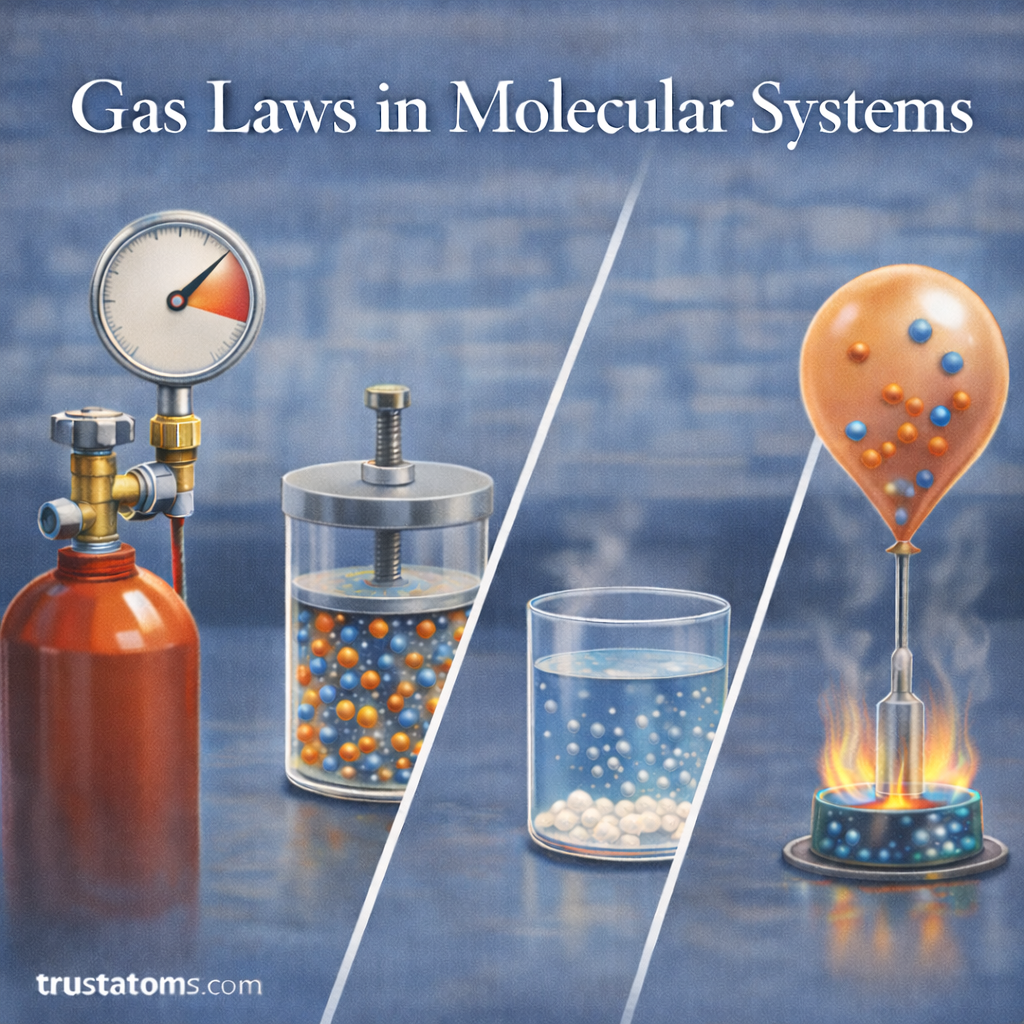
Gases behave in predictable ways when temperature, pressure, and volume change. In chemistry, these relationships are described by gas laws, which help scientists understand how gases behave at the molecular level.
Gas laws explain many everyday phenomena—from how air fills a balloon to how engines operate and how weather systems form. By studying the interactions of gas molecules in controlled conditions, chemists developed mathematical relationships that describe how gases respond to changes in their environment.
Understanding gas laws provides important insight into molecular motion, energy transfer, and the physical behavior of gases in both natural and industrial systems.
What Are Gas Laws?
Gas laws are a set of scientific principles that describe how gases behave when physical conditions change. These laws connect four main variables:
- Pressure
- Volume
- Temperature
- Amount of gas
When one of these variables changes, the others respond in predictable ways. Gas laws allow scientists to calculate these relationships and predict how gases will behave in different environments.
Because gas particles move freely and interact through collisions, their behavior can often be modeled using relatively simple physical rules.
The Molecular View of Gases
To understand gas laws, it helps to examine how gas molecules behave.
In a gas:
- Molecules move constantly in random directions.
- Particles collide with each other and with container walls.
- Large spaces exist between molecules.
- Intermolecular attractions are usually very weak.
Pressure arises from molecular collisions with the walls of a container. Temperature reflects the average kinetic energy of the gas molecules. Volume determines how much space the molecules have to move.
These molecular behaviors form the foundation of gas law relationships.
Boyle’s Law: Pressure and Volume
Boyle’s Law describes the relationship between pressure and volume in a gas when temperature remains constant.
According to this law:
- If the volume decreases, the pressure increases.
- If the volume increases, the pressure decreases.
This occurs because gas molecules collide with container walls more frequently when the space available to them is reduced.
Common examples include:
- Compressing air in a syringe
- Scuba divers experiencing pressure changes underwater
- Air compression in mechanical systems
Boyle’s Law demonstrates how changing the physical space of a gas affects molecular collisions and pressure.
Charles’s Law: Volume and Temperature
Charles’s Law explains how gas volume changes with temperature when pressure remains constant.
When temperature increases:
- Gas molecules move faster
- Molecules spread farther apart
- The gas expands
When temperature decreases:
- Molecular motion slows
- Gas particles occupy less space
- Volume decreases
This relationship helps explain why heated air expands and why hot air balloons rise when air inside the balloon becomes warmer than the surrounding atmosphere.
Gay-Lussac’s Law: Pressure and Temperature
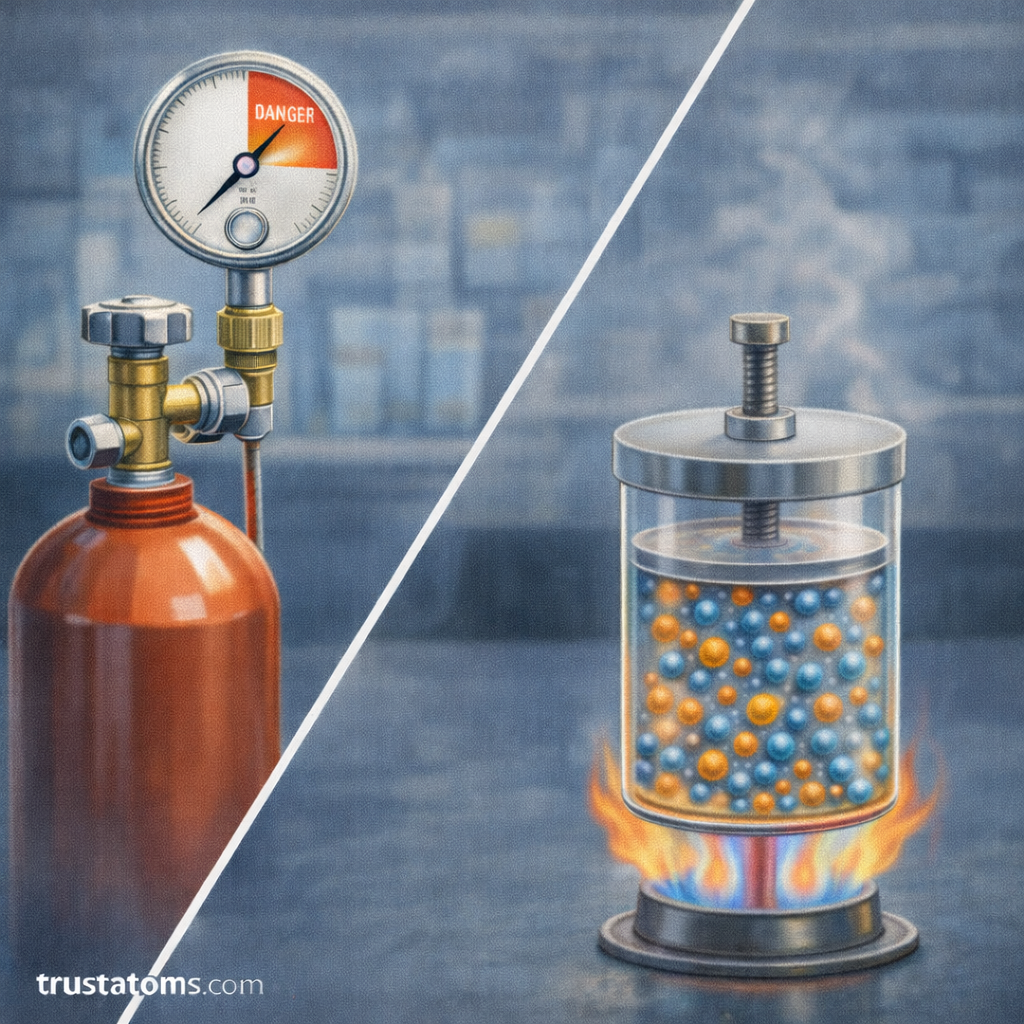
Gay-Lussac’s Law describes the relationship between pressure and temperature when volume remains constant.
As temperature increases:
- Molecular motion speeds up
- Collisions with container walls become stronger
- Pressure increases
If temperature decreases, pressure drops because molecules move more slowly and collide with less force.
This law is important in systems where gases are stored in fixed containers, such as:
- Aerosol cans
- Gas cylinders
- Engine combustion chambers
Understanding this relationship helps engineers design safe systems that handle pressurized gases.
Avogadro’s Law: Gas Volume and Molecules
Avogadro’s Law connects the amount of gas with the volume it occupies.
The principle states that equal volumes of gases at the same temperature and pressure contain the same number of molecules.
This means:
- Increasing the number of gas molecules increases volume.
- Removing gas molecules decreases volume.
Avogadro’s Law is especially important in chemistry because it links gas behavior with the number of particles present in a system.
The Ideal Gas Law
The Ideal Gas Law combines several gas relationships into a single equation that connects pressure, volume, temperature, and the amount of gas.
This law allows chemists to calculate how gases behave under many different conditions.
The ideal gas model assumes that:
- Gas particles have negligible volume
- Collisions between particles are perfectly elastic
- There are no attractive forces between molecules
Although real gases may deviate slightly from this model, the Ideal Gas Law works well for many practical calculations.
Real Gases vs. Ideal Gases
While the ideal gas model simplifies calculations, real gases behave slightly differently in certain situations.
Real gases deviate from ideal behavior when:
- Pressure becomes very high
- Temperature becomes very low
- Intermolecular forces become significant
- Gas particles occupy measurable space
In these cases, molecular attractions and particle size begin to influence gas behavior.
Chemists account for these differences using more complex models that adjust for real-world conditions.
Applications of Gas Laws
Gas laws are essential in many scientific and technological fields.
Atmospheric Science
Meteorologists use gas law principles to understand air pressure changes, weather systems, and atmospheric circulation.
Engineering
Engine design, refrigeration systems, and air compression technologies all rely on predictable gas behavior.
Medicine
Respiratory physiology depends on gas laws to explain how oxygen and carbon dioxide move through the lungs.
Environmental Science
Gas behavior helps scientists study pollution, greenhouse gases, and atmospheric chemistry.
Industrial Chemistry
Chemical manufacturing often requires precise control of gas pressure, temperature, and volume during reactions.
Common Misconceptions About Gas Behavior
Several misunderstandings can arise when studying gas laws.
Some important clarifications include:
- Gas molecules never stop moving, even at lower temperatures.
- Pressure results from molecular collisions, not from the weight of gas itself.
- Real gases only closely match ideal behavior under moderate conditions.
Recognizing these concepts helps students better understand the molecular basis of gas behavior.
Final Thoughts
Gas laws provide a powerful framework for understanding how gases behave in molecular systems. By linking pressure, temperature, volume, and particle number, chemists can predict how gases respond to changes in their environment.
From everyday phenomena like balloons and weather patterns to advanced industrial and scientific applications, gas laws remain fundamental tools in chemistry and physics.
Studying these relationships helps reveal how microscopic molecular motion influences the macroscopic behavior of gases in the world around us.