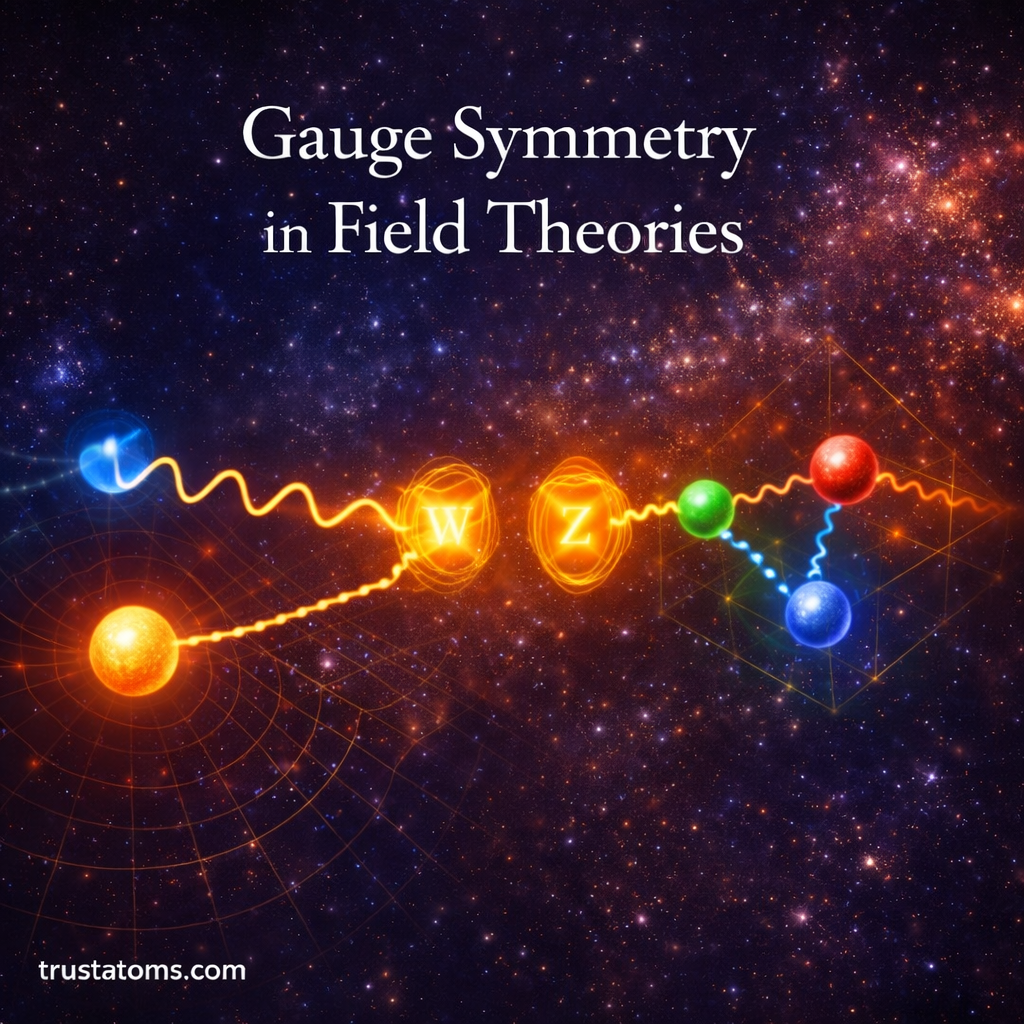
Modern physics rests on a powerful and elegant idea:
The fundamental forces of nature arise from symmetry.
More specifically, they arise from gauge symmetry — a principle that governs how fields transform without changing observable physics.
Gauge symmetry is not just a mathematical curiosity. It is the structural foundation of:
- Electromagnetism
- The weak nuclear force
- The strong nuclear force
- The Standard Model of particle physics
In this article, we’ll explore what gauge symmetry is, why it matters, and how it shapes our understanding of the universe.
What Is Symmetry in Physics?
In physics, symmetry means:
A transformation that leaves the laws of physics unchanged.
Examples:
- Rotating a system without changing its behavior
- Shifting in time without altering physical laws
- Moving in space without changing equations
Symmetries are powerful because of their connection to conservation laws.
As shown by Emmy Noether:
- Time symmetry → Energy conservation
- Space symmetry → Momentum conservation
- Rotational symmetry → Angular momentum conservation
Gauge symmetry extends this idea even further.
What Is Gauge Symmetry?
Gauge symmetry refers to a transformation that can vary from point to point in space and time, yet leaves physical observables unchanged.
This is called a local symmetry.
Unlike global symmetry (which applies uniformly everywhere), gauge symmetry allows transformations that depend on position.
That local freedom has profound consequences.
A Simple Example: Electromagnetism
The simplest example of gauge symmetry appears in electromagnetism.
The equations of electromagnetism were unified by James Clerk Maxwell.
The electromagnetic field can be described using electric and magnetic fields.
However, a deeper description uses potentials.
Here’s the key insight:
Certain changes to the electromagnetic potential do not change the observable electric and magnetic fields.
This freedom is gauge symmetry.
To preserve this symmetry in quantum mechanics, a new field must be introduced.
That field turns out to be the electromagnetic field itself.
This leads to a remarkable conclusion:
Requiring gauge symmetry forces the existence of interactions.
Global vs. Local Symmetry
Understanding the difference is crucial.
Global Symmetry
- Same transformation everywhere
- Example: multiplying a wavefunction by a constant phase
Local Symmetry
- Transformation varies at each point
- Requires compensating fields
- Leads to force-carrying particles
It is the demand for local symmetry that generates gauge fields.
Gauge Fields and Force Carriers
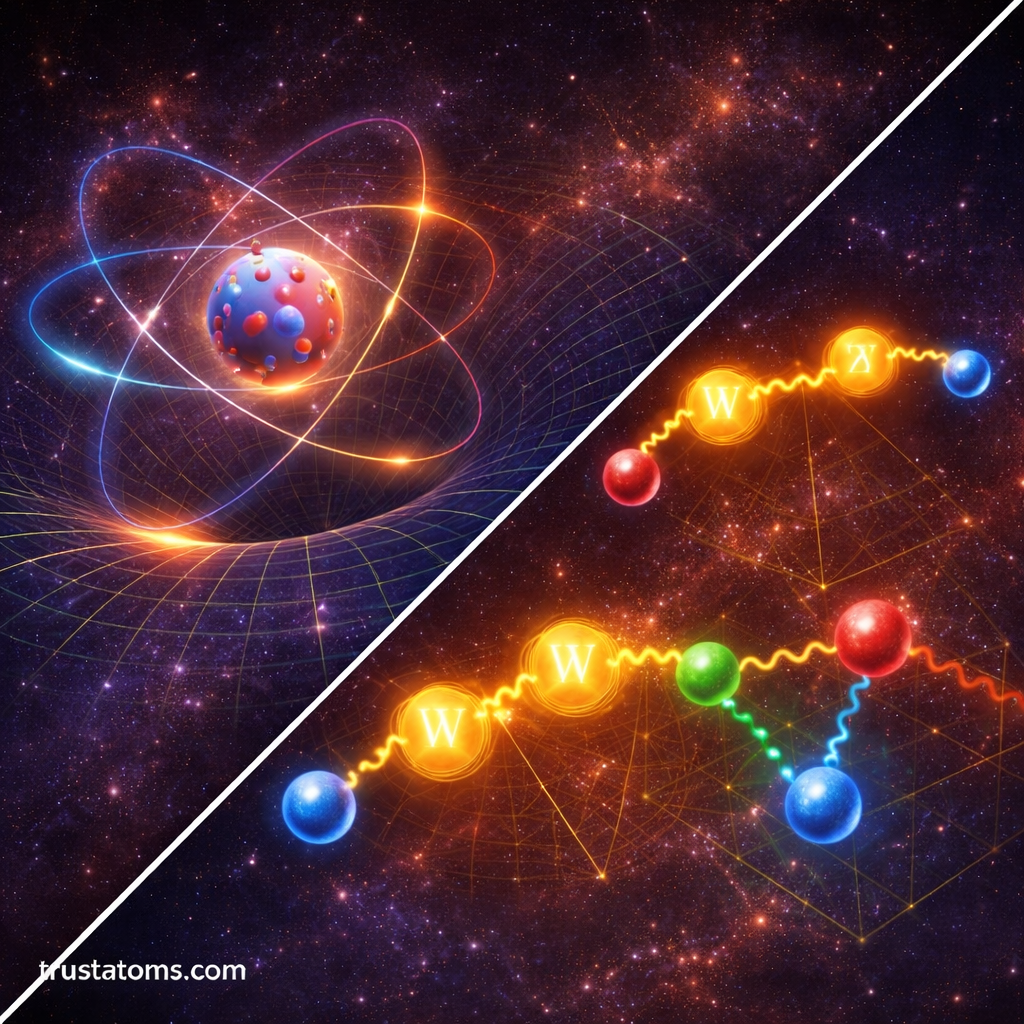
When a local symmetry is imposed, additional fields must be introduced to preserve invariance.
These new fields correspond to force carriers:
- Electromagnetism → Photon
- Weak force → W and Z bosons
- Strong force → Gluons
The requirement of gauge symmetry dictates:
- The form of interactions
- The existence of force particles
- The structure of field equations
Symmetry does not just describe forces.
It generates them.
Gauge Symmetry in Quantum Field Theory
Gauge symmetry plays a central role in quantum field theory (QFT).
In QFT:
- Particles are excitations of fields.
- Fields must obey symmetry principles.
- Interactions arise from symmetry constraints.
The Standard Model is built entirely on gauge symmetry.
Its structure is based on symmetry groups that determine how particles interact.
These groups define:
- The types of charges particles carry
- The nature of interactions
- The allowed coupling strengths
Without gauge symmetry, the Standard Model would collapse.
Non-Abelian Gauge Theories
Electromagnetism is an example of an Abelian gauge theory.
This means:
- Transformations commute.
- The force carrier (photon) does not interact with itself.
The weak and strong forces are different.
They are described by non-Abelian gauge theories, where:
- Transformations do not commute.
- Force carriers interact with one another.
This leads to:
- Complex particle dynamics
- Confinement in the strong force
- Rich interaction structures
Non-Abelian gauge symmetry is a cornerstone of modern particle physics.
Gauge Symmetry and the Standard Model
The Standard Model is based on a combined gauge symmetry structure.
This structure determines:
- How quarks interact
- How leptons behave
- How forces are unified mathematically
The symmetry framework predicts:
- Force strengths
- Particle charges
- Interaction types
It successfully explains experimental results across decades of research.
Spontaneous Symmetry Breaking
Gauge symmetry can be hidden.
Through spontaneous symmetry breaking:
- The underlying laws remain symmetric.
- The observable state does not.
This mechanism explains:
- Why some force carriers have mass
- Why the weak force is short-range
The Higgs mechanism is an example of spontaneous gauge symmetry breaking.
It provides mass to certain particles while preserving the underlying gauge structure.
Why Gauge Symmetry Is So Powerful
Gauge symmetry:
- Determines interaction structure
- Predicts force carriers
- Enforces mathematical consistency
- Ensures renormalizability in quantum theories
- Unifies seemingly separate forces
It turns symmetry from a descriptive property into a generative principle.
Instead of asking:
“What force causes this interaction?”
We ask:
“What symmetry requires this interaction?”
Gauge Symmetry Beyond the Standard Model
Physicists continue exploring:
- Grand Unified Theories
- Supersymmetry
- Quantum gravity frameworks
Each of these relies on extended gauge symmetry ideas.
Even attempts to unify gravity with quantum mechanics involve gauge-like structures.
Gauge symmetry remains central to theoretical research.
Common Misconceptions
Gauge Symmetry Is Just Mathematical Freedom
It may appear that way, but enforcing local gauge symmetry leads directly to physical forces.
It has observable consequences.
Symmetry Means Nothing Changes
Symmetry means invariance of physical laws — not absence of dynamics.
In fact, gauge symmetry produces interactions.
Intuitive Summary
Gauge symmetry is a principle of local invariance.
Demanding that physics remain unchanged under local transformations forces the introduction of fields.
Those fields become forces.
In this way:
Symmetry creates interaction.
It is one of the deepest ideas in modern theoretical physics.
Final Takeaway
Gauge symmetry in field theories is the foundation of modern particle physics.
It explains:
- Why forces exist
- Why particles interact
- Why force carriers appear
- Why the Standard Model works
What began as a mathematical requirement has become the structural backbone of our understanding of nature.
Symmetry does not merely describe the universe.
It shapes it.