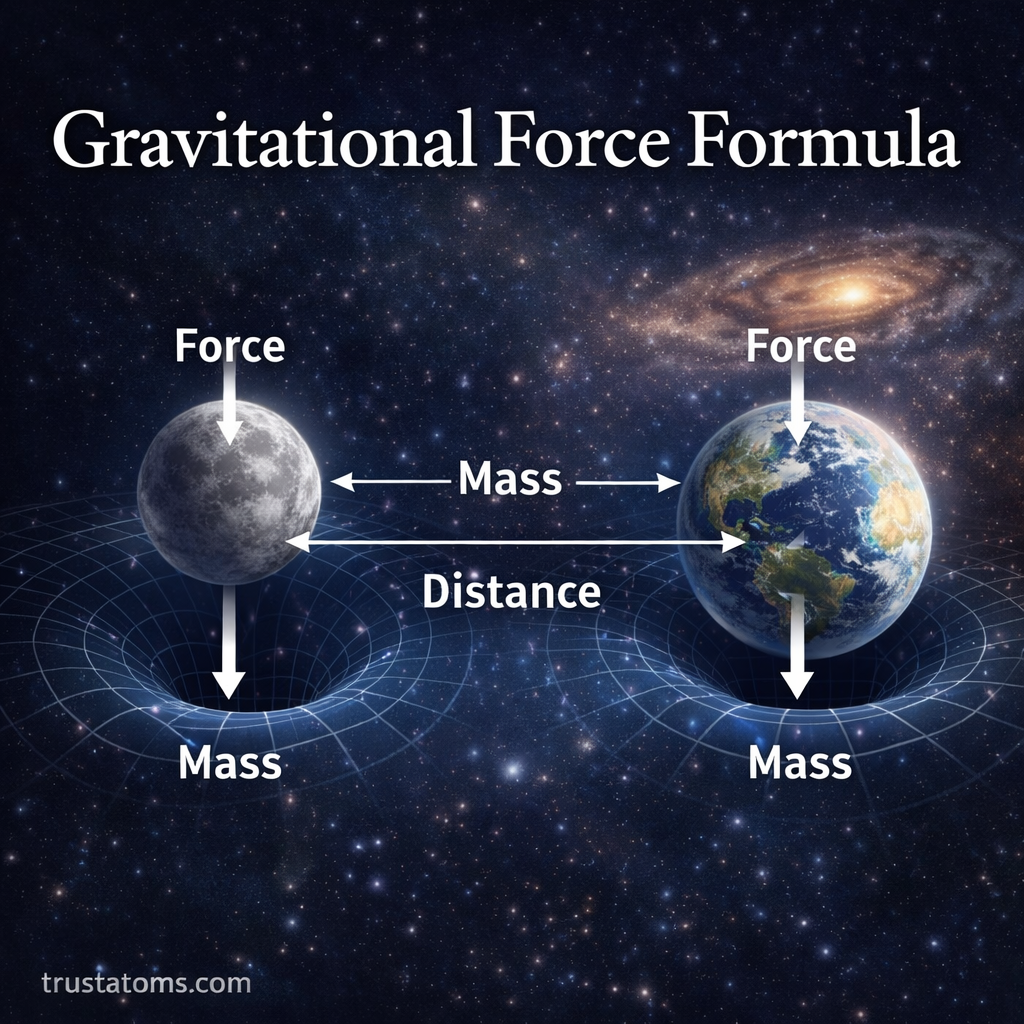
The gravitational force formula explains how strongly two objects attract each other.
From falling apples to orbiting planets, gravity governs motion throughout the universe. Understanding the formula behind gravitational force helps explain everything from your weight on Earth to how galaxies stay together.
In this guide, you’ll learn:
- What the gravitational force formula is
- What each variable means
- Why distance matters so much
- How the formula applies in real life
- Common mistakes students make
What Is the Gravitational Force Formula?
The gravitational force between two objects is calculated using Newton’s Law of Universal Gravitation.
The formula is:
F = G (m₁m₂ / r²)
Where:
- F = gravitational force (measured in newtons, N)
- G = gravitational constant
- m₁ = mass of the first object (kg)
- m₂ = mass of the second object (kg)
- r = distance between the centers of the two objects (meters)
This equation shows that gravity depends on two key factors:
- Mass
- Distance
What Is the Gravitational Constant (G)?
The gravitational constant (G) is a fixed number that makes the equation work.
Its value is approximately:
6.674 × 10⁻¹¹ N·m²/kg²
This number is very small, which tells us something important:
Gravity is a relatively weak force compared to other fundamental forces.
However, when objects are extremely massive (like planets and stars), gravity becomes powerful.
How Mass Affects Gravitational Force
Mass directly increases gravitational force.
If you double one object’s mass:
- The gravitational force doubles.
If you double both masses:
- The gravitational force becomes four times stronger.
This is because mass is multiplied together in the formula.
That’s why:
- Earth has strong gravity
- The Moon has weaker gravity
- Jupiter has much stronger gravity than Earth
The more massive an object is, the stronger its gravitational pull.
How Distance Affects Gravitational Force
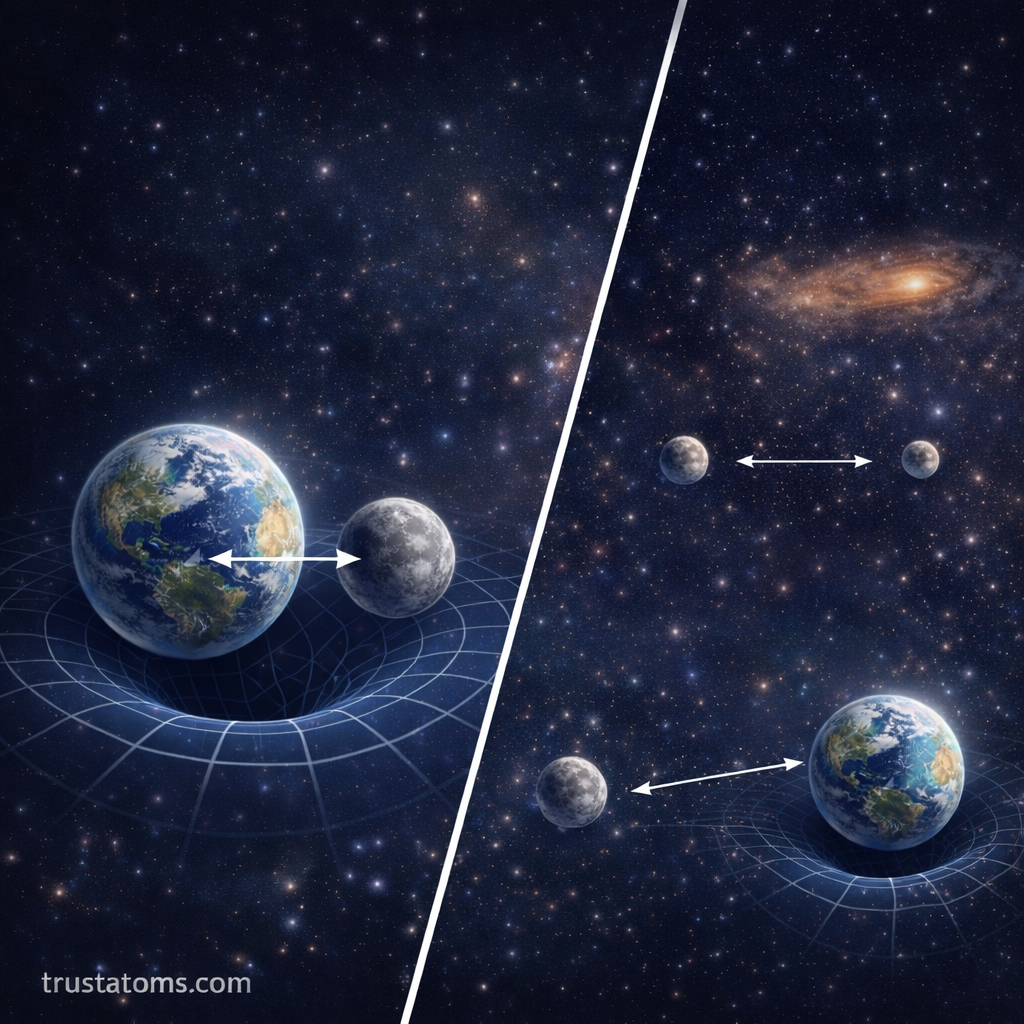
Distance plays an even bigger role.
Notice the formula includes r² (distance squared).
This means gravitational force follows an inverse square law.
If distance doubles:
- The force becomes one-fourth as strong.
If distance triples:
- The force becomes one-ninth as strong.
Gravity weakens very quickly as objects move farther apart.
This is why astronauts feel less gravitational pull the farther they are from Earth.
Why the Inverse Square Law Matters
The inverse square relationship explains:
- Why satellites must stay within specific orbital distances
- Why planets farther from the Sun move more slowly
- Why gravity becomes weaker in deep space
The square in the denominator makes distance incredibly important in space physics.
Example Calculation
Let’s simplify the idea without heavy math.
Imagine:
- Two objects with moderate mass
- They are close together
The force between them will be noticeable.
Now imagine:
- The same two objects
- But placed much farther apart
The force becomes dramatically weaker.
In everyday life, you don’t feel gravitational attraction between yourself and another person because:
- Your masses are small
- The force is extremely tiny
But between Earth and you, gravity is strong because Earth’s mass is enormous.
Units of Gravitational Force
The unit of gravitational force is:
Newtons (N)
Force in physics is generally measured in newtons, named after Sir Isaac Newton.
Real-World Applications of the Gravitational Formula
The gravitational force formula helps scientists:
- Calculate planetary orbits
- Launch satellites
- Predict eclipses
- Study black holes
- Understand tides
Without this formula, space travel would not be possible.
It is one of the foundational equations in classical physics.
Common Mistakes to Avoid
When learning the gravitational force formula, students often:
- Forget to square the distance
- Use surface-to-surface distance instead of center-to-center distance
- Confuse mass with weight
- Forget to keep units consistent
Remember:
Mass is measured in kilograms.
Distance is measured in meters.
Force is measured in newtons.
Gravitational Force vs. Weight
Weight is a special case of gravitational force.
When you stand on Earth:
Your weight = gravitational force between you and Earth.
That’s why weight changes on different planets, but mass stays the same.
Final Thoughts
The gravitational force formula may look simple, but it explains motion on a cosmic scale.
It shows us that:
- Mass creates attraction
- Distance weakens force
- Even weak forces can shape the universe
From keeping your feet on the ground to holding galaxies together, this single equation reveals how gravity connects everything in the universe.
Understanding it is a key step in mastering physics.