Radioactive materials naturally change over time through a process known as radioactive decay. One of the most important ways scientists describe this process is through the concept of half-life.
Half-life calculations allow researchers to determine how long it takes for a radioactive substance to decay, estimate the age of objects, and understand nuclear reactions occurring in nature and in laboratories. From nuclear medicine to carbon dating, half-life plays a central role in modern science.
This guide explains what half-life is, how it works, and how scientists calculate it in nuclear reactions.
What Is Half-Life?
Half-life is the amount of time required for half of the atoms in a radioactive sample to decay into another element or isotope.
During radioactive decay, unstable atomic nuclei release energy by emitting radiation. As this process continues, the number of radioactive atoms steadily decreases.
For example:
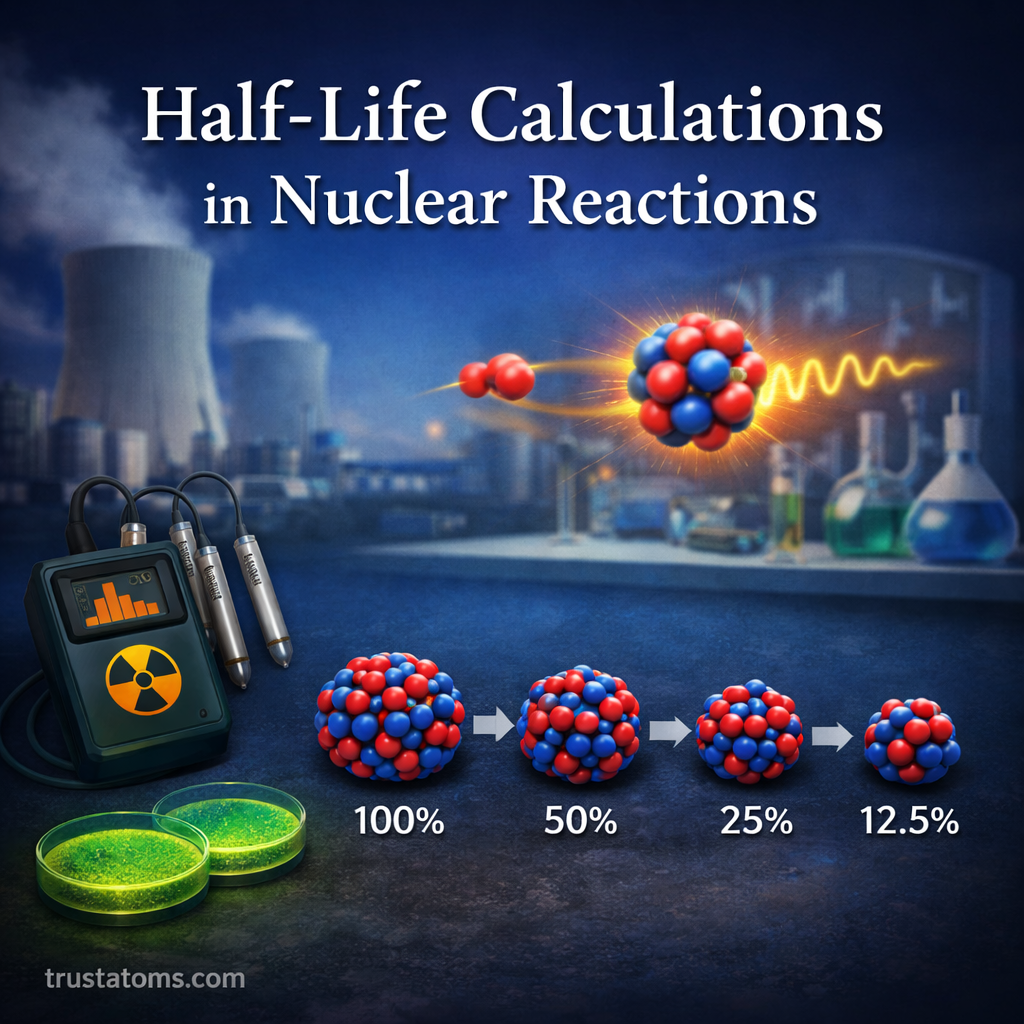
- If you start with 100 radioactive atoms, after one half-life 50 remain
- After two half-lives 25 remain
- After three half-lives 12.5 remain
The key idea is that half-life is constant for a specific isotope, regardless of the amount of material present.
Why Half-Life Matters in Nuclear Chemistry
Half-life helps scientists understand how quickly nuclear reactions occur and how long radioactive materials remain active.
It is important for several fields of science and technology:
- Radiometric dating used in archaeology and geology
- Nuclear medicine treatments and diagnostic imaging
- Nuclear energy management
- Environmental monitoring of radioactive materials
- Astrophysics and cosmic element formation
Because each radioactive isotope decays at a predictable rate, scientists can use half-life as a reliable measurement tool.
How Radioactive Decay Occurs
Radioactive decay happens when an unstable nucleus releases energy to reach a more stable state. This may involve:
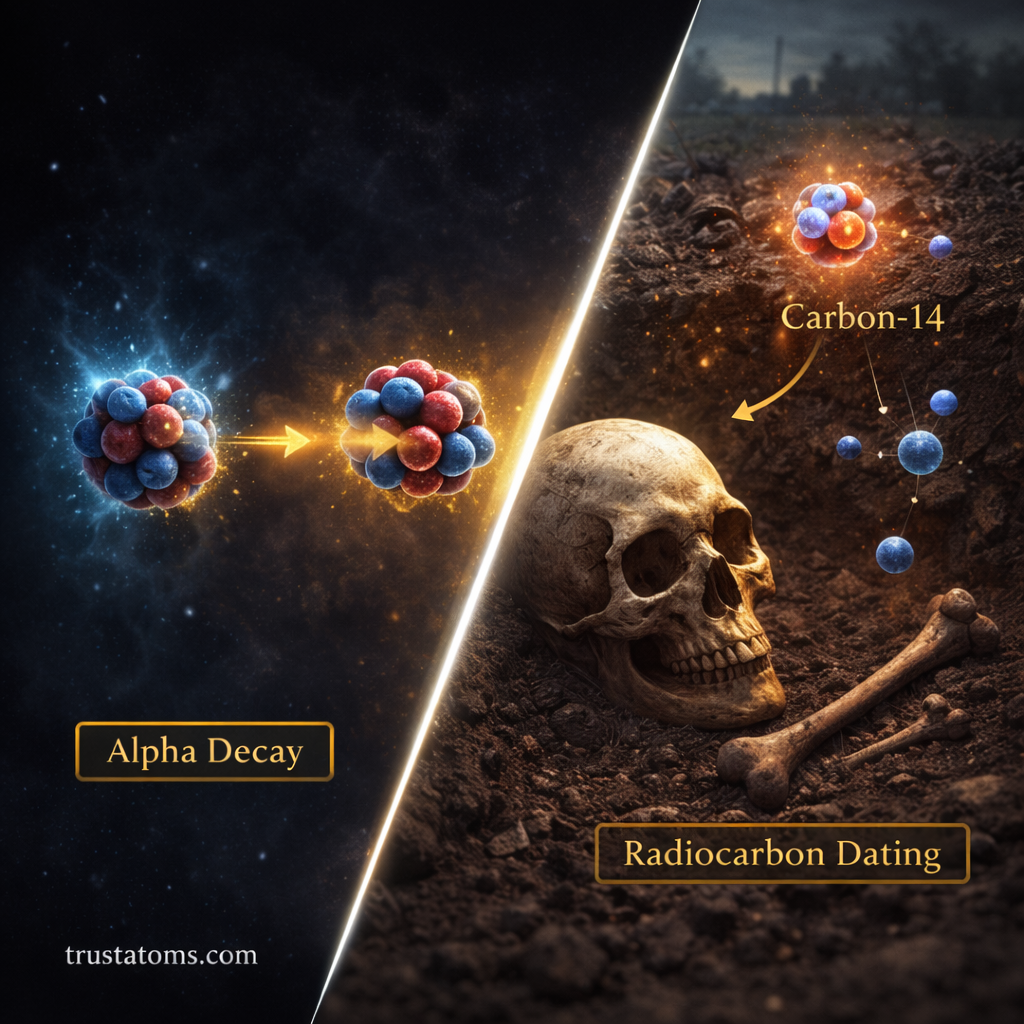
- Alpha decay – emission of a helium nucleus
- Beta decay – emission of an electron or positron
- Gamma decay – release of high-energy radiation
Each decay event reduces the number of radioactive atoms remaining in the sample.
However, decay does not occur all at once. Instead, it happens randomly at the level of individual atoms while following predictable statistical patterns overall.
Understanding the Half-Life Pattern
Half-life follows an exponential decay pattern. Instead of losing a fixed number of atoms over time, a radioactive substance loses a constant fraction during each half-life period.
Example progression of a radioactive sample:
| Half-Life Count | Amount Remaining |
|---|---|
| Start | 100% |
| After 1 | 50% |
| After 2 | 25% |
| After 3 | 12.5% |
| After 4 | 6.25% |
This pattern continues until the material becomes extremely small or fully decays into a stable isotope.
Basic Half-Life Calculation Method
Scientists often need to determine how much radioactive material remains after a certain number of half-lives.
The calculation process typically follows these steps.
Step 1: Identify the initial amount
Determine how much radioactive material you begin with.
Example:
Initial sample = 80 grams
Step 2: Determine the half-life of the isotope
Every radioactive isotope has a known half-life.
Example:
Half-life = 10 years
Step 3: Determine the number of half-lives that have passed
Example:
Elapsed time = 30 years
Number of half-lives:
30 years ÷ 10 years = 3 half-lives
Step 4: Apply the halving process
Each half-life reduces the amount by half.
- After 1 half-life: 80 → 40 grams
- After 2 half-lives: 40 → 20 grams
- After 3 half-lives: 20 → 10 grams
Remaining radioactive material = 10 grams
Using the Half-Life Formula
In more advanced nuclear chemistry, scientists use a mathematical equation to calculate radioactive decay precisely.
The standard half-life equation is:
Remaining Amount = Initial Amount × (1/2)^(number of half-lives)
This formula allows researchers to calculate decay for any amount of time, even when it does not match exact half-life intervals.
Example application:
Initial amount = 100 grams
Half-lives elapsed = 4
Remaining amount:
100 × (1/2)⁴ = 6.25 grams
Real-World Examples of Half-Life
Half-life calculations are used in many practical scientific applications.
Radiocarbon Dating
Carbon-14 has a half-life of about 5,730 years.
Scientists measure how much carbon-14 remains in ancient organic materials to estimate their age. This technique is widely used in archaeology and paleontology.
Nuclear Medicine
Medical imaging often uses isotopes with short half-lives, such as technetium-99m, which decays in about 6 hours.
Short half-lives are beneficial because they reduce long-term radiation exposure for patients.
Nuclear Waste Management
Understanding half-life helps engineers determine how long radioactive waste must be safely stored before its radiation levels decrease to safe levels.
Some materials decay quickly, while others remain radioactive for thousands of years.
Factors That Do Not Affect Half-Life
One important concept in nuclear chemistry is that half-life is independent of external conditions.
The following factors do not change the half-life of an isotope:
- Temperature
- Pressure
- Chemical reactions
- Physical state (solid, liquid, gas)
This stability makes half-life a reliable scientific measurement.
Common Student Mistakes in Half-Life Problems
When learning half-life calculations, students often make a few common errors.
These include:
- Confusing elapsed time with number of half-lives
- Forgetting that decay follows exponential reduction
- Dividing by two incorrectly after each step
- Misreading the half-life duration in the problem
A good approach is to calculate the number of half-lives first, then apply the halving pattern.
Why Half-Life Is Fundamental to Nuclear Science
Half-life calculations provide a powerful tool for understanding radioactive processes.
They allow scientists to:
- Predict how nuclear materials change over time
- Measure the age of ancient objects
- Design safer medical treatments
- Manage nuclear waste responsibly
- Study the formation of elements in the universe
Because radioactive decay follows consistent mathematical patterns, half-life remains one of the most useful concepts in nuclear chemistry.
Final Thoughts
Half-life calculations help scientists measure and predict the behavior of radioactive substances. By understanding how quickly unstable atoms decay, researchers can apply nuclear chemistry to medicine, environmental science, archaeology, and energy production.
Although individual atoms decay randomly, large groups of radioactive atoms follow predictable patterns. This predictable behavior allows half-life to serve as a reliable scientific tool for analyzing nuclear reactions across many fields.