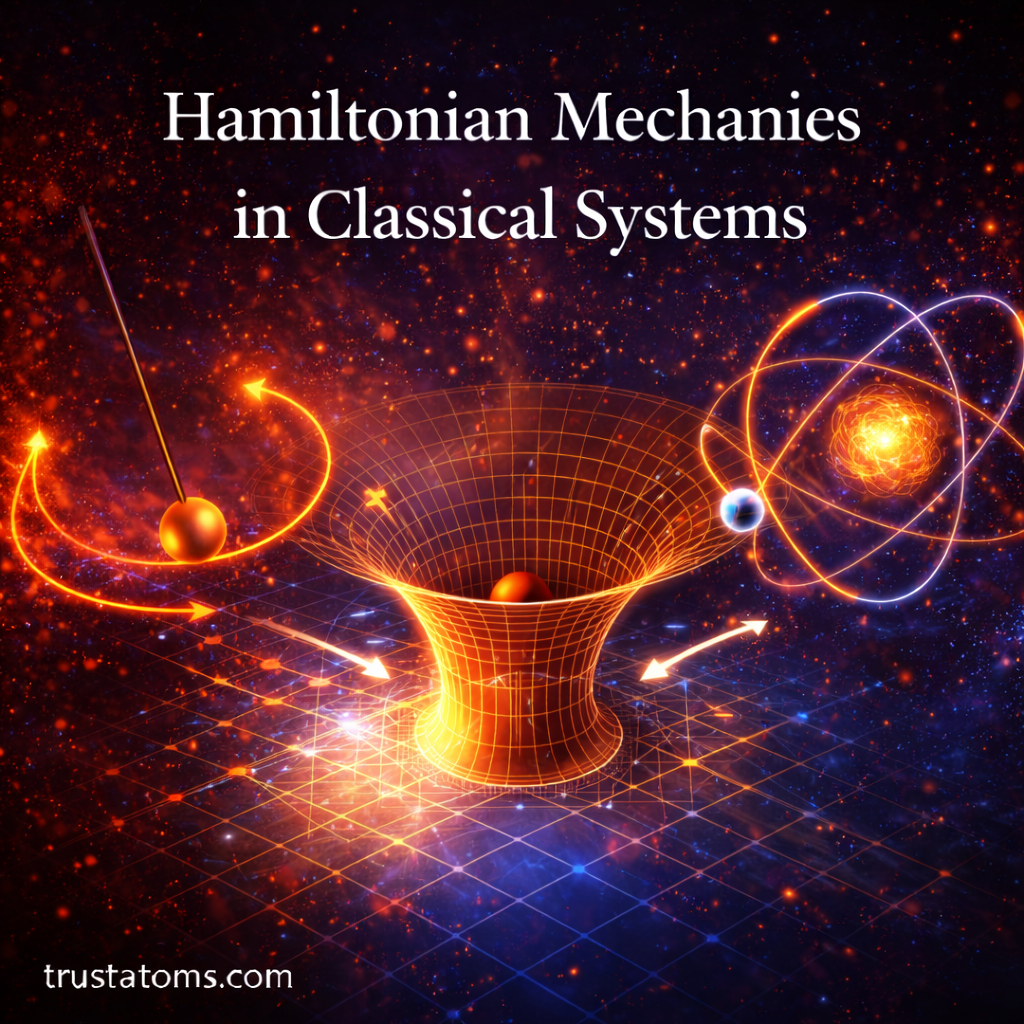
Hamiltonian mechanics is one of the most elegant and powerful formulations of classical mechanics. While Newton’s laws describe motion in terms of forces, and Lagrangian mechanics focuses on energy differences, Hamiltonian mechanics reformulates motion using energy functions and phase space.
This framework not only simplifies many complex mechanical systems but also serves as a bridge between classical physics and quantum mechanics.
In this article, we’ll explore what Hamiltonian mechanics is, how it works, and why it remains essential in modern physics.
From Newton to Hamilton
Classical mechanics evolved through several reformulations:
- Newtonian mechanics — Based on forces and acceleration.
- Lagrangian mechanics — Based on kinetic and potential energy.
- Hamiltonian mechanics — Based on total energy expressed in phase space.
Hamiltonian mechanics builds directly on the Lagrangian approach but transforms the equations into a form that often reveals deeper symmetries and conservation laws.
What Is the Hamiltonian?
The Hamiltonian is a function that typically represents the total energy of a system.
In many classical systems, the Hamiltonian equals:
- Kinetic energy
- Plus potential energy
However, the true power of the Hamiltonian lies in how it generates equations of motion.
Instead of describing motion with forces, Hamiltonian mechanics describes motion through changes in coordinates and momenta.
Generalized Coordinates and Momenta
In Hamiltonian mechanics, we describe a system using:
- Generalized coordinates (positions)
- Generalized momenta (momentum-like quantities)
Each coordinate has a corresponding momentum.
For a system with multiple moving parts, this framework allows us to treat complex motion systematically.
This pairing of coordinates and momenta defines what is known as phase space.
Phase Space: The Complete Picture of Motion
Phase space is a conceptual space where:
- Each axis represents either a coordinate or a momentum.
- Every point describes a complete state of the system.
For example:
- A simple pendulum has one coordinate (angle) and one momentum.
- Its phase space is two-dimensional.
Instead of tracking motion over time in physical space, Hamiltonian mechanics tracks how points move in phase space.
This perspective provides a more complete description of dynamics.
Hamilton’s Equations of Motion
The core of Hamiltonian mechanics lies in Hamilton’s equations.
These equations describe how:
- Coordinates change over time.
- Momenta change over time.
Unlike Newton’s second law, which uses acceleration, Hamilton’s equations use first-order differential equations.
This symmetry between position and momentum makes the equations especially useful in advanced physics.
Why Hamiltonian Mechanics Is Powerful
Hamiltonian mechanics offers several advantages:
1. Symmetry and Conservation Laws
The Hamiltonian framework naturally reveals conserved quantities.
If the Hamiltonian does not explicitly depend on time:
- Total energy is conserved.
If the system has spatial symmetry:
- Momentum may be conserved.
This deep connection between symmetry and conservation laws plays a major role in theoretical physics.
2. Simpler Treatment of Complex Systems
For systems with many interacting components, Hamiltonian mechanics:
- Reduces complicated force analysis.
- Makes constraints easier to handle.
- Provides a structured approach to multi-particle systems.
3. Bridge to Quantum Mechanics
In quantum theory, the Hamiltonian becomes an operator that governs the evolution of quantum states.
The Schrödinger equation, central to quantum mechanics, is built directly from the Hamiltonian concept.
This makes Hamiltonian mechanics a critical stepping stone between classical and quantum physics.
Example: The Simple Harmonic Oscillator
One of the clearest examples of Hamiltonian mechanics is the simple harmonic oscillator.
This system:
- Has kinetic energy from motion.
- Has potential energy from restoring forces.
In phase space:
- The motion traces closed loops.
- Energy remains constant.
- The system evolves predictably.
Hamiltonian mechanics describes this motion smoothly without directly invoking force equations.
Canonical Transformations
Hamiltonian mechanics allows for transformations that preserve the structure of the equations.
These are called canonical transformations.
They allow physicists to:
- Simplify complex problems.
- Change variables without losing physical meaning.
- Reveal hidden constants of motion.
Canonical transformations are foundational in advanced mechanics and quantum field theory.
Liouville’s Theorem
One of the key results in Hamiltonian mechanics is Liouville’s theorem.
It states that:
- The volume of phase space occupied by a system remains constant over time.
This principle is essential in statistical mechanics and thermodynamics.
It connects microscopic motion to macroscopic physical laws.
Hamiltonian Mechanics vs. Newtonian Mechanics
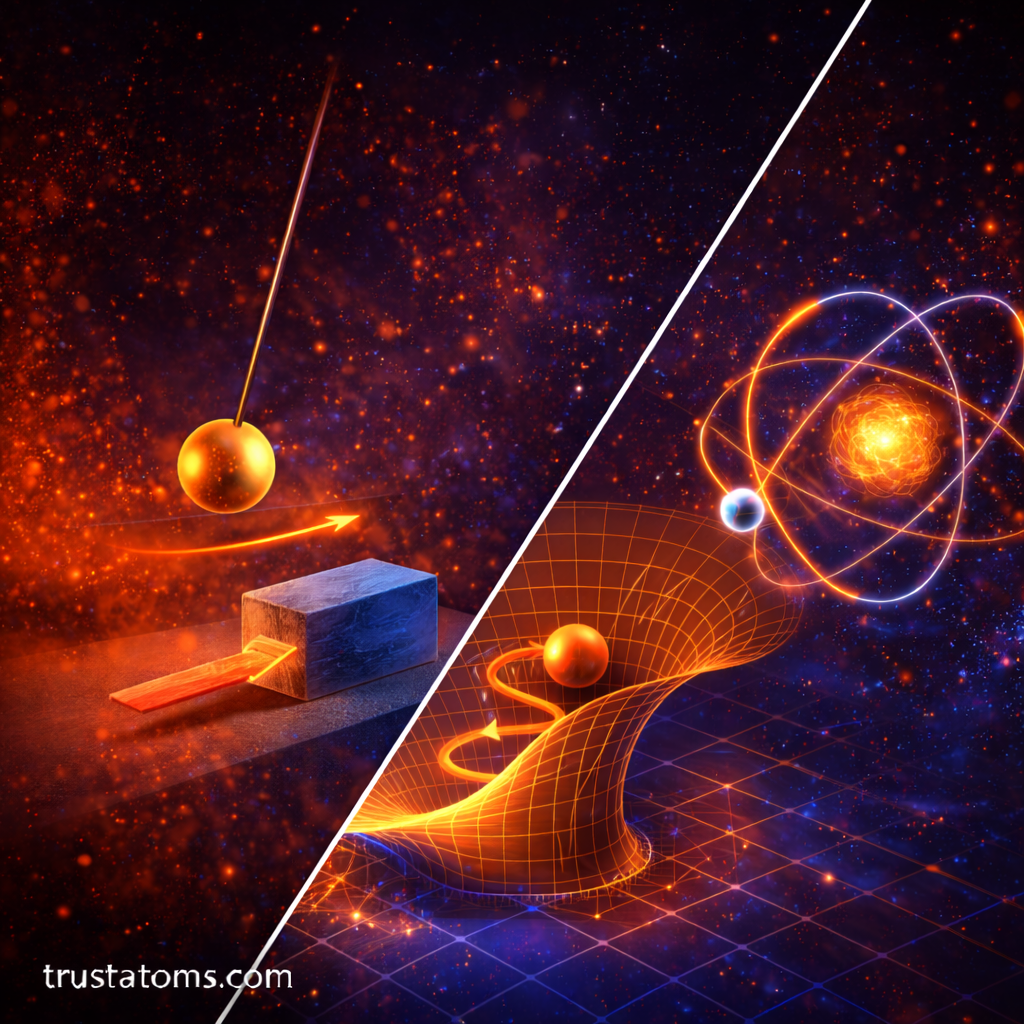
Newtonian mechanics:
- Focuses on forces.
- Uses second-order differential equations.
- Best for simple systems.
Hamiltonian mechanics:
- Focuses on energy.
- Uses first-order differential equations.
- Ideal for complex and multi-dimensional systems.
Both describe the same physical reality but offer different mathematical tools.
Applications in Modern Physics
Hamiltonian mechanics plays a central role in:
- Celestial mechanics
- Particle physics
- Quantum mechanics
- Statistical mechanics
- Plasma physics
It is also essential in computational simulations where tracking energy conservation is critical.
Why It Still Matters
Even though Hamiltonian mechanics was developed in the 19th century, it remains one of the most powerful frameworks in theoretical physics.
It provides:
- A deeper understanding of energy and motion.
- Insight into conserved quantities.
- The foundation for quantum theory.
Its mathematical structure continues to influence modern physics research.
Final Thoughts
Hamiltonian mechanics reformulates classical motion in terms of energy and phase space, offering a more symmetric and powerful framework than force-based approaches alone.
By focusing on coordinates and momenta, it reveals hidden symmetries and conservation laws while serving as the conceptual bridge to quantum mechanics.
Understanding Hamiltonian mechanics isn’t just about mastering classical systems — it’s about unlocking the structure underlying much of modern physics.